
World Birds
Field identification plates
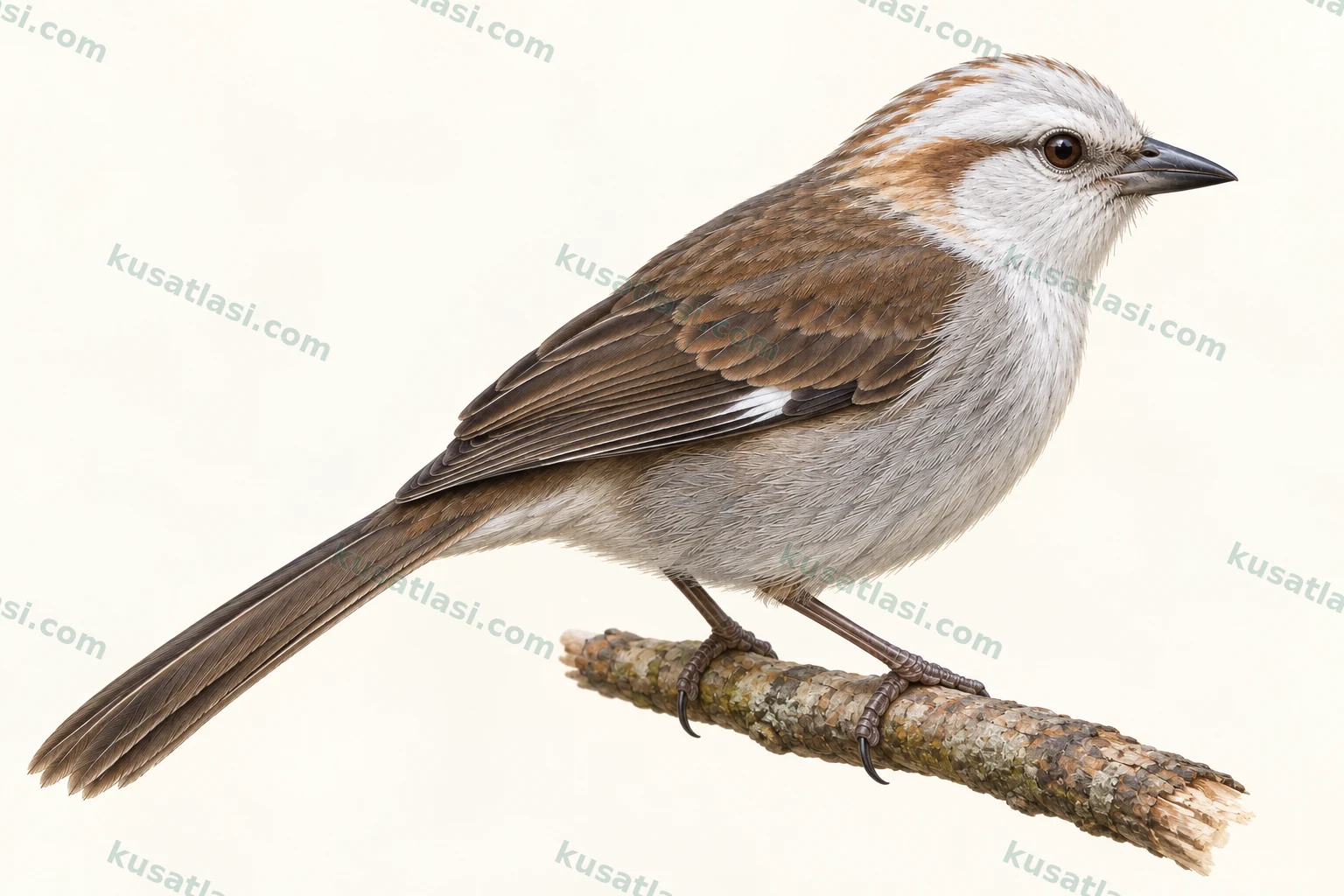
Swipe left or right between the two adult plates.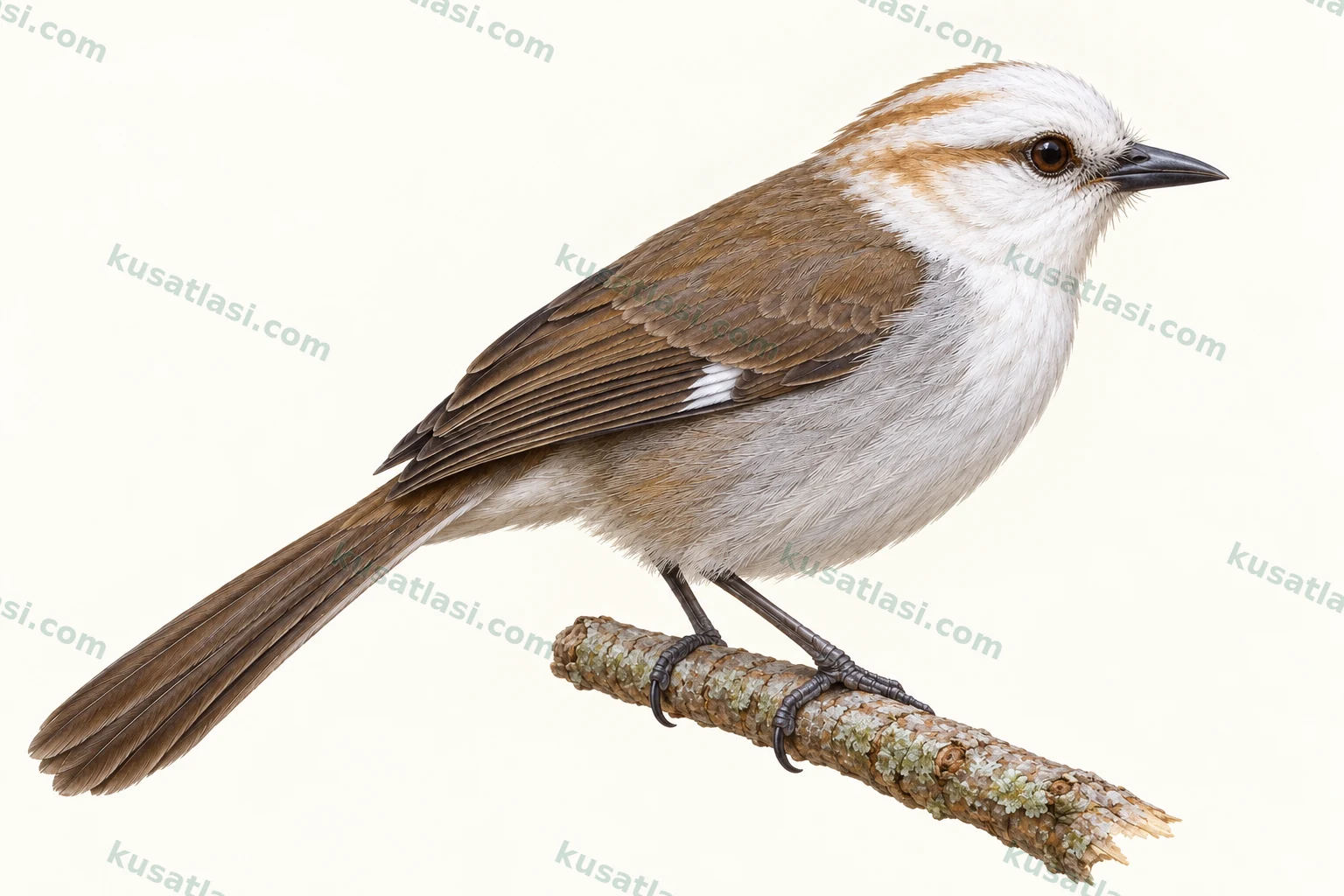
Passerellidae
Pale-headed Brushfinch
Atlapetes pallidiceps
Brown facial marks can vary in adults; do not determine sex from one patch.
- Order
- Passeriformes
- IUCN status
- EN · EndangeredGlobal IUCN. BirdLife v10 (2025); taxon matching: AviList 2026 / IOC 15.2; checked 29 October 2026. Checklist year is not the species assessment date. Source and method · BirdLife
At a glance
- See the whole pale head
Brown facial marks can vary in adults; do not determine sex from one patch.
- The young bird’s head is different
A grey head and rusty-brown crown stripe may not resemble an adult’s pale head.
- Search Yunguilla scrub
Semi-open hillside scrub and feeding movements within cover provide the main context.
Biometrics
Length
- Male
- 16 cm
- Female
- 16 cm
Wing length
- Male
- 7.75 cm
- Female
- 7.75 cm
Weight
- Male
- 33.4–35.3 g
- Female
- 28.7–32.8 g
Length: Shared species value Wing length: Shared species value
World distribution
Pale-headed Brushfinch
Customise map layers
Observation points
Preparing globe…
Monthly record count
Bars show record counts in this sample, not bird abundance or a breeding calendar. They are affected by recording and observation effort.
Rotate the globe and compare layers. Coloured areas are not exact observation or nest locations.
The source does not provide verified monthly range boundaries. All areas are shown; the month slider and monthly playback are therefore disabled.
- Jan
- Apr
- Jul
- Oct
- Dec
Generalised data and method
Base map: Natural Earth · Public domain
Open central bibliography ↗Calendar
In the 2002–2003 Yunguilla observations, breeding extended from February to late June. The start and replacement attempts vary between pairs; these records give neither a precise annual starting day nor a monthly migration route.
All months: monthly data have not been verified.
January
February
March
April
May
June
July
August
September
October
November
December
Habitat
Yunguilla Valley, Azuay, Ecuador
Watch for the pale head and darker back in semi-open hillside scrub; allow for the different head pattern of young birds.
Sound
Male songs are short and may contain several phrase types. Both members of a pair may give contact calls and rapid descending sequences together. Listening early in the morning is useful; song may decrease during care of young. Females are not assumed never to vocalise.
Do not play recordings to attract birds; observe quietly, especially near nests.
Breeding
The 2002–2003 Yunguilla study followed breeding from February to late June. The nest is an open cup, usually with two eggs; nests with one–three eggs were also recorded. Approximate periods of 12–14 days were reported for incubation and nest stay; in a few direct records incubation lasted 14 days and the nestling period 11.5 days. The female incubates, and both parents feed the young. Young receive care for weeks after leaving the nest. These durations belong to the local sample; days are not counted by approaching a nest.
Compare
Compare male and female
A grey head and rusty-brown crown stripe may not resemble an adult’s pale head.
Species information
Quick identification
This small bird of scrub in Ecuador’s Yunguilla Valley is noticeable for its pale head and darker brownish-grey back. The pale head is useful in adults, but a uniformly spotless white head is not expected in every individual. Fieldwork recorded extensive brown facial marks in some adults and an almost entirely white head in others. Head, back and the bird’s age are assessed together.
General appearance and posture
The contrast between pale head and the body’s brown and grey tones is a first clue when the bird appears briefly among leaves. It matters which part of the head is in the light: a branch shadow can make the face pattern look darker than it is. Because variation in adult face pattern is documented, one brown mark alone does not show that the bird is another species or a female.
It often remains within bushes or near the ground while feeding. Yunguilla observations recorded it holding the tail partly raised and moving it in a circle for balance while reaching fruit. That movement is described in the context of reaching food on a branch, not as an identification mark that must be performed continually. While searching for insects it may bend towards the upper and lower sides of a branch, and it may stretch sideways when picking fruit.
Young trees projecting above scrub cover are used as brief lookout and song perches. Seeing a bird on such a perch does not mean that tall forest is its principal feeding habitat. Research following the species emphasises semi-open scrub and early-stage regenerating vegetation. An individual visible in the open in the morning may be much harder to see in dense shaded cover during hotter hours.
Males, females and young birds
A reliable key that distinguishes males from females with certainty from plumage colour alone has not been verified for this account. Male song, females perching less openly and females incubating in the nest are useful behavioural clues during research, not certain sex labels for one still photograph. Although male song was conspicuous in the study, contact calls and rapid joint vocal sequences by both members of a pair were also recorded.
Newly fledged young have heads very different from adults. A description of nine young recorded a grey head, a rusty-brown stripe from crown to nape and an initially weak facial pattern. The pale cheek area developed about two–three weeks after leaving the nest. The bill’s yellowish horn colour darkens with time. These periods belong to the young followed in the study; they do not calculate an exact age in days from one photograph.
The juvenile’s rusty crown stripe runs into the brown back, while wings look darker grey-brown. As the crown stripe becomes less extensive with age, the pale cheek patch may become more conspicuous. Assigning such a bird immediately to another species because it does not match an adult’s pale head would be mistaken. Smaller nestlings were described as largely uniform brown; that appearance is not the same developmental stage as a fledged juvenile.
Appearance in flight
Short flights between bushes may help locate the bird again in another viewing gap. Rediscovery observations sometimes recorded somewhat longer local passages too, but this account does not use a verified upperwing or underwing pattern that identifies the species alone. Rather than certainly identifying a shadowed silhouette only by a pale-looking head, it is safer to see head and back again after it lands.
The feeding research also observed short take-offs, sallies towards insects and brief hovering. These are food-gathering movements of a resident scrub bird. Flying after an insect must not be confused with a long-distance migration journey.
Voice and behaviour
Songs of males studied in Yunguilla consist of short, multipart sequences. In the 1998–2002 observations, a song phrase could contain five–twelve notes, with distinguishable opening, more prominent middle notes and a final sequence. Phrases vary among individuals, and a male may alternate several types. Reducing every bird to one written syllable is therefore inappropriate. Neighbours may also share some phrases.
Pair members may produce rapid descending sequences when reunited or when meeting another pair. These shared sounds show why the observation of only males singing must not be expanded into “the female never vocalises”. Song and feeding are easier to notice early in the morning. Song activity may decrease during incubation, care of nestlings and the period of following fledged young; silence is not certain evidence that no bird is present.
Similar species
A juvenile Pale-headed Brushfinch can resemble the dresseri form of Atlapetes leucopterus through its rusty-brown crown stripe and grey forehead; the nesting study explicitly noted this resemblance. Development of pale head areas, back and wing colour, age and locality are examined together. Applying the adult pale head as a required mark to every young bird could wrongly exclude the species’ own offspring.
Scientific studies discuss encounters with Atlapetes latinuchus living on the same slope system and movement towards wetter, taller vegetation. Habitat difference is supporting context, not identification alone. Other local brushfinches are not separated certainly by the general rhythm of song alone; many Atlapetes sing structurally similar songs. Head pattern, age, the complete voice and natural locality are considered together.
Global distribution
The species is endemic to Ecuador, with its known native population centred in the Yunguilla Valley in southern Azuay Province. The area belongs to the inter-Andean valley system of the upper Río Jubones basin. The initial rediscovery research found the bird there in 1998, and subsequent breeding and feeding studies took place in the same surroundings. Calling it an Andean bird does not mean that it occurs in every Andean country; verified natural distribution is very restricted.
Status within its natural range
Establishment of the reserve, habitat management and work addressing brood parasitism have together contributed to population recovery. American Bird Conservancy’s September 2026 species account reports an estimate of 240–360 birds; it is not presented as a complete current census or a count of adults alone. Current specialist accounts place it in EN. The CR assessment and historical estimate below one hundred in early papers do not replace today’s category and number. Recovery does not mean that all risks to a population dependent on one valley have ended.
Local movements
No long-distance seasonal migration route has been verified. Research records pairs in the same local surroundings through the year, moving while feeding among bushes, shaded streambeds and some irrigated plots. Families raising young using neighbouring areas, or another pair occupying a vacant territory, are not migration. The roughly 1,650–2,000 m study belt in early research describes its observation setting, not a precise boundary for every slope. No new range is declared without specifying locality, date and research effort.
Breeding habitat
Semi-open scrub in Yunguilla’s transition between dry valley floor and wetter upper slopes is important. Dense bushes, small openings, climbers and patches of Chusquea bamboo occur on former fields and regenerating slopes. The species’ needs cannot be summarised simply as many trees; research emphasises that scrub structure rather than closed forest. Excessive grazing and clearance may reduce cover and nest support.
Nest site
The nest is a bulky open cup. Thin hanging branches of bushes or climbers and places around bamboo may be used; the nest is often hidden just below the upper leaf layer. The proportions of twigs, grass stems and bamboo pieces vary with locally available material, and the lining uses finer fibres. The published mean dimensions of nine Yunguilla eggs were 2.4×1.78 cm (the local 2002 sample, not the fixed size of one egg).
Daily space use
It collects food from branches and leaves within scrub, sometimes also from ground litter. Song or feeding may be more visible in the upper scrub in the morning, while during hot hours birds are sought in dense shaded cover. A plant community used for nesting does not mean that most food necessarily comes from that plant. Bamboo may provide nest sites and shelter; other bushes also matter in feeding observations. Branches are not opened or concealing cover disturbed to see a nest.
What does it eat?
Its diet consists of insects and other invertebrates, fruits and some seeds. Nest observations identified crickets, grasshoppers, caterpillars, adult butterflies and moths, beetles and earthworms among foods brought to young. Adults eating Rubus fruit were regularly recorded; other field observations also report fruit from other plants. A single fruit delivery to a chick is not turned into a claim that all chick food is fruit.
How does it feed?
It picks small prey from upper and lower branch surfaces, reaches leaves and sometimes catches insects in short sallies. It may move dry leaves and litter on the ground. It moves its tail for balance when reaching fruit; seeds may be taken on the ground or at an accessible low point. Fruit and insect observations in sixty feeding encounters during the 1998–2002 research varied seasonally. Those are encounter counts, not the mass or calories eaten or exact food percentages for the whole year. Invertebrates carried to nests reached 1–3 cm long in the local study (observed large prey); this is not an adult bird body measurement.
A rediscovered valley bird
The long absence of new records after the 1969 record raised concern that the species might have disappeared. Scientific research in November 1998 rediscovered living birds in Yunguilla. This was not the return of an extinct organism, but confirmation of a small overlooked population. Poor understanding of the right habitat was discussed among the reasons for long unsuccessful searches.
Another bird’s chick
Molothrus bonariensis may lay in this species’ nest, and the host pair may raise the foreign chick. Brood parasitism differs from a predator eating eggs or young. High parasitism in early studies was one reason for the conservation programme. That historical rate does not mean that every current nest is affected equally; monitoring and management periods are distinguished.
Recovery also has a spatial limit
The study analysing 2001–2014 data found that as numbers increased after conservation management, pairs’ territories became smaller and the number of young raised per successful pair declined in the later period. Researchers related this to habitat carrying capacity. The result shows how birds can respond to population growth, not an unchanging upper number for the valley forever.
Leaving the nest is not the end of care
Young followed in the study received food from parents for weeks after leaving the nest. Some observations found no second successful brood following a successful first brood, while replacement attempts followed failed nests. The idea that long care could limit a new brood is the researchers’ explanation, not a directly tested certain cause. Moving a young bird from its hiding place among leaves to an adult’s side may disrupt that natural care system.