
World Birds
Field identification plates
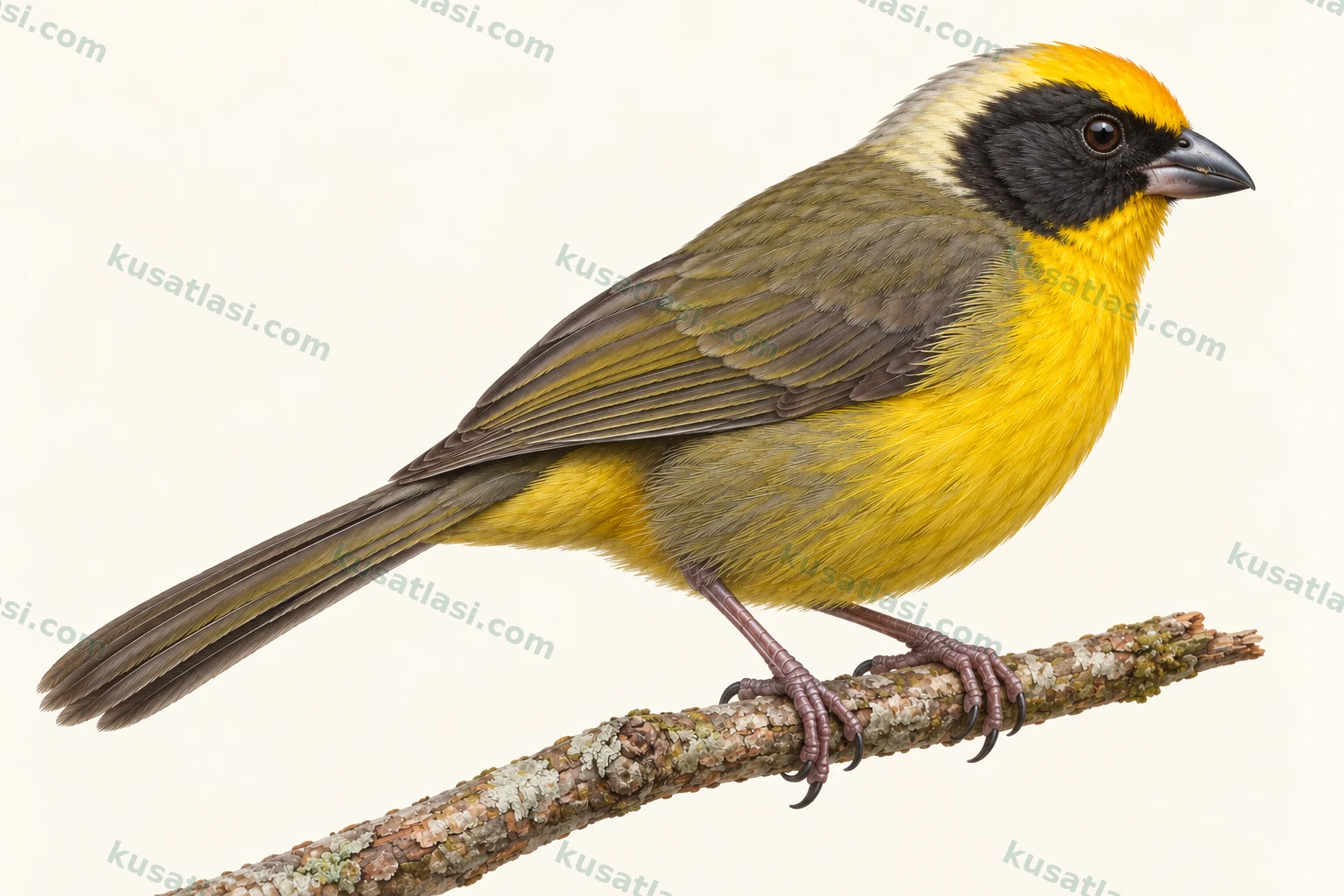
Swipe left or right between the two adult plates.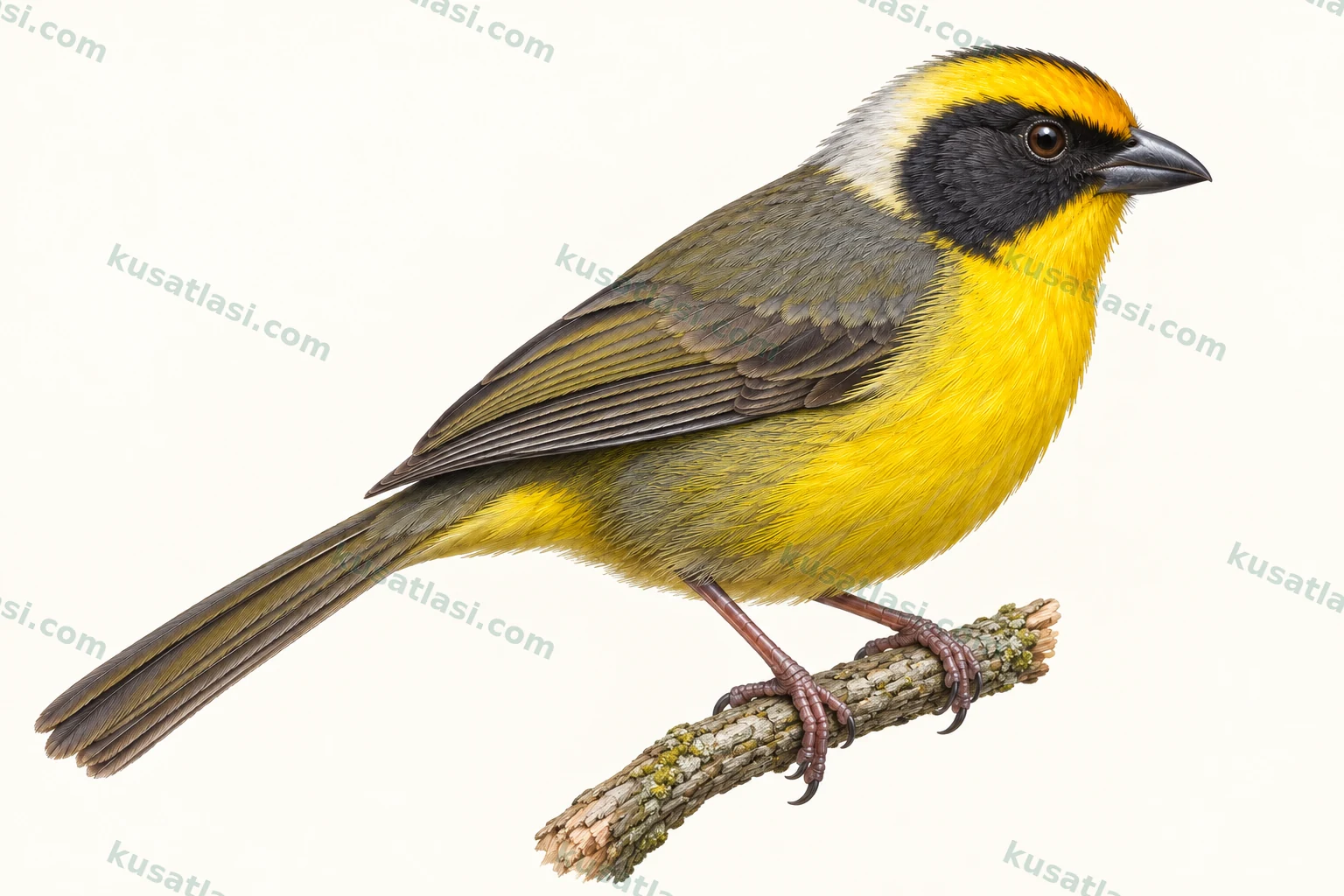
Passerellidae
Pale-naped Brushfinch
Atlapetes pallidinucha
Examine the cinnamon forecrown, dark sides and yellow throat together.
- Order
- Passeriformes
- IUCN status
- LC · Least ConcernGlobal IUCN. BirdLife v10 (2025); taxon matching: AviList 2026 / IOC 15.2; checked 29 October 2026. Checklist year is not the species assessment date. Source and method · BirdLife
At a glance
- Nape becoming white
Examine the cinnamon forecrown, dark sides and yellow throat together.
- High-Andean cover
Watch the low layers of humid mountain forest and scrub edges.
- Caution with sex and age
Colour brightness or one weighing is not a reliable sex key.
Biometrics
Length
- Male
- 18 cm
- Female
- 18 cm
Wing length
- Male
- 7.76 cm
- Female
- 7.76 cm
Weight
- Male
- 21.4–40.2 g
- Female
- 24.9–38.3 g
Length: Shared species value Wing length: Shared species value
World distribution
Pale-naped Brushfinch
Customise map layers
Observation points
Preparing globe…
Monthly record count
Bars show record counts in this sample, not bird abundance or a breeding calendar. They are affected by recording and observation effort.
Rotate the globe and compare layers. Coloured areas are not exact observation or nest locations.
The source does not provide verified monthly range boundaries. All areas are shown; the month slider and monthly playback are therefore disabled.
- Jan
- Apr
- Jul
- Oct
- Dec
Generalised data and method
Base map: Natural Earth · Public domain
Open central bibliography ↗Calendar
The single nest and nearby observations around Bogotá document activity in September–October. A link with local rainfall has been suggested; monthly breeding boundaries across the whole range have not been verified.
All months: Monthly data unverified.
January
February
March
April
May
June
July
August
September
October
November
December
Habitat
Northern Andes: Venezuela, Colombia, Ecuador and northwestern Peru
Watch high-mountain forest and scrub edges; assess the central stripe changing from cinnamon to white between the dark head sides together with the yellow throat.
Sound
The specialist account describes thin high-pitched trills and whistles. Sounds at one disturbed nest do not replace ordinary song or a proven defence strategy.
Do not play recordings to attract birds; observe quietly, especially near nests.
Breeding
Single-nest study: an open cup of dry twigs and grasses, with one incubated egg. This record does not determine typical clutch size; incubation and nestling periods were not verified.
Compare
Compare male and female
Watch the low layers of humid mountain forest and scrub edges.
Species information
Quick identification
The Pale-naped Brushfinch is a yellow-throated passerine with a distinctive head pattern, living at high elevations in the northern Andes. A cinnamon-orange central stripe starts above the forehead, becomes paler towards the back of the head and turns white on the nape. The sides of the head and neck are dark, and the back is grey with a slight olive cast. This combination of white nape, dark head sides and yellow underparts is important for identification. A pale head patch alone is insufficient; compare the entire appearance with other brushfinches bearing similar names.
General appearance and posture
It is a stocky bird noticeable in the lower layers of shrubby cover. The central head stripe is warm-coloured at the front of the forehead and white behind; the entire head is not white. The dark head sides emphasise the pale nape. The yellow throat looks brighter than the duller olive-yellow areas farther down the body. The lower belly may be darker. The back is a grey surface contrasting with the yellow underparts and also has an olive cast. Its tone may change with the light, so identification is not based on the colour saturation of one photograph.
Among vegetation, the head and throat may be seen first. A leaf covering the nape can make the white area look smaller; wait for the bird to change direction. Do not record the cinnamon forecrown as though it were the same colour as the white rear of the head. Examine the transition between colours together with the dark facial areas. When part of the tail or wing is hidden by cover, draw no conclusion about the length or pattern of the unseen portion.
Birds may occur in pairs or small groups. The specialist guide describes them as active and sometimes conspicuous; this does not mean they remain exposed all day. They use low vegetation inside forests and along their edges. Sometimes they join feeding groups containing different bird species. Membership of such a group does not establish permanent flock size or show that all its members eat the same food. Behaviour actually observed is recorded separately from the general species account.
Males, females and young birds
The sources checked do not provide a reliable male–female colour key usable at a distance. Sex is not assigned from the brightness of the yellow throat, the width of the white nape or a single weighing. In the Cundinamarca study, sex was mostly determined by examining reproductive organs; published male and female mean weights are not evidence of sex identification from outward appearance. The researchers’ failure to find significant sex differences in the species they tested also supports not using those means as definite separation thresholds.
The same number appears in both boxes on the length and wing cards because the selected sources did not give separate figures for males and females. This display does not imply that all individuals measure the same. The wing sample comprises museum birds from Ecuador, whereas the weight sample comprises live birds caught in Colombia; they are not the same individuals in one study. No reliable ageing key for young birds was verified. Rather than transferring juvenile plumage from another Atlapetes species, age is left unspecified where evidence is insufficient.
Appearance in flight
Grey upperparts and yellow underparts may be visible during a short flight, but these two broad colours alone do not identify the species conclusively. No separate flight key reliably distinguishing it solely by the upperwing or underwing was verified in the sources. The head and nape pattern of a perched bird offers a better comparison. If the back of the head was not seen during a movement between bushes, the flight view does not count as confirmation of the white nape.
The measurement is not the distance between the two wingtips or the width of the spread wing in flight. Shape, head pattern and the geographical context of the observation are considered together in identification.
Voice and behaviour
The specialist CORPOAMAZONIA account describes thin, high-pitched trills and whistled sounds. This information about natural song is not confused with sounds recorded when a nest was disturbed. In Peraza’s single-nest study, two birds thought to be a pair fluttered nearby while delivering rapid, thin trills and hissing notes. The author interpreted this as apparent distraction behaviour. The observation is not an experimentally proven strategy used in the same way by every individual.
Waiting at the edge without opening the undergrowth allows spontaneous sounds and movements to be watched. Where nesting is suspected, it is unnecessary to force the bird to respond to playback or part bushes to search for a nest. Wait for it to turn naturally to see the head pattern; changing its behaviour for a single photograph adds no scientific evidence to identification.
Similar species
1. Atlapetes pallidiceps is a different species, known in English as the Pale-headed Brushfinch. Its pale crown and throat, dark facial shading and white wing patch produce a generally paler appearance. Its restricted range in dry scrub around Yunguilla in southern Ecuador is not the range of this humid high-Andean bird. Similar scientific names do not permit nesting information or measurements to be transferred between the two species.
2. When comparing other yellow-underparted Atlapetes species, examine the central stripe changing from cinnamon-orange on the forehead to white on the nape together with the dark head sides. A yellow body alone or a pale head area alone is insufficient. A record that does not show the rear of the head should not be confirmed with a claim that every distinguishing feature was seen.
Global range
The species ranges through the northern Andes, covering Colombia, Ecuador, southwestern Venezuela and far northwestern Peru. It is not endemic to Colombia. Current taxonomy recognises two subspecies: the nominate pallidinucha in Colombia’s Eastern Andes and Venezuela’s Mérida and Táchira regions, and papallactae from Colombia’s Central Andes through Ecuador to the Cajamarca area of Peru. This does not mean continuous presence at every elevation throughout these countries.
Status within its natural range
Its global conservation category is Least Concern. This classification does not prove that every local forest or population is in the same condition. High-mountain forest and shrub cover restrict where the species occurs. The Sibundoy institutional guide gives 2,400–3,600 metres in Colombia, while Cornell emphasises about 2,700–3,700 metres in the highlands; these regional descriptions are not combined into fixed lower and upper limits for the whole range. A single nest record near Bogotá does not show that all other populations breed under the same conditions.
Seasonal movements
Sources describe the species as resident; no regular intercontinental migration was verified. Being resident does not mean that every individual remains on the same branch or in the same small area all year. The studies checked did not establish a pattern of seasonal elevational movements either. Consequently, no precise monthly routes, flight distances or country crossings are drawn. Observation points do not stand in for the entire natural range or breeding areas.
Breeding habitat
Humid high-Andean mountain forests, forest edges and the shrub layer are the main environment. Specialist accounts also mention high-mountain scrub and páramo margins. The species is not sought only deep inside undisturbed forest; the nest studied near Bogotá was in regrowing vegetation beside an old road. One record in such a place does not prove that roadsides are the best breeding habitat throughout the species.
Nest site
Peraza’s study describes a large open cup nest made of dry twigs and grasses, found in Usaquén in 2000 at 2,800 metres. It contained a single incubated egg; this is one nest record and is not presented as the species’ typical clutch size. Because the nest, egg and female were collected for research, incubation and nestling periods were not followed. These periods are not filled in from other brushfinches.
Daily habitat use
Birds move in pairs or small groups through low forest and edge vegetation, sometimes joining mixed feeding groups. The structure of the cover can make natural behaviour difficult to see. Observation does not require opening vegetation, approaching a nest or forcing a bird to remain exposed. Patiently watching the head and throat pattern from a shrub edge provides a more appropriate record.
What does it eat?
The specialist institutional guide lists fruits, fresh leaf shoots and insects among the foods, specifically mentioning shoots of plants such as Disterigma. This account does not provide measured dietary percentages. Naming the bird a brushfinch does not justify describing it as exclusively seed-eating. The stomach of a female collected in Peraza’s nesting study was full of insects. This direct finding concerns that individual’s diet at that time; it does not prove that all birds eat only insects in every season.
How does it feed?
Birds search for food while moving through low vegetation. Gathering fruit or shoots and searching for small animal food may occur in the same environment; from a distance, the food targeted by each peck is not always clear. Joining mixed bird groups does not mean that every member shares the same prey. Exact prey size, daily consumption and seasonal proportions were not verified in the sources checked. Food actually seen is recorded separately from feeding inferred from movement alone; missing details are not filled with another species’ food list.
What a single nest can tell us
The first detailed nesting account, published in 2009, was based on a single nest found in October 2000 in Bogotá’s Usaquén district. The open cup contained one incubated egg. It measured 2.5 × 1.69 cm and weighed 3.45 g (direct measurements of the single egg in this nest). The absence of another egg in the female’s oviduct supported a one-egg clutch in that specimen. The author’s interpretation is not generalised into a fixed clutch size for the whole species. Because the nest was collected, the duration of successful development was not measured.
A link with rainfall is an interpretation
The nesting study also recorded other pairs and a bird carrying dry grass nearby in September and October. The author discussed this local breeding activity as possibly associated with the second rainfall peak. This does not experimentally prove that rain initiated breeding; the same monthly calendar is not applied throughout the range, including Ecuador and Peru.
A white nape is not a white head
The cinnamon forecrown, rear crown becoming white and dark sides form a single pattern. The similarly named Atlapetes pallidiceps is a different bird, whose pale throat and white wing patch are important in comparison. The Emberizidae family used in older guides is not the same as the current classification either: this species is now placed in Passerellidae.