
World Birds
Field identification plates
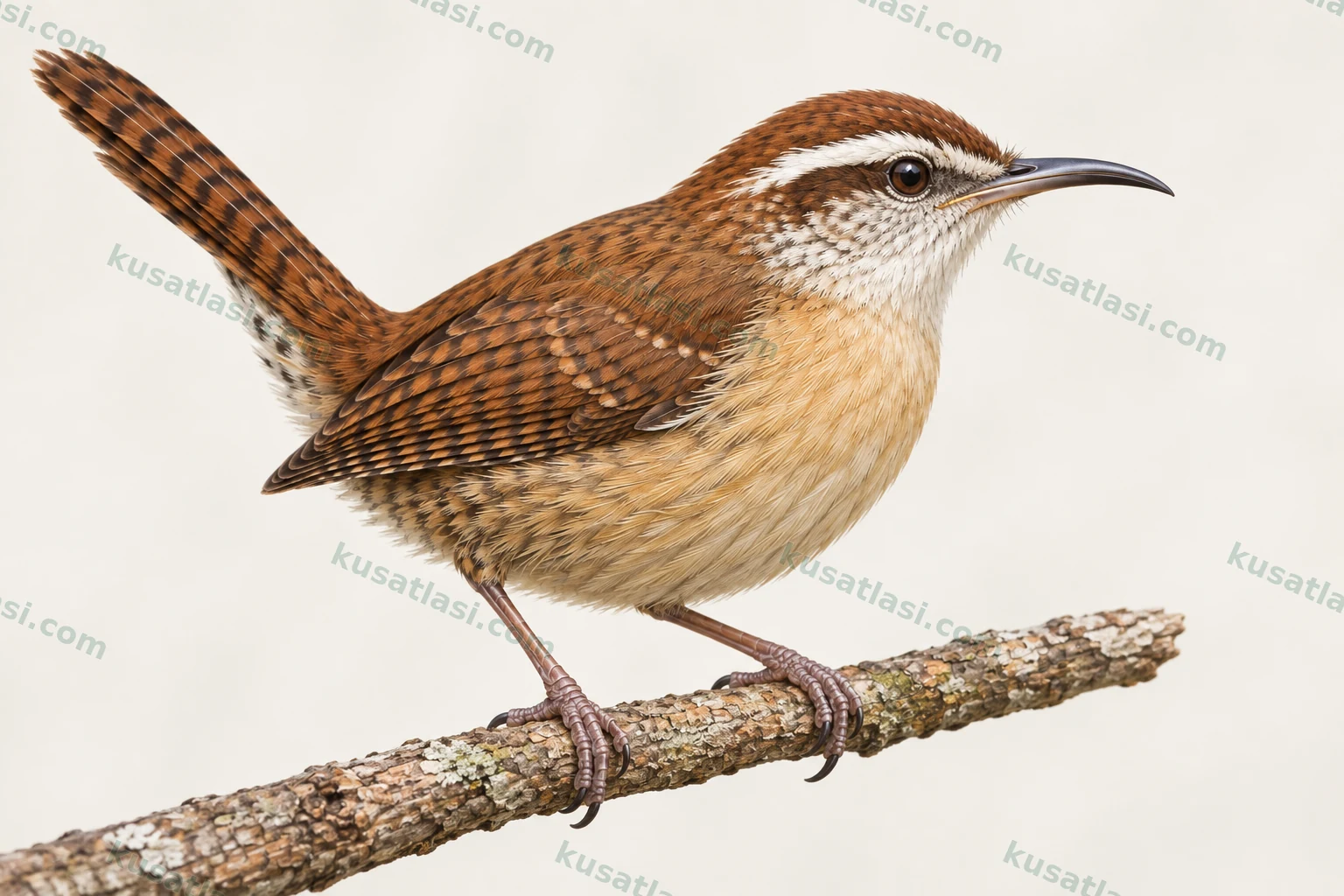
Swipe left or right between the two adult plates.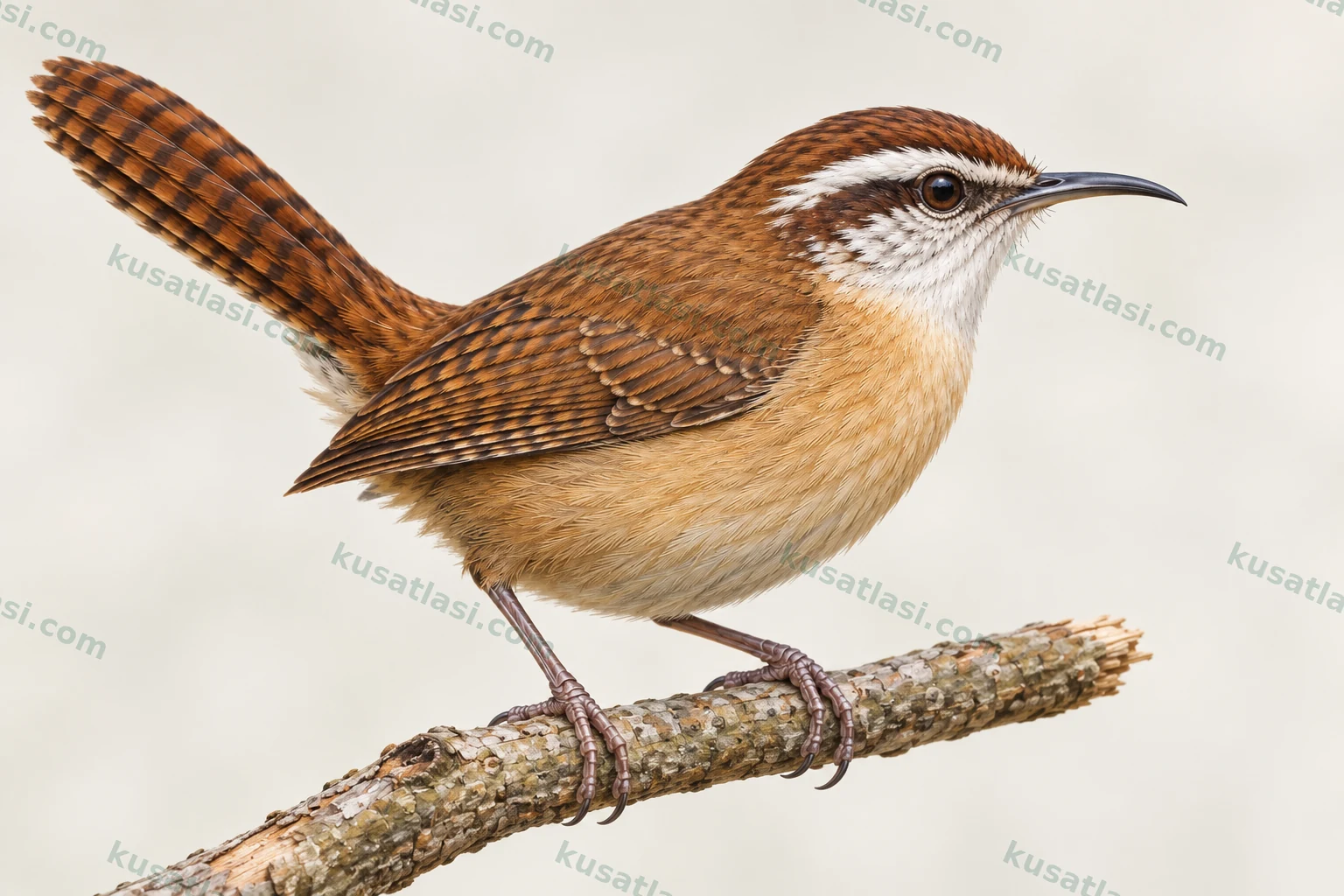
Troglodytidae
Buff-breasted Wren
Cantorchilus leucotis
Examine the fine pale and dark lines on the head sides together.
- Order
- Passeriformes
- IUCN status
- LC · Least ConcernGlobal IUCN. BirdLife v10 (2025); taxon matching: AviList 2026 / IOC 15.2; checked 29 October 2026. Checklist year is not the species assessment date. Source and method · BirdLife
At a glance
- Pale face lines
Examine the fine pale and dark lines on the head sides together.
- Warm breast
Assess the light brown underparts with the back and face.
- Barred tail
Dark crossbars on the rufous tail show at a suitable angle.
Biometrics
Length
- Male
- 14–15 cm
- Female
- 14–15 cm
Wing length
- Male
- 6.21 cm
- Female
- 6.21 cm
Weight
- Male
- 18.5–25 g
- Female
- 16–19.5 g
Length: Shared species value Wing length: Shared species value
World distribution
Buff-breasted Wren
Customise map layers
Observation points
Preparing globe…
Monthly record count
Bars show record counts in this sample, not bird abundance or a breeding calendar. They are affected by recording and observation effort.
Rotate the globe and compare layers. Coloured areas are not exact observation or nest locations.
The source does not provide verified monthly range boundaries. All areas are shown; the month slider and monthly playback are therefore disabled.
- Jan
- Apr
- Jul
- Oct
- Dec
Generalised data and method
Base map: Natural Earth · Public domain
Open central bibliography ↗Calendar
Rainfall onset at Tayrona was associated with local breeding timing; the Pantanal has a different flood calendar. No single monthly schedule was verified for the whole range.
All months: Monthly data unverified.
January
February
March
April
May
June
July
August
September
October
November
December
Habitat
From Panama to northern and central South America
Examine face lines, warm breast, rufous back and barred tail together.
Sound
Pairs may sing antiphonally. Do not identify the species before confirming the sound belongs to the visible bird.
Do not play recordings to attract birds; observe quietly, especially near nests.
Breeding
Separate nests for breeding and roosting are built in vegetation. In Gill and Stutchbury’s local Panamanian sample, breeding nests most often had three eggs, with two to three observed, and females incubated. No reliable general incubation duration in days was verified; avoid long waits at nests.
Compare
Compare male and female
Assess the light brown underparts with the back and face.
Species information
Quick identification
The Buff-breasted Wren inhabits thickets and forest undergrowth in the tropical American lowlands. Its back is rufous-brown, while the breast and front of the belly are warm light brown. Look for the pale eyebrow together with fine black-and-white lines on the sides of the head. Dark crossbars may show on the rufous-brown tail and flight feathers. The English name's buff breast and the scientific name's suggestion of pale ears do not identify it alone. In a bird partly concealed in shrubs, confirm head pattern, back, breast and tail on the same individual first.
General appearance and posture
The slender, slightly curved bill suits picking small arthropods from dense leaves. The rear upperparts can look plain rufous; dark bars are concentrated on the tail and flight feathers. Peru Aves's account of the Peruvian subspecies stresses the broad pale eyebrow, fine black-and-white head-side lines and a throat shading into light brown below. Transferring every detail unchanged to all Panamanian or Brazilian subspecies would be wrong. Avibase includes several subspecies under the accepted species; locality and possible subspecies matter when comparing colours.
The bird often appears in brief movements through moist edge vegetation. A dark shadow behind a branch may make the pale face look narrower, while direct sun brightens the pale breast. Tail crossbars may only show when it spreads at a suitable angle. Do not mistake a branch crossing the tail in a photograph for a marking. Rufous colour alone is not diagnostic either: other wrens can show a similar back tone in the same light. Comparing face lines, breast tone and tail from several angles reduces misplaced confidence.
Ahumada's dry-forest study at Tayrona in northeastern Colombia shows birds mainly foraging in the understorey. Nóbrega and Pinho's Brazilian Pantanal research associates records with woodland near water. Finding the species in both a dry forest and a seasonal floodplain shows why no single obligatory habitat can be drawn. Neither study, however, proves equal frequency across its entire geography. Vegetation and water conditions should be recorded for ecological interpretation as well as identification.
Males, females and young birds
The species sources reviewed provide no general rule reliably sexing a free bird from colour or head lines alone. Gill and Stutchbury sexed marked birds using several contextual clues: laying, incubation, duet parts and relative size within a pair. Applying that field method to any photograph and calling the pale-faced bird male is wrong.
Gill and Stutchbury distinguished adults and young through marked-family behaviour and some anatomical evidence; no single juvenile feather colour is offered as a reliable age marker across the range. A bird beside an adult may be its young, but sharing a branch does not prove kinship. Observed feeding and sustained association are stronger evidence. State which feature was actually seen when assigning age or sex from photographs. An exact age given to a bird briefly glimpsed in shrubs can magnify errors in later breeding calendars.
Appearance in flight
The species can make short flights between branches or shrub clumps in dense vegetation. Dark crossbars on the rufous tail and wings may show at the right angle, but one bar glimpsed during movement does not securely separate every similar wren. The checked sources did not establish an invariant, independently diagnostic flight pattern for both wing surfaces. No special spot or contrasting colour is therefore added to the unseen underwing. Look again for face lines and breast colour on the same bird after it lands.
If all that was seen in the air was a rufous flash, record movement direction and the next landing rather than asserting that it was the tail. This keeps the flight observation within its actual limits.
Voice and behaviour
Antiphonal singing by partners has been studied in this species. Research compared paired space use, nest building and offspring feeding. A sound from a thicket does not necessarily belong to the visible bird. Do not turn a recording into a species identification before securely matching its source. The studies treat duetting in its behavioural context; they do not prove a recording alone separates all subspecies.
Gill and Stutchbury distinguished breeding nests from the separate roosting or “dormitory” nests built throughout the year. In their population, males put more work into roost-nest construction than females, whereas contributions to breeding-nest construction and nestling feeding were more similar. Male effort on roost nests was associated with later offspring feeding effort. This is neither an invariable rule for every male nor proof of direct causation. Many roost nests in the same study could stand empty; a finished-looking nest must not automatically be assumed to contain eggs.
Similar species
1. Moustached Wren (Pheugopedius genibarbis) can look similar in parts of Amazonia. Peru Aves describes Buff-breasted Wren as having less densely patterned head sides, more rufous-buff underparts and no grey on the neck sides. This regional comparison is not a universal rule for other subspecies or lighting. Both head sides, breast and neck should be seen together.
2. The possibility of encountering congeners such as Long-billed Wren (Cantorchilus longirostris) depends on region. Bill length can appear different with viewing angle. Check both taxa's relationships and historical record names separately in Avibase; do not force a comparison without evidence that both can occur there.
3. Other small rufous-brown wrens can also have tail and wing bars. A record saying only “rufous back” is insufficient for C. leucotis. Combine the actual positions of pale face lines, underpart colour, tail bars and geography. Keep uncertainty in an inadequately documented record rather than finalizing a species name.
Global distribution
Avibase's current Cantorchilus leucotis concept includes populations from western Panama through northern Colombia and Venezuela, the Orinoco and Amazon basins and northern and central South America. Some islands off Panama and regions reaching northern Brazil and Bolivia fall within the same broad species. This list does not mean that the bird occupies every point in those countries.
Status within its natural range
Check the current taxonomic scope when combining subspecies boundaries with studies written under the former name Thryothorus leucotis. Oiseaux.net's country-map warning is particularly relevant: a presence mark does not mean a country's whole surface is occupied. Local observations and habitat data give finer distribution information than colouring entire countries.
Migration
The Brazilian Pantanal study considered the birds recorded over its study years resident. Gill and Stutchbury's year-round pair roost nests also indicate local continuity. These two regional findings do not establish that all subspecies never move. Checked sources did not verify an obligatory long-distance route connecting the whole range through individual tracking. Any local movements linked to flooding, drought or food changes should be studied separately from intercontinental migration.
Breeding habitat
The Colombian Tayrona study concerned a dry-forest understorey population; the Poconé Pantanal research examined woodland and areas near water subject to seasonal floods. Of Nóbrega and Pinho's 87 nests, 52 were in a local moist-forest type, 26 in wetland and nine in another forest type. Without explaining that these counts refer only to that sample, one cannot say the species always breeds in wetlands. Scrub and forest edges can be used to different degrees according to regional settlement.
Nest site
Gill and Stutchbury distinguished nests used for breeding from year-round roost nests. Pairs build within vegetation; a completed nest need not hold eggs. In the studied Panamanian population, breeding nests most often contained three eggs, with an observed range of two to three per nest, and females incubated. This local finding is not an invariant count for all subspecies. No verified general incubation period was found. Opening an active nest for photographs or waiting beside it for a long time can alter breeding behaviour.
Daily space use
Birds may search leaf surfaces, dry branches and plant debris caught between branches for arthropods. At Tayrona the abundance of these food microhabitats was linked to rain; in the Pantanal, woodland close to water was often used. The two areas do not share identical seasons or vegetation. Distinguishing low scrub, moist forest edge and dry-forest undergrowth in notes allows safer comparisons with space use elsewhere.
What does it eat?
Ahumada's direct feeding observations at Tayrona showed arthropods taken from upper and lower understorey leaf surfaces, dry branches and suspended plant litter. AVONET also places the species in the broad invertebrate-eating class. This does not say every prey item is an insect or that one group dominates in every season. Reaching beneath a leaf cannot be recorded as catching a caterpillar unless the prey in the mouth was seen. Tayrona's feeding findings relate to dry-forest rainfall; the same proportions are not automatically transferred to Amazon floodplain forest.
How does it hunt?
Moving among stems and fine branches, it may scan leaf surfaces and pick small prey with its bill. Ahumada recorded changes in arthropod abundance in some understorey microhabitats with rain, alongside rain-related breeding onset. Coincidence alone does not prove each nesting individual hunts only one particular insect. Seasonal rising water can alter accessible shrubs and feeding sites; the Pantanal habitat findings give a relevant local context but no detailed prey proportions.
Comparisons of partners' nestling-feeding work confirm food delivery, but the study did not identify the taxon of every mouthful. Thus insect percentages or exact daily prey counts are not invented. Recording visible prey size, leaf surface, height and time creates more useful data for future feeding studies. Prolonged waiting near a nest can itself affect parents' natural delivery rate.
Two functions for nests
Gill and Stutchbury's pairs built not only breeding nests for raising young but separate dormitory nests for year-round roosting. Males contributed more than females to roost-nest construction, while breeding-nest building and food delivery were more balanced. Male effort on roost nests was associated with subsequent nestling feeding. This shows why counting every nest in a nest-rich area as active incubation is wrong. Association does not prove causation or identical roles throughout the range.
A calendar changed by rain
Ahumada compared breeding timing through two years with different rainfall in northeastern Colombia. This species began breeding with the rains locally; in the dry year breeding started later but continued. Another wren compared in that research used different food microhabitats and did not show the same rainfall response. This is more informative than one worldwide laying month. Tayrona's seasons, Pantanal flooding and Amazon forest climates should not be equated.
The limits of numbers
Pantanal researchers found 87 nests, but 58 were abandoned during building, four damaged by weather and only 25 reached egg laying. Apparent breeding success in that sample was reported as 12 percent, with predators important in active nest losses. The number is striking but cannot stand for the species' entire annual success. Shrub density, rainfall, flooding and nest-finding methods vary among places. Confusing roost and breeding nests can also change denominators.
The former genus name
Most older studies published this bird as Thryothorus leucotis; the catalogue now uses Cantorchilus leucotis.