
World Birds
Field identification plates
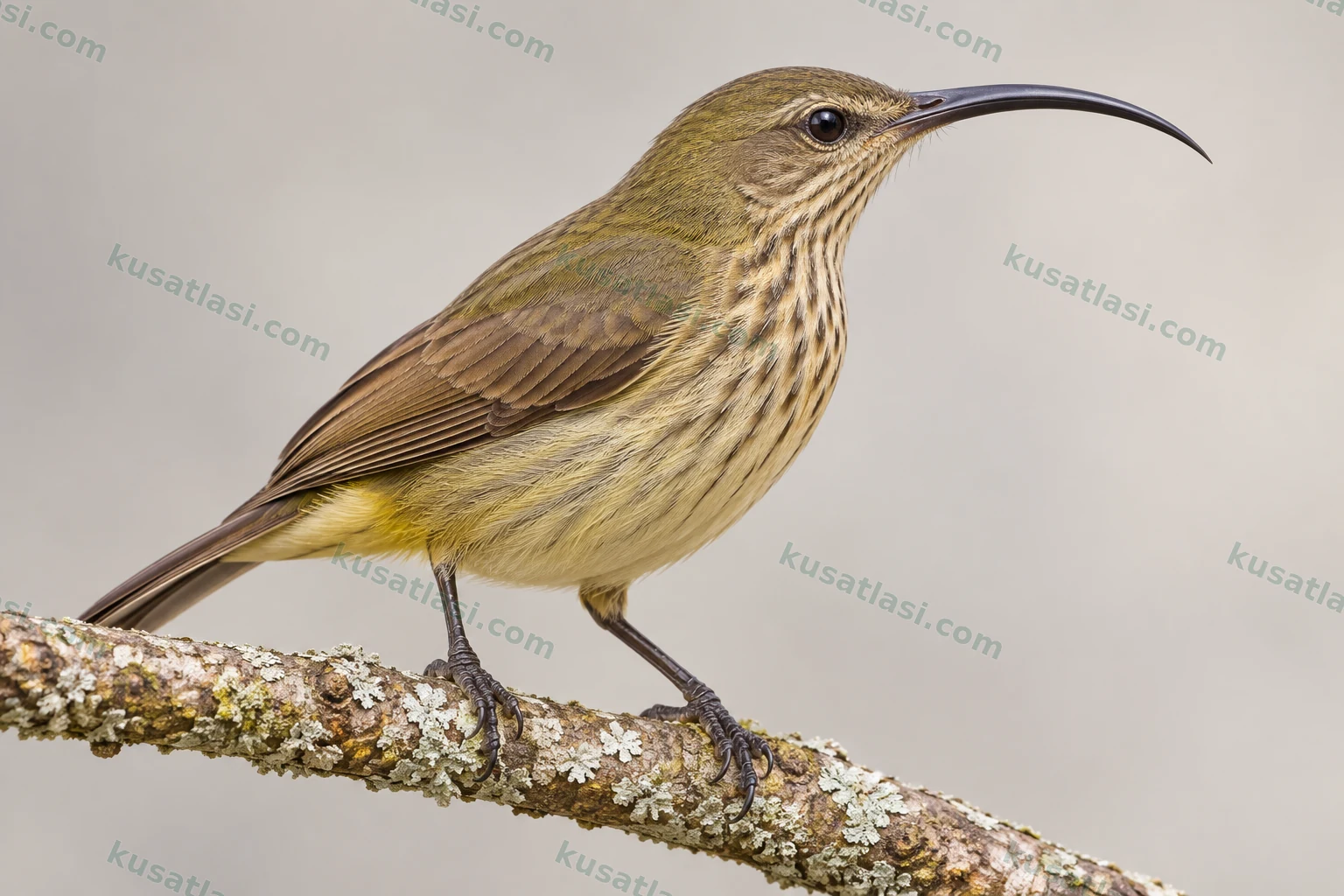
Swipe left or right between the two adult plates.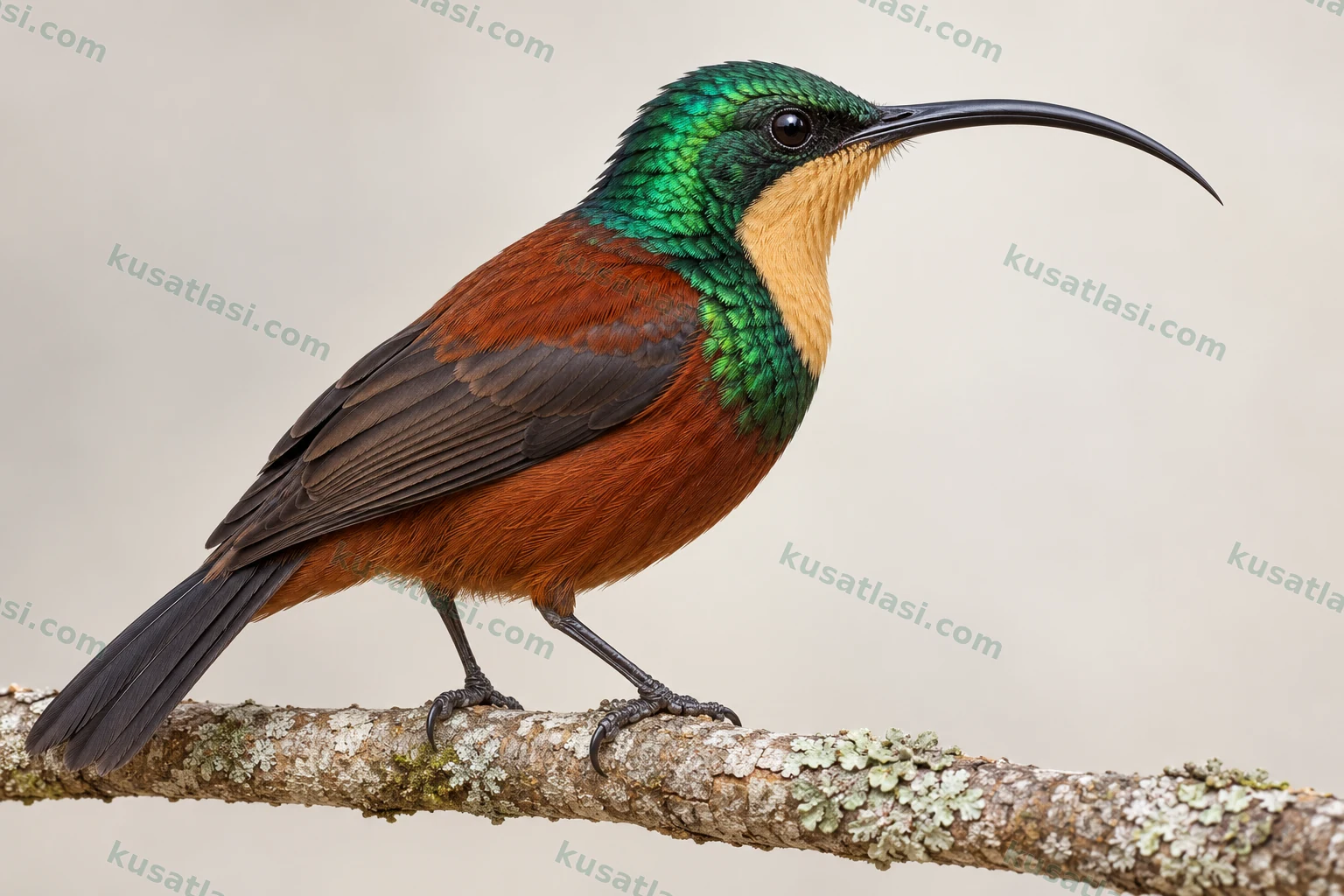
Nectariniidae
Buff-throated Sunbird
Chalcomitra adelberti
See the male’s pale yellow throat, black breast band and chestnut belly together.
- Order
- Passeriformes
- IUCN status
- LC · Least ConcernGlobal IUCN. BirdLife v10 (2025); taxon matching: AviList 2026 / IOC 15.2; checked 29 October 2026. Checklist year is not the species assessment date. Source and method · BirdLife
At a glance
- Pale throat, dark border
See the male’s pale yellow throat, black breast band and chestnut belly together.
- Streaked female underparts
Pale eyebrow and pronounced underpart streaks matter when comparing similar females.
- Flowering trees
Watch the upper forest layer and flowering branches from a distance.
Biometrics
Length
- Male
- 11–12 cm
- Female
- 11–12 cm
Wing length
- Male
- 6.07 cm
- Female
- 6.07 cm
Weight
- Male
- 8.3–8.9 g
- Female
- 9.9–11 g
Length: Shared species value Wing length: Shared species value
World distribution
Buff-throated Sunbird
Customise map layers
Observation points
Preparing globe…
Monthly record count
Bars show record counts in this sample, not bird abundance or a breeding calendar. They are affected by recording and observation effort.
Rotate the globe and compare layers. Coloured areas are not exact observation or nest locations.
The source does not provide verified monthly range boundaries. All areas are shown; the month slider and monthly playback are therefore disabled.
- Jan
- Apr
- Jul
- Oct
- Dec
Generalised data and method
Base map: Natural Earth · Public domain
Open central bibliography ↗Calendar
Nigerian records include a nest with eggs in January and one with young in February. These are place- and year-specific evidence; monthly breeding or migration limits were not verified for the whole range.
All months: Monthly data unverified.
January
February
March
April
May
June
July
August
September
October
November
December
Habitat
West African forest belt; from the Guinea region to Nigeria and neighbouring Cameroon
In flowering trees, watch the male’s pale throat, dark breast border and chestnut belly together; in the female, the pale eyebrow and streaked underparts.
Sound
A strong two-part call and thin, squeaky whistles repeated in a simple pattern are reported. Assess them together with the visible bird’s head and breast pattern.
Do not play recordings to attract birds; observe quietly, especially near nests.
Breeding
The Nigerian 1972 record describes four white eggs in a mango-tree nest woven from grass stems, with a side entrance and plant-down lining; it is a single-nest record. Both parents fed two developed young in 1965. Incubation and young-development periods could not be verified.
Compare
Compare male and female
Pale eyebrow and pronounced underpart streaks matter when comparing similar females.
Species information
Quick identification
The Buff-throated Sunbird is a small passerine of West African forests and wooded surroundings. In the adult male, the pale yellow throat, black breast band immediately below and chestnut belly stand out together. Metallic green on the front of the head and around the chin contrasts strongly with this warm brown body. The whole bird is not green. Seeing the pale throat, breast boundary and position of the head iridescence together is more valuable than one distant colour patch.
General appearance and posture
The male’s pale throat may appear straw-yellow to cream-yellow. The dark border below it should be followed separately from the chestnut belly. In shade, the black band can merge with other dark body areas and obscure the distinctive pattern. The metallic area at the front of the head appears brighter or duller with the direction of light. Failure to see the iridescence in one photograph does not establish its absence; different views of the same bird help.
Upperpart colour varies geographically. Chestnut-brown is more prominent in western birds, blackish brown in eastern birds. The description should therefore not be reduced to the darkest or warmest photograph from one region. Wolters’s species account describes chocolate-brown upperparts and chestnut underparts and stresses the restriction of metallic areas to the front of the head and around the lower bill. The back and bright head area are not the same colour surface.
The fine bill, margins of the pale throat and belly colour are easier to examine when the bird perches naturally. Feeding in the crown of a flowering tree may partly conceal the body among branches. Its occurrence in the upper tree layer in the Benin study means observers should not search only low bushes. Following movement among flowers and waiting for a view of the head and breast reveals detail without opening the vegetation.
Males, females and young birds
Adult males and females do not share the same plumage. The female has a faint pale eyebrow and pronounced streaking below. The male’s conspicuous pale throat, black band and chestnut belly cannot be used to describe the female. Examine her pale eyebrow and streaked underparts together. Bill length in profile also helps compare similar female sunbirds; the viewing angle can make the bill look shorter than it is.
The female can resemble female Cinnyris johannae; the specialist identification account gives the Buff-throated Sunbird’s shorter bill as a difference. This is not a rule to measure a bill with a ruler on an image and decide from that alone. Head angle, underpart streaks and locality must be assessed together. A species-specific field key reliably separating young birds in every case was not verified in the sources examined. Not every plain or weakly iridescent bird should be called a young male.
Appearance in flight
In brief movements between flowering branches, the metallic head area or pale throat may show only momentarily. Shadow and motion can also leave the chestnut body as a dark silhouette. A pale spot during a short flight therefore does not replace the complete male identification pattern used when perched. Once the bird perches naturally again, the throat, breast band and head-area boundaries can be checked.
The sources examined did not provide a flight key conclusively separating this species by a single underwing mark. There is no need to flush the bird or approach the flowering tree to make it fly. Quiet observation helps place brief movements and longer feeding behaviour in the same context.
Voice and behaviour
The specialist voice description reports a strong two-part call and a song of thin, squeaky whistles repeated in a simple pattern. A written syllable does not carry every aspect of the real sound’s pitch, duration and arrangement. On hearing something similar, also check the bird’s head, breast pattern and vegetation layer. Not every short whistle is assumed to belong to this species.
Similar species
1. Male Chalcomitra fuliginosa also has a brown body and metallic head areas. Wolters’s account notes a metallic forehead and throat and yellow feathers at the breast sides. The Buff-throated Sunbird’s pale yellow throat and dark band below form a different pattern. Iridescence alone does not separate them.
2. Throat colour and boundaries also matter when comparing Chalcomitra rubescens. A similar brown body does not justify assigning every Chalcomitra the same name. The pale throat, dark lower border and chestnut belly must be checked together in a good frontal or side view.
3. Female Cinnyris johannae may cause confusion because of her streaked underparts. A shorter bill favours the Buff-throated Sunbird, accompanied by the pale eyebrow and overall pattern. If bill angle is unsuitable, the record may remain uncertain rather than being finalised.
Global range
The natural range extends along West Africa’s forest belt. The taxonomic account gives northwestern Guinea and the vicinity of Guinea-Bissau east to southeastern Nigeria and adjacent Cameroon. Sierra Leone, Liberia, Côte d’Ivoire, Ghana, Togo and Benin lie within this west–east distribution. Country names do not mean uninterrupted occurrence in every part of every province; rainforest, wooded transitions and suitable flowering areas matter.
Status within its natural range
Small numbers were recorded in the upper tree layer of Niaouli, Lama and Pobè forests in southern Benin. Not seeing it at Lokoli during the same study does not mean that site is always unoccupied. The Togo survey reports records between Assoukoko and Dzogbégan; missing it on that trip at previously known Klouto likewise illustrates the limits of one survey. Counts from different sites should not be read as population comparisons unless methods and timing match.
Seasonal movements
No long-distance migration route was verified for the species in this work. Visiting a flowering tree or defending a feeding site does not prove intercontinental migration. January and February feeding and nest records are assessed with their place and year. They do not yield one migration or breeding calendar for the whole range. A record documents presence, not by itself the route of arrival or subsequent destination.
Breeding habitat
Lowland rainforest, riverine woodland, wooded farmland and gardens are among the environments used. Original Nigerian nest records concern trees in gardens. This does not mean the species breeds only in human settlements; surrounding tree cover and sheltered branches are part of the context. Records from Benin’s upper forest layer show that habitat cannot be defined only by ground vegetation.
Nest site
The 1972 mango-tree nest was a domed, side-entrance structure woven from grass stems and lined with plant down. The report also describes another similar nest in a raffia palm. The 1965 account describes a hanging fibrous outer covering at a branch tip and a small projection above the entrance. White inner fibres were thought possibly to be kapok, but the material was not confirmed. These details belong to nests directly observed.
Daily habitat use
Flowering tree crowns and mistletoe clumps are used for feeding. A male may defend such a food source against other sunbirds. Watching the branch reached, flower visited and next movement from a distance is useful. Pulling branches, climbing trees or opening cover near a possible nest is not recommended today, even if a historical report did so.
What does it eat?
The association with flowers is supported by direct field records. Benin observations recorded a flowering clump of Tapinanthus bangwensis mistletoe, the flowering crown of Albizia zygia and flowers of Albizia glaberrima. AVONET places the species in a broad nectar-feeding group. That does not establish that all daily food is nectar or that the same three plants are used everywhere. As no verified detailed prey inventory or dietary percentages were found, insect species and daily quantities are not added.
How does it feed?
Watching visits to flowering branches, returns to the same place and interactions with competing birds explains feeding patterns. The species is included in a scientific synthesis of sunbird–plant associations. Not every flower visit means successful pollination; pollen transfer and a resulting response in the plant require separate evidence.
What does an old nest record show?
Herman H. Gray found a nest in a garden mango tree in southeastern Nigeria on 27 January 1972. The woven grass-stem structure had a side entrance and plant-down lining. It contained four white eggs, measured as 1.8 × 1.2 cm (the source’s measurements from one nest, not a fixed value for the whole species). Another similar nest was seen in a raffia palm in early February. Incubation duration was not measured in the report.
Two chicks do not mean two eggs
C. H. Fry’s record of 10 February 1965 describes two well-developed young in a nest. Both parents were seen bringing food and removing faecal sacs. No eggs or shells were seen, so the original clutch size was unknown. A two-chick record and a four-egg record therefore cannot replace each other. The February observation is breeding evidence from one place and year, not a fixed seasonal boundary for all West Africa.
Defending a flowering tree
At Niaouli in Benin, a male chased Hedydipna collaris from the crown of a flowering Albizia zygia. In the same study another male defended a flowering mistletoe clump. These observations show how food can shape space use. Treating every chase as nest defence would add an unobserved breeding event to the record. The study also recorded a female at Albizia glaberrima flowers.
The difference between pollination and visiting
A scientific paper published in 2020 reviewed literature on African sunbirds’ food plants and included the Buff-throated Sunbird. Its method assumes pollination for some food plants; it does not experimentally demonstrate successful pollination on every visit by this species. Seeing a bird use a flower does not replace separately measuring the plant’s subsequent fruit or seed success.