
World Birds
Field identification plates
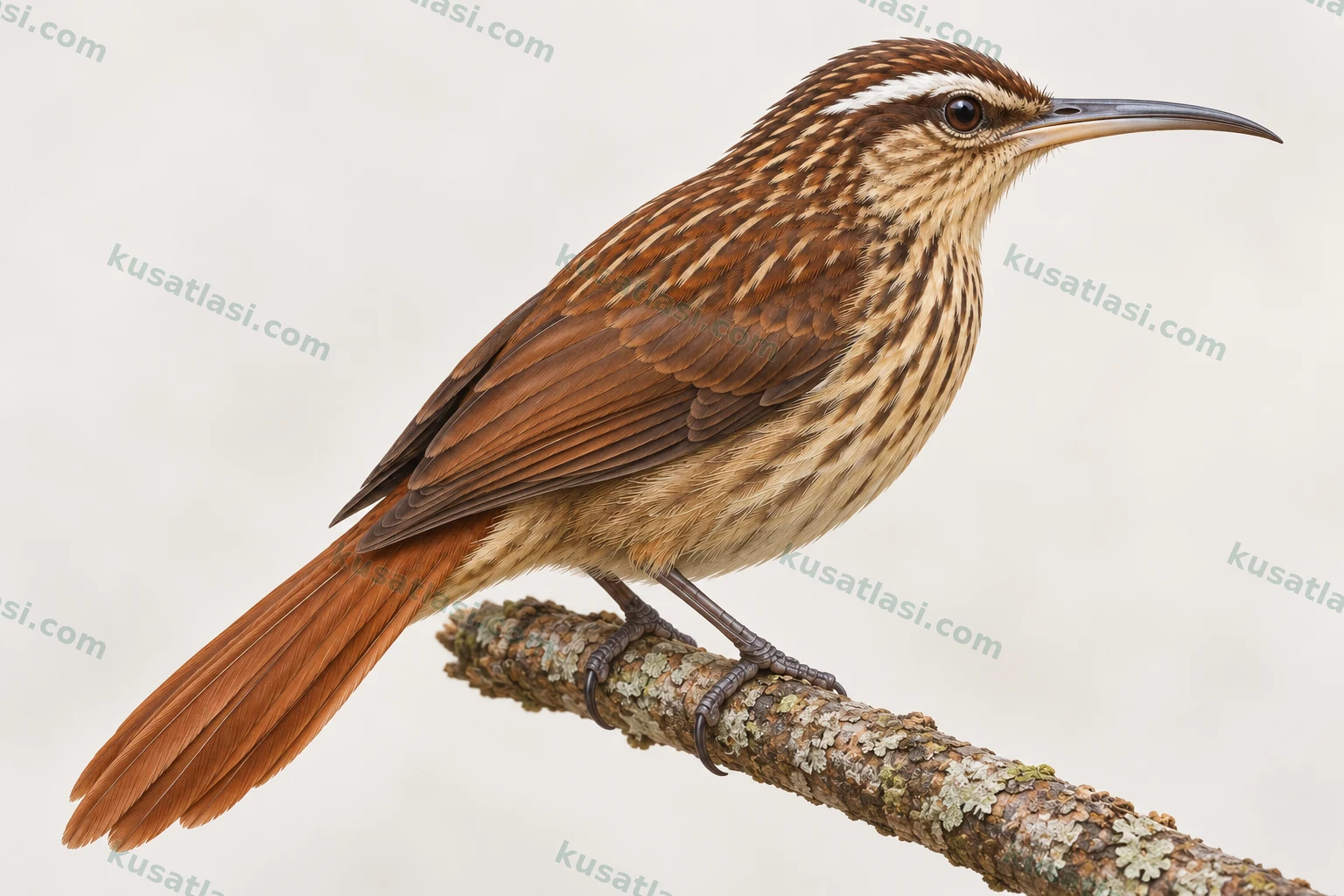
Swipe left or right between the two adult plates.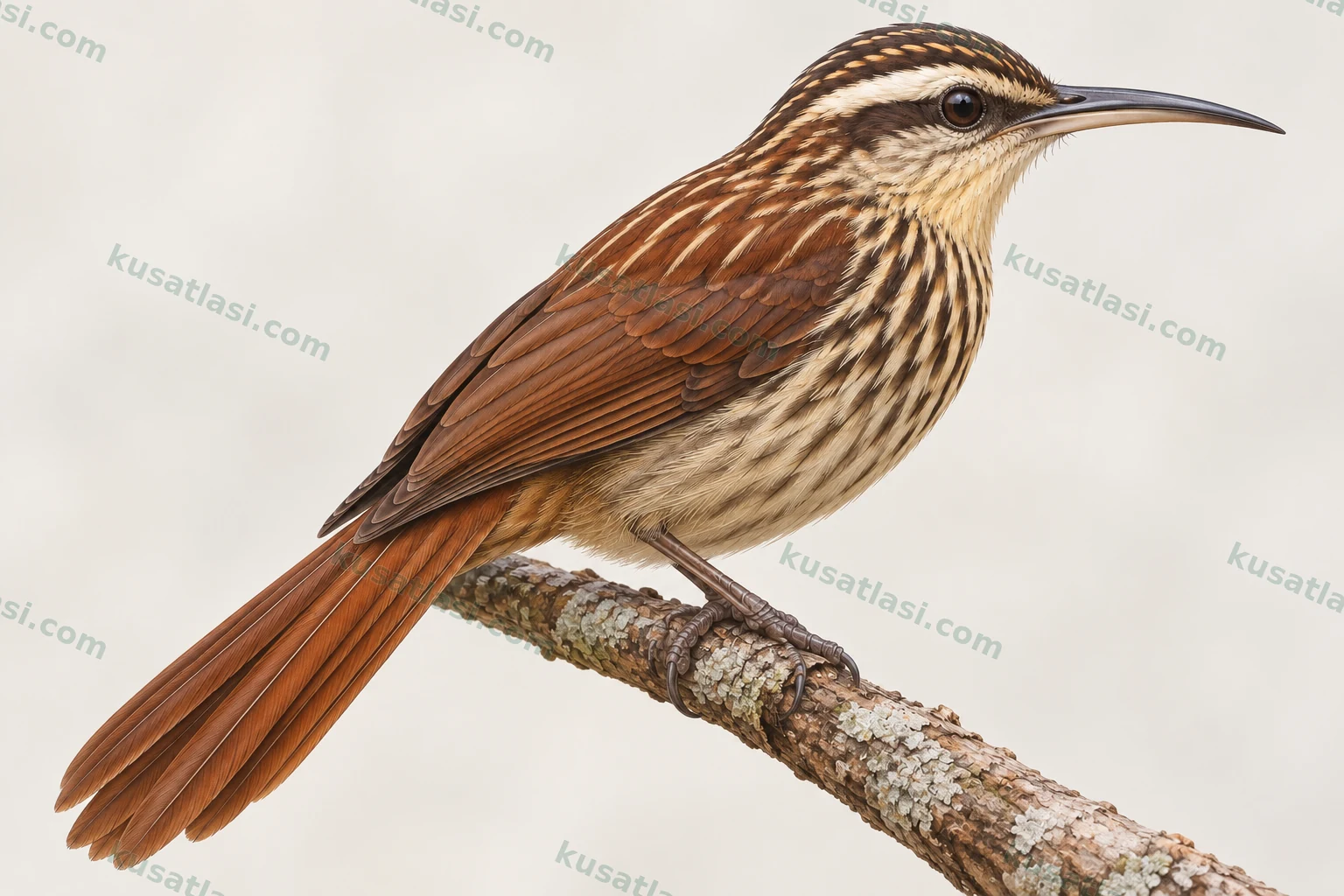
Furnariidae
Pale-browed Treehunter
Cichlocolaptes leucophrus
Check pale eyebrow, streaked back and underparts on the same bird.
- Order
- Passeriformes
- IUCN status
- Source-taxon assessmentGlobal IUCN. BirdLife v10 (2025); taxon matching: AviList 2026 / IOC 15.2; checked 29 October 2026. Checklist year is not the species assessment date. Source and method
At a glance
- Combine eyebrow and streaks
Check pale eyebrow, streaked back and underparts on the same bird.
- Watch the bromeliad patiently
It can almost disappear inside the leaf cluster when feeding.
- Listen to the full sequence
Notice the strong short notes following the initial trill.
Biometrics
Length
- Male
- 18–23 cm
- Female
- 18–23 cm
Wing length
- Male
- 10.33 cm
- Female
- 9.83 cm
Weight
- Male
- 38.3 g
- Female
- 38.3 g
Length: Shared species value Weight: Shared species value
World distribution
Pale-browed Treehunter
Customise map layers
Observation points
Preparing globe…
Monthly record count
Bars show record counts in this sample, not bird abundance or a breeding calendar. They are affected by recording and observation effort.
Rotate the globe and compare layers. Coloured areas are not exact observation or nest locations.
The source does not provide verified monthly range boundaries. All areas are shown; the month slider and monthly playback are therefore disabled.
- Jan
- Apr
- Jul
- Oct
- Dec
Generalised data and method
Base map: Natural Earth · Public domain
Open central bibliography ↗Calendar
No monthly breeding calendar applicable to the entire range was verified. Santa Teresa’s March moult record does not establish a breeding or migration month.
All months: Monthly data unverified.
January
February
March
April
May
June
July
August
September
October
November
December
Habitat
Eastern and southeastern Brazil’s Atlantic Forest
In humid forest, look for the bird’s pale eyebrow and lengthwise streaks around bromeliads.
Sound
A fast dry trill is followed by strong regular short notes. Holti recordings are higher-pitched; assess sound structure, locality and appearance together.
Do not play recordings to attract birds; observe quietly, especially near nests.
Breeding
Nest site and structure, typical clutch size, incubation and nestling periods were not verified. Feeding inside bromeliads is not a nest record; breeding numbers from other species are not used.
Compare
Compare male and female
It can almost disappear inside the leaf cluster when feeding.
Species information
Quick identification
Assess the pale eyebrow above the eye, pale lengthwise streaks on the brown body and long bill together. This Brazilian forest bird can conceal most of its body while foraging inside bromeliad leaf clusters. Do not identify from the exposed tail's colour alone. When it reappears, check head, back and breast patterns on the same bird. The eyebrow helps, but other brown birds nearby may have a similar line.
General appearance and posture
Streaking on back and underparts is among the most useful patterns. Pale lengthwise marks stand out among brown feathers. Lines caused by leaf shadows are not plumage; watch the real streaks remain in place as the bird moves and light changes. A side view shows the eyebrow, a more rearward view helps assess the back. Rather than deciding from one colour name, establish where the pattern extends.
The long bill is conspicuous with the posture of searching leaf clusters. Moving through bromeliad leaves, it can insert head and breast and hide its eyebrow. Brief concealment does not exclude it. The comparative study describes feeding movements as slow and deliberate. This does not mean identical speed every second; posture changes while feeding, moving and calling.
Do not complete every feature of a brown bird on a branch from one frame. If back streaks, face and bill are not visible together, combine views of different moments. Avoid matching a second nearby bird's face to the first bird's back. Different forest flock species can look alike in size and colour. Continuous tracking is the easiest way to attach behaviour and plumage to the right individual.
Males, females and young birds
Mata do Passarinho's institutional guide portrays the sexes as similar. Eyebrow brightness or body darkness is therefore no reliable sexing key. Separate museum wing means for males and females do not determine a distant bird's sex either. Sample size and subspecies scope are defined; one number is not an immutable boundary for every individual.
Separate subspecies differences from sex differences. Holti specimens have shorter wings; do not instantly call a small-looking southern bird female. No detailed verified species-specific field ageing key was obtained. Do not base juvenile claims on dull colour, short tail or weak streaking alone.
Appearance in flight
A brief forest passage may not show eyebrow and streaks together. Before take-off and after landing help interpret a flight frame. Wait for a bromeliad-emerging bird to reappear on a branch rather than identifying a silhouette alone. No verified species-specific flight key gives certain identification from one upperwing or underwing mark.
A short forest crossing is not migration by itself. Seeing its origin and the cover it enters helps assess movement within a feeding area.
Voice and behaviour
The comparative vocal study describes a fast dry trill followed by loud short regularly spaced notes. Basic structure is similar in both subspecies; holti recordings are higher-pitched. Linking this with smaller body size is the researchers' suggested explanation, not experimental proof that size alone determines pitch. Listen to the full sequence before using one short note to represent the entire song.
Santa Teresa observations report calling in mid-level forest bromeliads and frequent mixed feeding flocks. A mixed group is not a same-species flock or verified breeding pair. Several birds may move where a sound comes from. Watch bill and posture while calling to match the sequence to the visible bird; loudness does not necessarily mean closeness.
Similar species
1. Philydor atricapillus may confuse while foraging in the same forest. Its bromeliad use does not make every bird on that plant a Pale-browed Treehunter. The comparative publication describes its particular search in accumulated dry leaves and a descending-pitch trill. For the treehunter, conspicuous rough short notes following the initial trill matter. Rather than one plant preference or one sound, assess your bird's streaked back, face and full vocal sequence together.
Global distribution
The natural range is associated with Brazil's Atlantic Forest belt. This page uses Cichlocolaptes leucophrus to include leucophrus and holti. Northern leucophrus is reported from southern Bahia to Rio de Janeiro, holti from São Paulo south towards Santa Catarina. Some sources treat holti as a species; their narrower range must not be confused with the whole species' range.
The Atlantic Forest is not continuous identical vegetation everywhere in Brazil. Santa Teresa records and the Mata do Passarinho guide provide species-specific evidence from separate forests. These do not establish occupancy of every intervening patch or all Brazil. Sites and extinction information for the separate northeastern taxon Cichlocolaptes mazarbarnetti are not transferred here.
Status within its natural range
Santa Teresa's field account records searching forest bromeliads and frequent mixed feeding flocks. Absence from the small woods examined is local, not a definitive minimum-area threshold for all Atlantic Forest. Mata do Passarinho's guide also concerns its own reserve. These records clarify habitat use, not broad-area population totals or occupancy rates of every patch.
Migration
This work found no verified long-distance migration route, country sequence or travel distance. Daily forest feeding movements are not mapped as migration. Wing-feather moult in March in Santa Teresa specimens does not establish that month's migration or breeding status for the whole species. Monthly records alone do not answer this without separate nesting or movement research.
Breeding habitat
Its habitat is humid Atlantic Forest. Studies describe forest layers with tree-growing bromeliads as feeding and calling sites. Being there does not mean a specific tree carries a nest. No reliable species-specific breeding-area boundary or monthly season was verified, so forest presence is not direct breeding proof.
Nest site
Verified species-specific nest placement and structure, typical clutch size, incubation and nestling periods were not obtained. Other members of the family using tree cavities or earthen burrows do not justify assigning those nests here. Entering a bromeliad is a published feeding behaviour, not a nest entrance.
Daily space use
At Santa Teresa it was observed in mid-level bromeliads and mixed groups; comparative research also mentions higher layers. It moves between branches to search small animals in leaf clusters. Absence in the sampled small Santa Teresa woods is regional, not a universal size threshold for every fragment. Observe without opening cover or dismantling leaf clusters.
What does it eat?
The diet includes invertebrates. A review of bird–epiphyte relationships records its invertebrate searching on bromeliads. An epiphyte uses another plant as support; feeding there does not mean eating the bromeliad. The sources do not give daily prey counts, total prey weight or one insect's proportion of the entire diet.
How does it hunt?
It probes dense bromeliad leaf clusters, sometimes almost hiding its body. Spaces between leaves and accumulated material are search surfaces. This does not prove nectar feeding or dependence on just one bromeliad species. A mixed group also does not imply identical prey and methods for all birds.
The review's five source records linking it with one plant family do not mean five birds or meals measured. Daily consumption percentages cannot be calculated from that source count.
Disappearing among leaves
Much of the body may disappear while it searches bromeliads. This shows it does not take prey only from exposed surfaces. Patiently watching one cluster links the visible tail to the reappearing head of the same individual. Entering a feeding cluster is no nest proof, and opening the plant to inspect is unnecessary.
The order of song matters
Strong short notes following a rapid trill help assess the whole vocal structure. Holti recordings are higher-pitched, not a fixed boundary for every bird. Matching the sequence with locality and visible plumage gives a better assessment among similar forest voices.
Knowing the source of a number
The bromeliad family recorded for its feeding does not mean an obligatory relationship with a single plant species.