
World Birds
Field identification plates
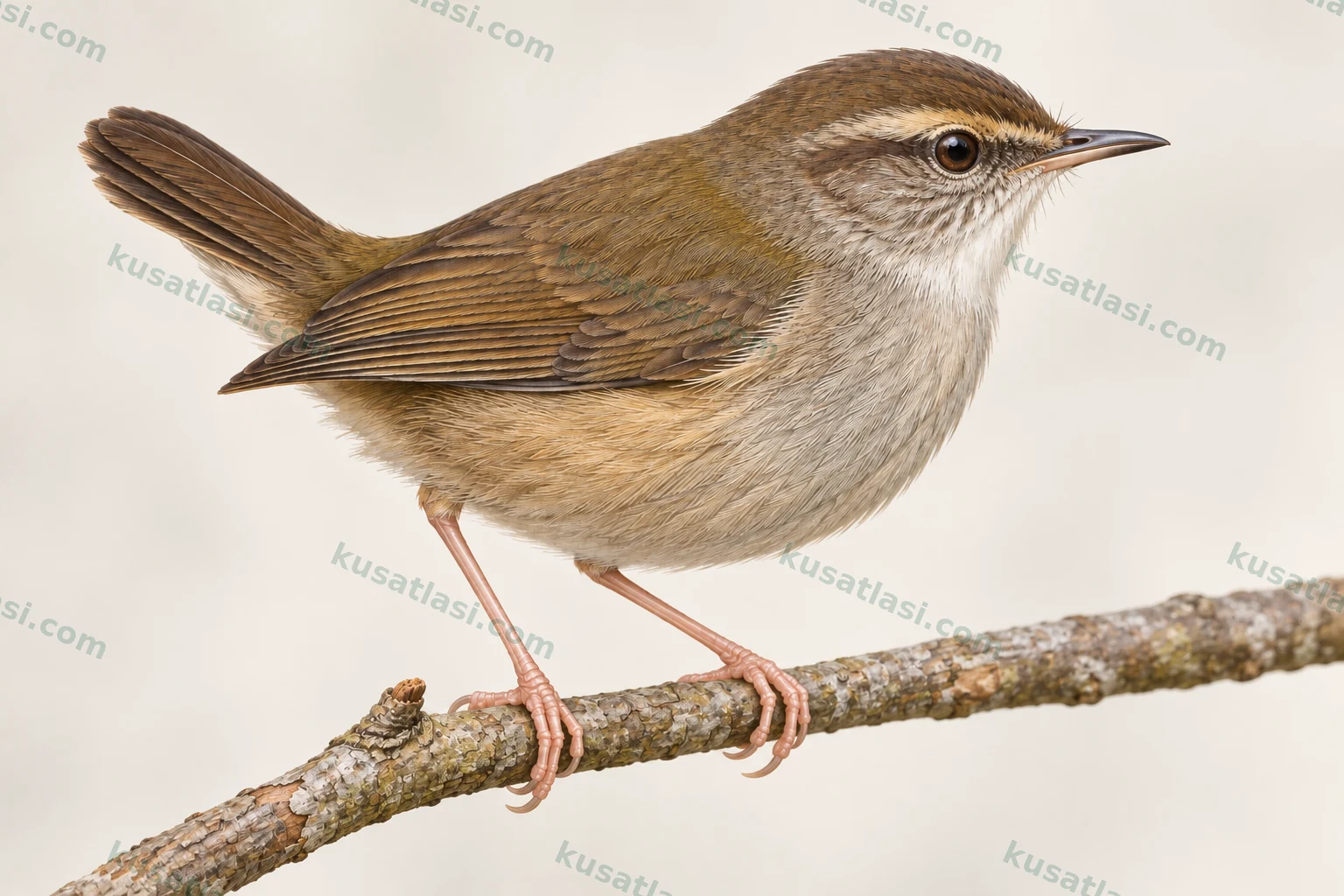
Swipe left or right between the two adult plates.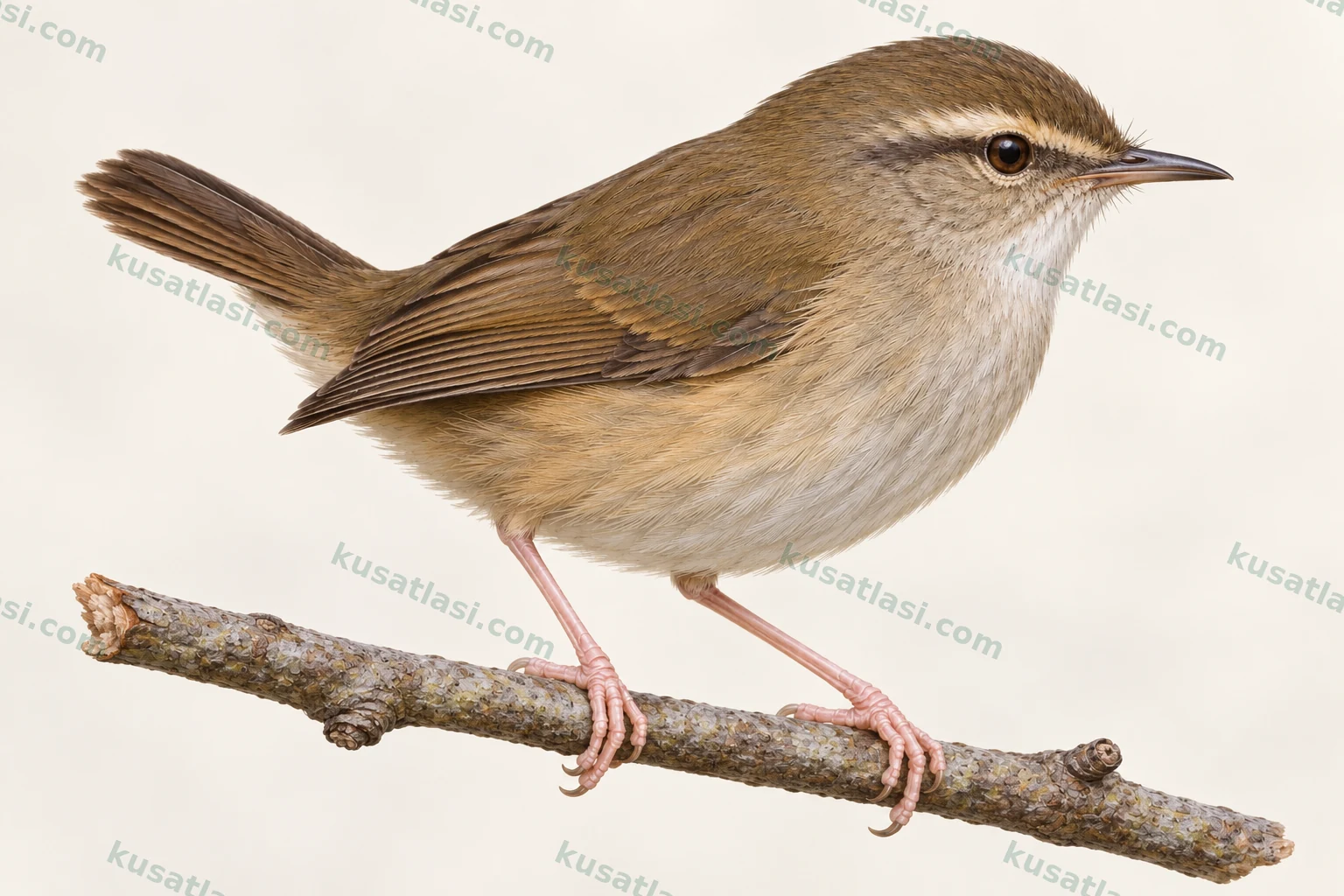
Scotocercidae
Pale-footed Bush Warbler
Hemitesia pallidipes
Examine the facial pattern together with the pale eyebrow.
- Order
- Passeriformes
- IUCN status
- LC · Least ConcernGlobal IUCN. BirdLife v10 (2025); taxon matching: AviList 2026 / IOC 15.2; checked 29 October 2026. Checklist year is not the species assessment date. Source and method · BirdLife
At a glance
- White throat and dark eye-stripe
Examine the facial pattern together with the pale eyebrow.
- Short but discernible tail
Do not mistake a tail hidden by plants for an extremely short one.
- Dense undergrowth
Watch low grasses and shrubs at forest edges from a distance.
Biometrics
Length
- Male
- 11–13 cm
- Female
- 11–13 cm
Wing length
- Male
- 4.91 cm
- Female
- 4.91 cm
Weight
- Male
- 7.9–10.8 g
- Female
- 7.9–10.8 g
Length: Shared species value Wing length: Shared species value Weight: Shared species value
World distribution
Pale-footed Bush Warbler
Customise map layers
Observation points
Preparing globe…
Monthly record count
Bars show record counts in this sample, not bird abundance or a breeding calendar. They are affected by recording and observation effort.
Rotate the globe and compare layers. Coloured areas are not exact observation or nest locations.
The source does not provide verified monthly range boundaries. All areas are shown; the month slider and monthly playback are therefore disabled.
- Jan
- Apr
- Jul
- Oct
- Dec
Generalised data and method
Base map: Natural Earth · Public domain
Open central bibliography ↗Calendar
Behaviour varies regionally: some populations are resident, others move south in winter. Hong Kong winter records are not the breeding or migration calendar of the entire species.
All months: Monthly data unverified.
January
February
March
April
May
June
July
August
September
October
November
December
Habitat
Himalayan foothills, southern China and Southeast Asia; Andaman subspecies
Watch dense grass and low scrub from a distance. Assess the white throat, dark eye-stripe and short tail together.
Sound
Strong rolling “trrk” and shorter “chek” calls; a sharp beginning followed by rapid chattering song. Song of Hong Kong wintering birds is not always fully developed.
Do not play recordings to attract birds; observe quietly, especially near nests.
Breeding
Two nests of the Andaman subspecies recorded in 1907 each contained four eggs; this is not generalised to the entire species. Nest architecture, incubation and young-development periods could not be verified.
Compare
Compare male and female
Do not mistake a tail hidden by plants for an extremely short one.
Species information
Quick identification
The Pale-footed Bush Warbler is a small brown passerine living in dense grass and scrub in Asia. Its white throat, pale eyebrow extending backwards above the eye, and dark eye-stripe below the eyebrow are conspicuous head features. The legs look pale grey-pink. This pale colour does not provide certain identification alone; assess the short rounded wing, discernible but quite short tail, white throat and brownish flanks together. When the bird appears briefly through scrub, noting the head pattern and tail proportions is more useful than trying only to catch its leg colour.
General appearance and posture
The upperparts are plain brown; some birds show a warmer, reddish tone. Comparison of Hong Kong’s first records with museum specimens showed that this rufous-brown appearance agreed with the subspecies laurentei. Looking for an olive tinge on the back is therefore not an essential identification requirement. Crown, back and tail form broadly similar brown areas; the arrangement of pale and dark facial lines attracts attention rather than strong colour blocks.
A dark stripe passes in front of and behind the eye beneath the eyebrow. The narrow white marking around the lower half of the eye should not be described as a complete broad eye-ring. The white throat contrasts with grey-brown or buff-brown flanks. The belly is pale, distinctly white in some birds; the undertail coverts may look warmer buff or pale brown. The upper bill and tip of the lower mandible are dark; the base of the lower mandible may be paler and pinkish. Assess these details in good light and from a suitable angle.
The short wings lie close to the body. The flight feathers projecting behind the folded wing do not form a very long extension. The tail is not reduced to the barely visible state seen in the Asian Stubtail; its rather square-looking tip and discernible projection behind the body are useful in comparison. The whole bird may not be visible in dense vegetation. A tail concealed by a leaf should not be mistaken for a truly very short tail; combine several different glimpses where possible.
Males, females and young birds
The sources checked do not provide a reliable male–female colour key usable at a distance for this species. A brighter eyebrow, whiter belly or warmer back does not establish sex. Shared body-length ranges and wing means on the cards do not mean that every individual of both sexes is the same size either. The wing mean comes from only five birds; unpublished male and female means have not been calculated here.
Nor was a sequence of plumage and eye colours verified that would distinguish young birds in every case. Although an old capture report described the inside of one bird’s mouth in detail, that record alone is not an ageing key for field use. Head pattern, tail and wing structure are primarily used for species identification. Where evidence for sex and age is insufficient, those fields can be left blank in the observation; an uncertainty-concealing label is unnecessary.
Appearance in flight
This bird is mostly identified in dense undergrowth, when perched or briefly exposed. Rounded wings and a short tail are structural clues that may be caught in flight. The sources checked do not establish an underwing or upperwing pattern seen only in flight that is diagnostic on its own. A sudden brown movement is therefore not assigned conclusively to the species without enough facial and structural detail.
When assessing a flight photograph, consider the bird’s turn, how far its wing is spread and feathers concealed behind plants. A good perched view supporting identification can complement an incomplete flight frame.
Voice and behaviour
This secretive species is sometimes noticed by its strong voice before it is seen. The Hong Kong specialist account describes a harsh, rolling “trrk” call; in an agitated bird it may become a louder, faster rolling series. Shorter, solid “chek”-like calls have also been recorded. Song may begin with a sharp note followed by rapid chattering or squeaky sounds. These written examples approximate the sound; accent, distance and recording conditions change the impression heard.
Song in Hong Kong’s wintering birds is not always fully developed. This does not justify concluding that they never sing in winter. Equally, hearing a bird does not show that it nests there. Observe its position among grasses and low shrubs from a distance, listen to spontaneous calls and wait patiently for head and tail details. There is no need to open the cover or lure a bird out with sound near its nest.
Similar species
1. Urosphena squameiceps differs in its much shorter-looking tail. Both birds can show brown upperparts and a pale eyebrow, so compare tails on a fully visible bird. Look for Hemitesia pallidipes’s discernible tail, white throat and complete facial pattern together.
2. Horornis fortipes generally looks less contrasting. The Pale-footed Bush Warbler’s white throat and dark eye-stripe give stronger facial and underpart contrast. Shade may reduce this difference, however; the brightness of white in one photograph is insufficient alone.
3. Horornis canturians and Horornis diphone are larger and longer-looking bush warblers. As the impression of size changes with viewing distance, check the eyebrow, throat and tail alongside the short, more compact body. Similar calls require voice to be supported by structural observation.
4. The Pale-legged Leaf Warbler, Phylloscopus tenellipes, is a separate species with a similar Turkish name. Pale legs and an eyebrow do not make the two names interchangeable. The first Hong Kong bird was initially thought to be a leaf warbler, illustrating why wing and tail structure require careful examination.
Global range
The Pale-footed Bush Warbler ranges from the Himalayan foothills to southern China, Myanmar and parts of Southeast Asia; a separate subspecies also occurs in the Andaman Islands. The three accepted subspecies do not overlap completely geographically. pallidipes is considered in the Himalayan belt, northern Myanmar and western Yunnan; laurentei in the relevant parts of southern China and northern Indochina. The island subspecies osmastoni does not mean that the entire species is restricted to islands. Its dependence on dense cover can make records within the range look patchy; a gap between records does not directly establish absence.
Status within its natural range
Resident populations in southern China and Hong Kong’s rare winter visitors do not share the same local status. Autumn and winter records in dense cover in Hong Kong do not show that the species breeds there. Assess the region, season and scientific identity of records together.
Migration
One migration behaviour cannot be assigned to every population. Some parts of southern China have resident birds, while certain populations occur farther south in winter. In Hong Kong the species is regarded as a rare winter visitor. Autumn and winter records there do not allow the same calendar to be applied to Himalayan or Andaman birds. These sources do not provide a flight route or journey distance verified by tracking data for the whole species, so no definite route is added to the map.
Breeding habitat
Its main habitat is forest undergrowth, forest edges and openings on wooded slopes covered in dense grasses and low shrubs. A scientific institutional assessment concerning the Himalayan region stresses the importance of mixed grass and shrub undergrowth for nesting. Dense understorey in primary and secondary forests is discussed for osmastoni in the Andamans. These regional descriptions are not presented as requiring one elevation or plant species throughout the range.
Nest site
SACON’s assessment of historical records reports that each of two nests found at Mount Harriet in 1907 contained four eggs. This is a limited record of the Andaman subspecies; it does not show that every nest of the species has four eggs. Detailed nest structure, incubation period and fledging period could not be verified in the texts checked. When a bird is seen in dense cover, avoid parting plants to search for a nest and keep away from a possible nesting area.
Daily habitat use
Hong Kong winter records include varied settings such as reedbeds, scrubby slopes, streamside vegetation and small landscaped areas. Their shared feature is dense low cover in which the bird can hide. These records demonstrate winter use; they do not prove that each site is breeding habitat.
What does it eat?
The specialist species compilation classifies the Pale-footed Bush Warbler among invertebrate-feeding birds. This describes the principal food group, not percentages of particular insects, spiders or larvae. As the sources checked provide no detailed dietary analysis by season and subspecies, no long prey list or separate chick menu is constructed. The stomach contents of a related bird cannot replace direct feeding evidence for this species.
How does it obtain food?
Habitat descriptions indicate that the bird should be sought in dense ground cover and low vegetation. Appearing briefly in a forest-edge opening does not make it a species that continuously catches flying insects in open air. It is useful to record movements within vegetation and food actually taken in the bill; reaching towards a leaf alone does not identify prey. A feeding point is not the same as a nest site either. This account is limited to cover use and the specialist classification of invertebrate food; no unverified figures are added for capture rate, daily food intake or dependence on particular plants.
Old names, the same bird
Hemitesia pallidipes appears in older publications as Cettia pallidipes and Urosphena pallidipes. Its original scientific name was Phylloscopus pallidipes. A change of genus alone does not mean a new species was discovered or its geography changed. The multigene study of 2011 showed that the traditional Cettia group did not form a single natural lineage. Its main proposal was a broader Urosphena; retaining Hemitesia was one alternative discussed. The current name and an older study’s proposal are therefore not described as the same thing.
A long gap between island records
The Andaman subspecies osmastoni is poorly documented. Older research proposals stressed the very long gap between historical records and new documentation. G. Shakti Vel’s first-hand field account reports observations beginning in late 2020 and continuing with new photographs in 2023. These observations update the older statement that the bird had long gone undocumented; seeing a few birds does not mean that the population across all the islands has been measured.
Pale legs are not always the same shade
The legs of one Hong Kong bird looked darker pink during examination in the hand, then became paler again. The report records this change without giving a colour rule for all individuals or a definite physiological explanation. Light, imaging conditions and other structural features must be considered. Birds need not be captured for identification; face, throat and tail can be examined together from a distance.