
World Birds
Field identification plates
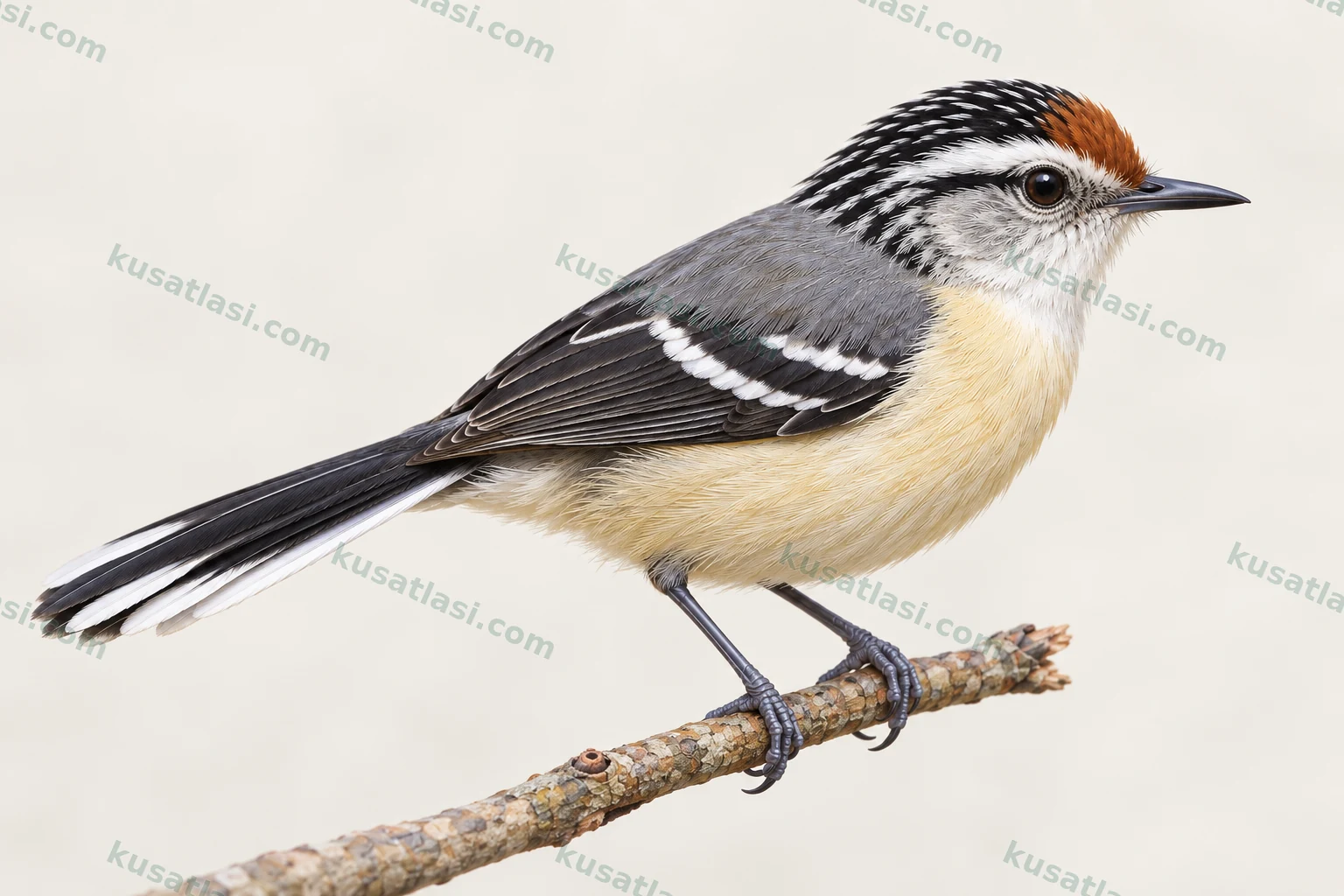
Swipe left or right between the two adult plates.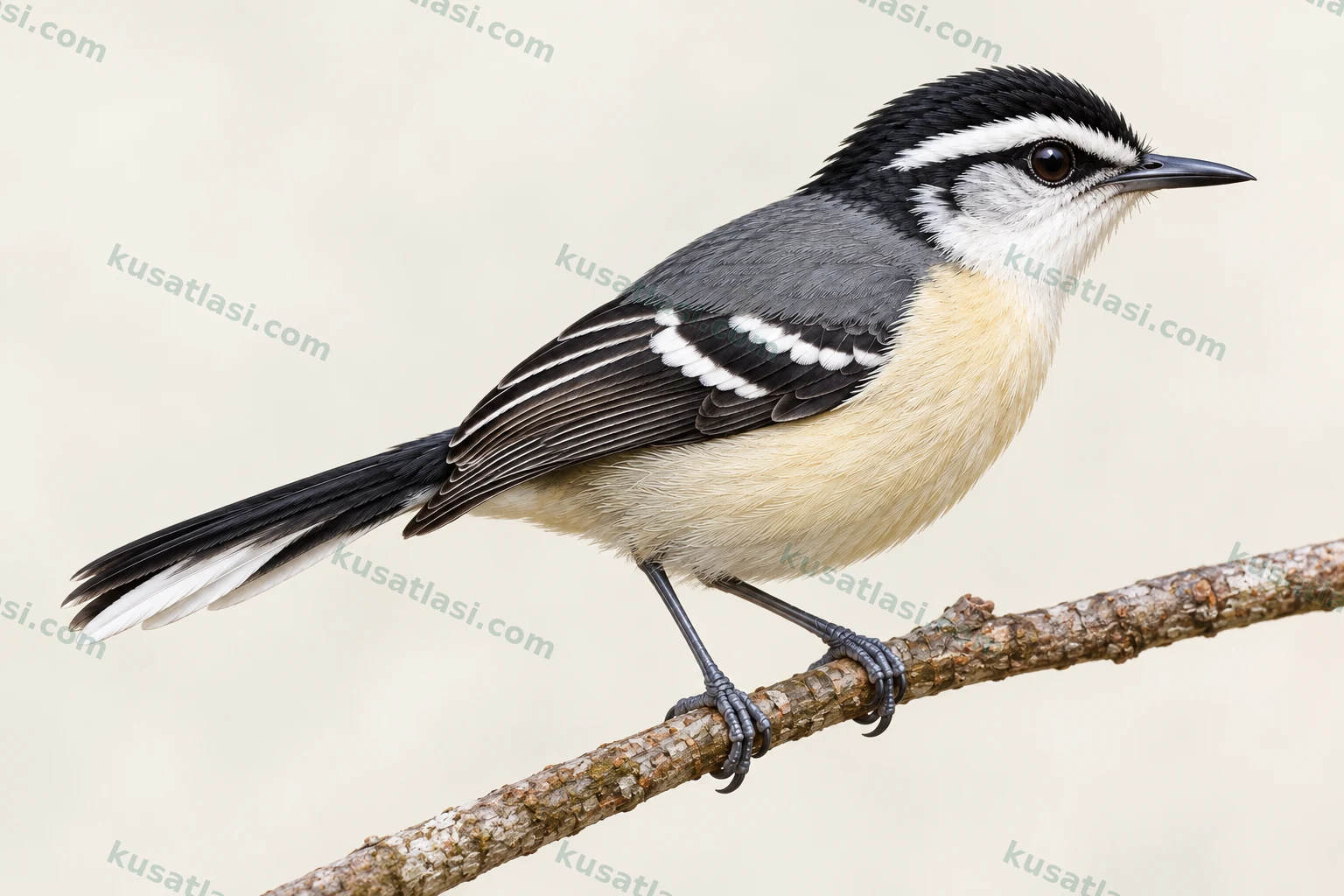
Thamnophilidae
Creamy-bellied Antwren
Herpsilochmus motacilloides
Assess pale eyebrow and dark crown together; check the female’s warm forehead tone.
- Order
- Passeriformes
- IUCN status
- LC · Least ConcernGlobal IUCN. BirdLife v10 (2025); taxon matching: AviList 2026 / IOC 15.2; checked 29 October 2026. Checklist year is not the species assessment date. Source and method · BirdLife
At a glance
- Look at the head pattern
Assess pale eyebrow and dark crown together; check the female’s warm forehead tone.
- Look for two wing bars
See both white bars on the dark wing together with white tail tips.
- Compare the underparts
Do not confuse yellowish-cream underparts with a bright yellow belly.
Biometrics
Length
- Male
- 11–12 cm
- Female
- 11–12 cm
Wing length
- Male
- 5.29 cm
- Female
- 5.29 cm
Weight
- Male
- 10.5–13 g
- Female
- 11 g
Length: Shared species value Wing length: Shared species value
World distribution
Creamy-bellied Antwren
Customise map layers
Observation points
Preparing globe…
Monthly record count
Bars show record counts in this sample, not bird abundance or a breeding calendar. They are affected by recording and observation effort.
Rotate the globe and compare layers. Coloured areas are not exact observation or nest locations.
The source does not provide verified monthly range boundaries. All areas are shown; the month slider and monthly playback are therefore disabled.
- Jan
- Apr
- Jul
- Oct
- Dec
Generalised data and method
Base map: Natural Earth · Public domain
Open central bibliography ↗Calendar
April–May field dates at Megantoni and July–August dates at Sira do not form a breeding or migration calendar.
All months: Monthly data unverified.
January
February
March
April
May
June
July
August
September
October
November
December
Habitat
Peru: eastern Andean slopes and Cerros del Sira
In tall tree crowns, look for pale eyebrow, two white wing bars, cream underparts and white tail tips together.
Sound
The original study reports vocal differences between close relatives, noting limited recording coverage. Identify a bird heard in the canopy with support from head, wing and tail patterns.
Do not play recordings to attract birds; observe quietly, especially near nests.
Breeding
Species-specific nest structure and location, typical clutch size, incubation and chick development periods were not verified from reliable original records for this work. They were not transferred from other Herpsilochmus species.
Compare
Compare male and female
See both white bars on the dark wing together with white tail tips.
Species information
Quick identification
The Creamy-bellied Antwren is a small forest bird of Peru's eastern Andean slopes. Look for pale eyebrow, dark crown, two white wing bars and yellowish-cream underparts together. Conspicuous white tail tips also help. It is usually seen in tree crowns and leafy branches just below, so searching for small antbirds on the ground may not find it. Belly colour alone is insufficient; assess head, wing and tail pattern on the same individual.
General appearance and posture
The male's forehead and crown are black, the back generally grey; the front of the back can include mixed black and white areas. A pale eyebrow contrasts with the dark crown. The fine dark mark at eye level is not a broad black mask covering the entire cheek. Watching several head positions makes eyebrow width and the dark eye line easier to assess.
White bars stand out on the dark wing feathers. A folded wing partly concealed by leaves or a trunk may show only one bar. Do not change the bar count from one incomplete view. Distinguish pale tail tips from the pale inner edges of central feathers. The original comparative study describes a continuous pale inner edge on the central tail feathers, unlike the rows of white spots in some relatives.
The throat is whitish; the white ground of breast and belly carries a yellowish wash. This is not the same as bright yellow underparts. The original paper noted one Vilcabamba specimen as less yellowish than the others, without considering it a separate species or subspecies. Cream can look paler in shade. Identify from the whole plumage arrangement and location rather than overstating one small colour difference.
Males, females and young birds
The female's forehead is warm yellowish brown. Her black crown has elongated white markings; pale olive and warm tones may mix into the grey back. Breast and belly also have a yellowish wash. The original study describes a white throat and yellow-washed breast. Do not describe the female as having exactly the male's head and back colours. A cream belly alone does not establish sex without seeing forehead and crown markings.
No verified field key separating young from adults in every situation was obtained. A pale photograph or barely visible head markings do not justify definite ageing; leave age or sex open if it cannot be reliably determined.
Appearance in flight
A bird moving between branches may appear only briefly. Pale underparts, dark wings and white tail tips may stand out while the detailed head pattern disappears. Once it settles, check eyebrow, crown and both wing bars. A spread tail may separate the white markings more clearly; do not draw every white area as one broad tail band.
Without a detailed verified upperwing–underwing identification key, no conclusive identification from a single flight patch is advised. Canopy occurrence is not evidence of long-distance seasonal migration either.
Voice and behaviour
Peruvian field observations show that its canopy voice can reveal it. The Megantoni survey heard it in Katarompanaki's taller forest; the specialist account also reports association with mixed bird flocks. Not every sound in such a group belongs to this species. Match the calling bird's location to head and wing features; do not add neighbouring birds' calls to its song.
The 1986 comparative study discusses vocal differences from close relatives, explicitly noting limited recording coverage. That old comparison is not used as a current definitive key covering every call. Recording natural sound time and the bird's branch layer is useful. Seeing a pair does not establish breeding then without a nest, eggs or young.
Similar species
1. Herpsilochmus parkeri is closely related but has a known range in a separate region farther north in Peru. The original study describes its male as greyer on throat and breast, lacking this species' yellowish underpart wash. Do not exaggerate the difference from a pale photograph alone; combine head, back, underparts and locality. Similarity does not make the two the same taxon.
2. Herpsilochmus axillaris has more distinctly yellow underparts. Both were recorded near the same elevation at Megantoni: researchers found the Creamy-bellied Antwren in taller forest and the other on slopes with shorter trees. This local observation is not an immutable habitat boundary across Peru. Tree height supports identification; it does not replace plumage pattern.
Global distribution
This species is endemic to Peru. It is known in humid forests on the eastern Andean slopes from Huánuco to Cusco and the Urubamba area, and in Cerros del Sira, separated from the main Andean chain by lowlands. Continuous occupancy of all areas between these mountain populations is not assumed. Specialist regional accounts give approximately 900–2,100 m. Records at 1,310–1,350 m in the 2010 Sira survey do not restrict its entire range to that narrow band.
Status within its natural range
The 2023 global assessment places it in Least Concern. A possible decline linked to forest loss is nevertheless considered; no monitoring result counting the whole world population is provided. Few records came from Megantoni's two camps, and the methods state that no quantitative population census was made. Those few local records are not used to calculate Peru-wide numbers or an annual decline rate.
Migration
It is considered resident, with no verified long-distance migration route. Movement between branches and canopy layers does not turn records at different elevations into a seasonal route. Megantoni's April–May sampling and Sira's July–August survey were at different sites and in different years. They should not be joined as successive journey stops of one bird or definite breeding months.
Breeding habitat
Its natural habitat is tall evergreen forest on humid Andean slopes. The original comparative study describes forests rich in mosses and other plants growing on trees. A forest record does not make every observation point a nest site. Territory use was observed in canopy around 30 m high at Megantoni; this is not a required tree height for the entire species.
Nest site
For this work, species-specific nest structure, precise nest height, typical clutch size, incubation and nestling periods were not verified from reliable original records. Other antbirds' nest shapes or two-egg clutches are not transferred. A canopy pair's nest is not automatically assigned to the same branch layer. If an active nest is seen, record identity, date and behaviour separately without approaching and displacing birds.
Daily space use
Look in crowns and leafy branches immediately below; when following mixed bird groups, note bird height and trees crossed. Megantoni observations associated with different tree heights near the same elevation show that simply calling a forest humid is insufficient. Home-range size or daily distance cannot be inferred from this brief survey.
What does it eat?
Megantoni's original bird survey describes this species as a canopy insectivore. A species-specific food sample showing insect groups and proportions was not obtained, however. Insects and spiders listed in another member of the genus' stomach are not added as confirmed prey here. Having “ant” in its name does not mean eating only ants or obligatorily following ant swarms on the ground.
How does it hunt?
It forages in leafy crowns and branches just below. Association with mixed bird groups in the specialist account shows that it can use the same trees at the same time as other forest birds, not that all flock members eat identical prey. In a feeding record, note separately whether the prey was actually seen, branch height and any capture movement. No verified prey percentages, daily intake or special prey choice are available for numerical claims.
From similar appearance to genetic comparison
This species was formerly considered with the group around Herpsilochmus pileatus. The 1986 study advocated separate species status through comparisons of plumage, measurements, habitat and voice. A 2021 genetic study also evaluates it within the relevant related group in Herpsilochmus. Proposing a new genus for another species in that study does not mean the Creamy-bellied Antwren's scientific name also changed.
Forest height as a research clue
A territory was recorded in forest with roughly 30 m canopy at Megantoni, while Herpsilochmus axillaris near the same elevation was associated with shorter-tree slopes. The proposed local habitat separation is interesting, but one rapid inventory is not an experiment testing the cause of competition or fixed preferences throughout the range. The difference is a question to record carefully in new fieldwork.
A mountain record is not an ocean-island record
Cerros del Sira is a mountain massif separated from the main Andean chain by lowlands. Presence there shows the species does not inhabit only continuous slopes of the main chain. The 2010 survey's record elevations depend on place and sampling time; they cannot establish a seasonal migration route. Comparing old and new records under the same taxon name helps understand this small forest bird's true distribution.