
World Birds
Field identification plates
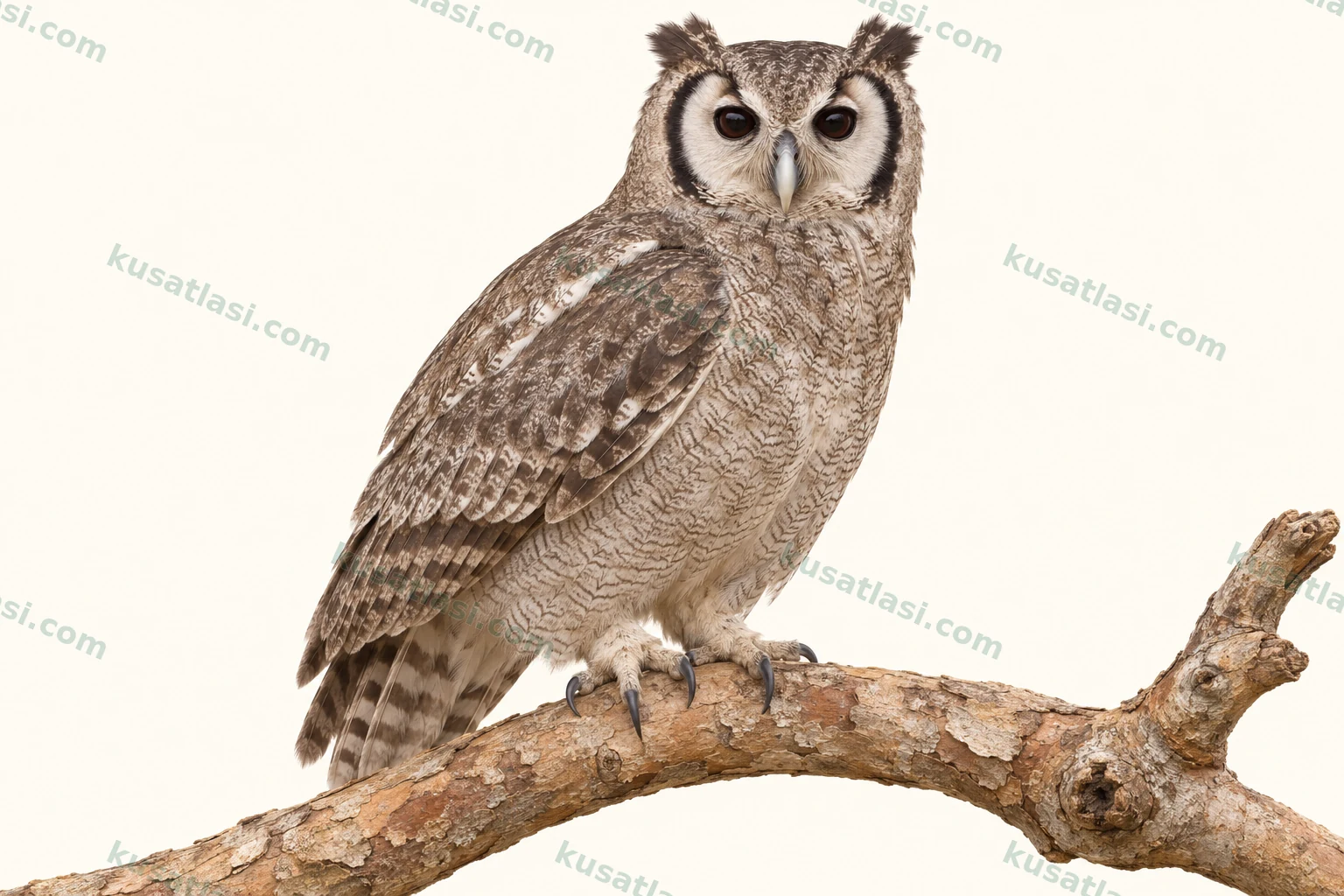
Swipe left or right between the two adult plates.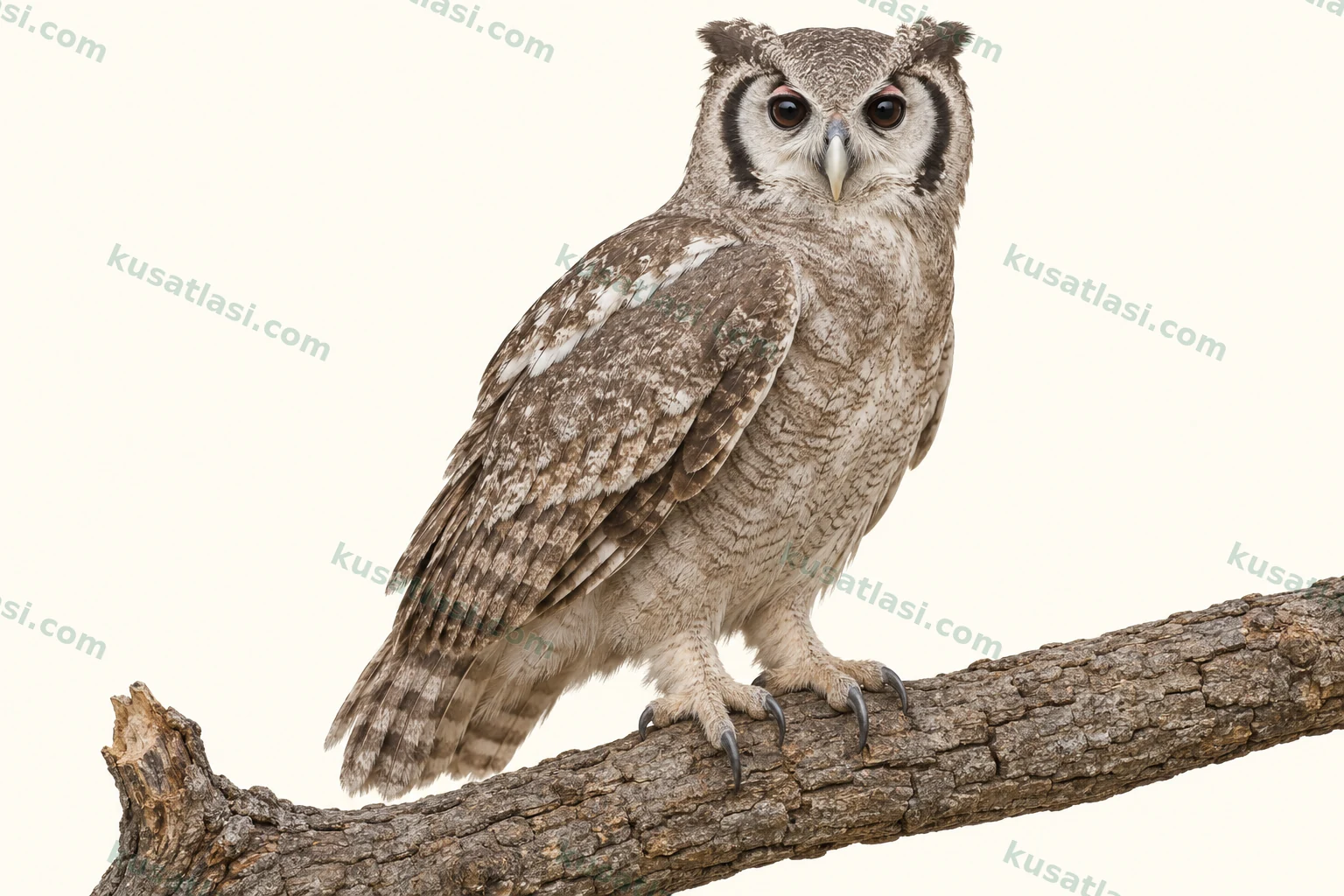
Strigidae
Verreaux's Eagle-Owl
Ketupa lactea
Look at the dark eyes, pale face with a dark border and short ear tufts together.
- Order
- Strigiformes
- IUCN status
- LC · Least ConcernGlobal IUCN. BirdLife v10 (2025); taxon matching: AviList 2026 / IOC 15.2; checked 29 October 2026. Checklist year is not the species assessment date. Source and method · BirdLife
At a glance
- Pink eyelids
Look at the dark eyes, pale face with a dark border and short ear tufts together.
- Large pale grey owl
- Old scientific name
Bubo lacteus is the former combination for this species, not Verreaux’s Eagle.
Biometrics
Length
- Male
- 60–65 cm
- Female
- 60–65 cm
Wingspan
- Male
- 143 cm
- Female
- 143 cm
Weight
- Male
- 1.615–1.96 kg
- Female
- 2.475–3.115 kg
Length: Shared species value Wingspan: Shared species value
World distribution
Verreaux's Eagle-Owl
Customise map layers
Observation points
Preparing globe…
Monthly record count
Bars show record counts in this sample, not bird abundance or a breeding calendar. They are affected by recording and observation effort.
Rotate the globe and compare layers. Coloured areas are not exact observation or nest locations.
The source does not provide verified monthly range boundaries. All areas are shown; the month slider and monthly playback are therefore disabled.
- Jan
- Apr
- Jul
- Oct
- Dec
Generalised data and method
Base map: Natural Earth · Public domain
Open central bibliography ↗Calendar
Breeding months vary between African regions; no single calendar for the whole continent has been established.
All months: Monthly data unverified.
January
February
March
April
May
June
July
August
September
October
November
December
Habitat
Sub-Saharan Africa
Look in patchy savanna and woodland in central, eastern and southern Africa; the map geometry will be examined separately.
Sound
Deep hoots.
Do not play recordings to attract birds; observe quietly, especially near nests.
Breeding
The expert source reports mostly two eggs and an incubation period of 32–39 days; the local timing and sample context are retained.
Compare
Compare male and female
Species information
Quick Identification
Verreaux's Eagle-Owl Ketupa lactea is a large, pale grey African owl. Its conspicuous pink eyelids, pale face with a dark border, almost black-looking eyes and short ear tufts together form a strong set of identification features. Pink eyelids do not mean that the eye itself is orange. The specialist accounts from Oiseaux.net and Oiseaux-Birds describe dark eyes and pinkish lids. The breast and underparts have fine pale and dark rippling, while the flight feathers and tail bear broader bars. The white throat may become especially visible when the bird calls. A large owl silhouette alone is not enough to confirm the species.
The current scientific name is Ketupa lactea. Brown's Kenyan study and Avery's South African study were published under the older combination Bubo lacteus and concern the same bird. These are not two species: the new genus also brought a change in the adjective's ending. The current ITIS record, based on the IOC list, links the English name Verreaux's Eagle-Owl to the same taxon. Before using data from older research, the synonym must be checked to ensure that it really refers to this species. A large eagle also bears Verreaux's name; its prey, dimensions and breeding figures must not be assigned to this owl. Taxon, locality and visible features should be recorded together rather than relying on a brief photograph caption.
Overall Appearance and Posture
The head is large, and its short, tuft-like ear feathers can be held upright or flattened according to posture. The face is pale grey with a dark border. The upperparts can appear ash-grey to pale brown; their dense, fine pattern makes the bird difficult to pick out among bark and shaded branches by day. Thick, powerful feet and talons are suited to grasping large prey. When resting on a shaded branch, it may fluff its body feathers and look rounder, whereas its posture becomes more extended during night hunting. Pink lids are striking at close range, but failure to see their colour in a dark, distant photograph does not make the bird another species. Facial-disc shape and the colour of the whole body are considered together.
Males, Females and Young Birds
The pale grey pattern and pink eyelids of adults are similar in both sexes. Females are generally heavier; the male and female mass ranges supplied by Oiseaux-Birds have been kept separate. Nevertheless, sexing a bird from a photograph is unreliable: feeding condition, fluffed feathers, viewing angle and distance alter apparent size. Identical eyelid colour does not eliminate differences between the sexes. Early chicks have whitish, soft down that later becomes greyer; the adult facial border, fine pale-and-dark pattern and ability to fly develop over time. A pale young bird may not yet show features resembling those of an adult of this species.
Other tufted owls occur in many African regions. Judging age solely from how far the pink eyelids have become visible can mislead, because light, closed lids and image quality may conceal the colour. A young bird near a nest can help suggest its identity, but does not prove that a nearby large bird is automatically its parent. Sex-specific mass ranges do not encompass every possible individual weight; in particular, seasonal, age-related or captive values must not be equated with those of wild adults. Nest surroundings should be observed from a distance without alarming the bird, as disturbance during breeding can pose a serious risk to eggs and chicks.
Appearance in Flight
The large, broad wings move in slow, deep beats, which the bird may intersperse with silent glides. Oiseaux-Birds describes dark flight feathers and tail with broad pale grey bands. The lower surface is not uniformly coloured: fine feather lines and bars look different according to the light. Pink eyelids are usually indistinguishable in distant views of a flying bird. A locality associated with forest edge, a watercourse or open savanna provides important context, but geography alone does not prove an owl's identity. The perched bird's face, its resting branch and its appearance in flight together support a more secure identification.
If a flight plate is used, colours shown in the upper and lower views need separate verification; conspicuous eyelids cannot be transferred to an underwing as though they were a mark there. The white throat may stand out in photographs taken in darkness, but its opening and closing movements are also related to calling. Recording the place, time and several frames of the moving bird makes comparison more rigorous.
Voice and Behaviour
It is active mainly at dusk and during the night, resting in large, shaded trees by day. Brown's observations collected in Kenya between 1947 and 1964 focus especially on a nest near Nairobi and on waterside acacias. The study describes deep hooting heard after dusk and sometimes by day, and partners perched near one another. These are behaviours observed in Kenya; the same frequency must not be assumed throughout Africa. The specialist compilation of the Raptor Taxon Advisory Group also covers hunting in open savanna, wooded watercourses and semi-arid regions. Watching from a low branch and descending onto prey, or catching an insect in the air, are behaviours that may occur under different conditions.
A written voice description does not replace a recording. Deep hooting can be confused with other calls of large owls. A reliable recording should have a place, date, image and natural context, and its licence must be checked separately. Partners' roles around the nest also change with the stage. The specialist source states that the female does most of the incubation while the male brings food; this does not mean that individuals at every nest can be sexed with certainty from images. Since unnecessary approach disturbs the birds, observation should be distant, brief and careful.
Confusable Species
1. Spotted Eagle-Owl Bubo africanus is smaller and has a different facial pattern. Verreaux's Eagle-Owl's pink eyelids, pale dark-bordered face and very large build are compared together; the pink may not be visible in shade at night.
2. Shelley's Eagle-Owl Ketupa shelleyi, reported as approaching Verreaux's Eagle-Owl in size, is a much darker forest bird. Possible areas of overlap are limited and uncertain; seeing a huge owl does not establish that it is this species.
3. African Wood Owl Strix woodfordii is a different, smaller owl without ear tufts. Face shape, upperpart pattern and the presence or absence of pink eyelids need to be seen together.
World Distribution
Ketupa lactea has a broad but patchy distribution in sub-Saharan Africa. The Raptor Taxon Advisory Group describes parts of central Africa and large areas of eastern and southern Africa in association with open thorn savanna, waterside woodland and semi-arid regions. Brown's Kenyan field notes are only one local part of this broad overview.
Status in Its Natural Range
The De Hoop study in South Africa likewise represents a particular dietary sample from the south of the continent. Neither these two regional studies nor isolated observations in a country list fill the gaps to create a continuous distribution belt. A breeding place, feeding area and temporary sighting should not be shown with the same map symbol. Until detailed distribution geometry has been reviewed separately, a central point provides context only.
Migration Journey
Specialist accounts generally describe the species as a resident African owl. As they grow, young may leave the vicinity of their natal nest, while adults use their area according to local feeding conditions; these are not signs of regular intercontinental migration. Nor is it correct to assume that an individual seen in Kenya or South Africa on a particular date remained there all year. A coloured observation point and a research-confirmed natural-range boundary should be kept distinct on the map.
Breeding Habitat
Places where open savanna meets woodland, large trees beside watercourses and semi-arid wooded regions are important habitats. Brown's Kenyan observations describe the species especially at forest edges adjoining open ground and in belts of acacias along watercourses. That single study is not a census of all African habitats. A broad, shaded branch for daytime concealment, an opening with nocturnal prey and a usable nest structure may occur in the same area. Conserving a large tree can matter not only for resting but sometimes for nesting opportunities too. Seeing the bird in a park does not prove that urban settlement is always a suitable breeding environment.
Nest Site
The Raptor Taxon Advisory Group states that the species can use stick nests left by other large birds, as well as tree cavities or other sheltered places. The specialist compilation describes mostly two eggs and an incubation period of 32–39 days, with the female doing most of the incubation. These are not continent-wide averages measured directly at Brown's Kenyan nest, and sample size is not specified under every heading. Eggs laid on different days may result in differences in chick size. Approach to a nest must not be forced for a photograph: disturbance may cause eggs or chicks to be abandoned. A sheltered old nest alone does not show that this owl is necessarily breeding in it.
Daily Habitat Use
The bird watches its surroundings from a safe branch by day and leaves most movements until night. Since prey may range from small mammals in open places to birds roosting at night, its feeding area cannot be reduced to one vegetation type. Brown's Kenyan notes and the De Hoop prey remains from South Africa provide different geographical and temporal windows. Percentages from one prey study do not give habitat preferences or success rates for the whole continent. The day roost, breeding nest and night hunting area should not be drawn as a single point. An observer can separately note the occupied tree, surrounding openings and proximity to water.
What Does It Eat?
It is a large predatory owl; the sources include mammals, birds, reptiles and some large invertebrates. The 1985 study by Avery, Robertson, Palmer and Prins examined prey remains from De Hoop Nature Reserve. In that sample, birds accounted for 57.8% of total prey mass and mammals for 41.4%. This is the mass composition of remains collected at De Hoop, not the daily diet of every pair throughout Africa. Brown's Kenyan notes include observations of flexibility from insects to large prey. The Raptor Taxon Advisory Group also mentions mammals, birds and sometimes insects. A list of remains does not always reveal the prey's age or whether it was caught alive.
How Does It Hunt?
It hunts mainly at dusk and at night. It may watch the surroundings from an exposed branch and move on silent wings to the ground or another branch; under suitable conditions it may also take an insect in the air. Brown's observation of a bird catching insects beside a lit area in Kenya shows that this behaviour is possible, but does not make insects the main food of every pair. Nor does the bird-dominated composition of the De Hoop remains prove that avian prey dominates in every locality. Prey varies with place, season and available opportunities. Bones and feathers found around a nest should not be assigned to species without carefully establishing their origin. The ability to grasp large prey does not mean that every sighting represents a hunting event.
A New Name Did Not Create a New Bird
The large owl called Bubo lacteus in older ornithological studies is the same taxon recorded today as Ketupa lactea. ITIS links the current name with the English name Verreaux's Eagle-Owl. Changing a genus name and the form of a Latin adjective does not create two different biometric tables. By contrast, the African eagle bearing Verreaux's name is an entirely different bird; its measurements are not assigned to this owl.
Pink Eyelids, Not Eyes
The pink region striking at close range is the eyelids. The eye itself looks dark. Reflection and flash in a night photograph can change the appearance of the true eye colour; misleading impressions such as orange eyes in older descriptions need comparison with sources. The pale dark-bordered face and short ear tufts add to the identification. A feature invisible in darkness should not be treated as absent.
Regional Prey Percentages Do Not Describe a Continent
Counts of remains and percentages by mass are also different measurements.