
World Birds
Field identification plates
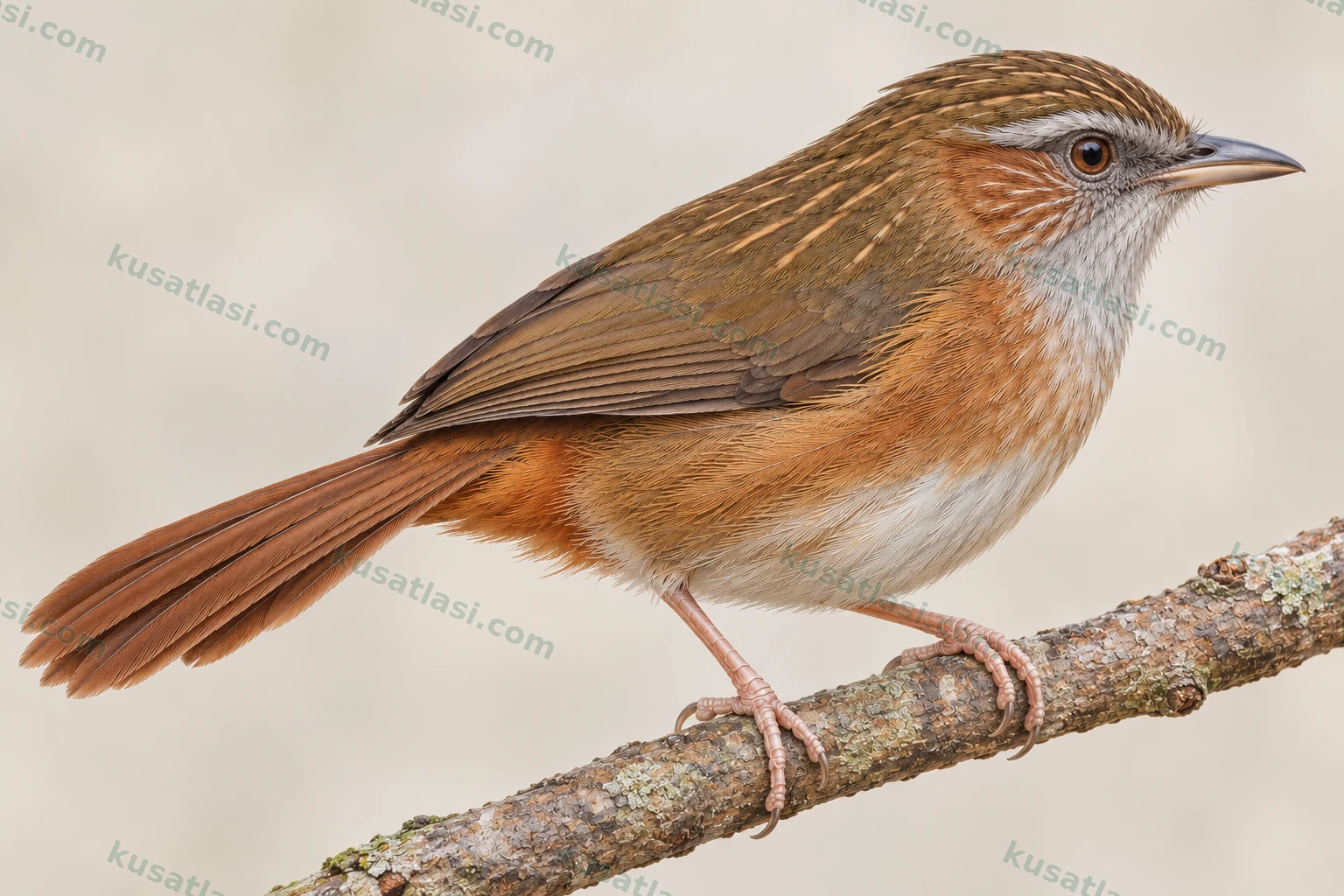
Swipe left or right between the two adult plates.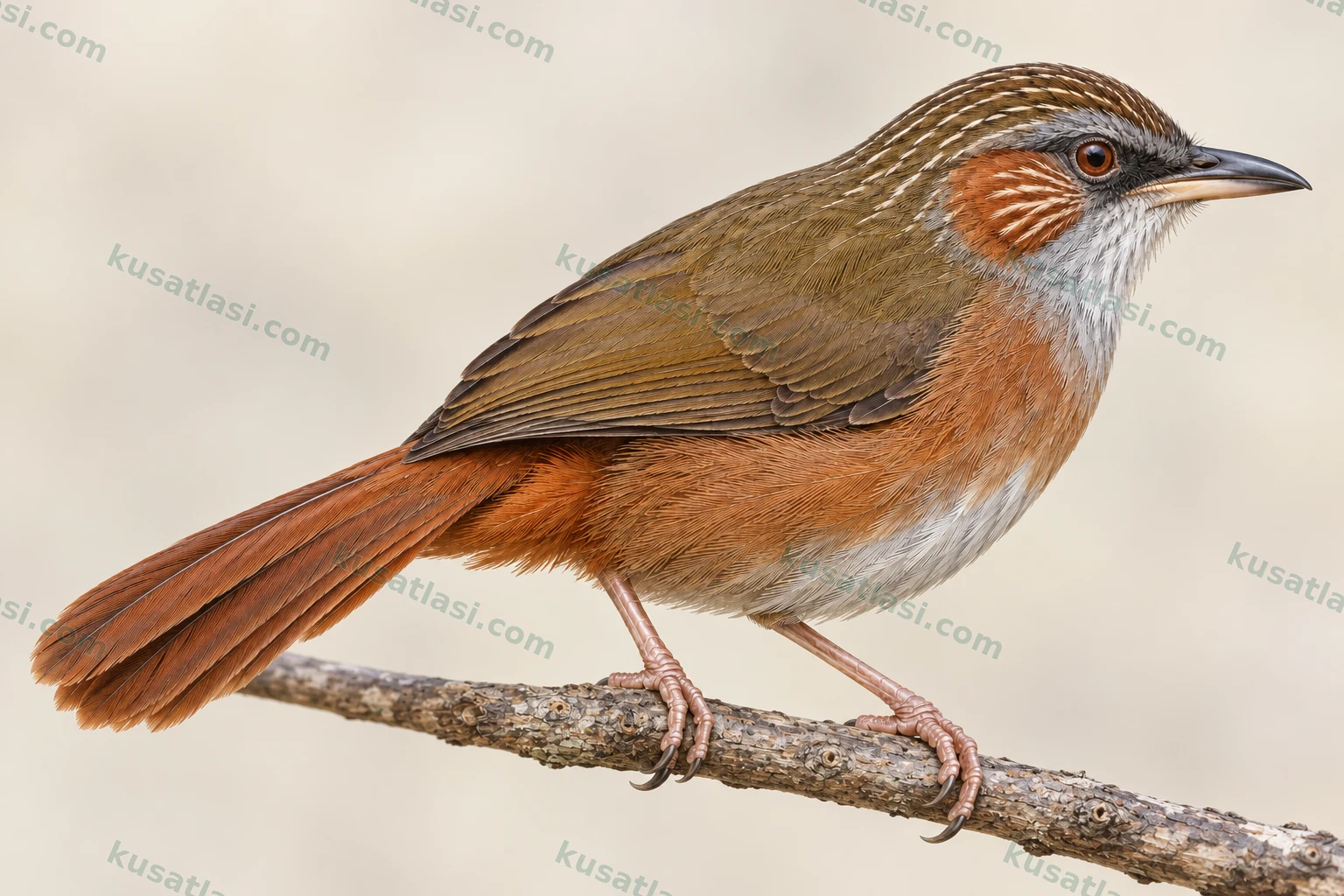
Pellorneidae
Abbott’s Babbler
Malacocincla abbotti
Examine the pale throat, rusty flanks and body proportions together.
- Order
- Passeriformes
- IUCN status
- LC · Least ConcernGlobal IUCN. BirdLife v10 (2025); taxon matching: AviList 2026 / IOC 15.2; checked 29 October 2026. Checklist year is not the species assessment date. Source and method · BirdLife
At a glance
- Short tail and thick bill
Examine the pale throat, rusty flanks and body proportions together.
- Dense forest undergrowth
Look for single birds or pairs on the ground or around low vegetation.
- A sequence of whistles
The short song, usually of three or four notes, helps locate it.
Biometrics
Length
- Male
- 15–17 cm
- Female
- 15–17 cm
Wing length
- Male
- 7.32 cm
- Female
- 7.32 cm
Weight
- Male
- 26–32.5 g
- Female
- 26.5–27 g
Length: Shared species value Wing length: Shared species value
World distribution
Abbott’s Babbler
Customise map layers
Observation points
Preparing globe…
Monthly record count
Bars show record counts in this sample, not bird abundance or a breeding calendar. They are affected by recording and observation effort.
Rotate the globe and compare layers. Coloured areas are not exact observation or nest locations.
The source does not provide verified monthly range boundaries. All areas are shown; the month slider and monthly playback are therefore disabled.
- Jan
- Apr
- Jul
- Oct
- Dec
Generalised data and method
Base map: Natural Earth · Public domain
Open central bibliography ↗Calendar
The calendar does not show a single breeding season for the entire range. The regional study at Khao Yai in 2003–2004 reports breeding from mid-January to late July; conditions in other regions are assessed separately.
All months: Monthly data unverified.
January
February
March
April
May
June
July
August
September
October
November
December
Habitat
Forests of South and Southeast Asia
Watch dense undergrowth in humid forests and secondary woodland. Look for single birds and pairs feeding slowly on or just above the ground.
Sound
The song usually consists of three or four melodious whistled notes; rougher calls are also heard. The voice aids identification, but its origin from the same bird is checked visually if possible. A real bird recording with separately verified licence and species identity has not yet been linked.
Do not play recordings to attract birds; observe quietly, especially near nests.
Breeding
The nest is an open cup of dry leaves, fibres and fine roots, placed in dense low vegetation. Rattan is an important support in studies from northeastern Thailand. Three eggs are typical in the Khao Yai study; the broader researcher’s summary for 2003–2004 reports two or three, usually three. A historical India–Myanmar account mentions three to five eggs, so no single fixed number is given for every region. The female incubates; in the 2003 sample, incubation was recorded as 14–15 days (six nests) and the nestling period as 10–12 days (four nests). The later regional summary reports 11–13 days. Some pairs raised young a second time within one season; this does not show that every pair has two successful broods each year. Do not inspect nests for the sake of observation or share sensitive locations.
Compare
Compare male and female
Look for single birds or pairs on the ground or around low vegetation.
Species information
Quick identification
Abbott’s Babbler is a short-tailed, plump-bodied passerine living in dense forest undergrowth in South and Southeast Asia. Assess its brown back, pale throat and centre of the belly together with its rusty flanks. The thick bill at the front of the head helps distinguish it from small, thin-billed scrub birds. A slight downward curve at the bill tip can be seen in a good side view. When a brown bird moves slowly at the foot of bushes, alone or with a partner, look for these features together.
At first glance there is no particularly striking colour or broad wing bar. Identification rests on the relationship between the pale throat and warm-coloured flanks, the short tail and the strong bill. If only the bird’s back is visible, brown colour is insufficient. Waiting for another view of the face and underparts is more useful than trying to drive the bird out of the bushes.
General appearance and posture
The upperparts have a plain appearance varying from olive-brown to warmer brown. The tail and the area where it joins the body may look more reddish than the rest of the back. The throat is pale grey-white; the pale centre of the breast and belly is surrounded by orange-brown on the sides of the body. Fine pale feather lines on the forehead may be noticed at close range, but from a distance it does not look conspicuously streaked. Examine carefully the transition between the grey tones of the face and the brown back as well.
The legs and feet are pale, pinkish flesh-coloured. The bill may look darker above and paler below. The eye’s reddish-brown tone is easily lost in forest shade; eye colour should be used as a supporting feature only in sufficient light. The shape of the thick bill is easier to see than this small colour detail. Green light reflected by leaves can make the back look more olive than it is, so compare all colours under the same lighting conditions.
The short tail gives the bird a round, compact appearance; when leaves cover the tail tip, its proportions become even harder to assess. In a brief view, do not make a definite size estimate without seeing the whole head and tail at the same time.
Males, females and young birds
In adults, assess the brown upperparts, pale throat, warm flank colours and thick bill used for identification together. The measurement compilations examined do not give separate male and female length and weight values representing the entire range. Showing the same shared number in both boxes is not an experimental finding that there are no size differences between the sexes. One bird looking large or having more reddish flanks does not provide reliable sex identification.
No detailed field plumage key for young birds covering all subspecies was verified. It is inappropriate to assign a particular age to every adult-like bird or to call a paler individual female on colour alone. The behaviour of a chick following a parent may support a family relationship; that observation alone does not show that this plumage appearance belongs to all young birds. In age and sex records, state clearly which feature was seen.
The species is represented by several subspecies across a wide area. Do not assume that every colour tone in historical specimens from Myanmar is identical to those of birds on the Malay Peninsula or Borneo. Establish the observation locality first, then compare the bird with an identification account appropriate to the region. A more reddish tail in one region does not by itself create a new sex or age category.
Appearance in flight
This bird is usually observed on the ground or among low vegetation. Although its short tail and brown wings may be noticed in flight, a very brief crossing between bushes provides a poor view for detailed plumage identification. Identification is more secure when the pale throat and flank colours are seen again. Wings looking dark inside a forest must not be interpreted as a separate black wing bar.
Voice and behaviour
When feeding near the ground, it scans its surroundings with relatively slow, steady movements rather than darting hastily back and forth. Single birds and pairs have been reported. Dense vegetation may allow the voice to be heard while hiding the body. The song is usually a short, melodious sequence of three or four whistled notes. The call repertoire also includes rougher, muffled sounds; different sounds are not all given in the same context.
Its voice helps locate the species. However, when another brown bird is seen, do not attribute every nearby sound to it. If possible, wait until the song and bill movement can be observed in the same individual. During breeding, it is inappropriate to reveal a nest by following adults travelling to and from it, or to use playback to call a bird repeatedly closer. Waiting quietly on the path makes it easier to see natural behaviour.
Species that may be confused
Pellorneum ruficeps is another brown bird that may occur in the same forest undergrowth. Compare its rufous crown, distinct pale eyebrow and brown streaks on pale underparts with Abbott’s Babbler’s plainer underparts and thick bill. Both species feeding on the ground does not make them the same bird. The head, breast and bill must be seen on the same individual; a brief vocal similarity must not override all visible features. Compare species that can actually occur in the observation region.
World distribution
The natural range extends from some lowland and foothill forests in South Asia into Southeast Asia. The current taxonomic account reports a patchy distribution from southern Nepal, eastern and northeastern India and Myanmar eastwards to central Vietnam and southwards to the Malay Peninsula, Sumatra and Borneo. Recognised regional populations also occur on certain islands, including Belitung and Bawean. This broad description does not mean that all intervening farmland and settlements are suitable for the bird.
Status within its natural range
The various subspecies do not occupy the same areas. For example, the population in India’s Eastern Ghats and that on the Malay Peninsula are treated under different names in regional taxonomic accounts. Rather than drawing an uninterrupted band along a country’s boundary, assess undergrowth structure together with local records. Ramree Island in Myanmar is important as the specimen locality of the first scientific description; this does not show that the bird is endemic to that island alone.
A study examining observations in Singapore in 2003–2009 recorded the species in the forests of Bukit Timah, Nee Soon and Sime Road–MacRitchie. Although it reported declines and losses in some places, it is a dated regional investigation, not a census of the entire present-day Asian population. Current local abundance values cannot be produced from old records.
Movements
The species is classified as resident; the sources examined do not describe a regular intercontinental migration route for it. Residency does not mean that no individual ever moves into a neighbouring area. The space use of pairs living in the same region throughout the year and the departure of young birds are different events. Without verified seasonal boundaries or a tracked route, a map showing monthly movements between countries is not prepared.
Breeding habitat
Dense vegetation close to the ground in humid forest, shrubs and regenerated undergrowth are its principal habitats. Its ability to use secondary forest does not mean it can live in every open, unvegetated area. Records from forest, scrub and planted woodland in the Singapore investigation show that suitable cover can occur in different settings. Broadleaved forest conditions in breeding studies in Thailand must also be assessed in their regional context.
Nest site
The nest is an open cup built from dry leaves, plant fibres and fine roots. It is placed within dense low vegetation, often supported by palms or rattan. In a study of 79 nests in northeastern Thailand, 90 percent were in rattan. This proportion cannot be applied to every Abbott’s Babbler nest worldwide; it is meaningful in relation to the local vegetation. Historical observations from Myanmar also describe nests in low grasses and small palms.
Daily space use
Because feeding occurs mainly on or very close to the ground, watch leaf litter and dense cover beside authorised paths. Historical species accounts particularly emphasise damp undergrowth near streams. Do not clear this cover to see the bird. If a passage leading to a nest has been identified, move away rather than approach; disclosure of a nest site can endanger eggs or chicks.
What does it eat?
Abbott’s Babbler’s diet is mainly invertebrates. A scientific ecological compilation classifies it as a bird searching for invertebrates on the ground. This general information does not prove that a particular insect species is its main food throughout the year. The sources examined did not yield a detailed prey list or food percentages covering the whole range. Fruit or seed records for other babblers are not automatically transferred to this species.
How does it forage?
It feeds by searching slowly and steadily on the ground and around low vegetation. Besides aiding identification, the strong bill makes it easier to follow the point where prey is taken. When the bird moves behind a leaf, it may be impossible to see what it actually catches; bill movement alone does not identify the prey. If prey is visible in a clear observation, record the bird’s identity, the prey’s appearance and the surroundings separately. A single prey item carried by an adult to a chick cannot stand for the diet throughout the year. Do not turn over forest litter and disrupt its foraging area; observe natural feeding from a distance.
Short tail, strong bill
Although it is a plain brown bird, body proportions help identification. Assess the short tail and strong bill together with the pale throat and rusty flanks. When subtle colours disappear in forest shade, shape may still help; shape alone also does not provide a definite identification.
Why are breeding durations given with their context?
The 2003 study at Khao Yai reports 14–15 days for incubation and 10–12 days for the nestling period. A researcher’s summary covering 2003–2004 in the same area gives a nestling period of 11–13 days. Incubation and the nestling period are different stages; combining numbers from different samples to produce a new average conceals the observed variation. These data must be read with their locality and study period.
The importance of rattan
The great majority of the 79 nests examined in northeastern Thailand were in rattan. Denser leaf cover and more rattan at nesting sites are associated with nest-site selection. However, the same investigation could not clearly distinguish successful and unsuccessful nests by vegetation structure. A plant hiding a nest does not mean that every nest will necessarily succeed.
Being resident does not mean being safe everywhere
The dated Singapore study reports that this bird could use some degraded or small forest fragments, yet disappeared from some places. Possible competition with another bird was discussed; this explanation is not presented as an experimentally established cause. Local loss and the species’ global status must be assessed at different scales.