
World Birds
Field Guide Plates
Swipe between the two adult plates.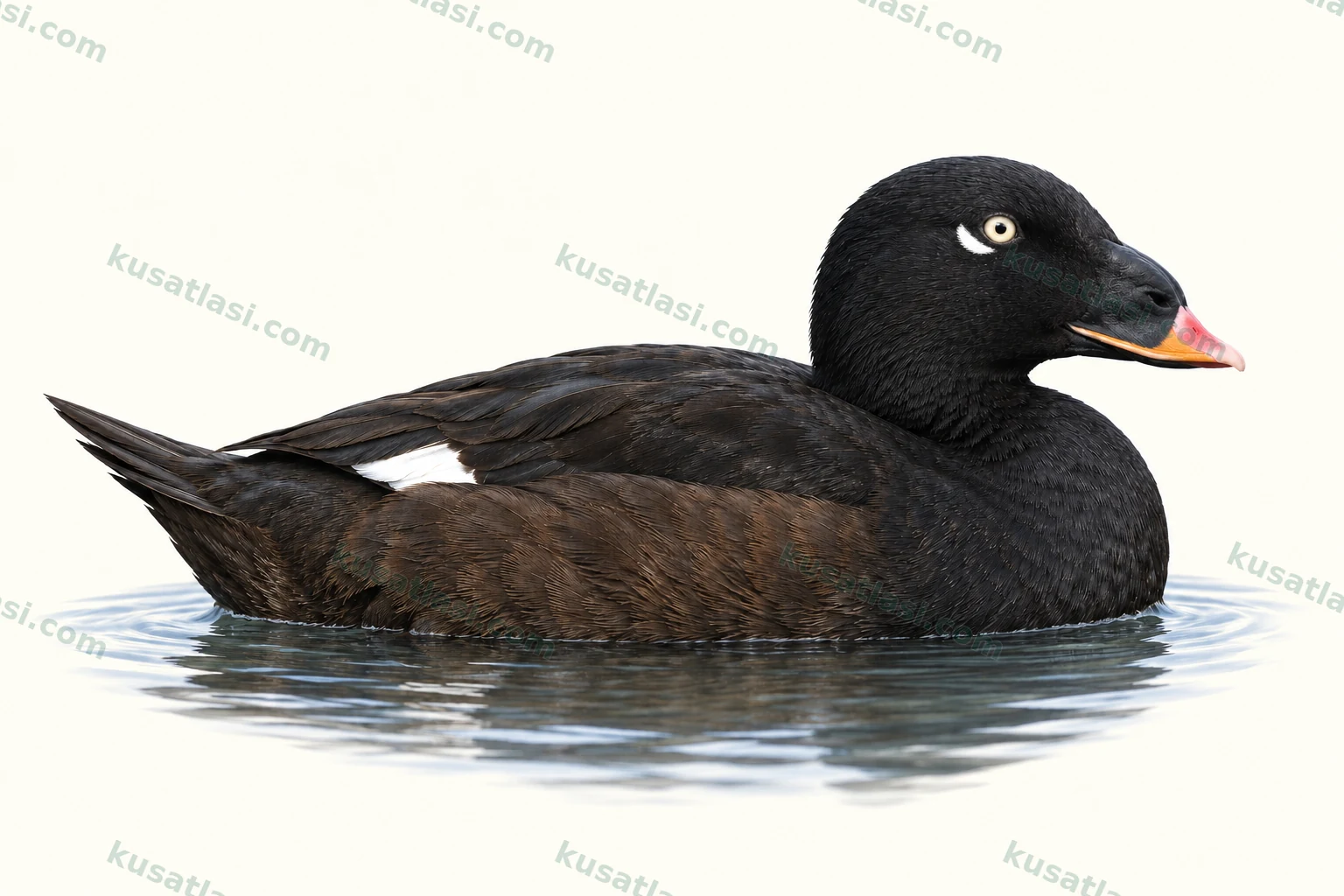
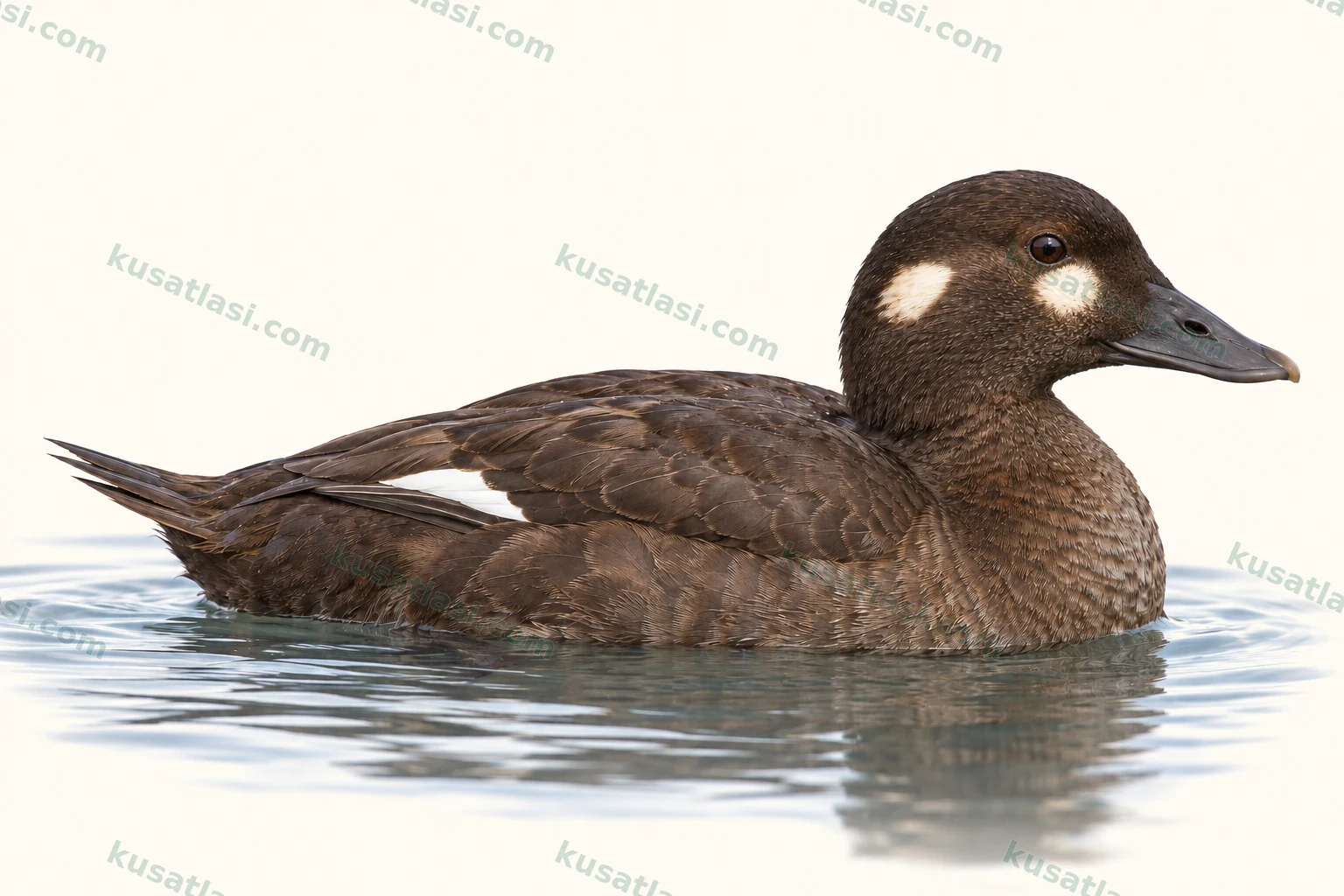
Anatidae · Anseriformes
White-winged Scoter
Melanitta deglandi
Ak Kanatlı Kadife Ördek
Check white inner flight feathers together with the head-and-bill profile.
- Order
- Anseriformes
- IUCN Status
- LCLeast Concern
Biometrics
Length
- Male
- Data unavailable
- Female
- Data unavailable
Wing length
- Male
- 27 cm
- Female
- 27 cm
Weight
- Male
- 1.36–2.128 kg
- Female
- 950–1946 g
Detailed explanations of these measurements are available on our website, on the same species page.
At a Glance
- White wing patch
Conspicuous in flight, sometimes hidden afloat.
- Heavy head and bill
Assess the raised bill base.
- Eye pattern
Males have a backward-curving white mark.
Males are blackish with a marked eye pattern; brown females and young have variable pale facial areas.
Calendar
Nest initiation at Redberry Lake in 2000–2001 was recorded in June–July; this is not a whole-range monthly calendar.
Species Information
Quick Identification
Begin with the white inner flight feathers of this dark sea duck. The male has an upward-curving white mark behind the eye and a raised bill base. The wing patch can be concealed on the water, so its apparent absence alone does not exclude the species.
General Appearance and Posture
It has a stocky body, thick neck and heavy head. The forehead and stout bill create a distinctive profile, and the tail may be held above the water. Assess the position of white plumage together with head shape and bill structure.
Males, Females and Young Birds
Adult males are blackish, with orange toward the bill tip and black at its base. Females and young birds are brown, with variable pale facial areas, a dark bill and a paler belly. Young males may not yet show the adult’s conspicuous eye mark or developed bill ornamentation.
Appearance in Flight
The white inner flight feathers are conspicuous in the open wing of both sexes. Audubon describes coastal flocks flying low in long, wavering lines, while overland migrants can fly higher. Flight style alone is not diagnostic.
Voice and Behaviour
It is mostly quiet at sea. Both sexes can give high whistles during vigorous courtship, while distressed females produce a lower, rough call. Whistling generated by the wings in flight should be distinguished from vocal calls. Winter flocks can include other sea ducks.
Similar Species
Confusion is possible with Surf Scoter (Melanitta perspicillata) and Black Scoter (M. americana); seeing the white inner flight feathers is useful in that comparison. Eurasian Velvet Scoter (M. fusca) and Asian M. stejnegeri also have white wing patches, so white alone does not separate that group.
Comparing Head and Bill Details
The published account of a young male seen in Scotland in 2011 highlights a double-stepped forehead-and-bill profile and the boundary of the pale bill area around the nostril. Age and sex alter these features; a distant female or immature should not be identified from bill colour alone.
World Distribution
This is a North American species, breeding from Alaska through interior and northern Canada toward Hudson Bay. It winters on both Pacific and Atlantic coasts. The extensive ranges of similar European and eastern Asian scoters should not be assigned to this species.
Status Within Its Natural Range
It is not exclusively coastal: a small wintering population uses the Great Lakes. Nebraska’s expert record compilation documents inland passage, particularly in autumn. A few winter records on a lake do not establish regular wintering throughout inland waters.
Movements and Migration
A 2018 eastern North American study tracked 52 adult females captured in the United States and Canada with satellite transmitters for up to two years. Most wintered from Nova Scotia to southern New England, with some on Lake Ontario; breeding locations extended from Québec to the Northwest Territories. James Bay and the St. Lawrence estuary were important molt areas. These results concern the sampled eastern adult females, not a single route followed by all western birds.
Breeding Habitat
During breeding it uses boreal lakes and ponds with nearby dense shrubs, and occurs less often in tundra. At Redberry Lake, Saskatchewan, Canada, a 2000–2001 study found almost all of 198 nests on islands. That local result does not mean the species nests exclusively on islands.
Nest Site
The female lines a ground hollow beneath dense cover with vegetation, small twigs and her down. Audubon’s expert guide gives a usual clutch of 9–10 eggs and female incubation lasting 25–30 days. Ducklings leave shortly after hatching; the female tends them, but they feed themselves. Age at first flight is uncertain in the source, so no fixed duration is supplied. Keep out of nesting cover and never move between a female and her young.
Daily Habitat Use
Winter habitats include coastal waters and bays over sandy or stony bottoms, while some birds remain on large freshwater bodies. Postbreeding molt can occur on breeding lakes or on larger lakes, rivers and marine waters. A bird should not be assumed to use the same small habitat patch throughout the year.
What It Eats
Marine food is dominated by bivalve mollusks, with crustaceans, aquatic insects and some fish also taken. Crustaceans and insects become important on freshwater breeding grounds. Research in Baynes Sound, British Columbia, Canada, showed that herring eggs can provide an abundant temporary spring resource.
How It Forages
It dives to seize bottom prey and can pull attached shellfish free. Radio-tracking in Baynes Sound compared winter bivalve feeding with feeding during herring spawn. Total underwater foraging time and dive frequency decreased during the egg pulse. This concerns local seasonal food abundance, not a rule that the birds dive less throughout the year.
Reading Older Scientific Names
North American studies often use Melanitta fusca or M. fusca deglandi. Current taxonomy separates White-winged Scoter M. deglandi, Velvet Scoter M. fusca and Stejneger’s Scoter M. stejnegeri. Matching an older paper to a current species requires checking its study area and sampled population.
The Ducklings’ First Days
At Redberry Lake, Canada, research in 2000–2001 followed 94 marked females and 664 ducklings and found losses concentrated soon after hatching. Favorable weather, larger initial broods and better initial duckling condition were associated with higher survival. The researchers considered gull predation an important likely factor, without directly proving the cause of every loss. This two-year local study is not a current global survival estimate.
The Value of Concealed Nests
The 2000–2001 nesting study at the same Canadian lake found greater concealment at successful nests. It also cautioned that search timing and methods can affect comparisons of nesting success with historical studies. Finding fewer nests and demonstrating fewer birds are different measurements.