
World Birds
Field identification plates
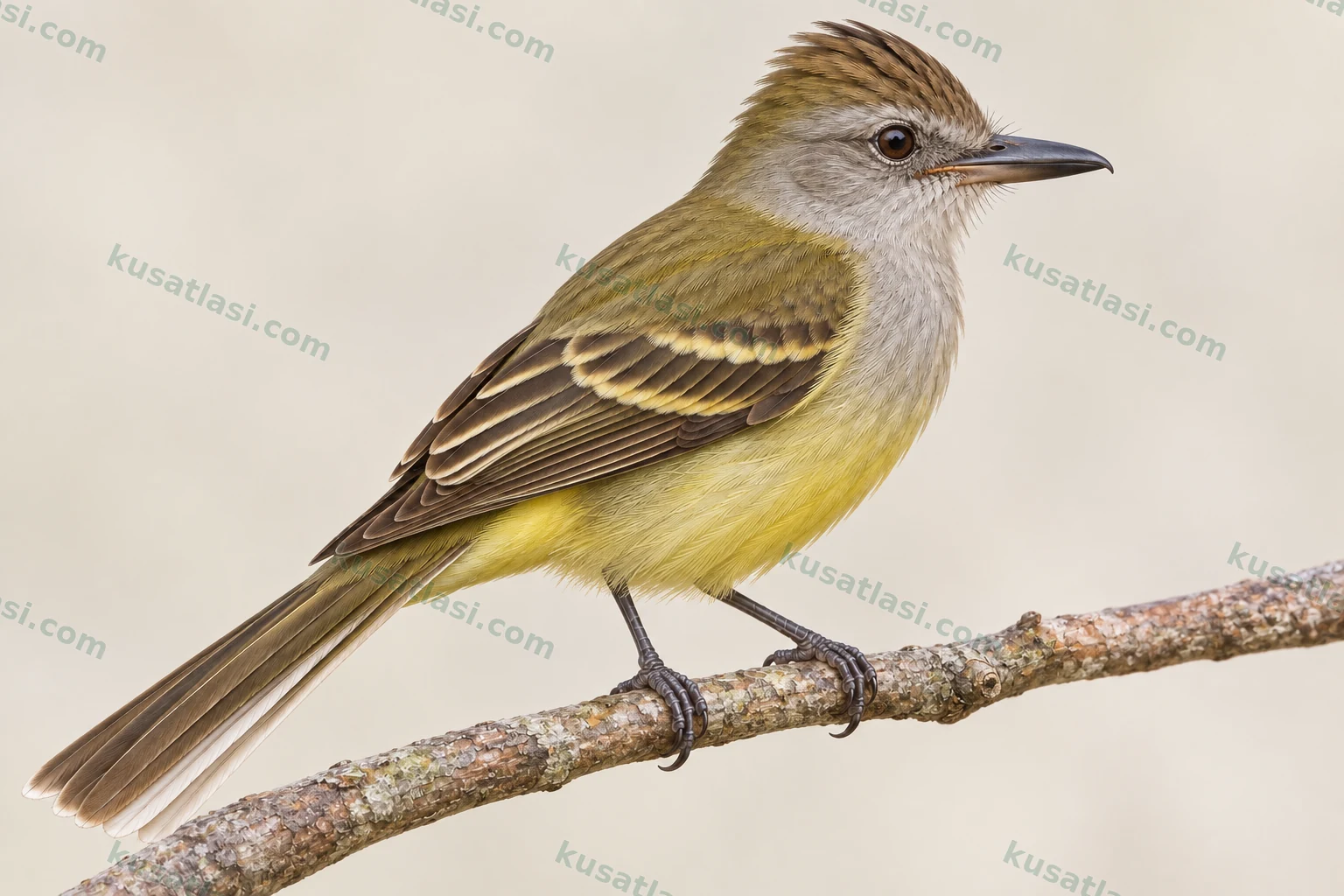
Swipe left or right between the two adult plates.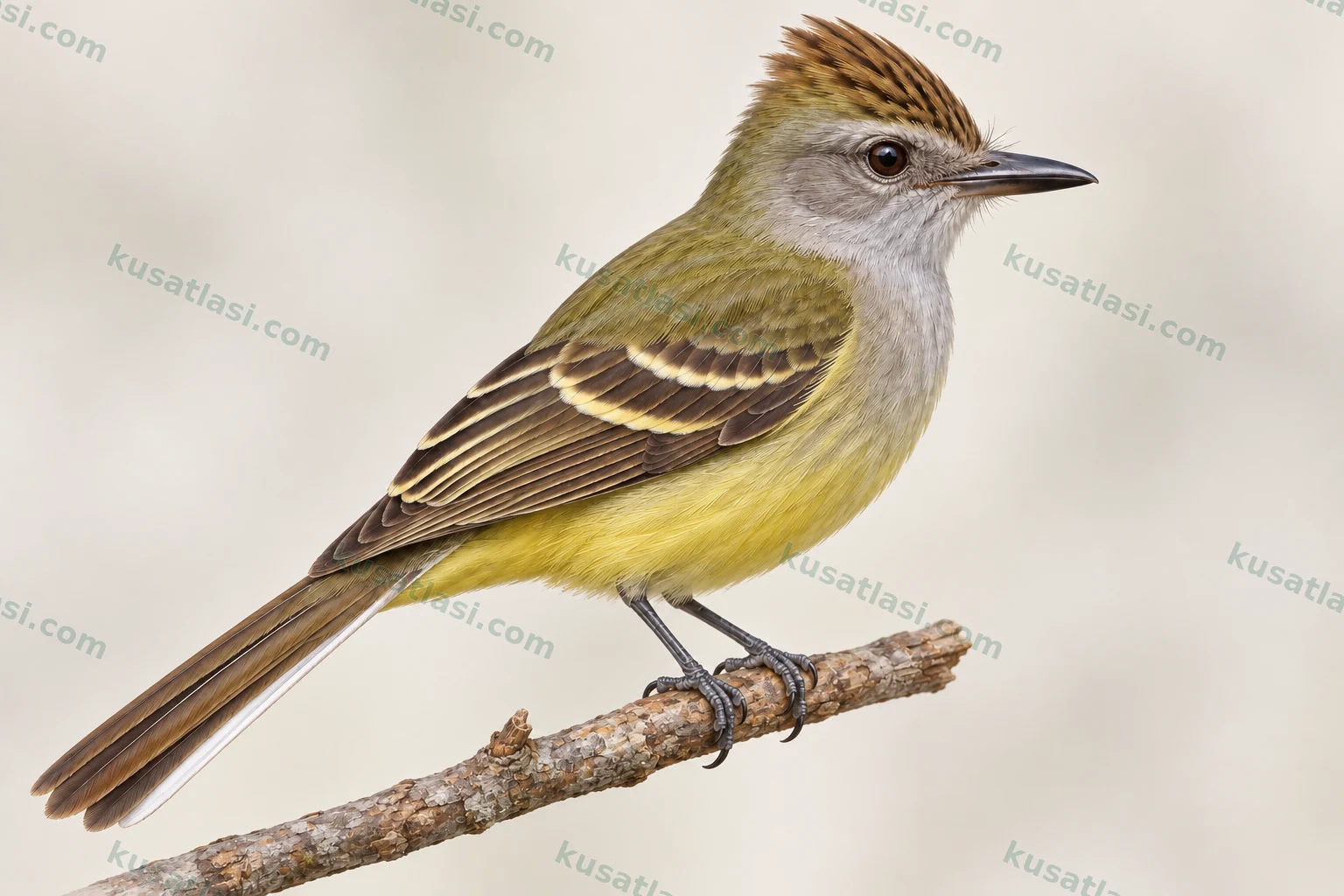
Tyrannidae
Pale-edged Flycatcher
Myiarchus cephalotes
See the pale outer edge of the outer tail feather together with the head and wing bars.
- Order
- Passeriformes
- IUCN status
- LC · Least ConcernGlobal IUCN. BirdLife v10 (2025); taxon matching: AviList 2026 / IOC 15.2; checked 29 October 2026. Checklist year is not the species assessment date. Source and method · BirdLife
At a glance
- Pale tail edge
See the pale outer edge of the outer tail feather together with the head and wing bars.
- Humid mountain edge
Check range and altitude; a yellow belly alone does not identify the species.
- Wing lines
Pale bars may show on the folded wing; consider feather wear and light.
Biometrics
Length
- Male
- 18–19 cm
- Female
- 18–19 cm
Wing length
- Male
- 8.88 cm
- Female
- 8.88 cm
Weight
- Male
- 22.5–31 g
- Female
- 20.5–28 g
Length: Shared species value Wing length: Shared species value
World distribution
Pale-edged Flycatcher
Customise map layers
Observation points
Preparing globe…
Monthly record count
Bars show record counts in this sample, not bird abundance or a breeding calendar. They are affected by recording and observation effort.
Rotate the globe and compare layers. Coloured areas are not exact observation or nest locations.
The source does not provide verified monthly range boundaries. All areas are shown; the month slider and monthly playback are therefore disabled.
- Jan
- Apr
- Jul
- Oct
- Dec
Generalised data and method
Base map: Natural Earth · Public domain
Open central bibliography ↗Calendar
Among the Ecuadorian pairs followed, most egg-laying records were in September–January, with one laying record in March. These dates belong only to the study area; no monthly calendar is drawn for all the Andes.
All months: monthly data have not been verified.
January
February
March
April
May
June
July
August
September
October
November
December
Habitat
Northern Venezuelan mountains and the Andes from Colombia to Bolivia
At humid montane forest edges, see head, wing bars and the outer tail edge together.
Sound
Repeated calls may help separate similar Myiarchus species; this account provides no verified universal species-specific voice transcription.
Do not play recordings to attract birds; observe quietly, especially near nests.
Breeding
The six northeastern Ecuadorian nests probably belonged to two pairs. They built a cup of soft material in nest boxes and spaces under eaves. Clutches contained two–three eggs; incubation lasted 18 days at two nests, and the observed young spent 18 days in the nest. This small regional sample is not a mean for the entire range.
Compare
Compare male and female
Check range and altitude; a yellow belly alone does not identify the species.
Species information
Quick identification
Pale-edged Flycatcher is a medium-sized tyrant flycatcher of humid South American montane forest edges. Dark bill, slightly raisable crown, olive-brown upperparts, pale grey throat and breast and yellowish belly are assessed together. Pale feather edges on the closed wing create two conspicuous bars. The pale yellowish outer edge of the outermost tail feather is an important comparison mark, but may be hidden when the tail is closed or light is against the observer. Recording another Myiarchus under this name just for a yellow belly or wing bar is unsafe.
General appearance and posture
The fairly long tail, straight strong bill and upright posture while scanning from a branch help separate it from small flycatchers with very short bills. A browner head tone may differ from the more olive back. Pale tips and edges of flight feathers and coverts make lines on the folded wing. The English name’s pale edge is not based on one line alone: a pale edge is also sought on the outer tail feather. Wear, shade and a photograph’s colour settings affect how visible those lines are. Identification uses the pattern’s location and the bird’s geography, not one coloured pixel.
The Colombian specialist account describes olive-brown upperparts, a slightly browner head and grey to off-white wing bars. It particularly states that the pale outer edge of the outermost tail feather does not extend to the feather tip. Seeing that detail may require a sideways turn or slight tail opening. Stripe width is not a ruler-fixed measurement identical in every bird. High-mountain haze, strong midday light and differences between fresh and worn feathers affect the contrast seen. Rather than infer sex or age certainly from a short glance, bill, head, wing and tail are recorded together.
Males, females and young birds
The sources examined do not provide a field key separating male and female with one reliable colour mark. Ecuadorian nesting researchers considered one of two ringed adults a probable male because it was slightly larger and did not incubate; that is a sex inference, not a visual rule for the entire species.
The sources reviewed lack a comprehensive reliable sequence documenting which feathers young replace and when in every geographical population. Begging from adults by a newly fledged bird is directly observed in Ecuador, but a warmer-looking wing at a distance does not establish age certainly. Recording the family group, locality and repeated calls is more appropriate for avoiding confusion with young of another Myiarchus. Frightening adults by approaching a nest to verify age can alter the very observation. When uncertainty remains, describing a bird as young-looking is better than a certain but unsupported label.
Appearance in flight
The bird often sallies a short distance from a perch after an insect and returns to a nearby branch. Wing bars may be partly seen, but movement and changing light mean they are not conclusive marks alone. Pale outer tail-feather edges may show better in a spread tail; their absence from a view of the closed tail does not exclude the species. We could not verify a pattern on upperwing or underwing unique to this species and reliable in every individual. No invented wing patch is therefore added to a dark flying silhouette.
When it perches again, head colour, bill, both wing bars and tail edge should be checked on the same bird. In field comparisons, altitude and the humid montane forest setting matter as much as an unclear pale line in a photograph.
Voice and behaviour
Myiarchus species can look similar, making repeated call sequences and locality important for identification. The open scientific sources reviewed did not provide a reliable syllable transcription or frequency threshold usable for this species in every region. If there is a recording, whether it truly comes from the bird seen, the recording’s locality and the simultaneous presence of other flycatchers must also be checked. No claim is made that one short sound separates every species.
In Ecuadorian fieldwork at Yanayacu, adults paused near the nest before delivering food to young. Behaviour there allowed direct study of food types and parental care, but artificial light beside the station could also have affected insect arrivals. Prey proportions at that nest are therefore not presented as the daily prey list of birds throughout the Andes. A short flight, searching between branches and returning to the nest are distinct behaviours. Recording them separately describes the bird’s actions more accurately.
Similar species
1. Apical Flycatcher, Myiarchus apicalis, is a similar species requiring comparison in Colombia. Pale tail-tip pattern and head and throat tones are examined together; the dry-valley bird must not be confused with this humid-montane bird only for generally yellow underparts. If one tail photograph is insufficient, locality and repeated voice are sought too.
2. Short-crested Flycatcher, Myiarchus ferox, may show a similar general body and underpart colour in lower areas. The location of the pale outer tail edge and actual habitat are checked. Sharing a broad country does not show frequent occurrence together at the same altitude.
3. Other Myiarchus may also show pale wing lines and a yellowish belly. Instead of naming a species from one mark, wing-line tone, outer tail feather, bill, head, locality and, when needed, verified voice are assessed together. An unseen tail detail is not written down as absent.
Global distribution
Pale-edged Flycatcher occurs in South America in northern Venezuela’s mountains and along the Andes in Colombia, Ecuador, Peru and Bolivia. This is not one continuous uniformly occupied coloured band: humid mountain habitats shift with altitude, slope and forest openings.
Status within its natural range
Greeney and Dyrcz report records in an approximate 800–3000 m elevation belt, while their own Ecuadorian study area lay at 1950–2150 m. That second narrow interval must not be treated as the species’ global elevation limits. Narrower regional elevations and mountain-range records in the Colombian specialist account likewise remain within their national context.
Migration
The specialist accounts examined portray it mainly as resident in mountain regions, without a long-distance intercontinental migration route. Residency does not mean that no individual ever moves. Food, season and habitat use may lead to local movements on mountain slopes, but the documents do not establish their kilometres or monthly calendar. An arrow from Venezuela to Bolivia is therefore not presented as one bird’s journey. The map should show natural-range context; an observation point, breeding evidence and a tracked migration route remain separate.
Breeding habitat
The species is documented at humid montane forest edges, clearings and treed semi-open areas. Greeney and Dyrcz also observed it in disturbed, relatively open places in northeastern Ecuador without claiming the same habitat preference everywhere in the Andes. A forest-edge record does not mean breeding on any bare farmland. The mosaic of trees and openings on a mountainside provides perches and access to flying insects. Nest, egg and parental behaviour are treated as separate levels of evidence rather than marking breeding habitat from one sighting.
Nest site
The six nests examined at Yanayacu probably represented repeated attempts by two pairs. Birds used nest boxes and spaces under building eaves, making a cup of soft material inside a cavity. One nest took about 23 days to build and was made by the female; that single duration is not the species’ universal mean. Natural tree cavities are possible nest sites but are not assigned the same evidence level as boxes and eaves directly studied. Observation should remain far enough away not to touch the nest or disturb adult behaviour.
Daily space use
Searching for insects from an open perch, moving between forest-edge trees and delivering food during breeding are documented behaviours. Movements around one nest do not provide a fixed area size for the entire species. Artificial light at Yanayacu attracted insects, so prey availability there could also differ from ordinary montane forest conditions. Keeping nest entrances clear for photographs, avoiding changes to chick-feeding frequency and limiting observation to brief distant visits protect the scientific record’s reliability.
What does it eat?
This is an insect-hunting tyrant flycatcher. The direct Yanayacu study identified adult moths and butterflies, cicadas, flies, grasshoppers, dragonflies and other insects among recognisable prey brought to young; a spider was recorded too. The list describes actual deliveries at a nest, not identical year-round proportions for every bird. The station’s insect-attracting light may particularly have increased local abundance of night-active insects. The paper’s prey counts are therefore not repeated as global menu percentages. All proportions of food adults take for themselves cannot be deduced from prey delivered to chicks alone.
How does it hunt?
The bird may watch from a visible perch and make a short sally towards a flying insect, or take prey among leaves. The Colombian specialist account describes both methods. Ecuadorian observers wrote that adults approaching the nest first paused on a nearby branch, making some prey identifiable. That pause does not always show where the prey was caught. When identifying an animal carried in the bill from a photograph, a possible moth must be distinguished from certain species identification.
Adults bringing different prey to young do not show that males and females are fixed prey specialists throughout life. The study involves a sample close to only two pairs and an area potentially affected by light. Catching prey among branches and brief aerial pursuit may work under different conditions; no reliable single value gives their seasonal proportions. Carrying prey to a nest is breeding behaviour, not a basis for generalising all daily feeding outside breeding.
Small sample, strong observation
Yanayacu researchers found six nests over several years, probably belonging to only two pairs. One nest held two eggs and four held three. At two nests, incubation from last egg to hatching lasted 18 days and the nestling period also lasted 18 days. Those directly observed numbers are valuable but do not mean that all nests in other countries follow the same timetable. Female-only incubation and the female providing more care for most young also describe the observed pairs. The study’s strength is following actual nests for a long time without concealing the small sample.
The family period after leaving the nest
Young did not become independent in one day after leaving. In the family where a ringed adult pair was followed, adults continued feeding young for at least nine weeks, and the family remained together for at least ten weeks. In the seventh week young were also hunting for themselves. This shows that flying and living independently are not the same event. The long follow-up likewise concerns only one particular Ecuadorian family. A newly fledged bird moving away from the nest does not prove that parental care is absent nearby.
Light and the prey list
Because light near the station could attract insects, the high share of moths and butterflies carried to young might not be repeated in another montane forest. The paper explicitly discusses that potential bias. Actually seeing the insects and knowing what proportion repeats under natural conditions are different questions. Eating insects is a reliable observation; eating mostly moths everywhere is not required by these data. Stating the limits of field evidence does not diminish knowledge, but keeps it in the right setting.