
World Birds
Field identification plates
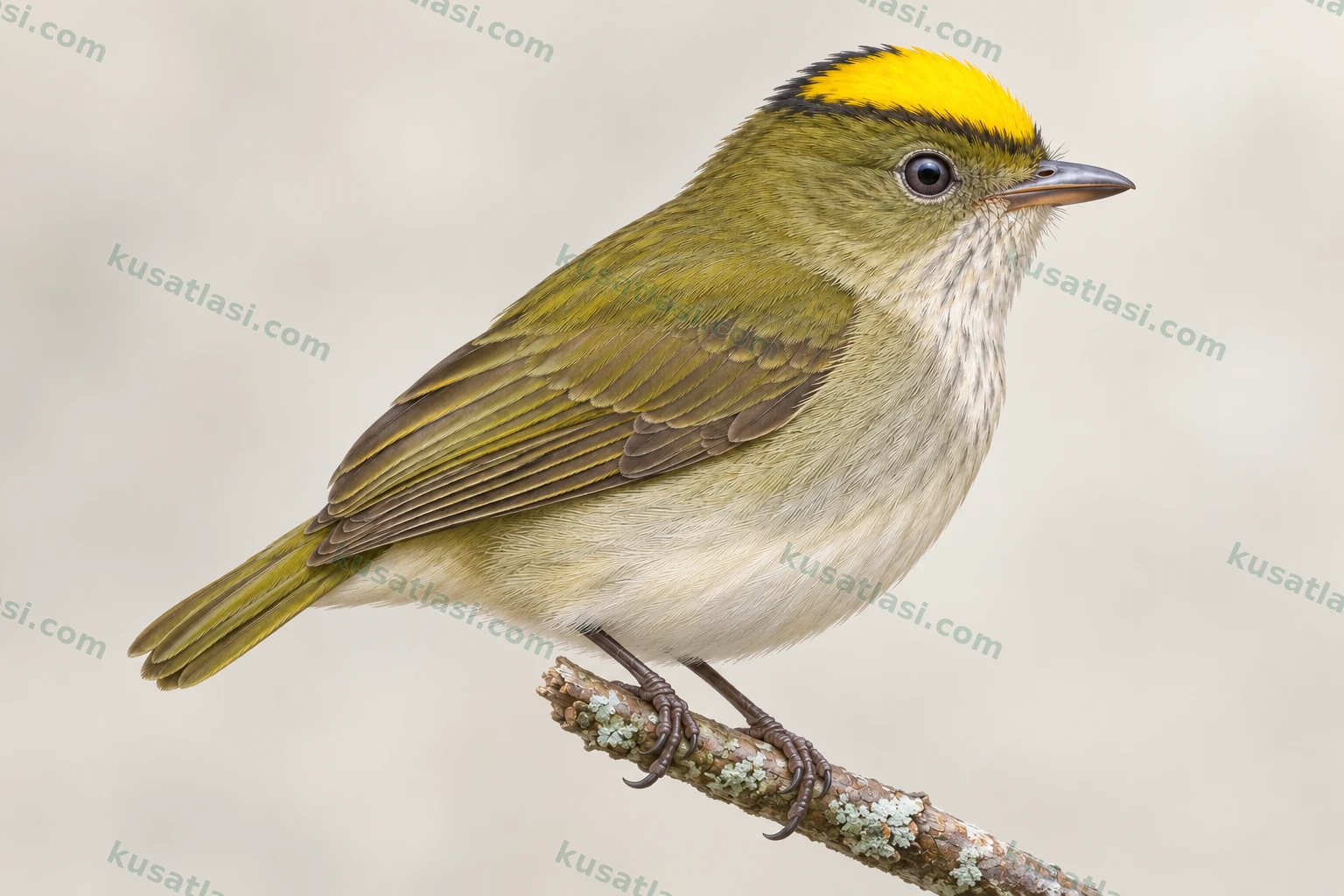
Swipe left or right between the two adult plates.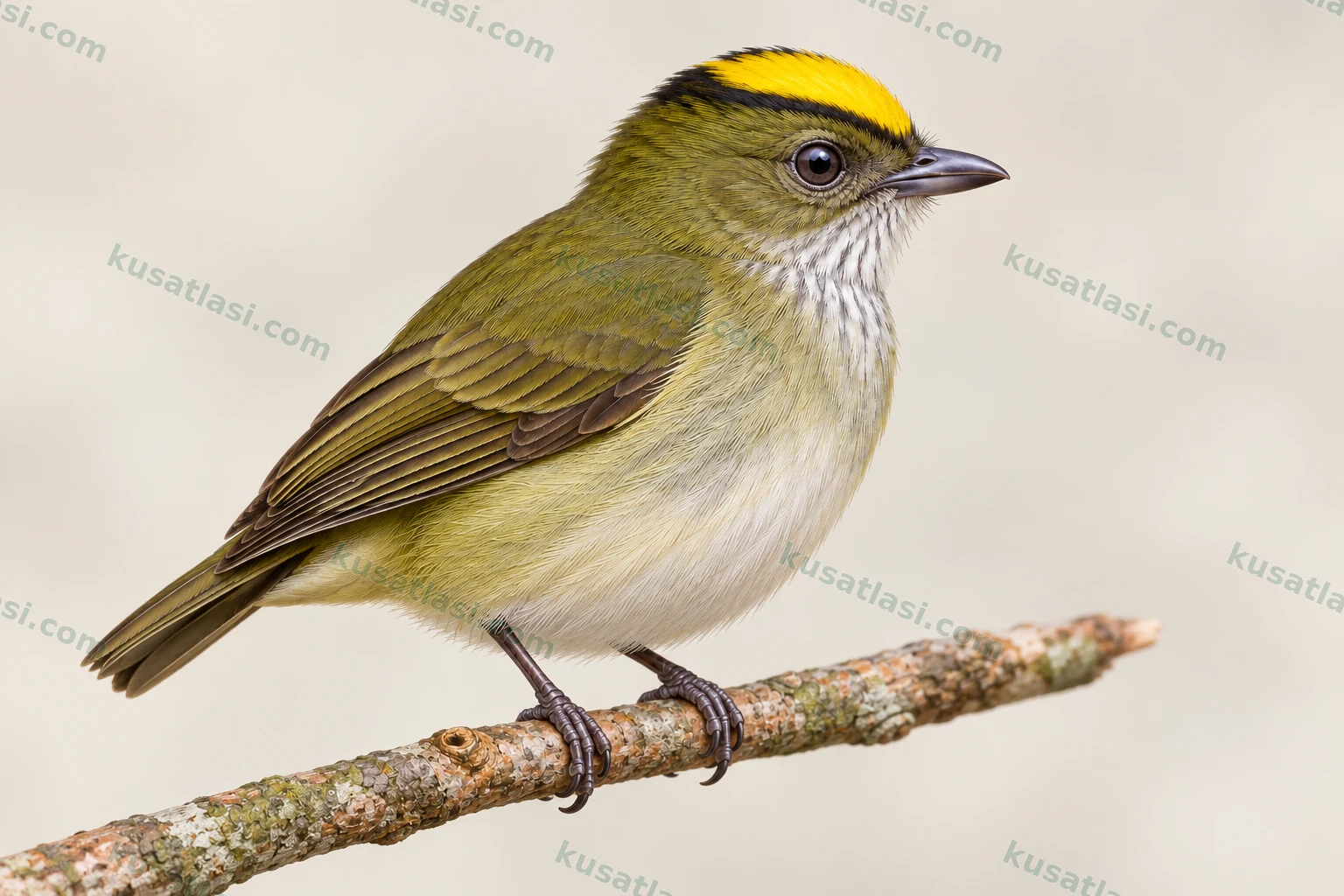
Pipridae
Pale-bellied Tyrant-Manakin
Neopelma pallescens
See grey breast, fine throat streaks and whitish belly together.
- Order
- Passeriformes
- IUCN status
- LC · Least ConcernGlobal IUCN. BirdLife v10 (2025); taxon matching: AviList 2026 / IOC 15.2; checked 29 October 2026. Checklist year is not the species assessment date. Source and method · BirdLife
At a glance
- Look at the pale underparts
See grey breast, fine throat streaks and whitish belly together.
- Wait for the hidden yellow
Yellow crown feathers are not always visible; females have them too.
- Match sound to the bird
See the display-site bird to distinguish other nearby sounds.
Biometrics
Length
- Male
- 14 cm
- Female
- 14 cm
Wing length
- Male
- 7.22 cm
- Female
- 7.22 cm
Weight
- Male
- 16–20.5 g
- Female
- 16–20.5 g
Length: Shared species value Wing length: Shared species value Weight: Shared species value
World distribution
Pale-bellied Tyrant-Manakin
Customise map layers
Observation points
Preparing globe…
Monthly record count
Bars show record counts in this sample, not bird abundance or a breeding calendar. They are affected by recording and observation effort.
Rotate the globe and compare layers. Coloured areas are not exact observation or nest locations.
The source does not provide verified monthly range boundaries. All areas are shown; the month slider and monthly playback are therefore disabled.
- Jan
- Apr
- Jul
- Oct
- Dec
Generalised data and method
Base map: Natural Earth · Public domain
Open central bibliography ↗Calendar
Florestal’s 2016 nesting season was recorded in September–November; it is not a single monthly breeding calendar for the entire range.
All months: Monthly data unverified.
January
February
March
April
May
June
July
August
September
October
November
December
Habitat
Brazil and northeastern Bolivia; separate Guyana–Suriname populations
In vine-rich woodland, look for olive back, grey breast and pale belly; the hidden yellow crown supports identification.
Sound
Short male jumps with the yellow crown opened may be followed by a vocal display. A wing origin for the double-knock-like jump sound is the researchers’ interpretation; the exact mechanism was not experimentally verified.
Do not play recordings to attract birds; observe quietly, especially near nests.
Breeding
In the Florestal study the female built a shallow grass cup attached to a fork with spider silk and undertook incubation and chick care. Of 11 nests, nine had two eggs and two had one. Incubation length was not calculated; the nestling period at two nests was 15 days. The local 2016 nesting season was recorded in September–November.
Compare
Compare male and female
Yellow crown feathers are not always visible; females have them too.
Species information
Quick identification
The Pale-bellied Tyrant-Manakin is recognized by its olive back, pale underparts and often hidden yellow crown feathers. Fine throat streaks and grey breast shading are assessed with the paler belly. Yellowish eyes help; bill and feet are dark. A small plain bird cannot be identified by a pale belly alone. Head posture, breast pattern and forest setting matter together. The “flycatcher” element of its Turkish name does not put it in the true flycatcher family; it belongs to the manakins.
General appearance and posture
Olive upperparts can make it disappear easily in leafy forest. The underparts are not uniformly bright yellow: the belly is whitish or very pale yellowish, with grey on the breast. Fine throat marks are not one dark patch covering the whole throat. When a branch shadow makes a sharp boundary on the breast, seek another angle. Separating actual plumage from shadow matters in this plain-coloured group.
Yellow crown feathers are not always exposed. Failure to see them on a resting bird does not exclude the species. A displaying male can open them conspicuously; the same yellow area was recorded on a nest-defending female. Yellow crown alone is therefore no male marker. Assess eye, bill and underparts on the same bird; do not imagine features missing from a brief view.
The plain perched bird contrasts with active male breeding displays. The original Florestal study describes a low horizontal branch or vine as display perch. That does not mean living only at that height all day. Feeding, courtship and nesting are different observation contexts; display-perch height is not the height of the entire daily range.
Males, females and young birds
Adult males and females have no conspicuous plumage-colour difference usable reliably in the field. The bright-male/green-female pattern of some other manakins is not transferred. At Florestal, ringed birds were sexed from blood samples and marked individuals' behaviour followed. Unmarked birds were sexed by behavioural interpretation. Thus not every bird exposing yellow feathers or moving vigorously is definitely male.
The original study followed plumage development of small nestlings. Near fledging, their overall colours resembled adults. This does not give an ageing key for every distant plain bird. A youngster being fed is better distinguished from an independent adult by the behaviour actually seen. Leave age and sex open without supporting features.
Appearance in flight
Pale underparts may show briefly when changing branches, while the small yellow crown and fine throat marks quickly disappear. Once it settles, check upperparts and underparts together. No definitive upperwing–underwing identification from one flight colour patch is proposed for this species.
In courtship the male makes short vertical jumps, rapidly moving the wings while opening the yellow crown. Researchers suggested that the accompanying double-knock-like sound might come from wings closing. This is an observation-based interpretation, not an experimentally measured definitive sound-production mechanism. Branch-changing flight, courtship jump and chasing a neighbour are different behaviours.
Voice and behaviour
Male display sites can be within hearing but not direct sight of each other. At Florestal, males displayed alone in separate areas and chased another male entering their site. A jumping sequence with the yellow crown spread may be followed by a vocal display. This is not the same as every manakin display with several males dancing together simultaneously on one branch. Seeing the actual calling bird's branch avoids assigning other nearby species' voices to it.
Females were also recorded making distraction movements around nests. Slightly opening wings and moving as if falling to the ground was interpreted as a display drawing observers away. When such movement occurs, retreat instead of following and approaching the nest. Recording natural behaviour does not rely on repeatedly disturbing a bird to reproduce the display.
Similar species
1. Neopelma aurifrons is a close lookalike that can coexist in parts of the known range. The specialist comparative guide separates the Pale-bellied Tyrant-Manakin by paler underparts lacking distinct yellow. The hidden yellow crown alone is insufficient; use underparts with reliable vocal comparison. Possible coexistence prevents locality from replacing plumage and voice.
2. Neopelma sulphureiventer has a more distinctly pale yellow belly. Light can yellow a photographed belly, so this small tonal difference does not establish identity alone. The guide's mention of nearby ranges does not mean coexistence everywhere. Compare regional records and the whole appearance, without combining different species' traits into one bird.
When recording this plain bird, separate seen from concealed features. State whether crown feathers opened and eye and throat were visible to make the record easier to assess. Seeing courtship does not make plumage comparison unnecessary; one still photo cannot show the behavioural sequence either. This is a way of reading existing evidence, not a new unverified body mark.
Global distribution
Most of its natural range is in Brazil, from central and eastern regions to southeastern forests. Species accounts also include records reaching northeastern Bolivia and separate populations around the lower Amazon, southern Guyana and Suriname. It is therefore not endemic only to Brazil. This broad outline does not make every intervening open area continuous habitat. Seek suitable woodland and forest fragments; presence within a country does not mean coverage of its entire surface.
Status within its natural range
The global conservation category is Least Concern, not a statement of abundance in every forest. Cabedelo's institutional guide calls it locally scarce, noting a bird ringed in 1995 but absence from more recent surveys. This is neither a range-wide census nor proven local extinction. Breeding study at Florestal does not establish identical density in every other forest fragment.
Migration
It is considered resident. Its distribution across countries is not successive seasonal stops, and no verified long-distance route is drawn. Use of a Florestal display site through the breeding season, and some males returning the next year, concerns local site fidelity. It does not mean all birds remain on the same branch for life or every population breeds in the same months.
Breeding habitat
Habitats include wooded savannas, dry or semideciduous forests, streamside woodland and vine-rich areas. Florestal's breeding study used two secondary semideciduous forest fragments. That local setting does not restrict the species to untouched old forest, but neither makes every bare cleared site suitable for breeding.
Nest site
The female builds a small shallow cup. Spider silk attaches its upper rim to forked branches; dry grass stems and heads form its delicate structure. Of 11 egg-containing nests at Florestal, nine had two eggs and two had one. Incubation length could not be calculated; nestling periods at two nests were 15 days. This is not incubation time. Observe without approaching nests, eggs or a distracting female.
Daily space use
Male display areas used small trees and vines. Feeding branch, courtship perch and female nest need not be one point. The local study suggested possible habitat separation from Antilophia galeata, but did not test it. Occurrence in different moist sections is not an immutable preference boundary throughout their ranges.
What does it eat?
Small arthropods dominate the diet, with small fruit also eaten. Direct Florestal observations report adults taking especially fruit of Psychotria, abundant at the site, and females feeding young mostly arthropods. That plant genus is not the sole food everywhere. The study gave no particular insect–fruit percentage, so daily diet is not presented in exact proportions.
How does it hunt?
Among forest plants it may move short distances for prey and fruit. A valuable record states what was actually taken when visible, not just that the bird was on a branch. Prey delivered to a chick is not a full list of everything the adult ate that day. This mainly insect-feeding manakin does not fit the idea that all manakins live on fruit alone.
Plain feathers, lively display
Male and female appearance is similar, yet the male courtship display is conspicuous. It combines opening the hidden yellow crown, short jumps and voice. Separate Florestal display areas placed neighbouring males within hearing but not direct view. Assuming every manakin performs the same communal dance obscures this variety.
An important distinction in nest periods
The original breeding study found a 15-day nestling period at two nests; normal incubation could not be calculated. Eggs spending 17 days in an abandoned nest do not establish how long healthy eggs take to hatch. Building, warming eggs and feeding chicks are different stages. Preserving that distinction gives a more accurate account than adding other birds' periods.
Time of day can affect research results
A separate Guaribas study assessed blood data from 74 birds after excluding recaptures. Among the substances examined, glucose was higher in the afternoon and ketones in the morning; links with breeding status were also assessed. This shows that sampling time matters in interpretation. It is not a universal diagnostic test establishing health from appearance or one blood value.