
World Birds
Field identification plates
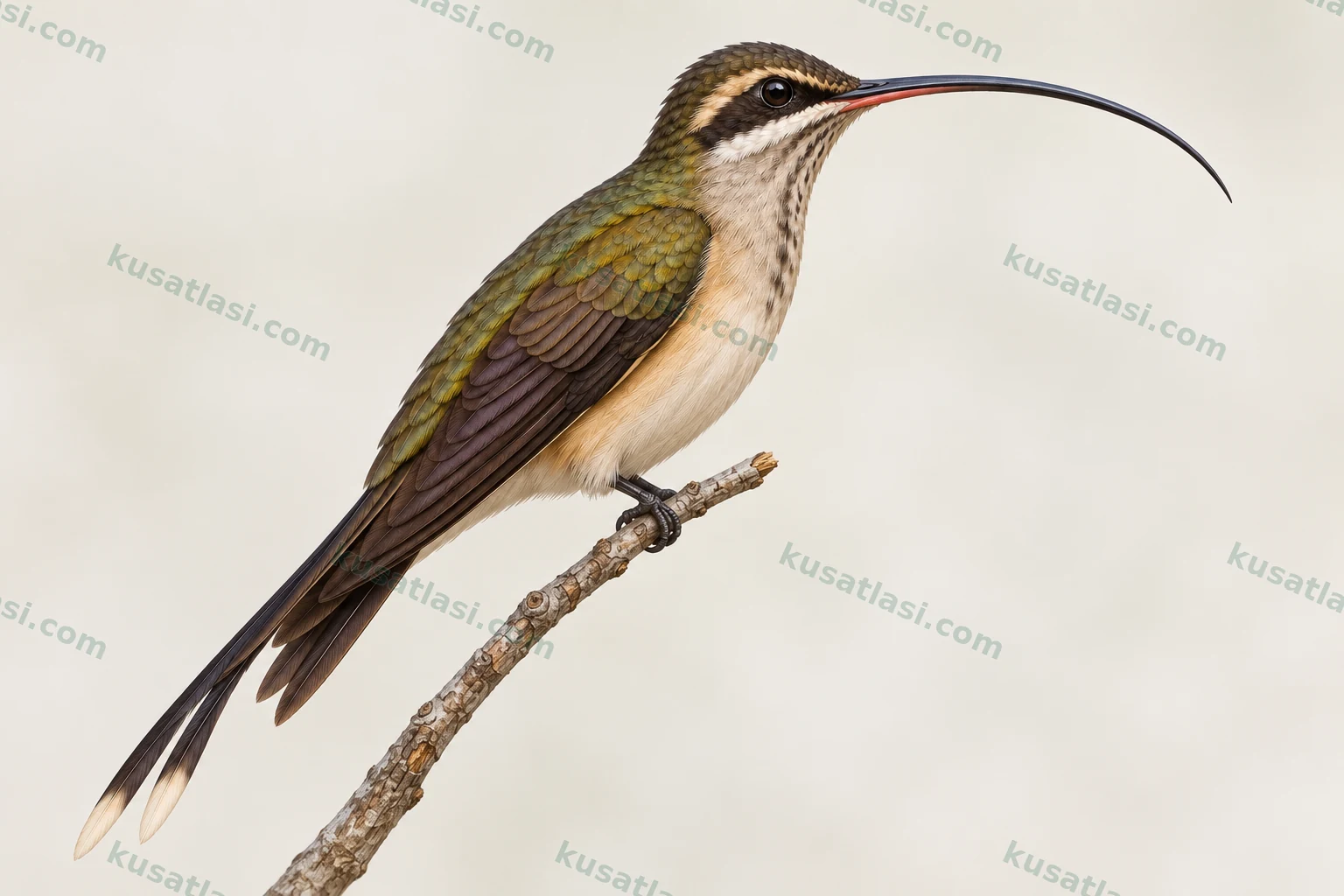
Swipe left or right between the two adult plates.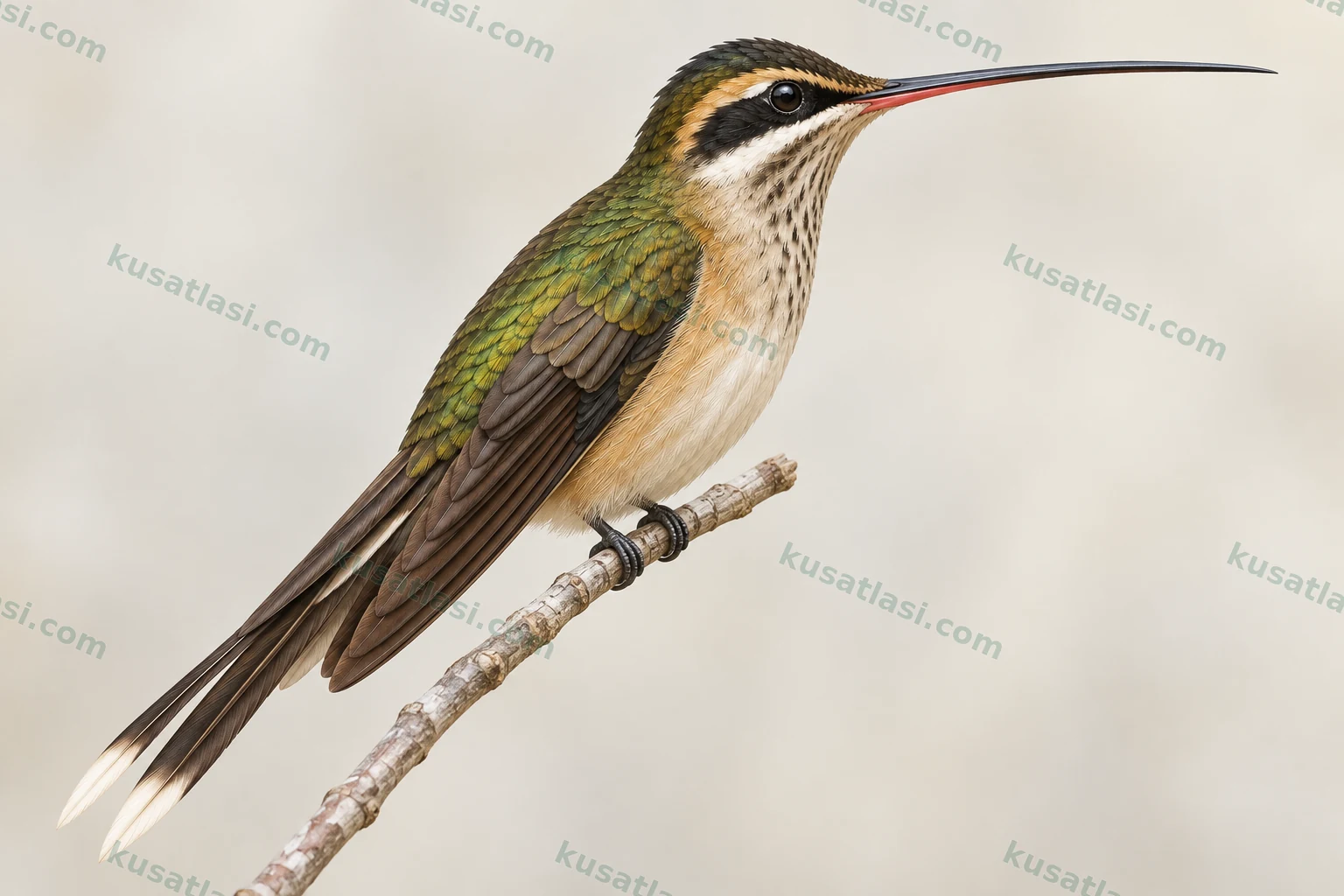
Trochilidae
Pale-bellied Hermit
Phaethornis anthophilus
Look for the faint eyebrow above the dark mask.
- Order
- Apodiformes
- IUCN status
- LC · Least ConcernGlobal IUCN. BirdLife v10 (2025); taxon matching: AviList 2026 / IOC 15.2; checked 29 October 2026. Checklist year is not the species assessment date. Source and method · BirdLife
At a glance
- Assess the face as a whole
Look for the faint eyebrow above the dark mask.
- Compare underparts and upperparts
Assess whitish underparts with the dull greenish back lacking marked rufous tones.
- Watch tail and bill
See elongated pale central tail tips together with the downcurved bill.
Biometrics
Length
- Male
- 13 cm
- Female
- 13 cm
Wing length
- Male
- 5.72 cm
- Female
- 5.72 cm
Weight
- Male
- 4.5–5.5 g
- Female
- 4–5 g
Length: Shared species value Wing length: Shared species value
World distribution
Pale-bellied Hermit
Customise map layers
Observation points
Preparing globe…
Monthly record count
Bars show record counts in this sample, not bird abundance or a breeding calendar. They are affected by recording and observation effort.
Rotate the globe and compare layers. Coloured areas are not exact observation or nest locations.
The source does not provide verified monthly range boundaries. All areas are shown; the month slider and monthly playback are therefore disabled.
- Jan
- Apr
- Jul
- Oct
- Dec
Generalised data and method
Base map: Natural Earth · Public domain
Open central bibliography ↗Calendar
Dry-forest sampling and historical specimen dates are not a verified monthly breeding or migration calendar.
All months: Monthly data unverified.
January
February
March
April
May
June
July
August
September
October
November
December
Habitat
Panama, northern Colombia, and western and northern Venezuela
In low vegetation and around flowers, look for face mask, pale eyebrow, light underparts and long tail tips together.
Sound
Detailed song and diagnostic call sequences were not verified for this work. A bird located by natural sound is identified with support from face mask, eyebrow, pale underparts and tail.
Do not play recordings to attract birds; observe quietly, especially near nests.
Breeding
The specialist compilation reports two eggs. Species-specific nest structure and placement, incubation and chick development periods were not verified from original records for this work; they were not transferred from other hermits.
Compare
Compare male and female
Assess whitish underparts with the dull greenish back lacking marked rufous tones.
Species information
Quick identification
The Pale-bellied Hermit is a hummingbird with a long, downcurved bill found in lowland Panama, Colombia and Venezuela. Assess the pale tips of its elongated central tail feathers, faint eyebrow above a blackish face mask and whitish underparts together. Its back has no conspicuous rufous tones, appearing generally dull greenish. A pale belly or white tail tip alone does not establish identity. Identification is more reliable when face, bill curvature and tail can be seen in the same observation.
General appearance and posture
The crown is dark grey-brown, the upperparts greenish with a slight bronze reflection. The pale line extending above and behind the dark eye area is useful in side view. Watch several head movements to distinguish an eyebrow from a mere reflection. A back appearing greenish in light can look browner or darker in shade. Small perceived back-colour changes therefore do not establish a different species on their own.
The underparts are whitish and pale grey, sometimes warmer and pale on the flanks. The older detailed species account also describes faint dark markings on chin and throat. They should not be drawn as a thick uninterrupted throat stripe. Distinguish fine markings in a close view from shadow at a distance. Look for mask, eyebrow, pale underparts and greenish back together on the same bird.
The tail is conspicuous because of two elongated central feathers. Pale markings at the tips of the side feathers differ in shape from the longer pale tips of the central ones. With the tail closed, overlapping feathers can make this structure appear narrower. When it spreads, the central extensions may show better. An old description states that the side feathers form an almost semicircular edge in the spread tail, a useful detail against simply assigning this species the same graduated tail shape seen in all hermits.
Males, females and young birds
Males and females share the general colour pattern. Pale eyebrow, dark mask and pale belly are not sex-specific marks. Calling the brighter-backed bird male and a shaded one female is unreliable. Feather orientation and observation light change colour perception; they do not replace sex determination. Recording sex as unknown does not conflict with correct species identification.
No verified species-specific field key distinguishing young from adults in all circumstances was obtained. A seemingly short tail, pale back or feather condition in one photograph therefore does not justify a definite age.
Appearance in flight
At flowers, the long-bill/slender-body proportions and tail extensions may be more useful than very brief passing views. Assess the bill's downward curve with the head in profile; it may appear less obvious when the bird faces the observer. If whitish underparts and pale tail tips show together, combine them with the other head and back features. Not every long-billed hummingbird approaching a flower is this species.
Without a verified species-specific upperwing or underwing colour scheme, no single flight patch is presented as diagnostic. Treat the record cautiously until face and tail features can be seen again under suitable light.
Voice and behaviour
Look mainly in the low layers of vegetation. The specialist account lists dry forest, mangroves and plantations, specifically mentioning visits to Heliconia flowers. An older Venezuelan field study also recorded this species among hummingbirds feeding at low flowers. These observations do not establish an obligatory plant, height or time of day throughout its range.
For this page, the detailed song sequence and diagnostic call structure were not verified in reliable accessible species-specific sources. No imitative syllables, exact repetition interval or voice-only identification rule is therefore added. Natural sound may help locate the bird; identity is supported by head, bill, underparts and tail. Playback to draw it close is no substitute for watching natural behaviour and flower visits.
Similar species
Other Phaethornis hermits can also have long curved bills, striped faces and elongated pale tail tips. Rather than ticking these shared traits separately, assess this species' pale underparts with dull greenish upperparts lacking marked rufous tones. Country is a starting point that narrows possible candidates, not proof of identity. The same candidate species are not assumed everywhere in Panama, Colombia and Venezuela.
Phaethornis longirostris is a broadly similar candidate because of facial lines, curved bill and pale tail extensions. Its specialist account describes use of shaded lower levels and edges of humid forest. Visiting flowers or being beside Heliconia is not a single separating feature. Compare underpart colour, head pattern and local range together in each case. A lookalike's song, breeding behaviour or route among flowers is not transferred to the Pale-bellied Hermit merely through resemblance.
Global distribution
The range extends from Panama through northern Colombia to western and northern Venezuela. Colombia's Magdalena valley and areas along the eastern foothills of the Eastern Andes are also included; the current taxonomy account mentions records reaching Meta. This does not mean widespread occurrence throughout South America or the entire Amazon basin. Forest, scrub and suitable flower resources should be assessed without assuming continuous occupancy across national borders.
Under the classification currently used, mainland populations are Phaethornis anthophilus anthophilus, and the Pearl Islands population on the Pacific side of the Gulf of Panama is Phaethornis anthophilus hyalinus. The Pearl Islands record is not generalized to every Panamanian island. A female specimen obtained near Puerto López, Meta, in December 1971 was presented in a 1988 paper as a historical range extension east of the Eastern Andes. Discovery then is not proof the bird migrated into the region that year.
Status within its natural range
The Chimichagua study in Colombia examined three tropical dry-forest remnants, recording the species in all five sampling periods. This demonstrates use of local feeding areas, not uninterrupted observation every day of the year. Encounters in that research do not replace a global census. Woodland structure and flower-resource condition are considered together in interpreting a local record.
Migration
No verified seasonal migration route or distance was found. Records in five dry-forest sampling periods do not represent continuous year-round monitoring. Relationships between changing flower supply and possible local movements are not turned into a definite migration calendar without tracking data. A map focus helps locate the observation area; it does not replace a verified route.
Breeding habitat
The species is recorded in dry and humid forest, scrub, mangroves and plantations. Occurrence in dry forest does not mean life only on bare open ground; flower resources in lower forest layers matter. Habitat records and confirmed breeding habitat are not the same. A flower visit does not imply an active nest at every location.
Nest site
The specialist compilation gives two eggs, but species-specific nest structure, precise placement, incubation and nestling periods were not verified through original observation for this work. Another hermit's under-leaf nest or female care role is not transferred here. The historical December female specimen is not a nest or egg record either. If a nest is seen, bird identity, activity and observation date are recorded separately; vegetation is not opened for photographs.
Daily space use
Low-flower feeding is documented in the Venezuelan field account, and associations with several flowers in dry-forest patches in the Colombian study. The Meta record was from a landscape of lakeside woodland beside cattle pastures; it does not make the bird aquatic. Use of an area is understood by considering low vegetation and accessible flowers together, not merely the name of the forest type.
What does it eat?
Nectar is a verified food source. The specialist account mentions Heliconia visits. A field study of three dry-forest fragments at Chimichagua combined flower observations with pollen carried by birds and reported seven plant sources for this hermit. This does not mean it eats from only seven plants worldwide. The combined plant list for the study's two hummingbirds is not used as this species' list alone.
How does it feed?
Feeding is described here as flower visiting. The same study observed associations with Arrabidaea cf. corallina, Aphelandra pulcherrima and Pogonopus speciosus. Pollen on the bill and other parts of the head demonstrates flower contact; successful pollination at every visit was not separately tested. Pollen analysis may not provide the same information as direct flower observations: the researchers used a lower threshold for the pollen analysed. Without a verified animal-food proportion or prey list for this species, insect feeding by other hummingbirds is not assigned numerical values here.
Flower visits and pollen records
The Chimichagua study in Colombia compared direct flower observations with pollen carried by birds. Combining methods yielded seven plant sources for this hermit, while pollen analysis yielded six. The difference concerns methods collecting information under different conditions rather than contradictory bird behaviour; researchers applied a numerical pollen threshold. This local list is not an unchanging worldwide dietary limit.
A record date is not a migration date
A female obtained near Puerto López in December 1971 expanded range knowledge in a field paper published years later. No earlier record does not mean a new arrival. A museum specimen provides important place-and-date evidence but does not by itself establish migration direction, breeding success or local abundance. Later research and current classification place the older record in a broader context.
Low flowers and a research question
An older Venezuelan study included this hermit among species feeding at low flowers. Its authors discussed a possible relationship between flowering and breeding time but stated that data were insufficient. This research question is not presented as an observed breeding calendar. Recording flowers and visit times without changing natural behaviour is valuable for testing such questions better in future.