
World Birds
Field identification plates
Swipe left or right between the two adult plates.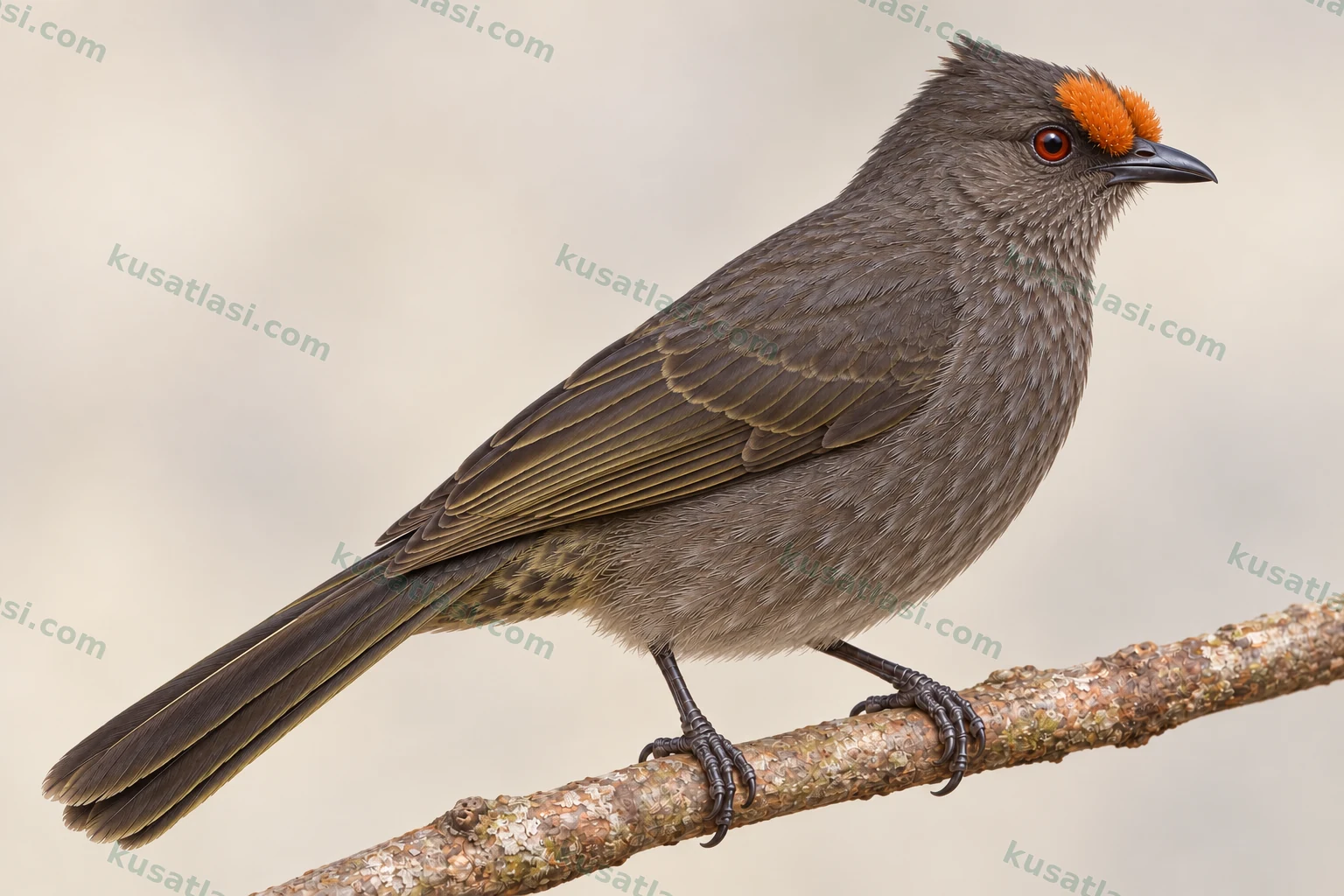
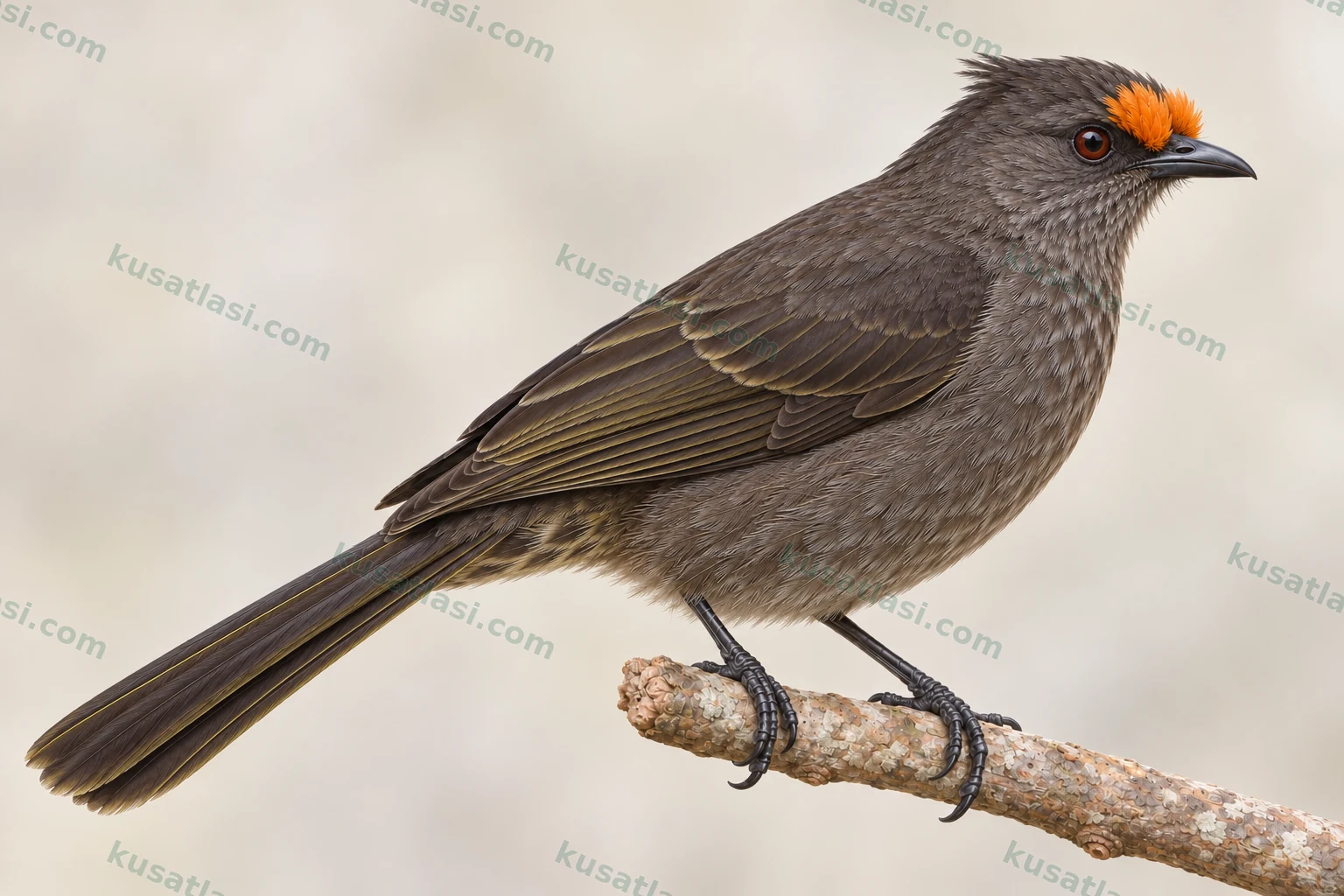
Pycnonotidae
Aceh Bulbul
Pycnonotus snouckaerti
Large orange feathers almost meeting above the forehead.
- Order
- Passeriformes
- IUCN status
- EN · EndangeredGlobal IUCN. BirdLife v10 (2025); taxon matching: AviList 2026 / IOC 15.2; checked 29 October 2026. Checklist year is not the species assessment date. Source and method · BirdLife
At a glance
- Orange forehead tufts
Large orange feathers almost meeting above the forehead.
- Dark belly and grey cheeks
Do not expect a broad white belly or plain yellow cheeks.
- Aceh’s forest clearings
Watch dense undergrowth and surrounding trees together.
Biometrics
Length
- Male
- 21 cm
- Female
- 21 cm
Wing length
- Male
- 9.67 cm
- Female
- Data unavailable
Weight
- Male
- Data unavailable
- Female
- Data unavailable
Length: Shared species value
World distribution
Aceh Bulbul
Customise map layers
Observation points
Preparing globe…
Monthly record count
Bars show record counts in this sample, not bird abundance or a breeding calendar. They are affected by recording and observation effort.
Rotate the globe and compare layers. Coloured areas are not exact observation or nest locations.
The source does not provide verified monthly range boundaries. All areas are shown; the month slider and monthly playback are therefore disabled.
- Jan
- Apr
- Jul
- Oct
- Dec
Generalised data and method
Base map: Natural Earth · Public domain
Open central bibliography ↗Calendar
Classified as resident. The September 2014 observations do not provide a breeding calendar; equivalent evidence for breeding and movements was not found for every month.
All months: Monthly data unverified.
January
February
March
April
May
June
July
August
September
October
November
December
Habitat
Mountain forests of Aceh in northwestern Sumatra
Watch forest clearings with dense undergrowth and edge trees from a distance. Compare orange forehead, grey cheeks and dark belly together.
Sound
Bubbling calls resemble those of the related Pycnonotus bimaculatus. The 2015 study describes a drier, reed-like or metallic song and notes that a larger recording series is needed. Assess voice together with dark belly and facial markings. A verified, licensed real bird recording has not yet been added.
Do not play recordings to attract birds; observe quietly, especially near nests.
Breeding
Species-specific nest structure, clutch size, incubation and fledging periods could not be verified in reliable sources. A pair seen together in September 2014 is not, by itself, nest evidence. The related species’ periods are not transferred; forest undergrowth is not opened to search for nests.
Compare
Compare male and female
Do not expect a broad white belly or plain yellow cheeks.
Species information
Quick identification
The Aceh Bulbul is a grey-brown bulbul confined to the mountainous Aceh region in northwestern Sumatra. Bright orange feather tufts rising on either side of the forehead almost meet. Assess the slightly pointed head, dark olive wings and dark underparts from breast to belly together. It lacks the broad white belly area of the similar Pycnonotus bimaculatus; at most, a small pale area appears at the centre of the belly. One orange forehead spot is insufficient; facial and belly plumage patterns matter.
General appearance and posture
Although the head, throat and breast may look uniformly grey-brown, close inspection reveals pale feather tips. The chin and upper throat are finely spotted pale grey, while the lower throat and breast look slightly scaled. The grey-brown cheek feathers have pale grey tips; they must not be confused with the conspicuous yellow cheeks of Pycnonotus bimaculatus. The absence of a narrow yellow-orange line around the eyelid is also part of the comparison. Examine the bright orange forehead and the small feathers around the eye separately.
The short undertail coverts are not plain bright yellow. They are mottled, combining dull yellow with broad dark grey-brown areas. This does not mean that all the long tail feathers are yellow. The tail-feather edges are more distinctly yellow-olive. The wings appear dark olive while the underparts remain grey-brown; the bird is not assumed to be one uniform colour. Cornell’s description of a weak crest supports the slightly pointed head profile, but feather posture and viewing angle can alter the silhouette.
In the 2015 field observations, birds fed in small clearings with ferns and tall grasses and sometimes sang from larger trees at the forest edge. A high song perch does not mean that they spend all day exclusively in the treetops. Record the vegetation layer and the bird’s movement together. Dense undergrowth may hide its body; a brief view in the open helps compare the head and underparts at the same time.
Males, females and young birds
The sources do not provide a complete key reliably separating all adult males and females by appearance. A brighter-looking orange forehead does not automatically identify a male, nor a paler photograph a female. The comparison of male specimens in the 2015 study cannot be used as female measurements. A verified mean wing measurement in the male box and missing data in the female box reflect that distinction; shorter female wings are not claimed.
The red eye colour in a photograph of a live bird was also supported by label information from three male museum specimens. This is a supporting feature in visible adults, not a detailed developmental study showing identical eye colour at every age and in both sexes. No verified identification key describing every juvenile plumage stage was found. A dark-looking eye in shade or a forehead patch hidden behind a branch is insufficient to call the bird young. Age, sex and species identity remain separate assessments.
The original description specifically noted that the sex record of the single type specimen was not entirely reliable. The 2015 male measurement series therefore does not have the same evidential scope as that older specimen’s label. Worn museum plumage does not explain all age-related changes in living birds either; features distinguishing the species are not treated as a definitive age or sex key without further evidence.
Appearance in flight
The dark underparts and relatively long tail may stand out in a brief flight, but cheek feathers and eye surroundings are easily lost in motion. Rather than identifying a flying bird from one orange flash, examine head and belly together when it lands again. The 1928 description calls the underwing coverts and feathers where the wing joins the body grey-brown; these areas are whiter in the similar Pycnonotus bimaculatus. Although useful, this underside difference cannot alone provide certain identification without accounting for light and viewing angle.
A museum wing measurement is not the tip-to-tip span of two spread wings. As actual wingspan has not been verified, none is derived from a flight photograph. In comparing male specimens, the 2015 study found longer wings and tails in this species than in the similar taxon; that does not mean every wild bird will visibly show the same size difference at a distance. A flight record without clear facial details may remain unidentified.
Voice and behaviour
The voice generally resembles the lively, bubbling calls of Pycnonotus bimaculatus. The 2015 authors described a drier, reed-like or metallic song, contrasting with the fuller, more open notes of the compared taxon. However, without a larger recording series and acoustic analysis, they gave the vocal difference limited weight. A written sound comparison is not a definitive key for all individuals. Voice is assessed together with the dark belly and facial pattern.
In September 2014, a pair and four birds were recorded at two separate Aceh sites. A pair seen together is not, by itself, evidence of a nest, eggs or successful rearing. Species-specific nest structure, clutch size, incubation and fledging periods could not be verified in the publications examined. Breeding periods of similar bulbuls are not transferred to this bird. Listening from a distance and watching without disturbing cover is more appropriate than repeated playback to find a rare species.
Similar species
Pycnonotus bimaculatus is the principal comparison. In the Aceh bird, look together for larger orange tufts almost meeting above the forehead, pale-tipped grey-brown cheeks rather than yellow ones, absence of the orange eyelid line and absence of a broad white belly area. Dark mottling of the undertail coverts also helps. A single white feather on the related species or the Aceh bird’s small pale belly centre is not decisive. Older publications may use Pycnonotus bimaculatus snouckaerti; this historical name refers to the currently accepted Pycnonotus snouckaerti. All island ranges, measurements and breeding information under the former combined species heading are not automatically assigned to the Aceh bird.
Global range
The natural range is associated with mountainous forests of Aceh in northwestern Sumatra. The species is confined to that region; occurring in Sumatra does not mean being widespread across the whole island. Java, Bali or wider Sumatran records under the old Pycnonotus bimaculatus heading are not directly added to the Aceh Bulbul’s range. Taxon identity and the region to which a record belongs are checked together.
Status within its natural range
The current specialist catalogue gives EN, Endangered. Cornell describes the species as a rare, declining regional endemic. Some searches in the 2015 study failed, while birds were found at two separate places in September 2014. These limited observations are not a census of the entire population. The authors suspected that cage-bird trapping contributed to low density but did not provide a definitive causal calculation measuring all loss in this species. They also withheld exact observation sites for conservation reasons.
Migration
The specialist catalogue classifies the species as resident. The sources examined do not verify regular long-distance migration, routes between countries or month-by-month elevation changes. Local movements between a clearing and forest edge are not migration routes. With few records, an absence of sightings in one month does not prove that the area was entirely abandoned then. The regional range is not expanded using unverified seasonal lines.
Breeding habitat
Cornell emphasises clearings with dense undergrowth in foothill and lower mountain forests. The 2015 field study recorded birds in small scrubby clearings dominated by ferns and tall grasses in forest above 1,000 m. This observation height is not a definite lower limit for the whole species. Species-specific breeding habitat cannot be confirmed merely from a clearing where a bird occurs; nest evidence at the same place is required.
Nest site
Nest structure, nest height, typical clutch size and incubation duration were not verified in the reliable sources examined. Another bulbul’s cup nest or clutch size is therefore not assigned to this species. A pair seen in September 2014 does not mean a nest was found then. Dense vegetation is not opened to search for nests.
Daily habitat use
Feeding observations concern the fern-and-grass part of clearings, while song perches sometimes involve large trees along the edge. These two uses show why watching only treetops or only bare clearings will not reveal all behaviour. Clearing, dense undergrowth and surrounding trees are considered together; detailed home-range size has not been verified.
What does it eat?
The specialist catalogue classifies the species among fruit-eating birds. This compiled ecological classification is not a dietary study measuring which fruits are eaten in Aceh or in what proportions. The original studies examined do not provide a species-specific fruit list, insect percentage or breakdown of foods for young birds. Fruit-tree records of the related Pycnonotus bimaculatus are not presented as this bird’s own dietary data. A fruit-based classification does not prove that animal food is never taken.
How does it obtain food?
The 2015 researchers saw birds feeding in small forest clearings covered with ferns and tall grasses. This directly records the vegetation in which feeding occurred, not the identity of each food item. A bird perching in a forest-edge tree to sing is not assumed to be eating fruit simultaneously. Seeing the food, following its uptake into the bill and recording the plant strengthen new feeding evidence. An unclear pecking movement does not yield an insect species or daily food quantity.
Reassessing the original description
Siebers described the bird as a separate species in 1928; later classifications treated it as a subspecies of Pycnonotus bimaculatus. Eaton and Collar’s 2015 study combined museum plumage, measurements, live photographs and voice comparisons to argue again for separate species status. This is not described as a DNA analysis; the nature of the evidence used matters.
A catalogue number may originate from another species
AVONET’s row for this taxon has no directly measured specimen, and its wing data were inferred from Pycnonotus bimaculatus. The mass field is also marked as data transferred to the split taxon. A number appearing in a table therefore does not mean that an Aceh bird was actually measured or weighed. The direct 2015 measurement and the transferred catalogue record are kept separate.
Withholding locality can be a scientific choice
The 2015 authors withheld the exact places where they found birds, considering conservation of a species under trapping pressure. The same paper notes that the bird’s absence from monthly samples at Medan markets did not entirely rule out trade. Monthly visits cover neither every day nor every selling place. Absence of a record is interpreted alongside the limits of the places searched and the method.