
World Birds
Field identification plates
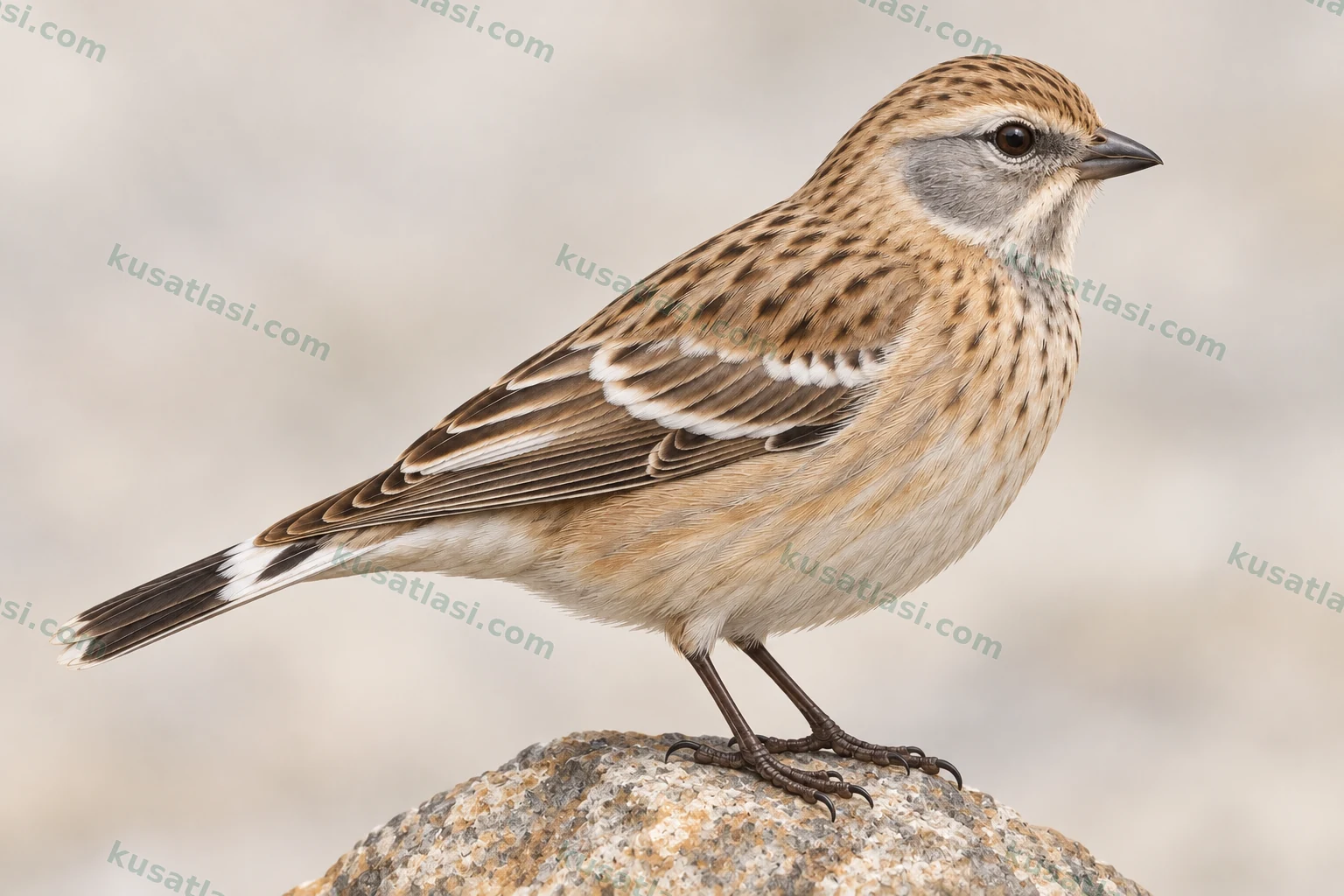
Swipe left or right between the two adult plates.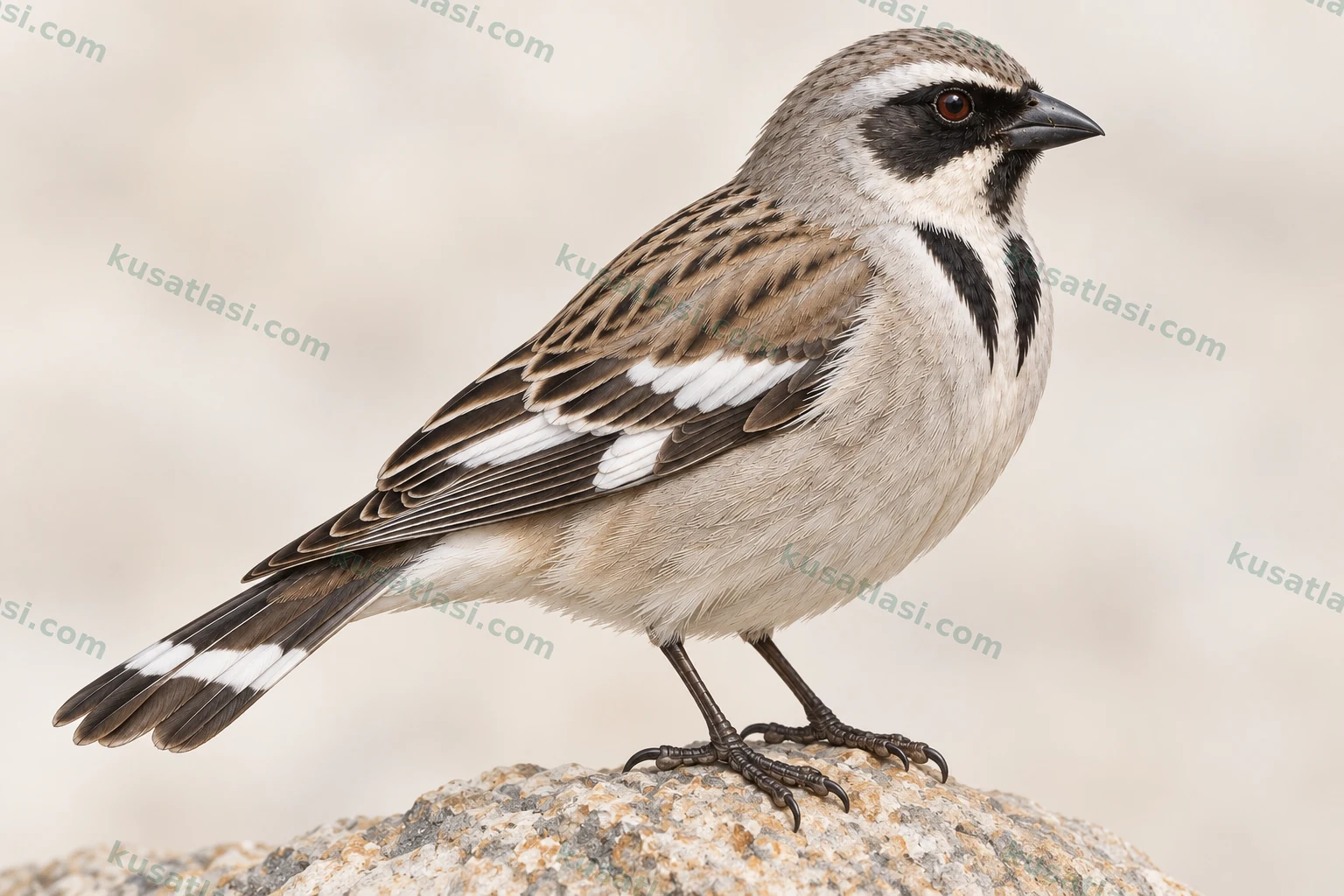
Passeridae
Afghan Snowfinch
Pyrgilauda theresae
Confirmed breeding sites are in Afghanistan’s open, stony mountains.
- Order
- Passeriformes
- IUCN status
- LC · Least ConcernGlobal IUCN. BirdLife v10 (2025); taxon matching: AviList 2026 / IOC 15.2; checked 29 October 2026. Checklist year is not the species assessment date. Source and method · BirdLife
At a glance
- Afghan highlands
Confirmed breeding sites are in Afghanistan’s open, stony mountains.
- Dark face, limited white
Examine the male’s face together with the limited white in its wing.
Biometrics
Length
- Male
- 13–15 cm
- Female
- 13–15 cm
Wing length
- Male
- 9.12 cm
- Female
- 9.12 cm
Weight
- Male
- 23–24 g
- Female
- 24.3–35 g
Length: Shared species value Wing length: Shared species value
World distribution
Afghan Snowfinch
Customise map layers
Observation points
Preparing globe…
Monthly record count
Bars show record counts in this sample, not bird abundance or a breeding calendar. They are affected by recording and observation effort.
Rotate the globe and compare layers. Coloured areas are not exact observation or nest locations.
The source does not provide verified monthly range boundaries. All areas are shown; the month slider and monthly playback are therefore disabled.
- Jan
- Apr
- Jul
- Oct
- Dec
Generalised data and method
Base map: Natural Earth · Public domain
Open central bibliography ↗Calendar
The species breeds locally in Afghanistan; a small number of winter specimens are known from Turkmenistan.
All months: Monthly data have not been verified.
January
February
March
April
May
June
July
August
September
October
November
December
Habitat
Afghanistan, Hindu Kush highlands
Look around Bamiyan and the confirmed mountain breeding areas; winter records are assessed separately.
Sound
Alarm calls from adults were recorded near a nest in Bamiyan. A written description of the calls alone does not provide a reliable identification.
Do not play recordings to attract birds; observe quietly, especially near nests.
Breeding
Two nests in Bamiyan were in what were probably pika burrows. An old source reports five chicks; the typical number of eggs and the duration of incubation have not been verified.
Compare
Compare male and female
Examine the male’s face together with the limited white in its wing.
Species information
Quick Identification
The Afghan Snowfinch Pyrgilauda theresae is a small songbird of Afghanistan's high, open, stony mountains. Its grey-brown body blends into rocky ground while foraging. Adult males show a dark facial area and throat patch together with limited white in the wing; females are warmer brown, with weaker facial markings and less conspicuous wing white. These differences do not safely sex a single distant photograph. Compared with White-winged Snowfinch, its wing white is narrower and overall appearance browner. Region, head pattern, wing and tail are assessed together; the name “snowfinch” does not fit every white-winged bird seen.
Overall Appearance and Posture
The short strong bill suits seeds of low plants and small ground foods. On open slopes it often stands on the ground, advancing a few steps and pausing to inspect it. Males show grey-brown upperparts and a dark face, whereas females give a more beige-brown impression. Fine dark back streaks, white wing areas and contrasting pale and dark tail help identification. Light direction, feather wear and a closed wing can change the apparent white area. Wing white alone risks confusion with other mountain sparrows nearby.
Males, Females and Young Birds
Foreign-language field guides describe dark male face-mask and throat patch, and a paler grey female face with less wing white. These are average differences. Dirt, shade and posture can mislead sexing, especially at a nest entrance. OSME's Bamiyan observation saw two adults near a nest and at least the male carrying food; this pair's division of work is not a fixed rule for all pairs. The sources give no complete verified key separating young from adults. A newly fledged bird should not automatically receive every adult female facial feature.
Appearance in Flight
White wing areas can be easier to see on take-off than with wings folded. They are assessed with grey-brown back and pale-dark tail pattern. White-winged Snowfinch has broader white panels; a momentary flash does not separate the two. Direction and height vary, so identification should not assume one fixed flight style. Flight photographs allow comparison of white placement, tail and face across successive frames. Without a clear close view, identification remains uncertain.
Because spread-wing tip-to-tip length was not reliably verified, the value here is not transferred into that gap. Wing size can contextualize the silhouette, but does not override locality, age or upperwing pattern alone. Combining short flight with perched details reduces errors.
Voice and Behaviour
In OSME's 2008 Bamiyan observations, adult alarm calls were heard near the second nest and at least one male carried food. This was a particular response to an approaching observer, not a complete comparison of every voice type. A written imitation alone does not distinguish it from other mountain calls. If the bird is visible, mask, wing and locality are examined too. Observation stays distant, since approaching an entrance may alter adult feeding routes.
Adults feed in open stony country and enter and leave underground nests during the breeding season. At the first Bamiyan nest, an adult was directly seen carrying an unidentified invertebrate; this does not mean insects at every meal or animal food only for young. Busuttil and colleagues cite an earlier 1965 observation of both parents feeding chicks. Winter dispersal to foothills is not confused with breeding behaviour. Where flock and migration evidence is limited, no exact count or one-way route is asserted.
Confusable Species
1. White-winged Snowfinch Montifringilla nivalis may occur in some Afghan mountains. Broader white panels and different overall contrast are compared. To identify Afghan Snowfinch, look for the browner body, more limited white in the wing and male facial pattern together.
2. Desert Finch Rhodospiza obsoleta may look similarly earth-coloured at distance in dry open terrain. Head and bill shape, back streaks and wing white arrangement are compared; brown body alone does not choose between them.
3. Blanford's Snowfinch Pyrgilauda blanfordi is related but mainly occurs farther east in high Asia. A shared genus does not establish that both species are confirmed to breed in the same area of Afghanistan; doubtful birds require geography and complete plumage pattern.
World Distribution
Confirmed breeding range is high open country of Afghanistan's Hindu Kush. Islam and colleagues' 2024 genetic study says the literature documents only nine breeding-season localities, all in Afghanistan. This does not mean every suitable mountain slope was surveyed; limited access leaves unknown areas.
Status in Its Natural Range
OSME's two Band-i-Amir nests are in Bamiyan Province. Joining points does not create uninterrupted nesting across the Hindu Kush. Habitat includes open stony slopes and plateaus; deserts, forests and every city in Afghanistan are not automatically range.
Migration Journey
It is a local Afghan mountain breeder, with winter specimens reported from southern Turkmenistan. Busuttil, Ayé and Shank in 2010 cite those specimens but treat Tajikistan reports as unconfirmed. Islam and colleagues preserve the distinction in 2024. Afghan breeding and a few cross-border winter records are not one broad continuous breeding belt. It has not been shown that particular individuals pass through the same valley each year, how far they fly, or that the entire species must travel to Turkmenistan. Local altitudinal change after snowfall is possible, but unverified routes are not drawn as certain.
Breeding Habitat
Two Bamiyan nests were in open mountain steppe at about 2,900 and 3,031 metres. One was on an uncultivated slope between fallow cereal field and road, the other in flatter uncultivated steppe near a ranger station. Different sites do not justify only one stony nesting microhabitat. Oiseaux.net lists open stony ground, mountains and some farmland. Presence in mountains does not mean equal abundance in all surrounding agriculture.
Nest Site
Busuttil, Ayé and Shank found two nests in 2008 whose entrances were probably old Afghan pika burrows. At the second the observer reached about 25 cm in without reaching the nest; its interior was not directly seen. They also cite Niethammer's 1965 nest about a metre inside a ground-squirrel burrow, made of hair and feathers and containing five chicks. The presence of five chicks does not establish the species’ typical clutch size. Representative egg numbers and incubation duration were not reliably verified; neither is invented.
Daily Habitat Use
The bird forages on open stony slopes and low vegetation and carries food to burrows during breeding. The food-carrying adult at the first Bamiyan nest was seen on 29 May, adults at the second on 11 June. These dates describe seasonal moments at the nests concerned, rather than an exact egg-laying calendar for all Afghanistan. Reaching into tunnels or staying at entrances can disrupt feeding. Stony ground, nest burrows and nearby feeding areas should be protected together.
What Does It Eat?
Oiseaux.net classifies Afghan Snowfinch mainly as a ground seed-gatherer. Small plant seeds on open rocky ground are the main food category. No species-specific quantitative stomach or faecal study on plant and season was verified here, so plant names are not added without evidence. Busuttil and colleagues directly saw an adult carrying an unidentified invertebrate to the first Bamiyan nest in 2008. This shows animal food can be delivered to young, not a fixed year-round insect share for every adult. Source type and observation context keep the account honest.
How Does It Forage?
As it moves over the ground, the bird uses its bill to pick up exposed grains or those that have fallen from low plants. “Hunting” here is not only animal capture; seed gathering is central. The 2010 note did not establish where or how the invertebrate carried to the nest was caught. Aerial insect-catching, following specific prey or daily feeding distance are therefore not fixed species traits. Recording slope vegetation, snow and season supplies research context. Food at one nest does not give a whole-population diet table.
The Name and Family
It belongs to Passeridae; the common name “snowfinch” does not place it in true finches, Fringillidae. Cornell's Clements list puts former Montifringilla theresae under Pyrgilauda theresae. Islam and colleagues’ 2024 study of DNA from museum specimens also supports the separation of the Pyrgilauda and Montifringilla groups. Old and new genera are not two Afghan species.
An Underground Nest
Alarm calls at the entrance were recorded in the context of the researchers' approach.
Few Records Require Care
The 2024 molecular study mentions only nine known breeding-season sites and no world population estimate. This lack of research does not prove that the bird can live on only nine slopes. Turkmenistan winter specimens are kept separate from Afghan breeding; Tajikistan claims remain doubtful in the same sources. The study's historical “out-of-Tibet dispersal” is a model inference about millions of years of evolution, not today's annual migration.