
World Birds
Field identification plates
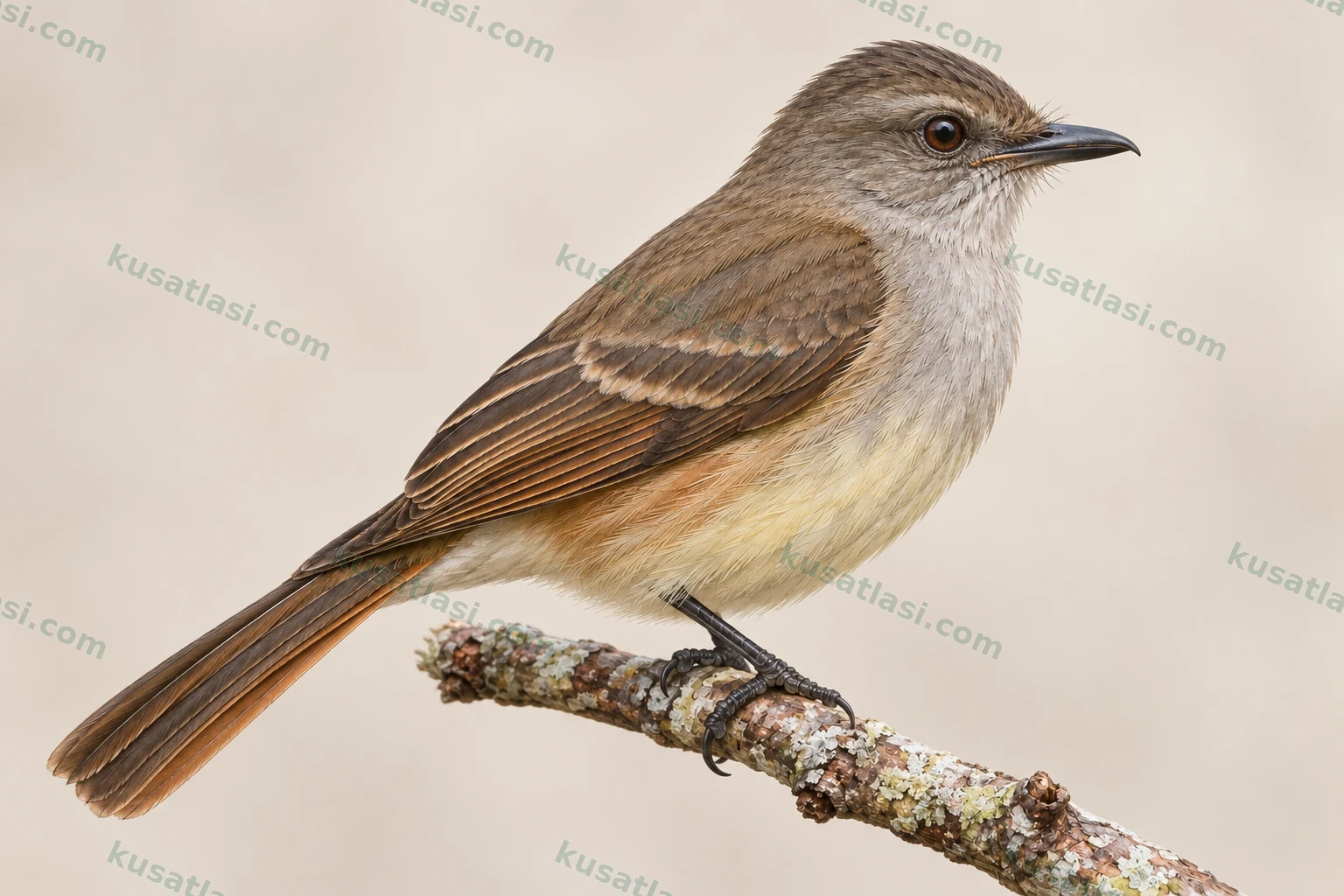
Swipe left or right between the two adult plates.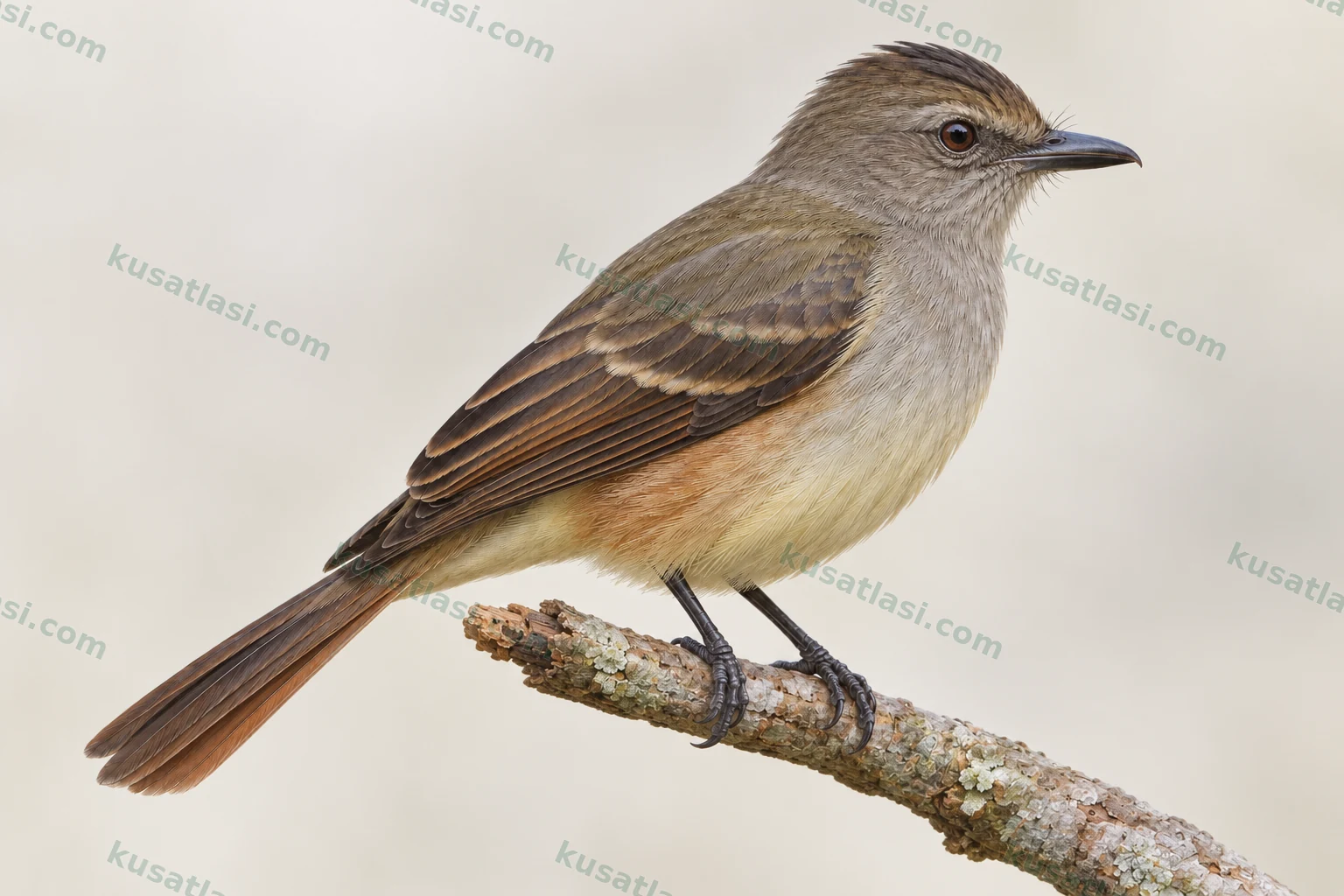
Tyrannidae
Pale-bellied Mourner
Rhytipterna immunda
Assess the rounded head with the relatively small bill.
- Order
- Passeriformes
- IUCN status
- LC · Least ConcernGlobal IUCN. BirdLife v10 (2025); taxon matching: AviList 2026 / IOC 15.2; checked 29 October 2026. Checklist year is not the species assessment date. Source and method · BirdLife
At a glance
- Look at head and bill together
Assess the rounded head with the relatively small bill.
- Compare breast and belly
Watch the slight colour change under similar lighting.
- Listen to natural sound
A full, sliding whistle may reveal the hidden bird.
Biometrics
Length
- Male
- 18–19 cm
- Female
- 18–19 cm
Wing length
- Male
- 8.6 cm
- Female
- 8.6 cm
Weight
- Male
- 25–30 g
- Female
- 25–30 g
Length: Shared species value Wing length: Shared species value Weight: Shared species value
World distribution
Pale-bellied Mourner
Customise map layers
Observation points
Preparing globe…
Monthly record count
Bars show record counts in this sample, not bird abundance or a breeding calendar. They are affected by recording and observation effort.
Rotate the globe and compare layers. Coloured areas are not exact observation or nest locations.
The source does not provide verified monthly range boundaries. All areas are shown; the month slider and monthly playback are therefore disabled.
- Jan
- Apr
- Jul
- Oct
- Dec
Generalised data and method
Base map: Natural Earth · Public domain
Open central bibliography ↗Calendar
The April record and Brazilian study dates document presence; they are not a verified annual breeding or migration calendar.
All months: Monthly data unverified.
January
February
March
April
May
June
July
August
September
October
November
December
Habitat
Patchy low forest and scrub in Amazonia and the Guianas
In low forest and scrub, assess rounded head, small bill and weak breast–belly contrast together with the natural whistle.
Sound
Its full, sliding whistle helps locate it. The Schiffornis comparison concerns sound quality, not the same family. Assess natural sound with head, bill and breast–belly contrast.
Do not play recordings to attract birds; observe quietly, especially near nests.
Breeding
Nest structure, typical clutch size, incubation and chick development periods were not verified for this species. The 2017 paper notes that these details were unavailable then; the described nest belongs to Rhytipterna holerythra and is not used here.
Compare
Compare male and female
Watch the slight colour change under similar lighting.
Species information
Quick identification
The Pale-bellied Mourner is an unobtrusive flycatcher of patchy low forest and scrub in tropical South America. Its rounded head, relatively small bill and rather gentle colour transition from breast to belly help distinguish it from the Myiarchus species it initially resembles. A pale belly alone is insufficient: assess the side profile of the head, bill proportions, transition across the underparts and natural voice together. It can remain unnoticed among leaves; its full, sliding whistle may reveal its position.
General appearance and posture
The first impression is of a plain, pale-toned flycatcher rather than a brightly coloured, sharply patterned bird. Breast and belly do not form the strong contrast associated with some Myiarchus. Compare both areas under similar lighting: a sunlit belly and shaded breast can exaggerate what is actually a gentle transition. The rounded head and relatively small bill are especially useful together in side view. A momentary head shape in a bird fluffing its feathers, or a bill viewed at a poor angle, is not a conclusive identification on its own.
Its apparently unhurried behaviour is also part of an encounter. It may wait on a branch and make a short sally towards foliage for food. Observing this movement differs from automatically calling any inactive bird a mourner. Watching several steps of natural behaviour is more useful for matching the bird's appearance to the sound actually heard and movement actually seen. When leaves conceal the bill or belly, record only visible features; do not fill hidden areas according to expectation.
Rhytipterna immunda is its accepted scientific name in Tyrannidae. Lipaugus immundus in the original description reflects historical classification; it does not place the bird in the cotinga family today. Scientific studies have compared its appearance and relationships with Myiarchus, especially M. ferox, noting that some relationships remain unresolved. The current Rhytipterna name is retained here. Similar appearance or an open research question does not justify silently changing its genus.
Males, females and young birds
The evidence examined provides no rule for reliably sexing every bird by appearance. The Rondônia table includes one male, two females and, separately, six adults of undetermined sex. Differences between these groups cannot be turned into a size-based sexing key for the entire species. One male's measurement is not the male population average; nor are the extremes of the two females' range allocated to male and female.
The group represented by the shared values in both card boxes is explicitly identified: six adults of undetermined sex. Matching numbers in the boxes do not assert that all adult males and females have identical size. Larger samples of known sex are needed to describe the extent of any consistent sex difference. A bird's weight cannot be measured from how large it looks in the field; two similarly sized birds at different distances are not a reliable ruler comparison either.
No verified species-specific juvenile plumage key or fixed month of eye and feather colour change was found. Features of another Rhytipterna or a young Myiarchus are not substituted. If age is uncertain, describe the plumage and behaviour actually observed. A bird feeding or singing in suitable habitat is not automatically a recently fledged youngster; the observation month alone is no proof of breeding at that time.
Appearance in flight
A short sally from a perch towards foliage may offer a view of the whole silhouette before the bird returns to cover. The feeding movement is useful, but the slight breast–belly difference or bill profile may not be visible during that brief flight. Watching the bird after it settles and hearing its natural whistle help check the first impression. A pale-toned bird crossing a clearing or one short dash cannot establish identity alone.
The evidence used did not verify a measured true wingspan, a diagnostic underwing patch applicable to all birds, or long-distance migratory flight. No migration route is drawn from this measurement. Other migrants occurring in the same Brazilian study do not make this species migratory too.
Voice and behaviour
Voice is especially useful for locating a bird easily overlooked among leaves. The specialist account describes a full, sliding whistle whose quality recalls Schiffornis. That comparison does not imply the same family. Listen to spontaneous calls and match them to head, bill and plain underparts without approaching the occupied branch. The examined evidence is insufficient for a universal syllable transcription or a measured singing frequency here.
At Guayaramerín in Bolivia in April 2005, researchers heard at least three individuals, occasionally seeing them in the upper part of low forest and semi-open scrub with scattered trees. Photographs and audio documented the record. A strong playback response in that study does not mean the bird is certainly absent wherever no response is obtained elsewhere. Ordinary observation listens to natural sound; a research experiment is not turned into advice to stimulate birds repeatedly.
Similar species
1. Myiarchus ferox is an especially important comparison: scientific accounts mention the resemblance, and the Rondônia study recorded both in the same landscape. Assess the mourner's smaller bill, rounded head and weaker breast–belly contrast with its distinctive whistle. Location alone cannot separate two birds sharing part of their range.
2. Other Myiarchus flycatchers can also look similar initially. A genus-level comparison is useful; it does not mean all members have identical plumage or occur together everywhere. Consider which species can actually occur in the region before deciding from belly colour alone.
3. A Schiffornis-like whistle may mislead someone hearing the bird without seeing it. The comparison concerns sound quality; this bird belongs to Tyrannidae. Preserve uncertainty for an unresolved sound-only record. Do not mistakenly combine a nearby bird's song with the appearance of the silent bird first seen.
Global distribution
The species occurs locally in some landscapes of northern and central Amazonia and the Guianas; it is not distributed continuously throughout rainforest. Current taxonomy sources summarize a range from eastern Colombia through the Guianas to Amazonian Brazil. Regional scientific accounts identify patchy white-sand or savanna-like areas in the Negro basin and parts of Pará, Amapá, Tocantins, Rondônia and Mato Grosso. Local records do not demonstrate presence throughout the intervening forests.
Tobias and Seddon documented the April 2005 record at Guayaramerín in northeastern Bolivia with photographs and sound, publishing it in 2007. In that dated account it was the first Bolivian record and first west of the Madeira. Their suggestion that it might be more widespread in suitable forests of Beni and Pando is not a completed survey finding it everywhere. Historical first records are assessed with their dates.
Regional status
The global LC category and rare or locally frequent encounters describe different scales. Ten birds caught in the Rondônia study demonstrate local presence under that method, not the world population or abundance everywhere. Date, habitat, location and research effort matter when interpreting a record. Sand extraction, logging and infrastructure pressures were documented at the Brazilian study site; that one study did not thereby measure the species' global decline rate.
Migration
The examined records provide no monthly long-distance migration route or travel distance. Short flights within forest are distinguished from migration. The migrant percentage in the Brazilian paper concerns the whole bird community, not this species specifically. Observation months remain local records, rather than becoming an annual migration or breeding calendar.
Breeding habitat
Scrub and low forest associated with nutrient-poor soils form the basis of records. A white-sand vegetation study places the species in a group largely associated with that environment while giving savanna as an alternative; this is not absolute dependence on every bare patch of sand. The Miratinga site in Brazil has dense shrubs, scattered short trees and nearby modified forest. Bolivian researchers explicitly distinguished low forests on other poor substrates from white-sand vegetation. Similar plant structure does not prove identical soil.
Nest site
Verified species-specific nest structure, typical clutch size, incubation and chick development periods were not accessible. The 2017 nest study concerns Rhytipterna holerythra and notes that comparable breeding details for R. immunda were unavailable then. That bird's tree cavity, materials and eggs are not transferred here. A dated lack of knowledge differs from claiming no later observation could possibly have been made.
Daily space use
Hard to notice in foliage, the bird waits on branches and makes short sallies towards leaves. Bolivian individuals were seen in the upper part of low forest and adjacent semi-open scrub. It can occur alone or in loose association with other species; no quantitative daily route or territory size was verified. Apparently suitable scrub does not guarantee presence. Observe from existing trails and preserve surrounding vegetation.
What does it eat?
The specialist account reports insects and fruit. An ecological compilation also places it in the invertebrate-feeding group; this broad classification is not a complete food list and does not invalidate the fruit record. Fruit–insect proportions, seasonal prey rankings and a detailed stomach-content list were not verified. The menu of similar-looking Myiarchus or other mourners is not substituted. Quiet waiting does not mean feeding only at night or only on the ground either.
How does it hunt?
It takes insects by sallying from a perch towards foliage. Its unhurried appearance can therefore include short purposeful movements rather than continuous pursuit in open air. Loose association with other birds does not establish a permanent mixed flock in every record. Describe prey capture only when actually seen and the item taken can be identified. Placing fruit, attracting insects or cutting leaves alters natural conditions. No numerical contribution to reducing agricultural pests is given without evidence.
Sound helped expand the known range
At least three birds were heard and occasionally seen in Guayaramerín's low forest. Publication as the first national record in 2007 describes knowledge at that time; it does not mean a newly arrived or newly formed population. Better recognition can change a known range without a new migration taking place.
A small area can matter
The scientific assessment places the bird in a group closely associated with white-sand vegetation while also including savanna. An area of low plants and poor soil can support a distinctive bird community. This is a qualitative habitat assessment, not experimental proof that every sandy clearing contains the bird or that soil alone causes its distribution.
Local frequency is not global abundance
Rondônia researchers caught ten birds during their study and collected five as scientific specimens; these are research records, not nest numbers. Local encounter frequency and global conservation status answer different questions. Habitat degradation was documented there, but a global population decline rate cannot be calculated from that alone. This distinction keeps field knowledge useful without turning a limited sample into the species' entire life history.