

World Birds IUCN statusLC · Least ConcernGlobal IUCN category. BirdLife v10 (2025); taxon matching: AviList 2026 / IOC 15.2; checked: 29.10.2026. The list year is not the species assessment date. Source and method · BirdLife OrderAnseriformesDucks, geese and allies FamilyAnatidaeAnatidae
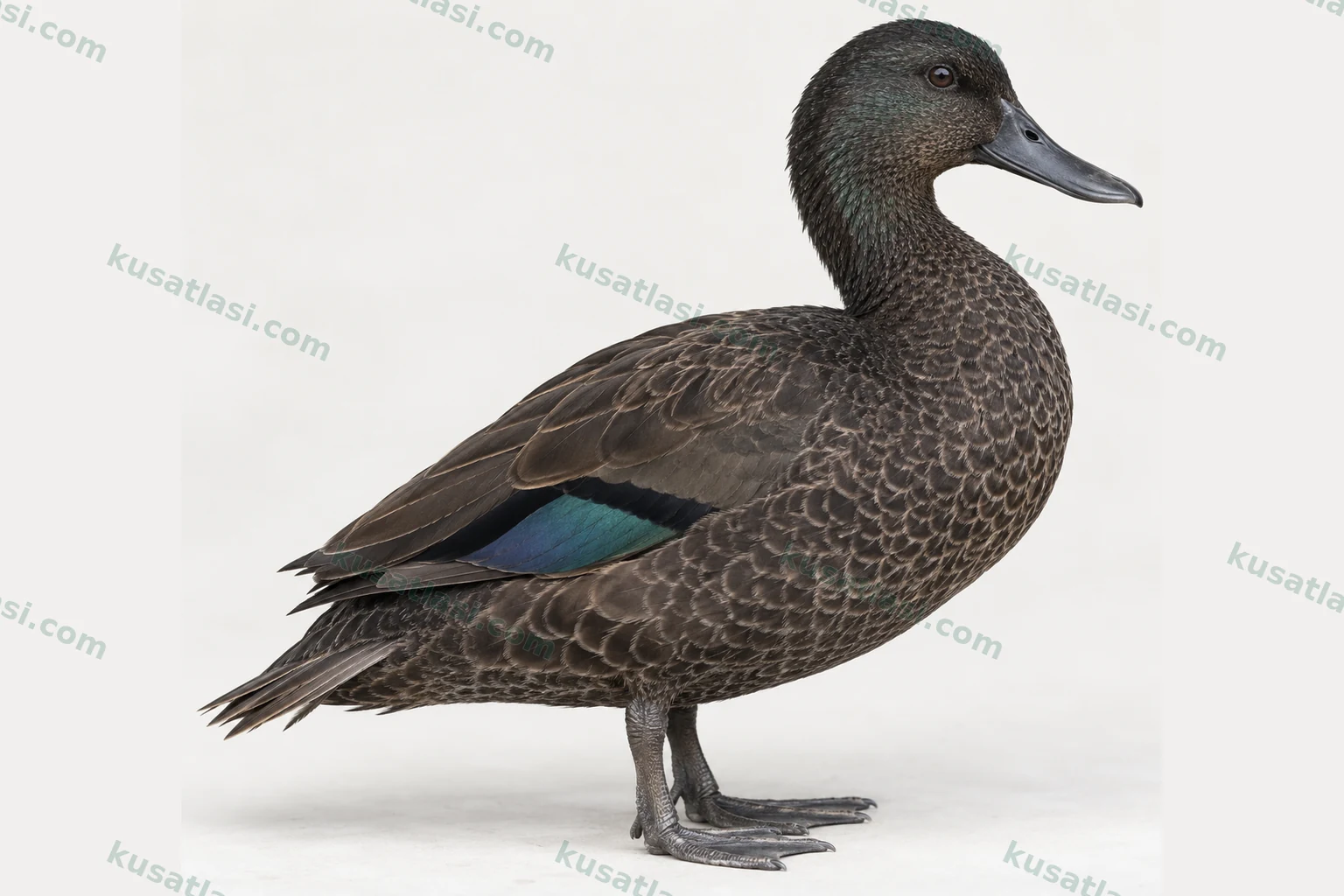
African Black Duck
Anas sparsa
Dark body, white marks above, bill not bright yellow; secretive duck of wooded streams.
Biometrics
Length
Male48–58 cm
Female48–58 cm
Shared species value
Wing length
Male24.74 cm
Female24.74 cm
Shared species value
Weight
Male950–1156 g
Female820–1055 g
African Black Duck
Wooded rivers of sub-Saharan AfricaObservation guide in its natural range
Look for three features together
Do not rely on a single featureDistinguish real feather marks on back and upper tail from water reflections.
Check the non-yellow bill with darker, plainer underparts.
Sexes look alike; assess young and adult patterns together.
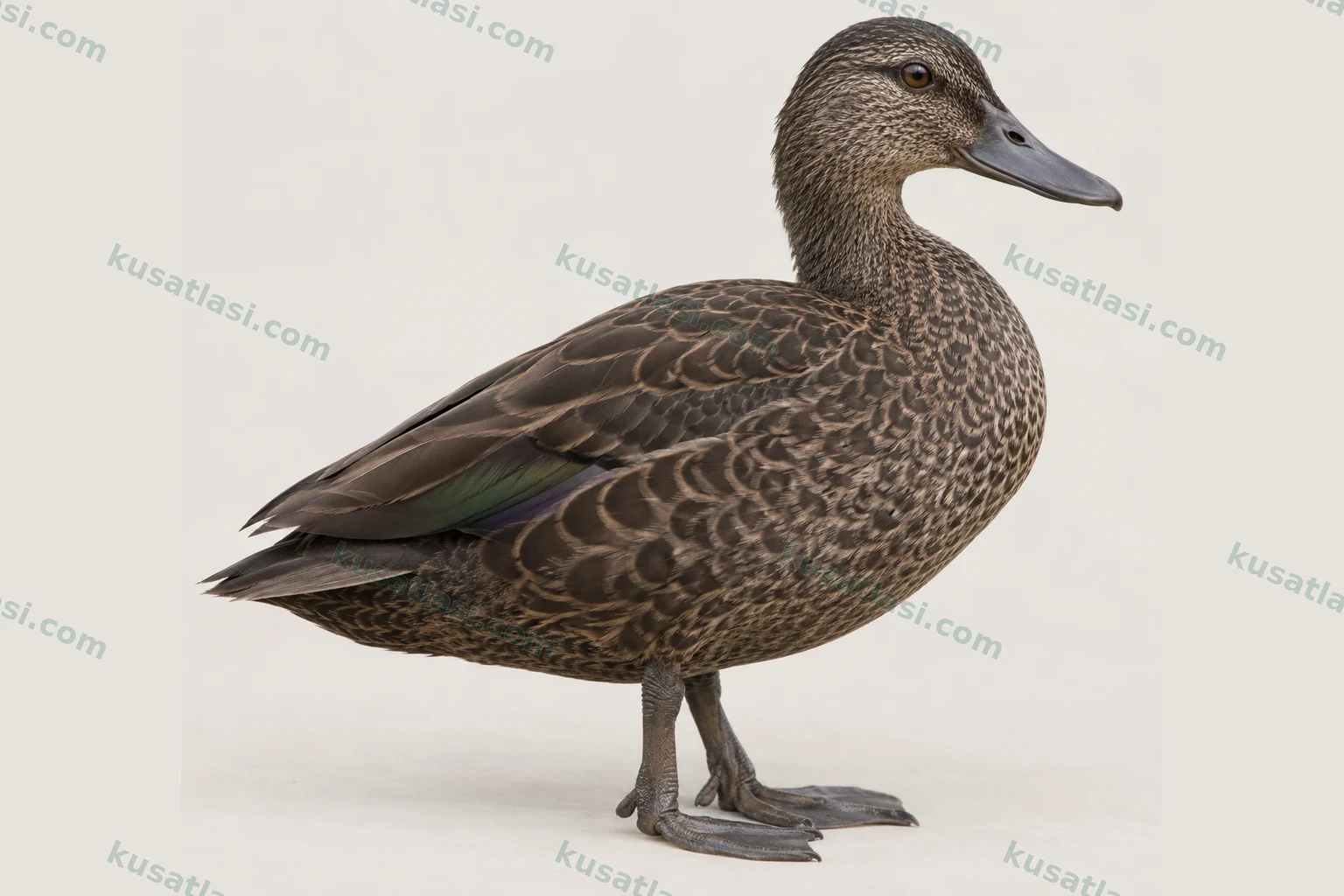
Compare male and female
 FemaleMale
Adult sexes look alike; small size or a white mark alone does not determine sex.
Where to look in its natural range?
Look for sections combining current, still pools and bank cover.
Regional laying periods from the dated South African atlas are shown; seeing ducklings is not a laying date.
January
Essentially resident; local movements between rivers and roosting areas. Transvaal, dated atlas: egg-laying, with a July peak. Zimbabwe, dated atlas: records throughout the year, with more in June–October.
February
Essentially resident; local movements between rivers and roosting areas. Zimbabwe, dated atlas: records throughout the year, with more in June–October.
March
Essentially resident; local movements between rivers and roosting areas. Zimbabwe, dated atlas: records throughout the year, with more in June–October.
April
Essentially resident; local movements between rivers and roosting areas. Zimbabwe, dated atlas: records throughout the year, with more in June–October.
May
Essentially resident; local movements between rivers and roosting areas. Zimbabwe, dated atlas: records throughout the year, with more in June–October.
June
Essentially resident; local movements between rivers and roosting areas. Transvaal, dated atlas: egg-laying, with a July peak. Zimbabwe, dated atlas: records throughout the year, with more in June–October.
July
Essentially resident; local movements between rivers and roosting areas. Southwestern Cape, dated atlas: egg-laying, with an August–September peak. Transvaal, dated atlas: egg-laying, with a July peak. Zimbabwe, dated atlas: records throughout the year, with more in June–October.
August
Essentially resident; local movements between rivers and roosting areas. Southwestern Cape, dated atlas: egg-laying, with an August–September peak. Transvaal, dated atlas: egg-laying, with a July peak. Zimbabwe, dated atlas: records throughout the year, with more in June–October.
September
Essentially resident; local movements between rivers and roosting areas. Southwestern Cape, dated atlas: egg-laying, with an August–September peak. Transvaal, dated atlas: egg-laying, with a July peak. Zimbabwe, dated atlas: records throughout the year, with more in June–October.
October
Essentially resident; local movements between rivers and roosting areas. Southwestern Cape, dated atlas: egg-laying, with an August–September peak. Transvaal, dated atlas: egg-laying, with a July peak. Zimbabwe, dated atlas: records throughout the year, with more in June–October.
November
Essentially resident; local movements between rivers and roosting areas. Southwestern Cape, dated atlas: egg-laying, with an August–September peak. Transvaal, dated atlas: egg-laying, with a July peak. Zimbabwe, dated atlas: records throughout the year, with more in June–October.
December
Essentially resident; local movements between rivers and roosting areas. Southwestern Cape, dated atlas: egg-laying, with an August–September peak. Transvaal, dated atlas: egg-laying, with a July peak. Zimbabwe, dated atlas: records throughout the year, with more in June–October.
Nest, egg and incubation
The female builds a grass-and-down cup, concealed on the ground near water. The specialist South African account gives 4–11 eggs and female incubation of 28–32 days; ducklings enter water early and fly at about 77 days.
Low short duck calls, possibly masked by running water.
Do not play recordings to attract birds; observe quietly, especially near nests.
Species information
Quick identification
The African Black Duck Anas sparsa is a duck of wooded riverbanks, with conspicuous white marks on its dark brown body. The head, neck and breast usually appear as one dark unit, distinct from the pale spots on the back and upper side of the tail. The bill is not bright yellow; pale pinkish areas and dark parts can be visible together. Orange legs, a short, strong-looking neck and dark underparts are supporting features. Assess the white back marks, bill colour and body pattern together when identifying it.
The word black in its name does not mean that the feathers must look coal-black in every light. They can appear chocolate brown in sunshine and very dark in shade. White reflections from foaming water can also be confused with true feather markings. Watching several postures of the same bird and checking that the marks move with the feathers is useful. The North American Anas rubripes has a similar name, but these are separate taxa; their measurements, ranges and breeding information must not be transferred between them.
General appearance and posture
A swimming adult has a dark back with pale markings that look like irregular spots or short bars. The breast and belly do not show the extensive pale-edged scaling found in Yellow-billed Duck. The eye is brown. The whole metallic wing panel may not be visible on the folded wing; do not count white on the back and pale wing edges as the same feature. A bill tip darkened by shade does not mean that the entire bill is black. Reducing this species to a single colour category is particularly misleading on flowing water.
The legs become more obvious when the duck rests on a stone at the bank, whereas only its upper body may show in water. A strong-looking neck helps in comparison, but the same bird can show different proportions when it extends its neck or draws its head into its shoulders. Do not estimate the size of a bird emerging from hidden bank cover before seeing its full length. Swimming against the current, crossing a short gap of open water and then retreating into tree shade are observations consistent with river life; every individual need not repeat that sequence continuously.
Males, females and young birds
Male and female have a similar basic plumage pattern. The female may generally be smaller, but distance, posture and the part of the body hidden by water can produce a false size difference. Neither the extent of white on the back nor the darkness of the body is a reliable sex criterion on its own. Even when a pair is seen side by side, do not decide with certainty from appearance alone that the larger one is male. The appearance of the sexes and their roles in incubation and chick care are different questions.
A young bird may be browner, with less conspicuous pale marks and more pale areas below than an adult. A dark-looking bill is not the sole proof of youth either. Feather wear, wetness and light alter the visibility of white markings. Examine head, underparts and upperparts together when assessing age. Small ducklings and juveniles approaching adult size should not be treated as one appearance class; a single spot cannot establish an exact age in months.
Once dry, ducklings are led to water by their mother and seek food themselves. They do not remain immobile in the nest for a long time. The flight age of about 77 days in the specialist South African account is not the same developmental stage as beginning to swim early (regional information for African Black Duck). Recording water entry, first flight and independence separately helps clarify which breeding stage was observed.
Appearance in flight
When the wings open, a metallic panel bounded by pale edges may appear against the dark background. Its blue or greenish sheen changes with viewing angle and must not be used alone for identification. The dark body, pale back and upper-tail markings, and bill that is not bright yellow should be considered together in the flight view. Orange legs may briefly be visible at take-off from the bank; when the legs are hidden, do not record this feature as either seen or absent.
Flying along a river is a movement; one flight does not prove seasonal migration. Studies have tracked individuals moving between rivers and ponds in the same valley. A bird heading towards a dam in the evening is not necessarily starting an intercontinental journey. Its landing place and whether it returns to the same stream next day may be more informative than a brief sighting. Because a true two-wing span has not been verified, it is inappropriate to double a folded-wing measurement to calculate wingspan.
Voice and behaviour
Low, short sounds may be heard alongside duck calls. Water noise can mask the bird’s voice; not hearing it does not show that the bird is absent. Matching a simultaneous sound to the visible bird reduces confusion with other ducks on nearby banks. Calling alone is not evidence of breeding starting either. Resident pairs may defend river sections, with pursuits and attacks on approaching individuals forming part of that defence. Observe natural interactions from a distance rather than use sound to draw the bird in and intensify conflict.
Long-term fieldwork near Stellenbosch showed that partners defended territory together and that some bonds lasted for years. Mate changes were recorded as well, so the findings cannot be summarised as all birds staying with the same mate for life. Non-territorial individuals also exist and may use nearby ponds. Seeing only two birds on a river does not mean that no others occupy the valley; hidden banks and roosting places affect the chance of detection.
Species that may be confused
1. Yellow-billed Duck Anas undulata looks paler, with a scaled pattern of pale feather edges, and adults have a distinctly yellow bill. African Black Duck is distinguished by its darker, relatively plain underparts together with white upperpart marks. When a bill is muddy or in shade, do not decide from the failure to see yellow alone; also check the head, breast and back patterns.
2. Red-billed Duck Anas erythrorhyncha is recognised by the contrast of a dark crown with conspicuously pale cheeks and by its pink-red bill. African Black Duck has a more uniformly dark head. Pale flight feathers and a black line on Red-billed Duck’s flying wing are not the same pattern as the other species’ metallic panel. Both ducks can have dark portions on the bill, so the whole bill and face pattern must be examined together.
World distribution
The African Black Duck is native to sub-Saharan Africa. The highland, wooded river networks of East Africa connect with river regions farther south; more isolated populations are also reported in Central Africa and western areas such as Cameroon, Nigeria and Gabon. This broad picture does not mean that it occupies every body of water in every intervening country. River flow and bank vegetation provide a more meaningful explanation of local occurrence than national borders. Records of the similarly named American duck are not included in this range.
Status within its natural range
The southern African atlas gives particular prominence to eastern river networks, the Lesotho highlands and Zimbabwe. It also occurs on suitable rivers in the southwestern Cape, but is very scarce through much of the arid interior. The absence reported in the dated atlas for the Okavango–Chobe floodplains shows that open wetland alone is not sufficient; it would be wrong to fill that observation with an invented, certain explanation involving food or competitors. An old assessment of distribution is not a present-day count of individuals.
Migration
The species is considered essentially resident and may make short movements between a river, a nearby dam pond and a roost. Rain-related local dispersal has also been reported. Territorial pairs tracked at Stellenbosch remaining on the same river during drought does not mean that every African stream holds water throughout the year under all conditions. A stream drying out and a pair remaining in its territory must be assessed at different scales. No verified monthly route across the continent was found, so no particular sequence of countries is drawn. On the map, samples of records and estimates accompanied by qualifications must be read separately from confirmed breeding areas; one location record does not demonstrate a resident population or breeding.
Breeding habitat
Rivers and streams combining flowing water, deeper quiet pools and wooded banks are the main habitat. Bank vegetation provides hiding and resting places. The water need not flow at the same speed throughout a stream; different sections of a small river may serve for feeding, resting and shelter. Birds roosting on nearby farm ponds do not lose their association with rivers. Assess breeding habitat from the quality of the banks as well as from the blue surface of the water.
Nest site
The female builds a deep cup of grasses and lines it with fine breast down. The nest is usually close to water in a sheltered place among roots, grass cover or a hollow log. The specialist South African account reports 4–11 eggs and female-only incubation lasting 28–32 days (regional expert information for African Black Duck). Do not enter bank vegetation to count eggs, or follow the mother when she leaves the water and thereby reveal the nest. Finding one nest does not show that all nearby pairs are laying at the same time.
Daily habitat use
Swimming, resting on the bank and short flights complement one another within the defended river section. A territorial boundary is not always a visible stone, bridge or stream junction. Mothers with ducklings may use neighbouring sections and conflicts can occur; ducklings do not follow boundaries drawn by people. Water abstraction, pollution, siltation and loss of bank vegetation are pressures that need to be considered together. Do not declare a single cause of decline in a basin without measuring their local effects; maintaining suitable flow and bank refuges directly relates to the species’ needs.
What does it eat?
Recorded foods include aquatic insect larvae, small crustaceans, molluscs, crabs and small fish; plant foods such as fruits, cereal grains and acorns are also eaten. The expert account explicitly states that the composition of the diet is not sufficiently known. A few food records therefore cannot establish an animal-to-plant proportion that applies throughout the continent. Seeing an adult eat an acorn does not show that small ducklings would receive adequate nutrition from the same food. The sizes of food that adults and ducklings can swallow must be considered separately.
How does it forage?
It gathers food at the surface and in shallow water, may filter water with its bill, and can extend its reach by lowering the head and raising the rear of the body. Ducklings have also been reported feeding by diving or following insects on the water surface. Not every feeding movement targets the same prey; if no fish emerges from a dipped bill, a fish capture must not be assumed. Activity around sunrise and sunset can help locate the bird on a wooded river, without implying that all feeding is confined to those hours.
Food abundance in a river section may be related to defence of that section, but explanations proposed by an old field study are not direct experimental results. Counting actual feeding events while also recording current, water level and bank cover is more informative. Giving the bird bread, grain or other food is not a method of studying its natural diet; it changes the observed behaviour and adds a burden to the stream ecosystem.
Why does a river section matter?
In the research carried out near Stellenbosch in the 1970s, marked birds were tracked repeatedly. Many location records of one individual do not mean an equal number of different ducks. The strength of the work lies in combining the movements of known individuals over time, rather than in a single photograph. Intensive tracking in the early years and intermittent tracking later on do not have the same sampling frequency; that distinction must be retained in long-term interpretations.
On the Eerste River, the average length of a section defended by a pair was about 700 m. This is the length measured along the river in that study, not an obligatory territory area for every African Black Duck or a value in square metres. Neighbouring pairs, non-territorial birds, and the food and shelter available along the banks may influence how boundaries form. The researchers discussing these possible explanations does not mean that any one of them is proved in every basin.
Pair bonds and care roles
Some pair bonds were observed to last for years, but mate changes and territories being taken over by other birds were also recorded. Together, these observations describe the species’ social life more accurately. Joint territorial defence is not the same as equally shared incubation; in the regional expert account, the female incubates. A mother accompanying ducklings by day and a pair occupying the same area at night are not the same act of care either. Summarising the roles in a single statement about fidelity loses important details.
Water quality as well as presence
A broad expanse of open water is not the same habitat as a wooded stream. A succession of currents, quiet pools and hiding places along a river offers different opportunities for daily use. A bird seen on a dam pond does not prove that this pond can replace an entire river corridor. Likewise, a pair remaining at a low water level does not mean that abstraction has no effect. Monitoring flow, food and bank cover together is more meaningful than looking only at total water area.
The species’ dark appearance and dense bank vegetation can cause it to be overlooked during short visits. Not seeing it on one day does not confirm absence; regular, repeated observations without disturbance are needed. Ducklings entering the water early also gives no reason to regard them as able to fly or independent of their mother. Distinguishing these life stages produces both more accurate records and more considerate observation.