

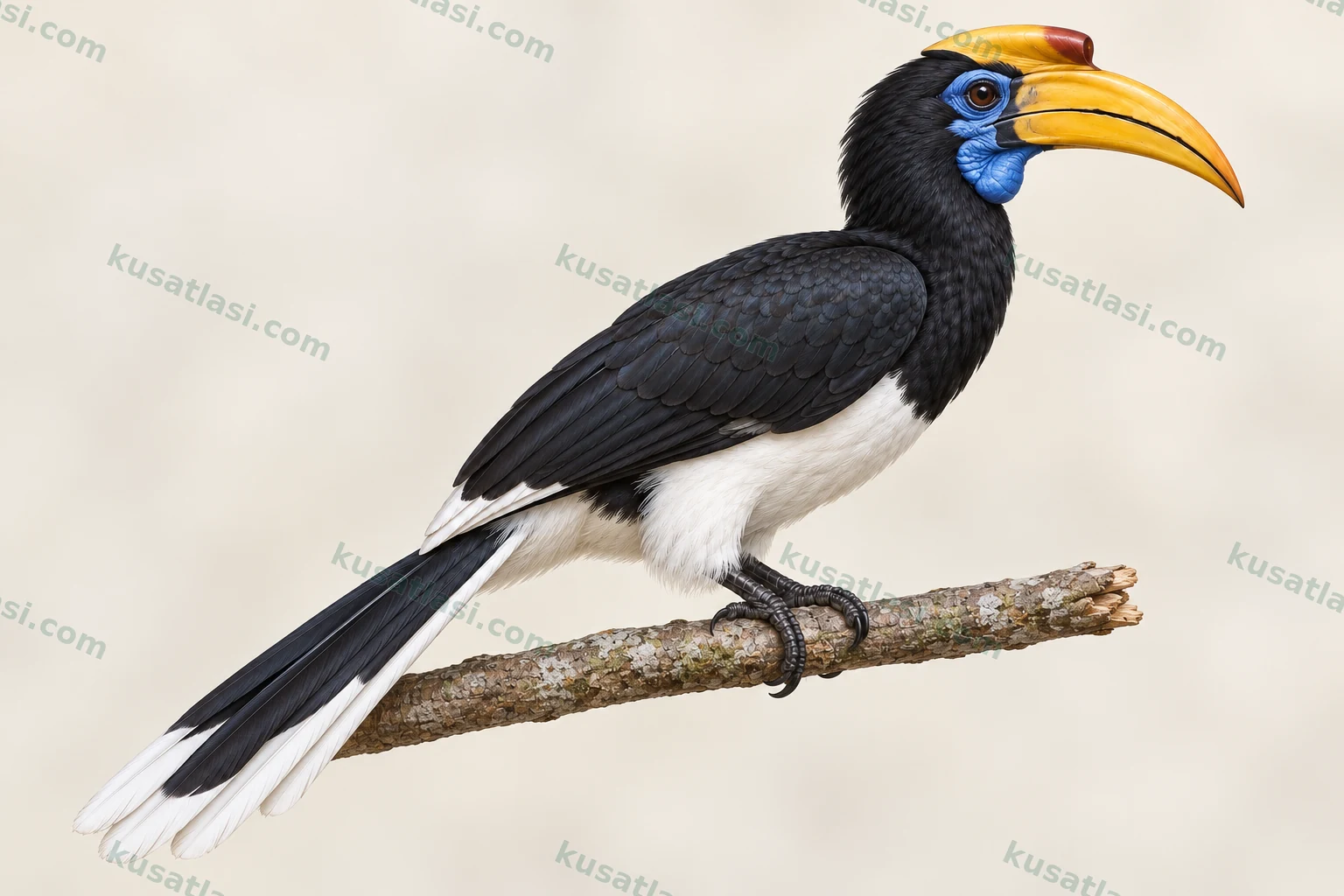
World Birds IUCN statusLC · Least ConcernGlobal IUCN category. BirdLife v10 (2025); taxon matching: AviList 2026 / IOC 15.2; checked: 29.10.2026. The list year is not the species assessment date. Source and method · BirdLife OrderBucerotiformesBoynuzgagalar FamilyBucerotidaeBucerotidae
Congo Pied Hornbill
Lophoceros fasciatus
The former broad African Pied Hornbill has been split into two species.
Biometrics
Length
Male50 cm
Female50 cm
Shared species value
Wing length
Male26.18 cm
Female26.18 cm
Shared species value
Weight
Male250–316 g
Female227–260 g
Congo Pied Hornbill
Central AfricaObservation guide in its natural range
Look for three features together
Do not rely on a single featureThe former broad African Pied Hornbill has been split into two species.
The blue bare eye surround, bill tip and tail are assessed together.
Compare male and female
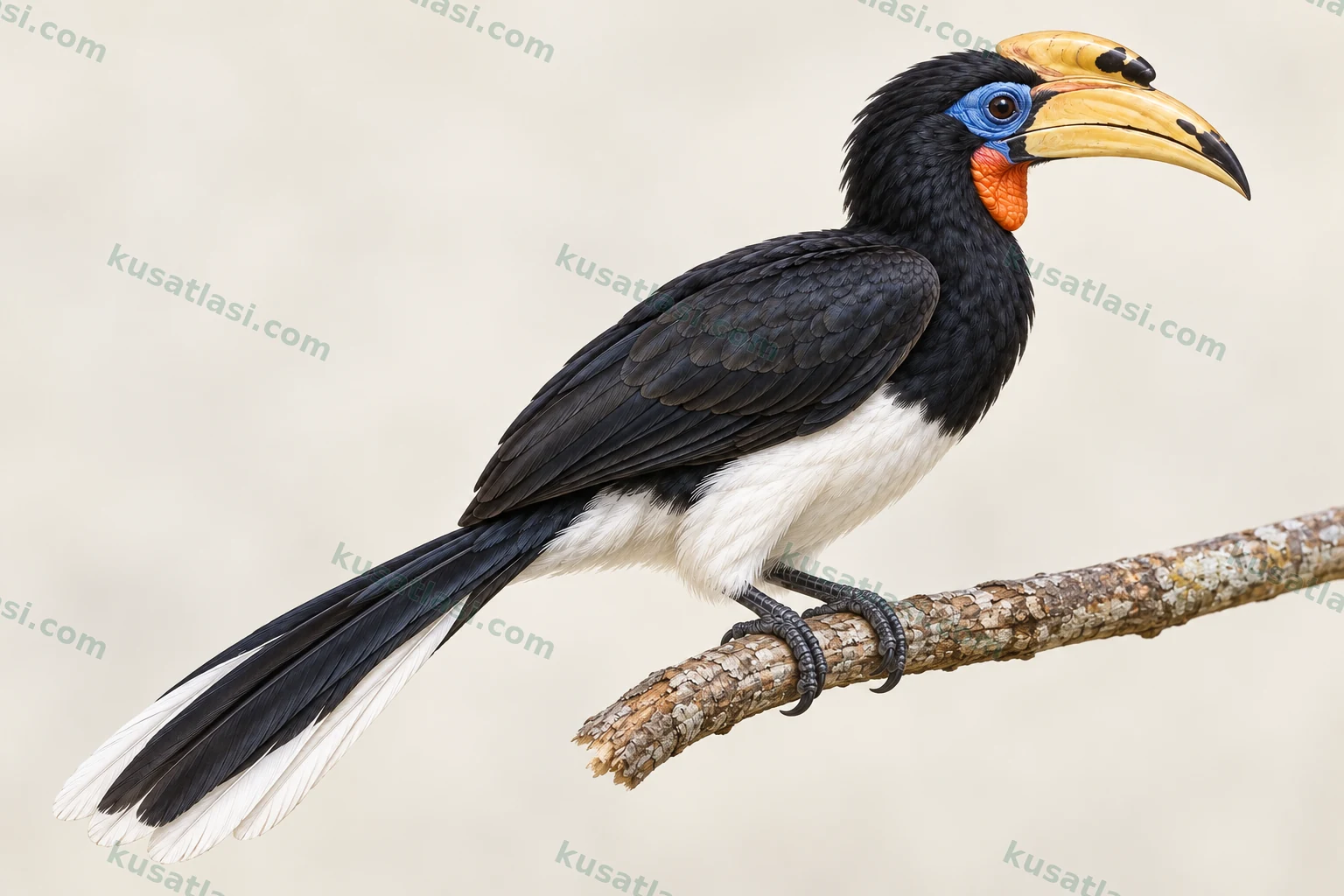 FemaleMale
The blue bare eye surround, bill tip and tail are assessed together.
Where to look in its natural range?
The range extends from southeastern Nigeria and southern Chad to Uganda, and south to northern Angola; detailed boundaries await confirmation.
The single regional nest observation in Cameroon does not establish a monthly calendar for the entire species.
All months: monthly data have not been verified.
January
February
March
April
May
June
July
August
September
October
November
December
Nest, egg and incubation
A reliable typical egg count and incubation duration have not yet been verified for the narrowly defined Congo species; they have not been transferred from another species.
Do not play recordings to attract birds; observe quietly, especially near nests.
Species information
Quick Identification
This record's scientific name is Lophoceros fasciatus. Although the Turkish catalogue retains its old broad Turkish name, current IOC and Cornell treatments divide that former broad concept: this is Congo Pied Hornbill, while western Lophoceros semifasciatus is separate. The distinction comes before combining similar black-and-white birds on maps or measurement cards. Glossy black upperparts, white belly and outer tail feathers, long pale bill and bare dark blue skin around the eye together identify it. A black-and-white body alone is insufficient. Poor light can hide which tail feathers are white or the bill-tip colour.
The IUCN Hornbill Specialist Group describes male Congo birds with long white sections on the outer tail and reddish tips to yellow bill and casque. Females have smaller bill and casque, black tip marking and possibly orange bare throat patch. West African Pied Hornbill has white more confined to tail tips and different dark bill-tip marks. Cornell notes subtle differences and a contact zone near Nigeria requiring care. Without visible white-tail shape in a distant photograph, identification stays within the image's limits. Old Tockus fasciatus records cannot be automatically assigned to the two current species without geography.
Overall Appearance and Posture
It is a medium-sized hornbill with a conspicuous head and large bill relative to its body. Black upper feathers gleam with light, the belly is clean white. Pale wing and tail areas stand out in movement. Bare eye skin forms a bluish ring. Throat skin and dark-reddish bill marks may help sexing, but distance, age and image colour blur them.
Males, Females and Young Birds
Both sexes share the black-and-white body, but the expert description gives smaller females with less-developed bill and casque. The male’s reddish bill tip, the female’s black tip and the different bare throat patches can be assessed together in close, well-lit views. Bill size alone is unsafe while a young bird's bill develops.
Young may have small pale yellowish bills without a pronounced casque. White outer-tail arrangement can differ from adults. Missing red in a young photograph therefore does not prove female. Development, body, bill and tail are considered together for age and sex. Cavity breeding is known across hornbills, but no clutch or incubation days unverified by an accessible Congo-specific study are given here. Disturbing a cavity for female-and-chick photographs may disrupt observation and breeding.
Appearance in Flight
Black wings contrast with white belly and pale outer tail in flight. Short glides may interrupt flapping as it passes treetops. Bill length and casque shape can disappear with angle. White confined to outer-tail tips versus extending much of their length matters against the western species, but a blurred tail is unreliable. Upper- and underwing marks need separate verification; a striking silhouette alone is not certain identification.
Voice and Behaviour
The IUCN account verbally describes thin high whistled notes and a territorial sequence that may rise and fall. This informs behaviour. Related hornbills can call high too. Without date, place and seen features, voice alone does not safely separate these two. Pairs or small families are frequent; a crowd in a fruiting tree is not a permanent colony. The source calls it resident in most places, but one count point cannot show a lifetime in one tree.
The account describes searching outer crowns for fruit and invertebrates, sallying for insects and descending for fallen fruit. These can all occur in the same bird. Threat, pair and feeding-group sounds should not be confused. An old Tockus fasciatus report records nestlings fed in Cameroon mountains; without locality and broad-taxon review it cannot supply a breeding calendar for all Congo birds. Any natural recording later requires species, licence and attribution checks separately.
Confusable Species
1. West African Pied Hornbill Lophoceros semifasciatus was formerly combined here. Similar wings and body differ in outer-tail white and bill-tip marks. Old broad maps are not directly used.
2. Crowned Hornbill Lophoceros alboterminatus can give a black-and-white impression. Bill and tail together, geography and habitat give better comparison than one white patch.
World Distribution
Current Lophoceros fasciatus does not occupy the whole former “African Pied Hornbill” range. The IUCN group describes southeastern Nigeria and southern Chad to Central African Republic, South Sudan, Uganda and Rwanda, south through Cameroon, Equatorial Guinea, Gabon, Congo, northern Angola and south-central Democratic Republic of the Congo.
Status in Its Natural Range
This is not an instruction to fill countries; not every town or clearing is occupied. Suitable pieces between rainforest, secondary forest and wooded transition matter. Western Senegal- and Ghana-centred records now require comparison with L. semifasciatus. Nigeria's possible contact or hybrid zone is more complex than a sharp line and needs separate geometric verification.
Migration Journey
The IUCN group calls it mostly resident and probably territorial widely. Moving among fruiting trees is not intercontinental migration. A 2025 rainforest study considers counts across years at a particular site; observations there do not show a bird’s complete annual route. Record point, habitat and definite breeding range are different layers. Loss and fragmentation may affect local movements, but their size is not presented as measured here.
Breeding Habitat
The IUCN group lists primary lowland rainforest, adjacent secondary forest, deciduous woodland, some oil-palm areas and farmland retaining old trees. The main setting is tropical wooded habitat; not every forest habitat of the western species is transferred to this taxon. Most reports range from the lowlands to about 900 m. This does not rule out an isolated higher observation in Cameroon, but neither makes it a typical elevation for the species. Fruiting time and large cavities are different resources. A feeding tree is not automatically a nest tree.
Nest Site
Hornbills generally breed in cavities, but accessible sources explicitly tied to today's narrow Congo taxon did not verify a typical egg count or a reliable incubation duration. Numbers are not borrowed from another hornbill or the old two-species group. A foreign Bakossi field report under Tockus fasciatus records noisy nestlings being fed and links laying to January; evidence is local only. Shining light into an entrance or climbing the tree can alter the adults’ behaviour. Occupancy is watched distantly over time.
Daily Habitat Use
It feeds in high crowns, on outer branches and at fruiting places; it may sally for a flying insect or descend for fallen fruit. Pairs or small family groups are common, and larger gatherings at a fruiting tree are possible. Communal roosts are reported, not single breeding colonies. Forest openings, secondary growth and field edges are not equally permanent habitat. Separating feeding, resting, nesting and incidental passage improves maps.
What Does It Eat?
The IUCN group describes fruit and small animals in roughly similar shares, not measured percentages for every season and forest. Invertebrates include grasshoppers, cicadas, mantises, butterflies, caterpillars and winged termites, plus spiders, ants and wasps. Lizards, tree frogs, rodents, bats or other birds' chicks may occur rarely. An observation of taking prey from a nest does not establish it as the main food of every individual. The fruit species eaten also vary regionally; unverified plants are not listed.
How Does It Feed?
It may move to outer crowns for fruit, sally briefly for flying insects or descend for fallen fruit. Kitamura’s 2011 review shows that hornbills can transport seeds after eating fruit pulp, but distances discussed at the level of the taxonomic hornbill family are not measurements of this Congo species. The 2025 forest census documents the research area where the species occurred, not every feeding event there. An unknown item in a bill is not confidently named. Time, tree position and movement are added to the record.
A Boundary behind a Changed Name
Old African Pied Hornbill and Tockus fasciatus records may include western and Congo birds. IOC and Cornell now recognize Lophoceros fasciatus as the Congo species and L. semifasciatus as a separate West African species. The old broad Turkish heading remains, but prose follows the recorded scientific taxon only. Western ends are not added to maps from habit.
What the Tail Shows
The description of male Congo birds gives long white sections on the outer tail feathers, while the white of the close western species is more concentrated at the tips. A clear rear image can thus matter. Young and worn feathers change appearance, so geography and bill are also compared.
Limits of a Field Record
Fed nestlings in Cameroon's Bakossi under the old name are concrete local breeding evidence, not January laying across Central Africa. Clutch size and incubation duration are not invented until verified for the separated taxon. Distant undisturbed nest-tree observation benefits bird and evidence.
Correct name matching sets how old records can be used. Western records of the old group do not automatically join Congo; a renamed record and a record assigned to another taxon are different cases.