

World Birds IUCN statusLC · Least ConcernGlobal IUCN category. BirdLife v10 (2025); taxon matching: AviList 2026 / IOC 15.2; checked: 29.10.2026. The list year is not the species assessment date. Source and method · BirdLife OrderGalbuliformesJacamars and puffbirds FamilyGalbulidaeGalbulidae
White-throated Jacamar
Brachygalba albogularis
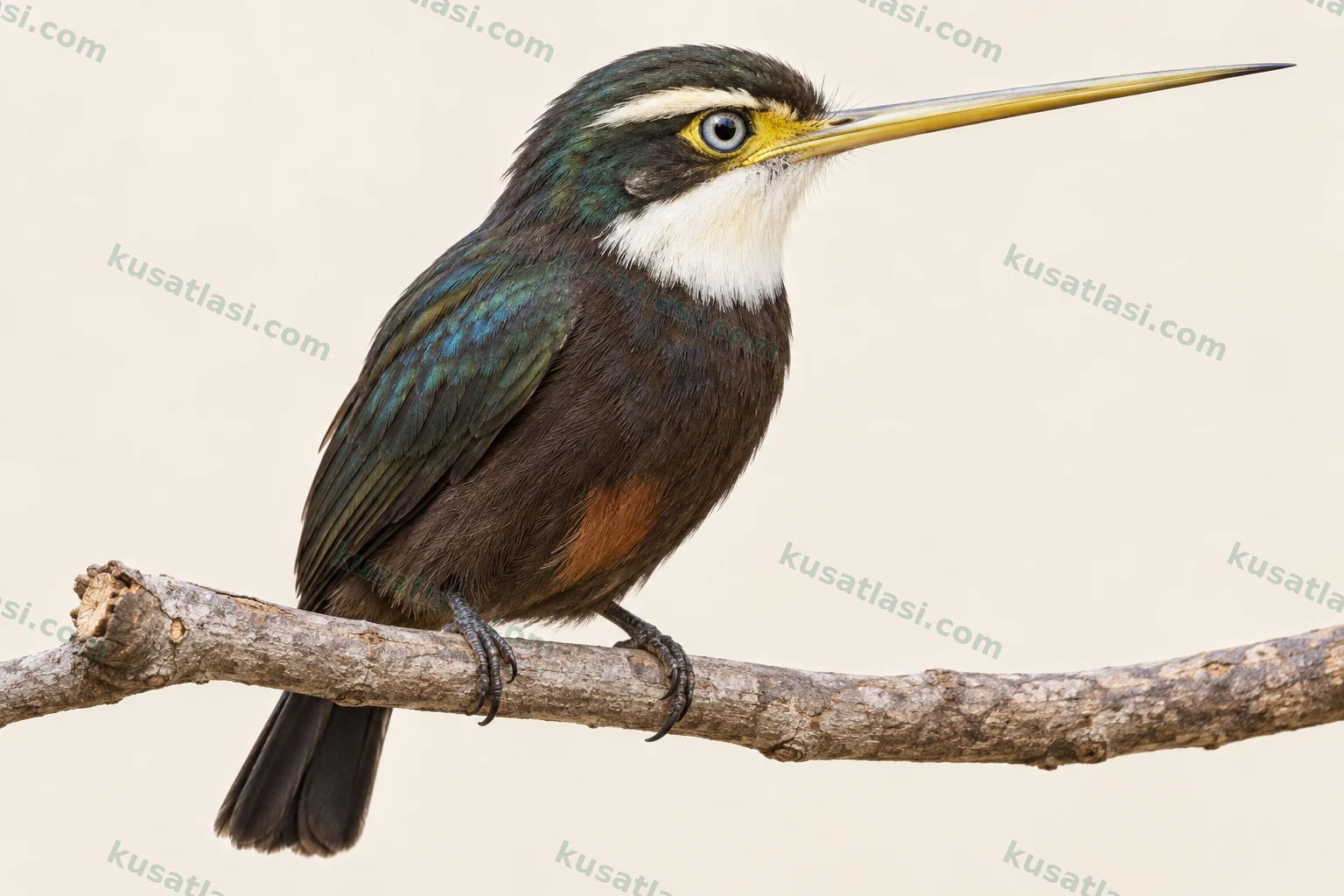
Look for a white face and throat, long pale yellow bill, dark body and short tail in small groups along Amazonian waterways.
Biometrics
Length
Male15–16 cm
Female15–16 cm
Shared species value
Wing length
Male6.95 cm
Female6.95 cm
Shared species value
Weight
Male17.4 g
Female17.4 g
Shared species value
White-throated Jacamar
Riverbanks in eastern Peru, northern Bolivia and the southwestern Brazilian AmazonObservation guide in its natural range
Look for three features together
Do not rely on a single featureCompare the white throat and sides of the face with the dark crown.
Look for the long, slender, pale yellow bill.
Assess the entire short tail and its comparatively straight end.
Compare male and female
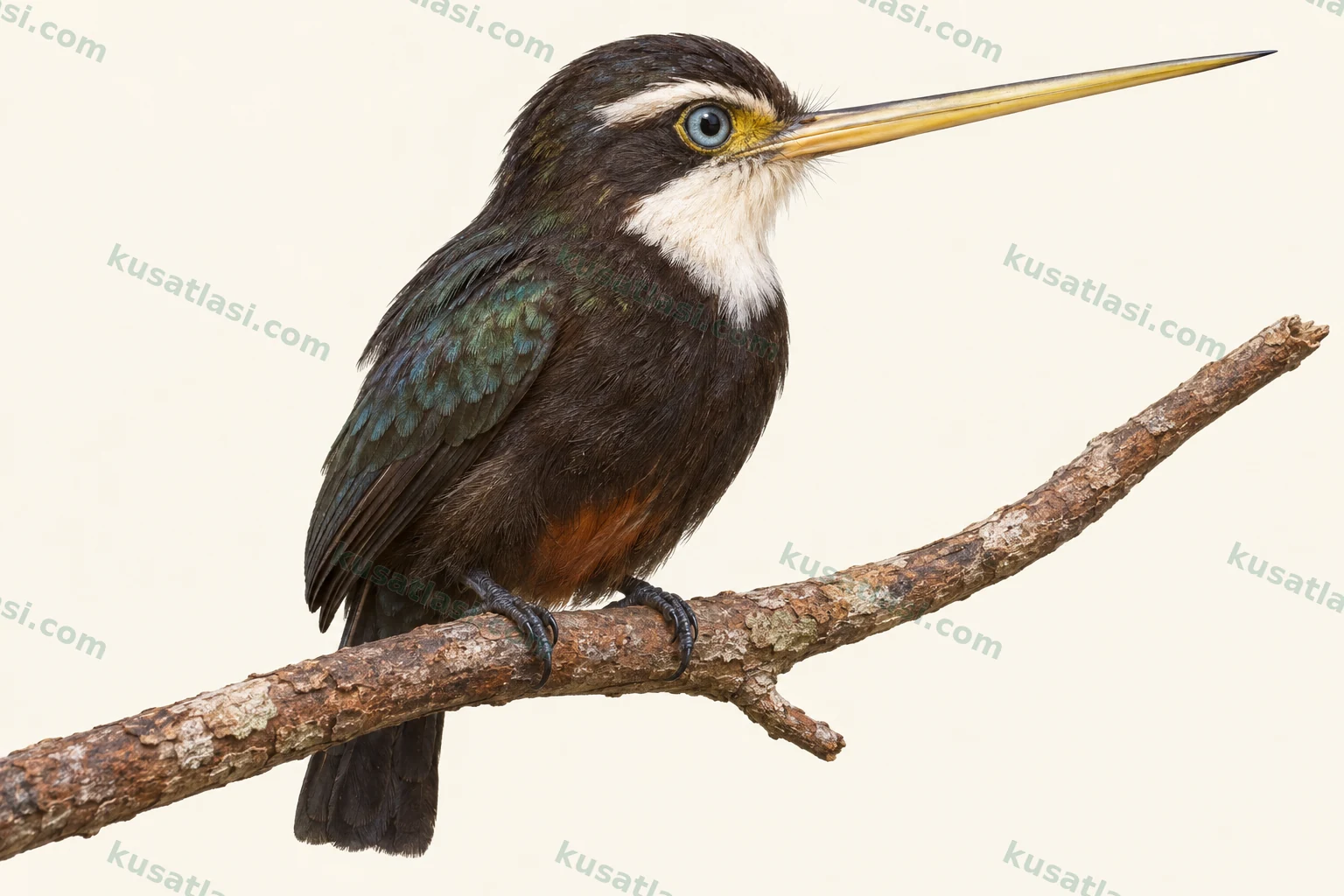 FemaleMale
Adult males and females look alike. The extent of the chestnut belly patch alone is not a reliable guide to sex. Juvenile appearance has not been adequately verified.
Where to look in its natural range?
Watch the exposed branches of young forest trees along streams and rivers.
The species is resident. Visibility and breeding timing during the year vary by region.
January
The species is generally resident. Look for it in suitable riverside habitat within its natural range. No verified regional date is given for this month. That does not imply local absence.
February
The species is generally resident. Look for it in suitable riverside habitat within its natural range. No verified regional date is given for this month. That does not imply local absence.
March
The species is generally resident. Look for it in suitable riverside habitat within its natural range. No verified regional date is given for this month. That does not imply local absence.
April
The species is generally resident. Look for it in suitable riverside habitat within its natural range. No verified regional date is given for this month. That does not imply local absence.
May
The species is generally resident. Look for it in suitable riverside habitat within its natural range. No verified regional date is given for this month. That does not imply local absence.
June
The species is generally resident. Look for it in suitable riverside habitat within its natural range. No verified regional date is given for this month. That does not imply local absence.
July
The species is generally resident. Look for it in suitable riverside habitat within its natural range. No verified regional date is given for this month. That does not imply local absence.
August
The species is generally resident. Look for it in suitable riverside habitat within its natural range. The 2001 study recorded active nests at Manu in southeastern Peru. This does not establish a breeding calendar for the whole range.
September
The species is generally resident. Look for it in suitable riverside habitat within its natural range. The 2001 study recorded active nests at Manu in southeastern Peru. This does not establish a breeding calendar for the whole range.
October
The species is generally resident. Look for it in suitable riverside habitat within its natural range. No verified regional date is given for this month. That does not imply local absence.
November
The species is generally resident. Look for it in suitable riverside habitat within its natural range. No verified regional date is given for this month. That does not imply local absence.
December
The species is generally resident. Look for it in suitable riverside habitat within its natural range. No verified regional date is given for this month. That does not imply local absence.
Nest, egg and incubation
The nest is in a burrow in a steep earthen bank. At Manu, at least four adults cooperated in feeding the young. Clutch size, incubation duration and development times have not been verified.
A thin call rises at the end. The more complex song has a short rising opening followed by notes that slow down.
Do not play recordings to attract birds; observe quietly, especially near nests.
Species information
Quick identification
The White-throated Jacamar Brachygalba albogularis is a small, long-billed insect hunter of the western Amazon basin. Its white throat and pale sides of the face stand out against the dark body. The slender, long bill is pale yellow. The tail is shorter and squarer at the tip than those of many long-tailed jacamars. In forest shade the upperparts can look almost black. In favourable light the dark feathers can show a greenish or bluish gloss. Assess the head, bill, throat and tail shape together for a more reliable identification than any single bright colour provides.
The best place to look is along streams and rivers within its natural range, where it uses exposed branches of young trees. A small group may wait silently on a branch. Sitting still does not mean the birds are not feeding. When they see an insect flying past, they make a short flight to catch it. Several small dark birds with white faces and pale bills in the same area are a useful first clue. Check the pattern of each bird for a firm identification.
General appearance and posture
Pale areas above the eye and on the side of the head and the white throat contrast with the dark crown and breast. The breast and belly are generally dark, but the middle of the belly may have a chestnut area. It can disappear from view as the bird turns, when a branch covers it or in some light. The folded wing and tail are dark. Assess the short, square-ended tail only when it is spread and clearly visible. A few feathers seen through branches can give a misleading impression of length.
The bill is long in proportion to the small head and tapers to a point. The pale yellow bill, yellow bare skin around the eye and dark feet are all part of the adult appearance. Do not expect the sheen on the dark body to look the same shade of blue or green in every photograph. The boundary of the white throat and the underlying dark colour of the body are more consistent than the hue of the gloss. A bird often sits quietly on a branch while remaining ready to make a quick hunting flight.
Males, females and young birds
Males and females share the same basic appearance, with a dark body, pale throat and long pale bill. An older specialist account says the central chestnut patch on the belly may be larger in the female. This is not a definitive way to sex a bird. A belly patch on one individual does not establish whether it is male or female without taking light and obstruction into account. The two adult plates compare basic appearance. The kinds of perches shown do not indicate that the sexes use different habitats.
This review could not adequately verify detailed appearance across juvenile stages. The identification guidance therefore does not require a young bird to display every adult colour. A paler photograph is also insufficient evidence of youth. Record the throat boundary, bill shape and tail shape of the bird you see. Leave age open if no reliable age mark is visible. Several adults can feed at one nest, and some of them may be helpers rather than parents.
Appearance in flight
A foraging flight often starts from a branch and consists of a short dash after an insect in the air before the bird lands again. The pale yellow bill, dark body and short tail can all be seen on a close pass in favourable conditions. The white of the face can disappear from view during a rapid turn. If you see only a small dark bird in a brief flight, watch the branch it lands on to identify it. Catching insects in the air does not make this bird a hummingbird. These short hunting sallies are different from hovering at a flower.
Observations at Manu show birds launching hunting flights from trees in open streamside areas. Flight distances recorded in the study concern birds feeding young on a particular day and do not measure the species’ entire daily range of movements. When possible, return to the head and body pattern of the perched bird instead of relying on one colour on the upper or lower surface of the wing.
Voice and behaviour
The call resembles a thin, slightly plaintive note that rises at the end. In their 2003 study, Tobias and Seddon described the call and a more complex song, with a short rising opening followed by slower, evenly spaced notes. Older statements that the song was unknown need to be updated in light of this observation. Written syllables cannot replace the recording. Do not attribute calls from other birds nearby to the individual you are watching.
Small groups may be found beside streams. More than one adult brought food to the nests studied, and helpers also participated in caring for the young. Birds carrying prey can wait on a branch before approaching the nest. An insect in the bill alone does not establish that the nest is close by. Stay out of the birds’ route to the nest entrance and avoid playing recordings to draw them closer.
Similar species
1. The Pale-headed Jacamar Brachygalba goeringi is a member of the same genus with a similarly small body and long bill. Paleness across the head and white restricted to the throat and face sides are different patterns. Consider the relative’s natural range in northern South America as well. Their distant ranges should not be treated as one shared observation area.
2. A dark or brown body alone does not distinguish the Brown Jacamar Brachygalba lugubris. Look for the White-throated Jacamar’s long pale yellow bill, clearly white sides of the head and white throat together. If the boundary of the white area cannot be seen, a quick glimpse does not justify a definite identification.
3. Longer-tailed Galbula jacamars can also fly out from branches after insects in the air. Consider the bird’s short tail, small body and contrasting white face and throat together. A shared hunting method does not mean they are the same species.
Global range
The natural range extends from the Amazon region of eastern and southeastern Peru to northern Bolivia and the southwestern Brazilian Amazon. The current AviList describes this distribution as patchy. That does not imply suitable habitat throughout all three countries. Suitable vegetation along rivers and places with actual records are more informative than a broad list of countries. Manu in Peru is one of the places where the species’ behaviour has been studied directly.
Status within its natural range
Look for the bird along rivers and streams within lowland rainforest. Young trees, tall herbaceous plants and exposed hunting branches along the banks are important. Gaps in suitable habitat make it difficult to assume that records close to one another on a map form a continuous population. The global Least Concern assessment does not mean the bird is abundant on every stretch of river. Local chances of finding it depend on the state of riverside vegetation and on how it is observed.
Movements and migration
The species is generally considered resident. Regular long-distance seasonal migration has not been verified. Hunting from branch to branch or shifting along the bank is distinct from intercontinental migration. Following one breeding group around its nest for a short period at Manu does not establish that every bird stays in the same small area throughout the year. Licensed observation examples on the map show areas with records. They do not trace a migration route, delimit the full natural range or establish breeding in every cell.
Breeding habitat
At Manu, breeding birds were associated with young forest vegetation growing beside small streams carrying pale, muddy water. The birds used banks with Cecropia trees, tall reed-like plants and bamboo. This local finding does not imply dependence on the same plants everywhere. The structure of vegetation beside the stream and the availability of open hunting perches matter together.
Nest site
The four active nests observed in 2001 were in burrows in steep earthen banks. Overhanging plants partly concealed the entrances. To avoid disturbance, the researchers did not inspect the inside of the burrows or count the young. No verified figures are therefore given for clutch size, incubation duration or the time the young spend in the nest. Giving a termite nest as the species’ confirmed nest site would substitute a family-level assumption for this direct observation.
Daily use of habitat
Exposed branches along the bank are places to watch for prey and launch hunting flights. Consider the water, vegetation and suitable branches together where the birds occur. There is no need to approach the burrow entrance, clear the bank or cut branches to observe them. In particular, keep far enough away for adults carrying food to reach the entrance freely.
What does it eat?
It feeds on flying insects. Among the identifiable prey brought to one nest at Manu, bee- and wasp-like insects and butterflies stood out. A small number of other insects were also recorded. The study followed food taken to young birds. The result does not establish that adults eat those prey in the same proportions every day of the year or that they feed only on those groups. Prey composition can vary with the insects flying at the time and the needs of the young.
How does it hunt?
The bird waits on an exposed branch, makes a short sally after prey passing in the air and lands again. Its long, pointed bill holds the prey. A bird carrying food can wait on the same branch for a while. Some hunting flights are unsuccessful. At Manu, a proportion of the directly observed sallies ended in a capture. Sitting still on a branch is part of this hunting method. Insecticide use or removal of streamside vegetation can affect the surroundings that provide food as well as the perch itself.
Helpers care for the young
Tobias and Seddon monitored four active nests in Peru’s Manu National Park. They recorded at least four adults bringing food to the young at each nest. This is direct evidence of cooperative feeding in the species. The study did not establish all relationships among the birds or whether every adult bred. Calling all the group members mothers or fathers would go beyond the evidence.
Missing information and old information are different
An older specialist summary gave little information on song and nesting. Later direct fieldwork documented the song, nests in earthen banks and cooperative feeding. Because the researchers did not inspect the interiors of the burrows, clutch size and development times remained unknown. A new study can fill some gaps while others remain. That is why the unknown durations on this species page are not taken from another jacamar.
What a prey study can tell us
The examination of 92 identifiable prey items taken to one particular nest in 2001 shows what insects that group caught while feeding young. Feeding proportions from one day are not a fixed dietary rule for the whole Amazon. Researchers assessed prey by observing it from a distance, and insect sizes were visual estimates. Those estimates cannot be used as direct measurements of the bird or its bill.
The value of a narrow strip along a river
A rainforest can look vast on a map, but not every part is equally valuable to this jacamar. Regrowing vegetation, open branches and earthen banks along a river can bring together daily foraging and nesting. Clearing the bank removes this small-scale structure. For conservation it is therefore useful to consider the bank habitat the bird actually uses as well as total forest area.