

World Birds IUCN statusVU · VulnerableGlobal IUCN category. BirdLife v10 (2025); taxon matching: AviList 2026 / IOC 15.2; checked: 29.10.2026. The list year is not the species assessment date. Source and method · BirdLife OrderPasseriformesPasserines FamilyTimaliidaeTimaliidae
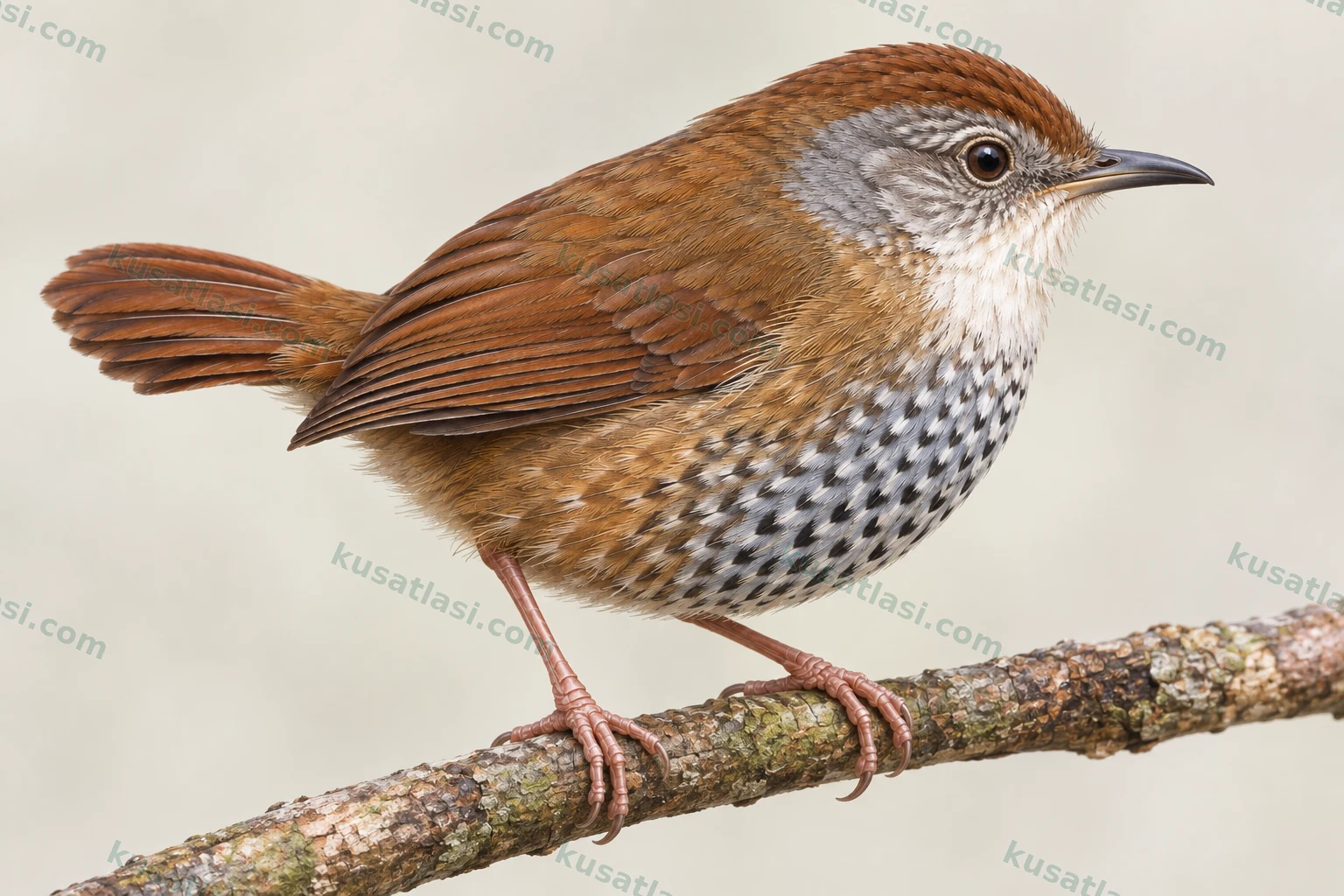
Pale-throated Wren-Babbler
Spelaeornis kinneari
Assess them with the dark scaled underparts and line at the bill edge.
Biometrics
Length
Male11–12 cm
Female11–12 cm
Shared species value
Wing length
MaleData unavailable
Female4.95 cm
Weight
Male11.8 g
Female11.8 g
Shared species value
Pale-throated Wren-Babbler
Northern Vietnam; southeastern Yunnan and northwestern Guangxi in ChinaObservation guide in its natural range
Look for three features together
Do not rely on a single featureAssess them with the dark scaled underparts and line at the bill edge.
Watch covered edges with ferns and fallen branches.
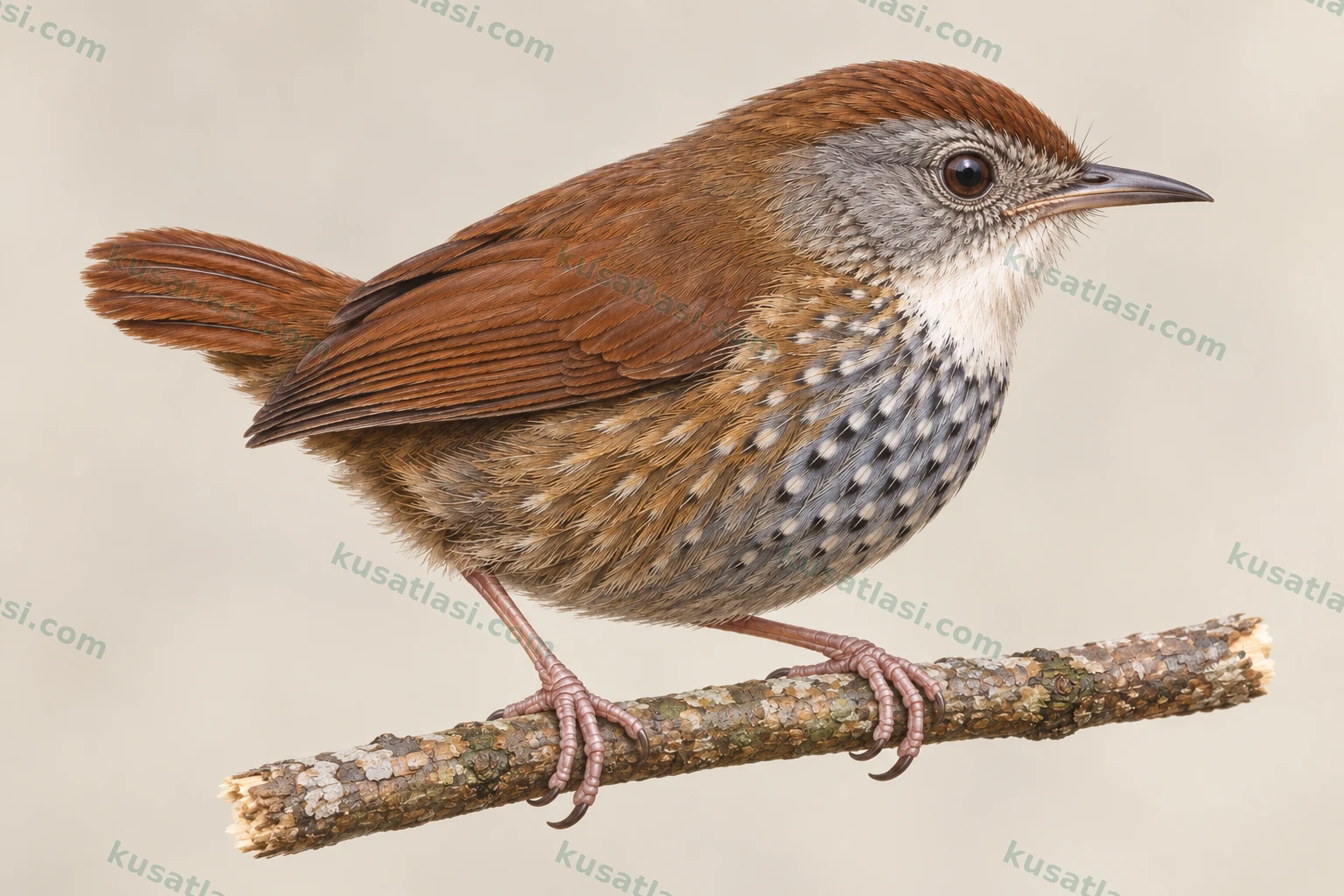
Some females have also been reported with white throats; do not determine sex from one colour.
Compare male and female
 FemaleMale
Watch covered edges with ferns and fallen branches.
Where to look in its natural range?
In dense mountain-forest undergrowth, watch the grey face, pale throat and scaled underparts together with the natural song.
Resident species. The May Tay Con Linh record is not a breeding or monthly movement calendar for the entire range; verified monthly boundaries were not found.
All months: Monthly data unverified.
January
February
March
April
May
June
July
August
September
October
November
December
Nest, egg and incubation
Nest structure and site, clutch size, incubation and chick development periods were not verified for this taxon. A feeding bird or natural song record alone is not breeding evidence.
A fast, lively sequence is followed by slower terminal notes; the expert comparison reports two trilling song forms. Assess the rhythm and ending of the natural sequence together with plumage.
Do not play recordings to attract birds; observe quietly, especially near nests.
Species information
Quick identification
The Pale-throated Wren-Babbler is a small, brown, secretive passerine associated with mountain forests in northern Vietnam and southern China. Assess the grey face, pale throat and dark, scaled-looking underparts together. The bird may appear briefly from dense undergrowth. A white throat helps identification, but alone proves neither species nor male sex. Plumage pattern, natural song sequence and locality gain meaning together.
General appearance and posture
Its overall appearance centres on a brown body, greyish face and conspicuous pale throat. The breast and belly are darker grey and more strongly scaled than in the similar grey-bellied relative. The pattern should not be described as a separate large spot on every feather; the overall texture formed by pale and dark feather margins matters. A dark line descending from the bill edge also helps comparison. A leaf across the face or a breast seen only in shade can conceal some details.
Watching the lower layers of mountain forest is more appropriate than scanning high treetops. Cornell describes a secretive bird of dense undergrowth. Researchers at Tay Con Linh saw birds foraging among ferns and fallen branches. Moving through these structures does not mean spending all day on exposed ground. Occurring at a clearing edge does not establish adaptation to broad treeless areas either.
During a good observation, first note the vegetation layer, then the relationship between face and throat, followed by the breast and belly pattern. Fog, shade and brief views can alter apparent colours. Rather than relying on brightness in a single photograph for the pale throat, several natural postures are useful where possible. No branch needs lifting or shrub opening; waiting without moving affects the bird’s surroundings less.
Males, females and young birds
The male is described with a whitish chin and throat. Females usually have a pale yellow-brown throat, and some may appear more chestnut. However, an important exception exists: two white-throated females were reported in the original specimen series. Collar’s scientific assessment explicitly records this variation. It is therefore unreliable to label every white-throated bird male, or every brief view of a pale brown throat certainly female.
This plumage variation must not be confused with ageing. The source does not explain the white-throated females as young merely because of that feature. A reliable species-specific plumage key separating young from adults was not verified in the publications examined. Leaving age uncertain after a brief view makes a more accurate record than borrowing juvenile appearances from other wren-babblers. Museum-label sex information and a field estimate based only on plumage colour are not equivalent evidence either.
Appearance in flight
A flight view of a small brown bird moving within dense vegetation is often incomplete. The sources examined did not provide an independent flight key that identifies this species conclusively from one upperwing or underwing mark. In this case, wait for a perched view of the grey face, throat and underpart pattern. Hearing voice from the same point after a short flight helps follow the observation; no certain association is made without seeing the sound’s source.
Voice and behaviour
The natural song may end with slower notes after a fast, lively sequence. Cornell’s short description emphasises two slow terminal notes. The expert comparison reported by Collar describes two different trilling sequences, repeated at intervals and slowing towards the end. One has an emphatic ending; the other has a broken rhythm in the middle and more widely spaced, full notes towards the end. These descriptions do not require every song to fit a single syllable pattern.
A calling bird inside dense cover can be hard to see. Recording the whole natural sequence, its pauses and ending is more useful than noting only the first few fast sounds. Comparison with related species’ voices must be combined with plumage and geography. Playback is not necessary to make the bird call. Its natural foraging or concealed behaviour can be watched from a distance.
Similar species
1. Spelaeornis reptatus is a close relative. The scientific comparison gives it a more spotted chin and throat and paler underparts; the Pale-throated Wren-Babbler has a stronger dark line at the bill edge and more pronounced underpart scaling. Song sequences differ too. Locality helps because their general ranges do not overlap, but the place attached to a misidentified record is not sufficient identification on its own.
2. Spelaeornis oatesi is compared through its white throat, large dark breast spots, browner face and lack of a conspicuous dark line at the bill edge. Its range, associated with the Chin and Mizo Hills, is not added to that of the northern Vietnamese bird. Measurements and breeding information from the former combined species account cannot be treated as shared here either.
3. Spelaeornis chocolatinus is a similar small, patterned relative, now recognised as a species associated with the Naga Hills. Older publications may list kinneari as its subspecies. That old name does not mean that the entire group is one species, or that every Indian population belongs to the taxon described here. Reliable separation requires the current taxon, natural song and a combined view of face, throat and underparts.
Global range
The natural range covers mountain forests of northern Vietnam and areas of southeastern Yunnan and northwestern Guangxi in China. A scientific comparison table lists these regions separately. Limiting the Vietnamese account to western Tonkin would be insufficient: birds observed at Tay Con Linh in 2000 became the first published records for eastern Tonkin. Tonkin is a historical regional name for northern Vietnam, not a synonym for the entire country or another species’ range.
Status within its natural range
Current specialist species pages give the global category as Vulnerable. This is not a direct count of birds at one observation site. A few birds in a small area do not show high density across an entire mountain belt. Secretive behaviour below the forest also complicates interpreting non-detection on a short visit. A country record does not mean occurrence in all its forests; the northern Vietnamese and Chinese areas are considered in their own regional contexts.
Seasonal movements
Sources classify it as resident. Regular intercontinental migration, specific border crossings or a sequence of movements for every month were not verified. Moving while foraging in vegetation is not the same event as long seasonal migration. The May observation at Tay Con Linh documents presence and foraging then; it does not define the entire breeding period or prove absence in other months. No precise monthly movement timetable is derived from this single record.
Breeding habitat
Dense undergrowth in middle- and high-elevation mountain forest is the species’ general habitat. The compiled habitat account gives 1,400–2,500 metres; the direct Tay Con Linh foraging observation was at about 1,700 metres. One region’s elevation record does not mean that all populations breed at the same height. A covered spot at a forest edge is not equivalent to a wholly treeless area.
Nest site
Nest site and structure, typical clutch size, incubation and nestling periods were not reliably verified for this taxon. Knowing that a close relative builds an enclosed nest does not establish the same structure here. Song or two birds together cannot replace eggs or a successful breeding record.
Daily habitat use
At Tay Con Linh, birds foraged among ferns and fallen branches at the edge of a clearing on a ridge. This is a feeding observation in the forest understorey. One can wait on the existing trail without lifting branches, opening cover or entering vegetation to search for nests. The cover where the bird hides is part of its habitat, not merely an obstacle to observation.
What does it eat?
A scientific trait compilation classifies it as an invertebrate feeder. Small insects and other invertebrates form this broad food group, but a detailed species-specific prey list or food percentages were not verified in the sources examined. Foraging among ferns does not mean eating the ferns. Other birds taking seeds, fruits or nectar at the same site do not establish those foods for this species either.
How does it obtain food?
A direct field record documents searching among ferns and fallen ground-level branches. These plants and branches describe the feeding setting, not the identity of swallowed prey by themselves. When a bill touch or brief movement is seen at a distance without visible prey, its identity remains uncertain. Daily intake or capture frequency for each food is not inferred from the sources. Watching natural searching from a distance gives a clearer observation without changing behaviour by offering food.
A white throat does not always mean male
The scientific taxonomic assessment reports that two females in the original series also had white throats. Other females were described with pale yellow-brown throats and more chestnut tones. This variation shows why a simple white-male, brown-female rule is incomplete. Plumage colour and sex on a specimen label are separate evidence; juvenile appearance is not invented from the variation either.
A current species inside an old name
The Tay Con Linh record published in 2003 names the bird Spelaeornis chocolatinus kinneari. Today, Spelaeornis kinneari is a separate species. Collar’s 2006 assessment considered voice and plumage differences together; Cornell’s 2011 checklist update also accepted the split. A changed name does not invalidate the old observation, but it does not automatically transfer everything known about the broad former group to the narrower current species.
Direct observation on a mountain ridge
On 20 May 2000, several birds seen at about 1,700 metres were foraging among ferns and fallen branches. The observation was important for eastern Tonkin in northern Vietnam. The study recorded 146 bird species across all sites; that does not mean 146 Pale-throated Wren-Babblers. The feeding record did not document a nest, eggs or incubation period either.
The small measurement sample
The place and date of the Tay Con Linh observation document the species’ presence at that point, not equal density in every forest at the same elevation. A record on one mountain cannot replace separate fieldwork on others.