World Birds IUCN StatusLC · Least Concern OrderApodiformesSwifts and hummingbirds FamilyHummingbirdsTrochilidae
White-crested Coquette
Lophornis adorabilis
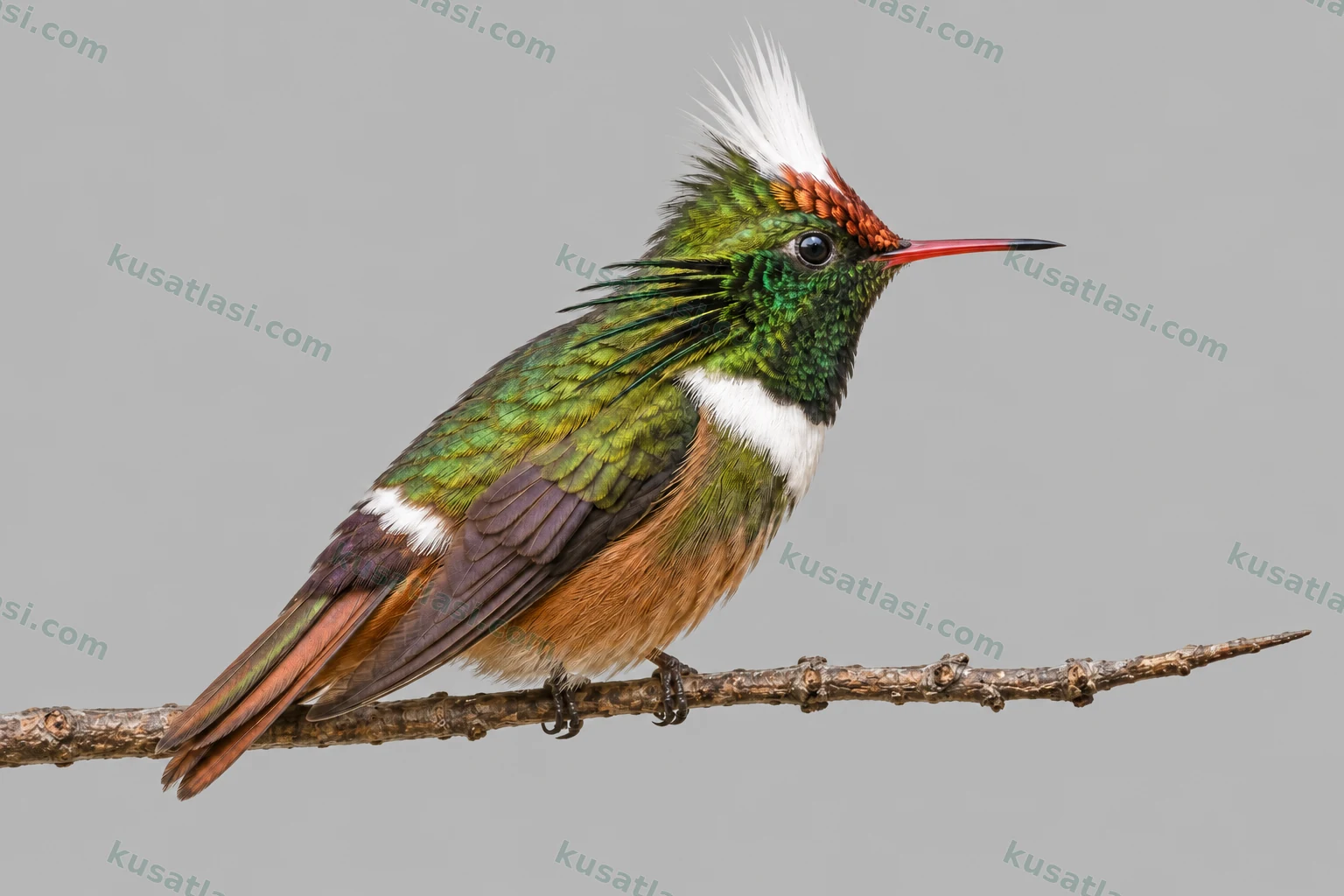
Look for the adult male’s erect white crest, green cheek ornaments and cinnamon belly together.
Biometrics
Length
Male7–8 cm
Female7–8 cm
Wingspan
MaleData unavailable
FemaleData unavailable
Weight
Male2.7 g
Female2.7 g
White-crested Coquette
Central AmericaField Guide in the Native Range
Look for all three signs
Never decide from one signLook for the adult male’s erect white crest, green cheek ornaments and cinnamon belly together.
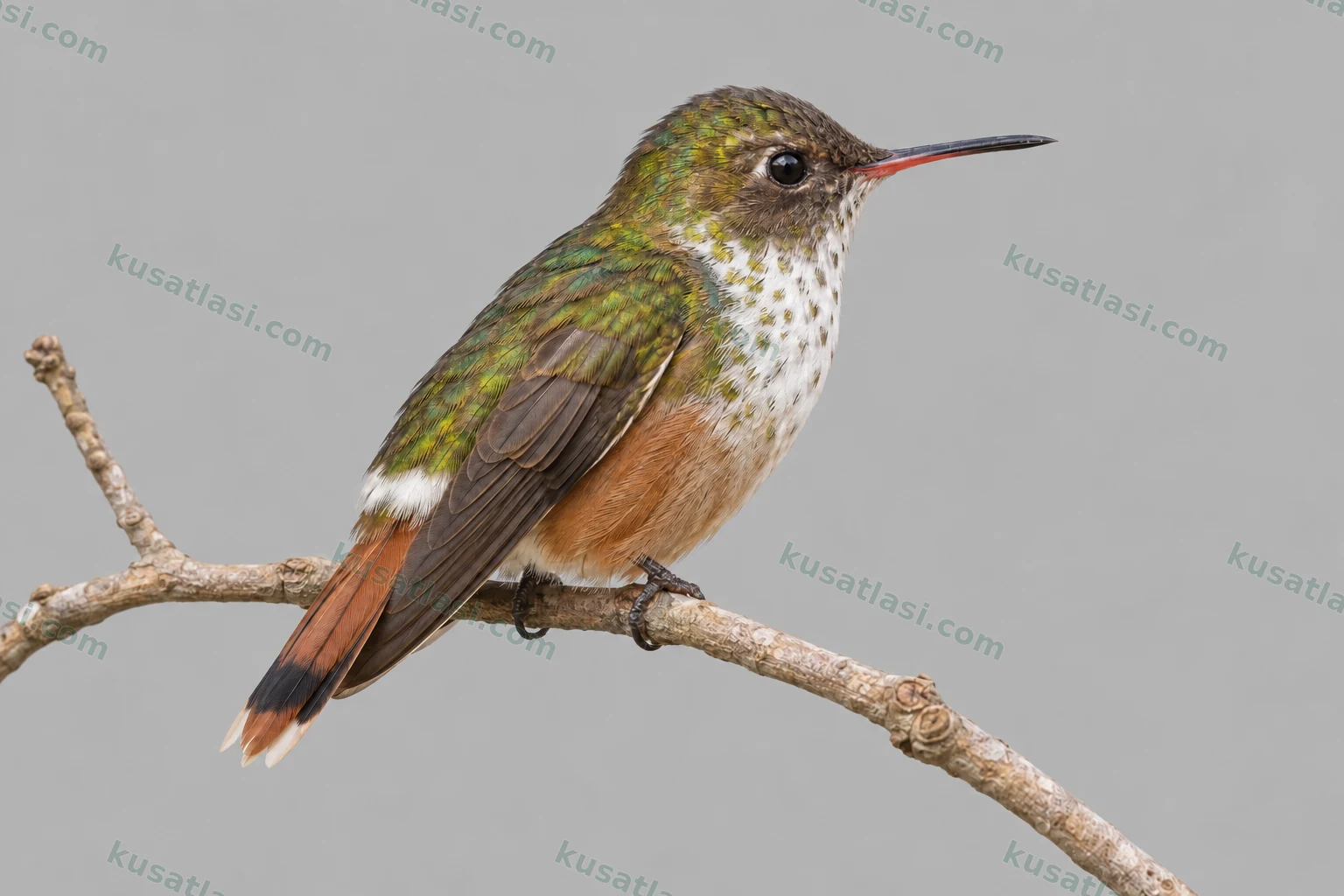
The female has no crest. Its pale throat, rufous belly and white rump band are useful clues.
Look for the white band where the back meets the tail. It occurs in both sexes and related species, so it is not diagnostic alone.
Field Guide Plates
Two of five views are available; flight and head plates will follow.
Male Underwing
This plate will follow; a perched view does not replace the missing angle.
Male Upperwing
This plate will follow; a perched view does not replace the missing angle.
Male Head and Bill
This plate will follow; a perched view does not replace the missing angle.
Compare male and female
FemaleMaleThe female has no crest. Its pale throat, rufous belly and white rump band are useful clues.
Where to look in its native range?
Flowering forest edges, developed secondary growth and gardens in southern Costa Rica and western Panama.
The calendar describes residency within the native range and documented nesting in southern Costa Rica. Breeding dates can vary with local conditions; individuals need not all nest in the same months.
January
Resident; nests with eggs documented in southern Costa Rica.
February
Resident; eggs and nestlings documented.
March
Resident; a late nest record is not a range-wide rule.
April
Resident; local movements may follow flowering.
May
Resident; range-wide monthly breeding limits remain uncertain.
June
Resident; visibility at feeding sites can vary.
July
Resident; no migration route is drawn.
August
Resident; look at productive flowers.
September
Resident; recording effort affects apparent abundance.
October
Resident; courtship documented in the field study.
November
Resident; feeding at flowering trees documented.
December
Resident; nest construction documented in southern Costa Rica.
Breeding Habitat
Humid tropical forest landscapes in lowlands and foothills provide the main setting. Forest edges, developed secondary growth and flowering clearings can be used. Secondary growth means vegetation regrowing after clearance, not that the species only lives in degraded habitat. Flower resources and suitable nest supports both matter.
Nest Site
Skutch’s four nests in southern Costa Rica included guava trees in clearings and plant support at a forest edge. Small lichen-covered cups were attached to fine branches, sometimes far from the trunk and partly exposed. These few examples do not prescribe one tree or height for every nest. Sensitive nest locations are not mapped.
Daily Habitat Use
Birds can feed high in trees and descend to lower edge shrubs and gardens. Being most easily noticed low down does not mean that canopy habitat is unused. Flowering changes affect visibility at a particular observation site. A garden occurrence does not establish that all agricultural landscapes are equally suitable; flowering vegetation and links to forest should be considered together.
Nest, Eggs and Incubation
The female builds a small open cup on a slender twig or comparable plant support, using plant down and spiderweb with lichens outside. Skutch studied nests at forest edges and clearings in southern Costa Rica. The three nests whose contents could be checked held two white eggs each. Females incubated and cared for the young; no male care was observed at the four nests. The paper did not establish the complete incubation period, so no duration is invented here. Young at one monitored nest left 21–22 days after hatching, which is a nestling period, not incubation. Keep nest locations private, do not move supporting branches and do not block the female’s access.
The tiny bird at a flower is often noticed before its voice. Skutch did not find the persistent singing from a regular station seen in some other hummingbirds. This does not imply that the species is silent. Recorded calls should be assessed alongside the verified recording identity, background sounds and visual evidence.
White-crested Coquette · Call
Recordist: Andrew Spencer · XC168730
CC BY-NC-SA 3.0 · Original recording, unmodified.
Do not play recordings to lure birds; observe quietly, especially near nests.
Species Information
General Appearance and Posture
The body is tiny and the bill slender and straight. It can hover at flowers and rest on fine plant twigs, where foliage readily hides it. A view including head, breast and tail is preferable to a close crop. Oiseaux.net reports a species length range of 7–8 cm; this is total length, not wingspan. The male has bronze-green upperparts, a darker purplish-bronze area behind the pale rump band and a chestnut-rufous tail with darker edges and tips. A shining green throat contrasts with the white upper breast and warm belly.
Glossy feathers change in apparent brightness as the bird turns. A throat that shines green in one view can appear very dark in another. Pattern position and structure should therefore be assessed separately from photographic brightness. A second view of the face and bill helps. An illustration, even a convincing one, is not itself scientific evidence.
Quick Identification
White-crested Coquette is a very small hummingbird native to Costa Rica and western Panama. An adult male combines an erect white crest with elongated green cheek ornaments, a white upper breast, a cinnamon-rufous belly and a white rump band. Check the whole pattern rather than a single pale feather. The female lacks the male’s crest and ornaments; its pale throat, rufous belly and rump band are more useful. Rump means the short part of the back immediately before the tail, not a collar or wing stripe.
Males, Females and Young
Adult sexes differ in appearance. A male has the white crest, green head ornaments and bright throat together, with a reddish bill base and dark tip. A bird lacking the complete ornaments should not automatically be called female: a developing male may also be incompletely ornamented.
The adult female has a plain head and pale throat and upper breast, sometimes with greenish throat flecks. The rufous lower body and dark band near the tail tip are useful; the upper bill is dark. Shared length and weight figures in the panel mean that separate sex measurements were not verified, not that male and female plumages are identical. Young birds can resemble females. Skutch recorded transitional-looking males but did not treat uncertain age or seasonal plumage interpretations as demonstrated facts. A single plain-headed photograph should not force a precise age or sex assignment.
Appearance in Flight
Hovering at flowers is a conspicuous feeding behaviour. Between plants the bird can be only a small, fast silhouette. A male’s ornaments may be visible in a suitable angle, while blur can make fine feathers disappear. The rump band is a supporting clue. A blurred flight photograph is insufficient for detailed sex identification.
Upperwing and underwing are different surfaces. Separate verified flight plates are not yet available on this page, and perched pictures are not relabelled as flight views. Hovering helps recognise a hummingbird but does not identify this species alone. Combine head, body and tail characters in the angle actually seen.
Voice and Behaviour
Individuals are often seen alone, although several may visit productive flowers. This is not evidence of routine flocking. Returning to a nearby fine twig after feeding is documented in field observations. Other hummingbirds may use the same flowering trees; local displacement does not summarise every interaction of the species.
A male facing a female and moving from side to side while hovering was documented in courtship. This is distinct from ordinary flower feeding. Watch productive plants quietly rather than using playback to attract birds. Failure to hear sustained song does not show absence: the small body and foliage also reduce detectability. Use visual evidence, behaviour and locality together.
Similar Species
Black-crested Coquette (Lophornis helenae) merits comparison, especially for plain-headed females. The adult male does not have the same white crest. Females require comparison of the rufous belly, tail pattern and range rather than simple absence of a crest. Sharing a genus does not make the two species’ images interchangeable.
Rufous-crested Coquette (Lophornis delattrei) is also relevant regionally. The adult male’s crest and head ornaments differ from those of a white-crested male. A brief view of a plain-headed young bird or female should not be assigned from size alone. Try to see throat, belly, rump and tail; when evidence is insufficient, an unidentified hummingbird record is preferable to a false definitive identification.
In an incomplete view, record which structures were actually visible. A hidden rump band is not an absent band, and fine head feathers lost to motion blur are not evidence of a plain-headed bird. Compare another unobstructed angle before assigning identity, age or sex. This is a practical observation safeguard rather than a new biological character.
Global Range
The native range is restricted to Costa Rica and Panama, mainly the Pacific lowlands and foothills of southern Costa Rica and western Panama. It does not cover all Central America. Historical observations also mention crossings to the Caribbean side in central Costa Rica; this does not establish continuous occupation of the Caribbean coast. The globe shows a broad geographic envelope drawn from textual range descriptions, not precise occupancy, nest sites or tracking points. Separate seasonal boundaries were not verified.
Status within the Native Range
The Pacific lowlands and foothills of southern Costa Rica, together with western Panama, form the principal native range. Look at flowering forest edges, developed secondary growth and suitable gardens. Local detectability changes with flowering and the height watched. Skutch's documented nests provide direct breeding evidence for his study area in southern Costa Rica; their dates are not a uniform breeding calendar for every forest edge or all of Panama. A bird feeding in a garden does not by itself establish nesting there.
Movements
Expert accounts classify the species as resident. Local appearance at flowering trees and subsequent absence are not evidence of long-distance migration. Skutch described changes in local visibility without establishing a route followed by every bird. No invented country sequence, travel distance or intercontinental route is shown. Absence at one feeding site does not mean absence throughout the region.
Breeding Habitat
Humid tropical forest landscapes in lowlands and foothills provide the main setting. Forest edges, developed secondary growth and flowering clearings can be used. Secondary growth means vegetation regrowing after clearance, not that the species only lives in degraded habitat. Flower resources and suitable nest supports both matter.
Nest Site
Skutch’s four nests in southern Costa Rica included guava trees in clearings and plant support at a forest edge. Small lichen-covered cups were attached to fine branches, sometimes far from the trunk and partly exposed. These few examples do not prescribe one tree or height for every nest. Sensitive nest locations are not mapped.
Daily Habitat Use
Birds can feed high in trees and descend to lower edge shrubs and gardens. Being most easily noticed low down does not mean that canopy habitat is unused. Flowering changes affect visibility at a particular observation site. A garden occurrence does not establish that all agricultural landscapes are equally suitable; flowering vegetation and links to forest should be considered together.
What Does It Eat?
Nectar, the sugar-rich liquid produced by flowers, is important. Nectarivore classification does not imply an exclusively sugary diet; small arthropods also belong to hummingbird diets. No verified percentage breakdown is supplied for this species. Skutch observed feeding at Inga trees and purple-flowered Stachytarpheta shrubs. These are examples rather than an exhaustive obligatory plant list.
How Does It Feed?
It hovers before a flower and inserts its slender bill, then moves to another flower or a resting twig. Intensive flowering can temporarily attract individuals. Larger hummingbirds may share a food source and displace it, but one observation is not a universal interaction rule. Protect natural flowers rather than catching birds or cutting their feeding supports for photography. Flowering alone does not make a pesticide-treated garden safe habitat.
A Tiny Bird with Elaborate Ornaments
The male’s white crest and green cheek feathers are conspicuous relative to its small body. They are specialised feathers, not horns or skin growths. Breast and belly pattern remain important alongside the ornaments. A head crop is not equivalent to the whole bird, and giving the same ornaments to a female erases a real sex difference.
Flowering and Detectability
Frequent appearances followed by scarcity at one site need not imply long migration. Flower availability, local food resources and the height watched all affect detectability. Residency and local wandering are therefore compatible. A general range map does not mean that every bird stays on one twig, nor are a few observation records alone a reliable population estimate.
Incubation Is Not the Nestling Period
Development inside the egg and development after hatching are distinct stages. The 21–22 days at one nest monitored by Skutch refer to hatching until departure. Putting that figure in an incubation field would conflate the stages. A complete incubation period was not established in that paper and is left explicitly uncertain rather than borrowed from another hummingbird.
Separating Knowledge from Gaps
The scientific and English names were matched against a foreign taxonomy account. Paphosia adorabilis in the older study is a former genus placement of the species now treated as Lophornis adorabilis, not a different bird. Wing length is also not the distance between fully spread wingtips. An honest missing wingspan is more reliable than a short wing measurement mislabelled as wingspan. New evidence can fill a gap; an invented number misleads the reader.
Similar and Confusable Species
Black-crested Coquette
Lophornis helenae
Cornell/eBird explicitly compares the female with female White-crested Coquette. Black-crested has strongly spotted underparts; the rufous belly of White-crested is useful. Males have a black rather than white crest. Both show a white rump band, so that band alone does not separate them.
Rufous-crested Coquette
Lophornis delattrei
The male has an orange-rufous crest with black-tipped feathers, unlike the white crest of White-crested. Females show a rufous forehead and throat. Tiny size and a white rump band are shared, not decisive. This is a visual comparison, not a claim that the species coexist throughout the range.