
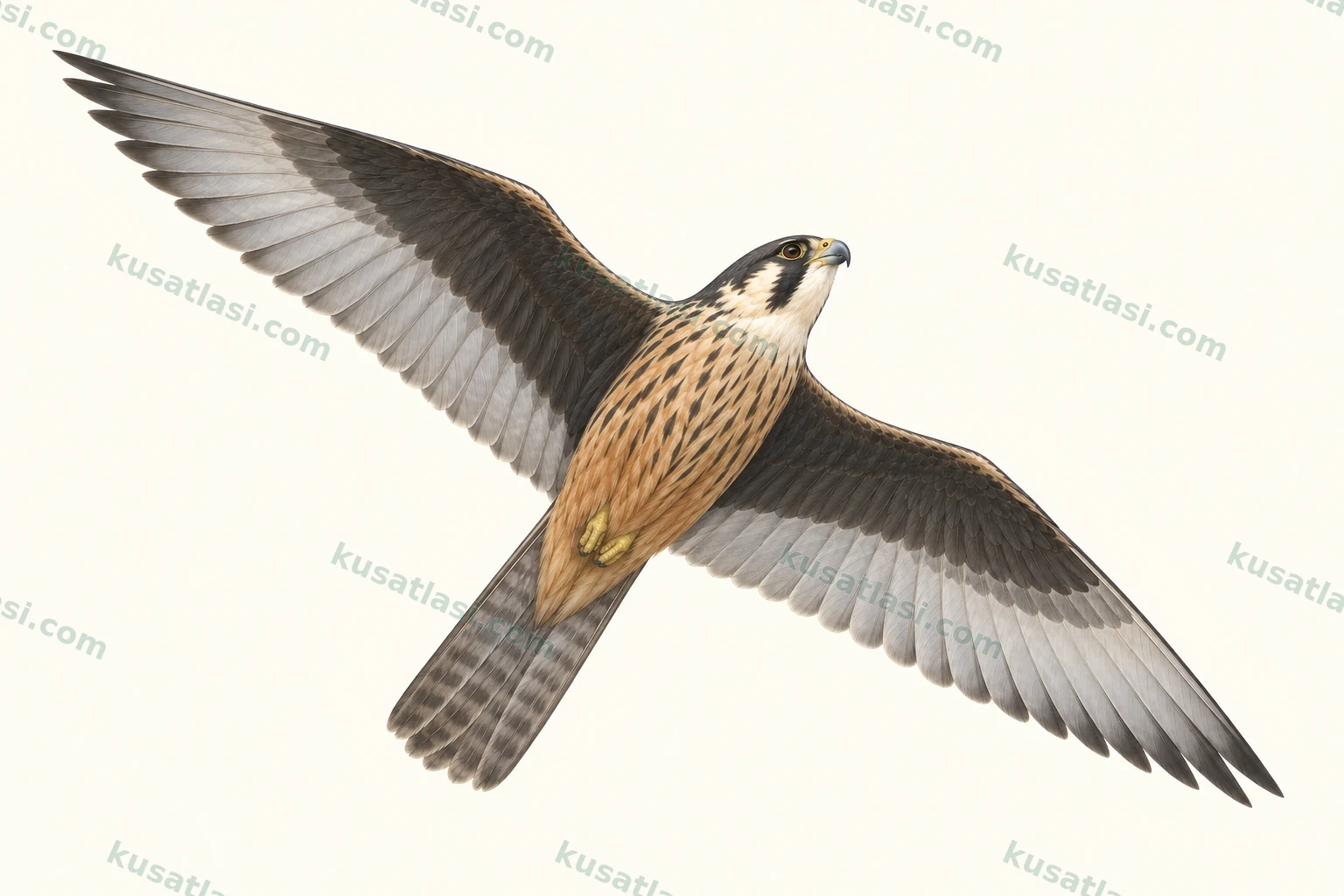
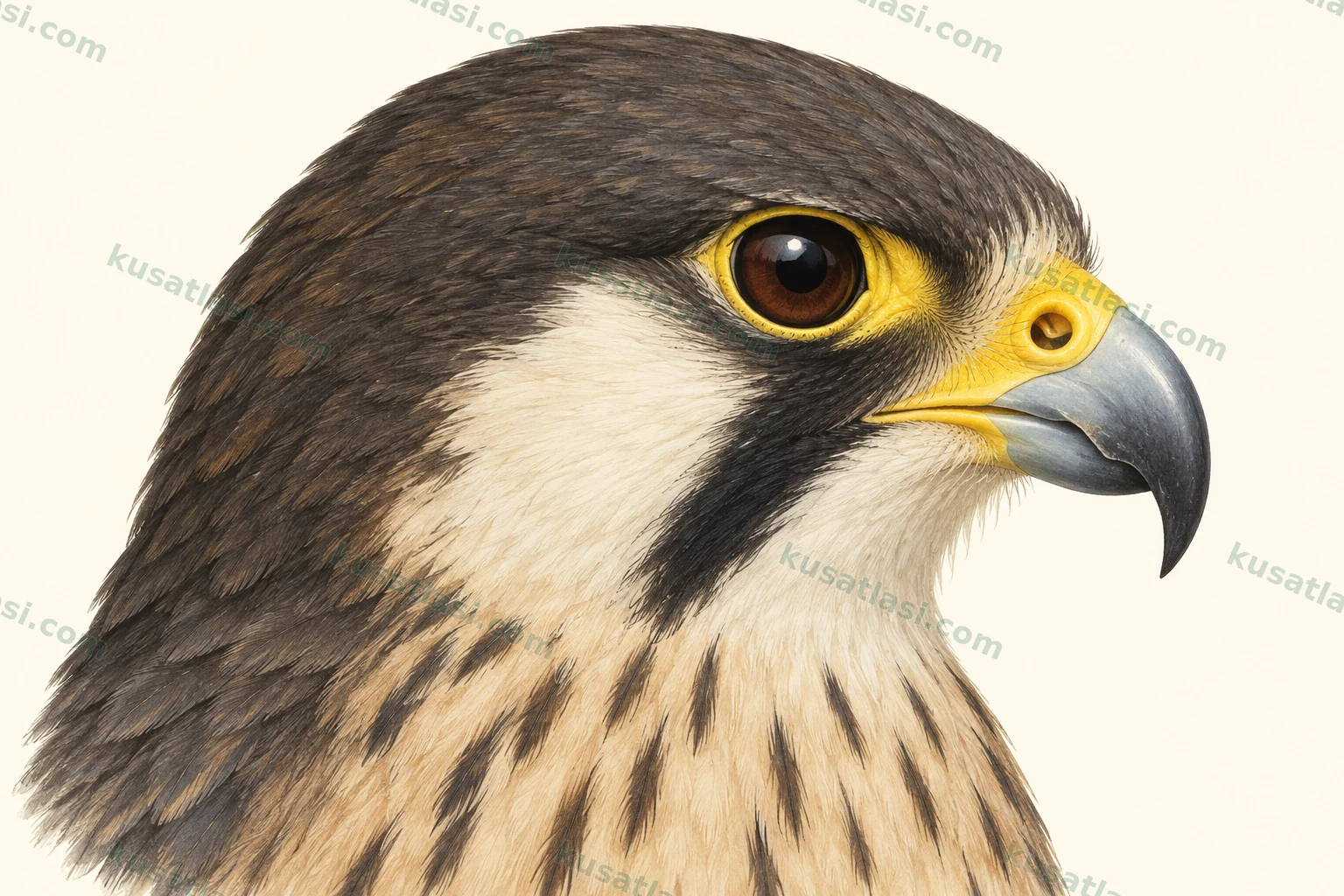
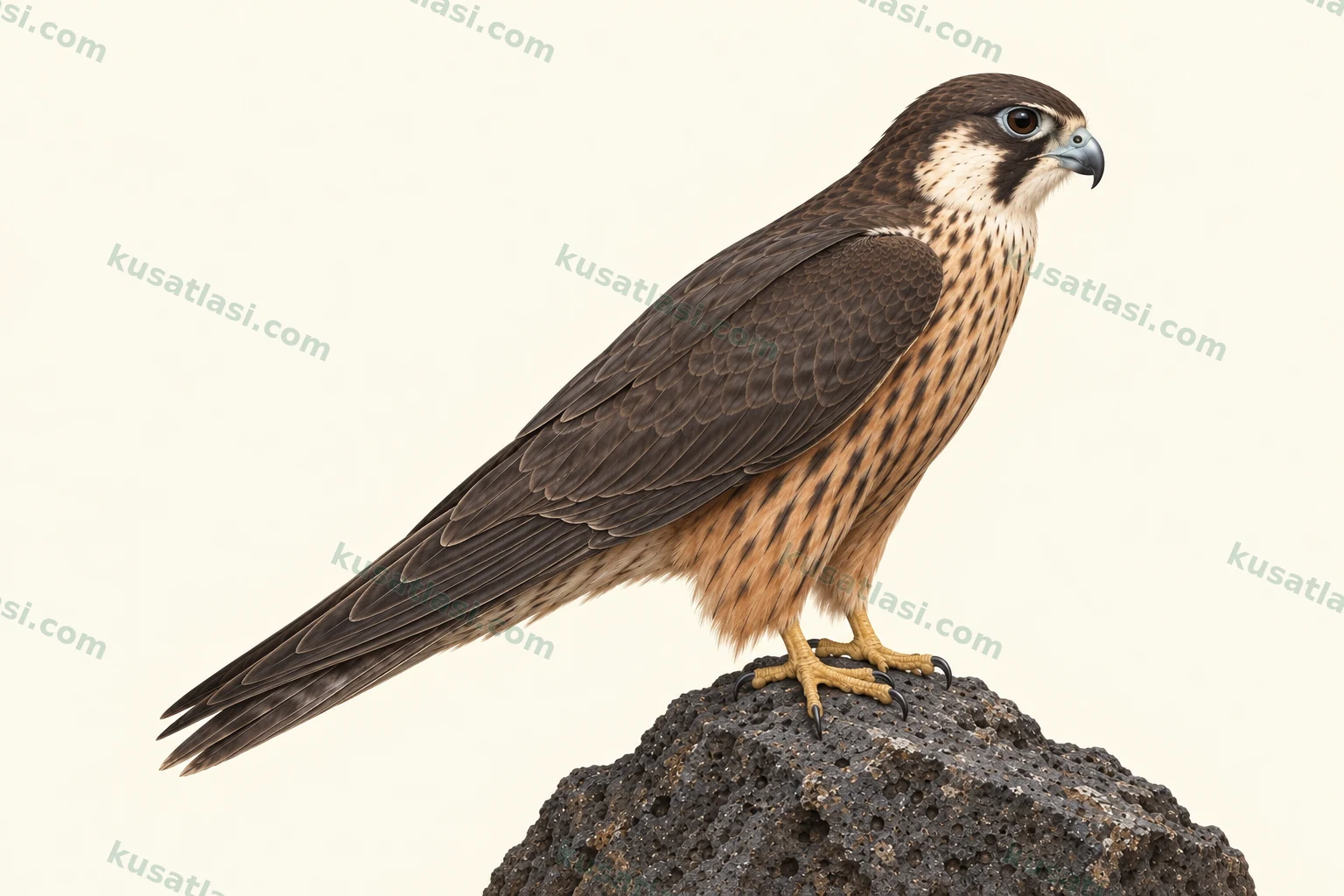
These plates show adult pale-morph Eleonora’s Falcons. Both pale and dark morphs occur in both sexes; plumage colour alone does not identify sex. The cere and bare orbital skin are yellow in the male and bluish-grey in the female. The head portrait shows the male. Dark underwing coverts contrast with paler, largely unbarred adult flight feathers. The different rocks do not imply a sex-specific habitat preference.
Approved field-guide plates
Eleonora's Falcon identification views
Swipe through four adult views.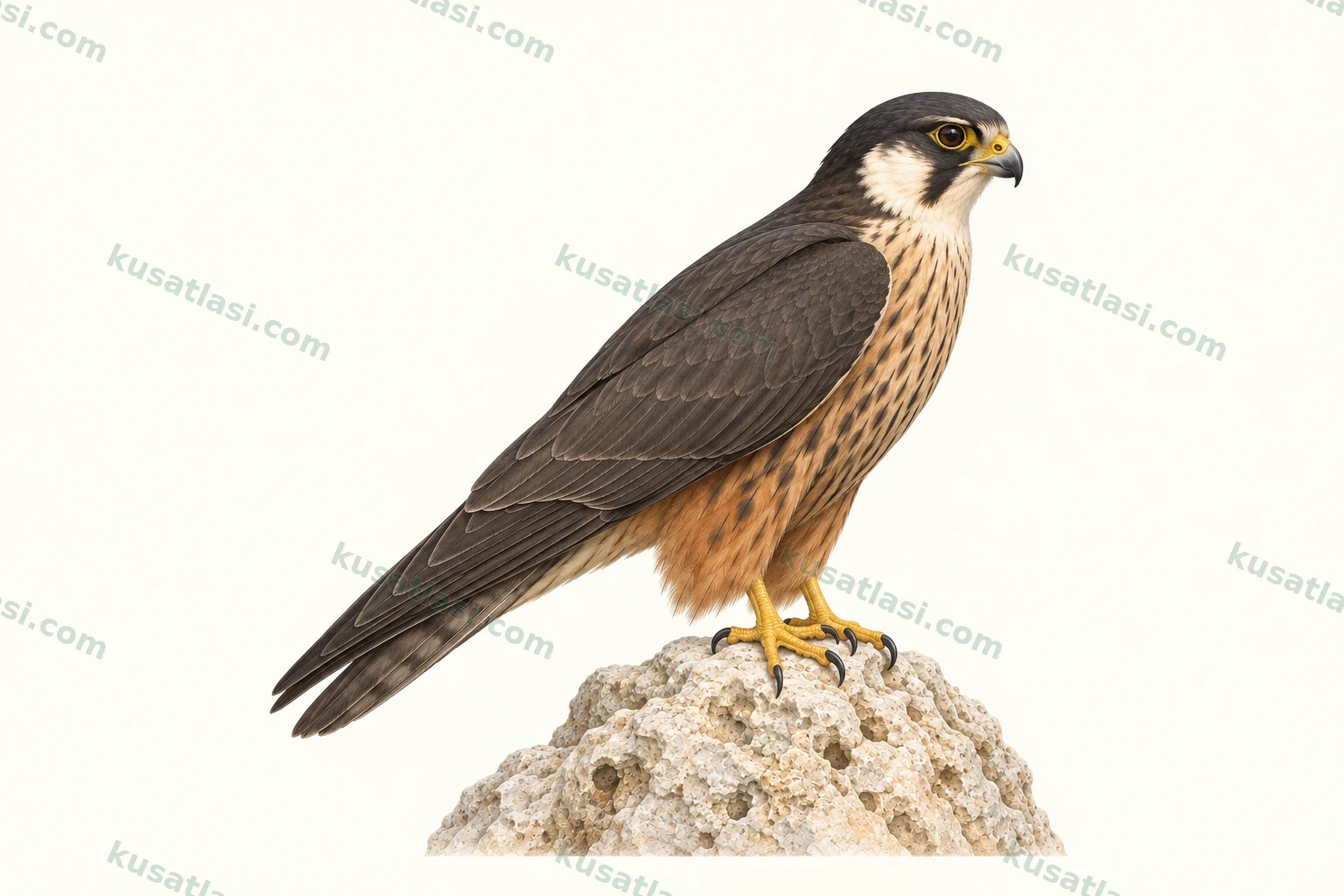
Falcons (Falconidae)
Eleonora's Falcon
Falco eleonorae
Ada Doğanı
A slim long-winged, long-tailed falcon with pale and dark morphs, breeding late in summer at coastal colonies in Turkey.
- Order
- Falconiformes
- Conservation status
- LC Least Concern
First look in the field
Quick identification
- Long narrow wings
The closed wing tips approach or pass the tail tip.
- Long tail
Together with the slim body it makes an elongated silhouette.
- Dark underwing coverts
In pale and dark adults, the underwing coverts are darker than the flight feathers. In juveniles, this contrast may be less distinct than in adults.
- Two colour morphs
Pale and dark birds occur in both sexes.
Biometrics
Length
- Male
- 38 cm
- Female
- 38 cm
Wingspan
- Male
- 90 cm
- Female
- 105 cm
Weight
- Male
- 341 g
- Female
- 414 g
Detailed explanations of these measurements are available on our website, on the same species page.
World distribution
Eleonora's Falcon
Customize map layers
Observation Sites
9.000 – 10.000 kmMediterranean cliffs → Sahara → Madagascar
↗ Open larger on MapsLoading observations…
Monthly record intensity
12 monthsRecord intensity is affected by observation effort.
Rotate the globe and compare the supported layers. Colours show broad range areas, not exact sightings or nests.
- Jan
- Apr
- Jul
- Oct
- Dec
Generalised data and method
Basemap: Natural Earth (public domain).
Bibliography ↗Authentic bird sound and ethical use
Voice and listening
Sharp repeated calls are heard at colonies; voice alone is not diagnostic.
Rapid wingbeats alternate with long glides.
Watch the colony from a distance and retreat from alarmed birds.
Spoken guide
Narration has not been recorded; no audio file has been created.
Observe without approaching the nest
Breeding
A shallow scrape in a sheltered rocky recess on an island or sea cliff.
Usually 2–3; most recorded clutches fall within 1–4.
The female incubates mainly for about 28–30 days.
Never rely on one mark
Similar species
Eurasian Hobby
Falco subbuteoSmaller, with a shorter tail.
Peregrine Falcon
Falco peregrinusBroader-winged, deeper-chested and more heavily moustached.
Scientific species guide
Detailed account
Quick Identification
Eleonora's Falcon is a slim medium-sized falcon with exceptionally long narrow pointed wings and a long tail. Pale and dark morphs occur in both sexes. Pale morph has a pale cheek, narrow moustache and warm streaked underparts; dark morph is smoky brown-black. In both, underwing coverts form a darker field than flight feathers.
General Appearance and Posture
It is less deep-chested than Peregrine and longer-winged and longer-tailed than Eurasian Hobby. Closed wingtips reach or slightly pass the tail. It glides on coastal wind and perches on exposed ledges.
Male, Female and Young
Female averages larger, but size alone cannot sex one bird. Adult male bare parts are often bright yellow, female yellow-green to bluish; light can distort colour. Juveniles are browner, pale-fringed and strongly streaked.
Flight Appearance
Above, read the long scythe wings and narrow tail. Below, dark underwing coverts against paler flight feathers are more useful. Upper and lower surfaces must be labelled separately.
Voice and Behaviour
Colonies carry sharp repeated calls and softer mate or chick notes. Before breeding it catches insects; in late summer it hunts southbound migrant birds and may cache surplus prey.
Confusion Species
Eurasian Hobby is smaller and shorter-tailed; Red-footed Falcon more compact; Peregrine heavier, broader-winged and thick-moustached. Juveniles require multiple views.
World Range
Colonies are scattered around the Mediterranean and eastern Atlantic islands, including the Canaries, Morocco, Balearics, Sardinia, Sicily, Adriatic and Aegean islands, Crete, Cyprus and Turkey. Birds winter mainly in Madagascar and nearby eastern Africa.
Status in Turkey
It is a summer visitor, passage migrant and local breeder on suitable Aegean and Mediterranean coasts. The 2013–2018 Adrasan study documents one southern breeding area, not a nationwide census.
Migration Journey
Satellite telemetry demonstrates variable inland African routes to Madagascar. Tracks from foreign colonies are not assigned to unmarked Turkish birds; observation points are not a route and no unsupported distance is drawn.
Breeding Area
Remote marine islands, islets and steep coastal cliffs provide shaded cavities, ledges and low predator pressure. Colony choice also depends on wind and access to autumn migrant prey.
Nest Site
No substantial stick nest is built. Eggs lie in a shallow scrape in a cavity, beneath a boulder or shrub. Usually 2–3 eggs are laid; incubation is about 28–30 days and young fledge around 35–40 days.
Daily Area Use
Before laying, birds hunt insects over scrub, stony slopes, wetlands and windy ridges. During breeding they patrol sea-facing migration lines. Keep boats, climbers, drones, cameras and playback away from colonies.
What Does It Eat?
For much of the year it takes dragonflies, grasshoppers, crickets, butterflies, moths and other flying insects. During late breeding it shifts strongly toward small southbound migrant birds. One colony's proportions are not universal.
How Does It Hunt?
Insects are seized and eaten on the wing. Migrant birds are intercepted over sea and coastal ridges in fast manoeuvring pursuits. Males supply much prey during incubation; transfers occur in air or on ledges.
Evidence Limits
Prey remains can reflect migration timing but remains, observations and consumption are different measures. Never sensationalize local caching as universal, bait a falcon or obstruct a hunting line.
An Exceptionally Late Breeder
Breeding coincides with autumn passage of small birds across the Mediterranean.
Morph Is Not Sex
Pale and dark birds occur in both sexes; one photograph cannot safely determine sex.
A Continent-Scale Journey
Satellite tracks reveal inland African routes to Madagascar, but one foreign route is not copied to a Turkish bird.
A Seasonal Diet Switch
Large insects dominate much of the year while migrant birds increase during chick rearing.
Simple Nests, Sensitive Colonies
A shallow scrape depends on shade, wind shelter and undisturbed access.
Local Turkish Evidence
Adrasan documents one coastal breeding area, not equal density across all Turkish coasts.
Plate Protection
Existing plates and pins are inspected but not altered; concerns are report-only.
Existing species account; references are in the central bibliography.
Open bibliography