
Approved field-guide plates
Goldcrest identification views
Mevcut 2 levha arasında sola veya sağa kaydırın; eksik levha oluşturulmadı.
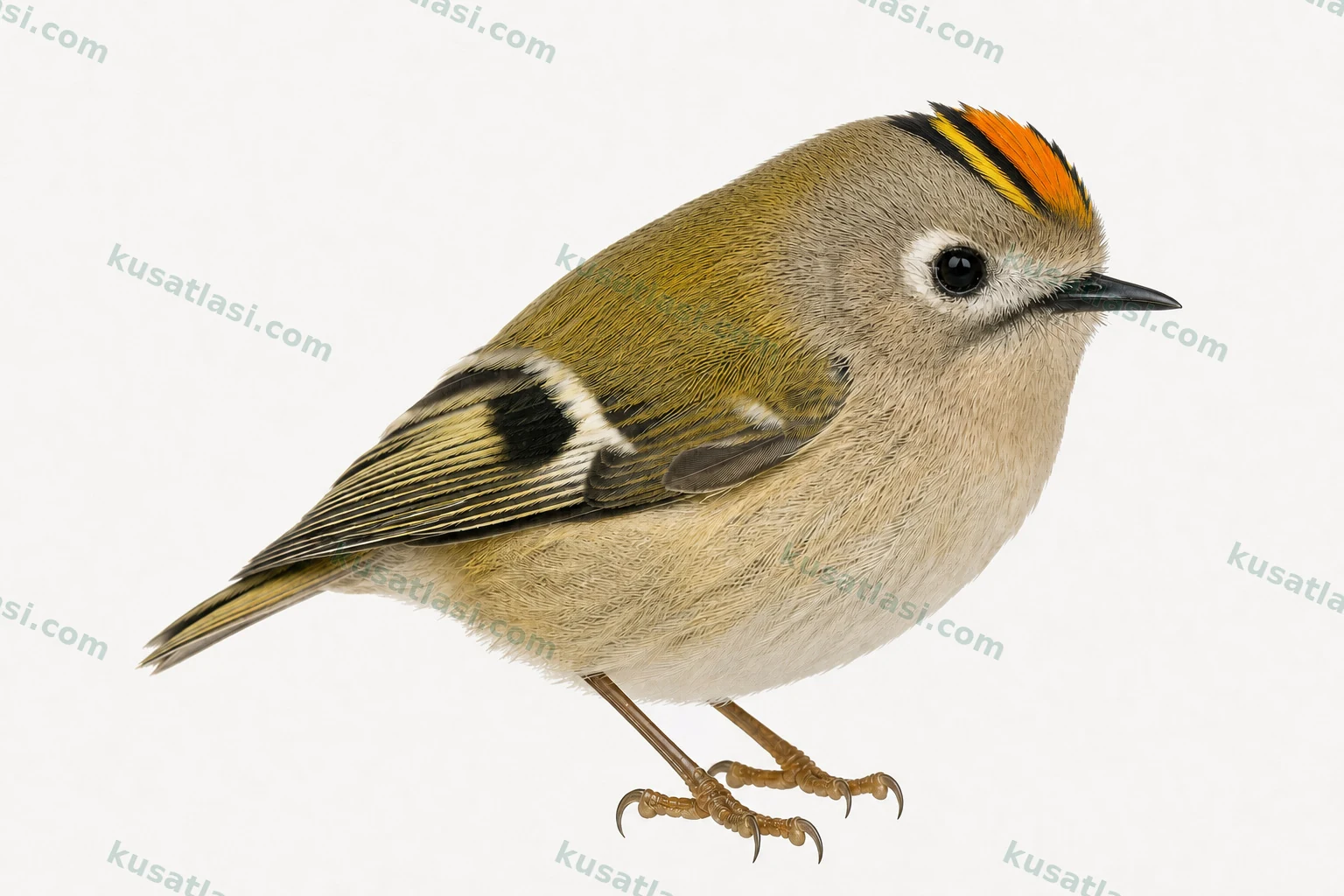
Kinglets (Regulidae)
Goldcrest
Regulus regulus
Çalıkuşu
Minute round olive forest bird with a plain face, black-bordered yellow-orange crown, two pale wingbars and very high thin voice.
- Order
- Neognathae
- Conservation status
- LC Least Concern
First look in the field
Quick identification
- Coloured crown
A yellow stripe bordered black; an orange centre may show in males.
- Plain face
It lacks the long white supercilium and black eye-stripe of Common Firecrest.
- Two wing bars
Judge them together with the dark wing panel and tiny rounded body.
- Very high voice
The calls may lie above the hearing range of some observers.
Biometrics
Length
- Male
- 9 cm
- Female
- 9 cm
Wingspan
- Male
- 14 cm
- Female
- 14 cm
Weight
- Male
- 5.4 g
- Female
- 5.2 g
Detailed explanations of these measurements are available on our website, on the same species page.
World distribution
Goldcrest
Customize map layers
Observation Sites
Bird Atlas recordsLoading observations…
Monthly record intensity
12 monthsRecord intensity is affected by observation effort.
Rotate the globe and compare the supported layers. Colours show broad range areas, not exact sightings or nests.
- Jan
- Apr
- Jul
- Oct
- Dec
Generalised data and method
Basemap: Natural Earth (public domain).
Bibliography ↗Authentic bird sound and ethical use
Voice and listening
Very thin, high, accelerating repetitions ending in a short flourish.
Fine repeated notes that may be inaudible to people with high-frequency hearing loss.
Avoid prolonged playback, especially in cold weather, so the bird can keep feeding.
Spoken guide
Listen to the scientific account; narration is not a bird call.
Observe without approaching the nest
Breeding
A deep cup suspended beneath a drooping conifer branch.
Usually 6–8; the recorded range is 2–12.
The female typically incubates for 16–19 days.
Altricial chicks fledge after about 16.5–18 days.
Never lift branches; withdraw immediately at alarm calls or food carrying.
Never rely on one mark
Similar species
Common Firecrest
Regulus ignicapillaLong white supercilium, black eye-stripe and a much more contrasting face.
Common Chiffchaff
Phylloscopus collybitaLarger and longer, without a coloured crown stripe bordered in black.
Pallas's Leaf Warbler
Phylloscopus proregulusStrong supercilium, crown stripe and bright rump; a rare record needs strong documentation.
Scientific species guide
Detailed account
Quick Identification
Goldcrest is a minute, round-bodied olive bird with a black-bordered yellow crown stripe, a plain pale face, two restrained pale wingbars and a small dark wing panel. Males have an orange centre within the yellow crown; females have yellow. The key distinction from Common Firecrest is the plain face: Goldcrest lacks Firecrest's long white supercilium and black eye-stripe. Confirm the plain face, crown, wing pattern, thin voice and active foraging behaviour together.
General Appearance and Posture
The neck looks absent, bill is needle-fine and tail short. Upperparts are olive-green, underparts pale buff-grey, wings and tail dark brown. Birds flick constantly through conifer tips, hang at odd angles and hover briefly. Plumage wear alters wingbar strength. The round dark eye and its fine pale eye-ring stand out on the otherwise plain face.
Male, Female and Young Birds
Adult body plumage is similar. A clearly seen orange crown centre supports male; an apparently yellow-only crown does not prove female when feathers are closed or the angle is poor. Juveniles initially lack the coloured crown and look plain-headed, retaining tiny proportions and wing pattern. BTO gives 6–8 eggs, female-only incubation for 16–19 days and fledging at about 16.5–18 days.
Appearance in Flight
Flight is quick, fluttering and weak-looking between branches. Above, olive upperparts, dark wings and restrained pale bars can be seen; below, the body and underwing are plain pale without a unique patch. Neither surface separates Firecrest safely. Never flush this energy-limited bird for another angle.
Voice and Behaviour
Calls are very thin, high repeated notes; song is a high accelerating series with a short flourish. Some observers cannot hear the highest frequencies. Birds glean tiny arthropods from conifer needles, hang below twigs and hover. In winter they may join mixed-species flocks and move into parks or gardens.
Confusable Species
Common Firecrest has a bold white supercilium, black eye-stripe and much more contrasting face. Chiffchaff and Willow Warbler are larger, longer and lack a black-bordered crown stripe. Pallas's Leaf Warbler has a strong supercilium, crown stripe, rump patch and stronger wing pattern. Use plain face, crown, double wingbar, size, voice and conifer-tip behaviour together. Never open hanging branches to find the suspended nest.
World Distribution
Goldcrest occupies the temperate forest belt from western Europe and Scandinavia through Russia and much of Asia, with resident island and mountain populations. Geographic taxa and genetic/song structure are complex. The species is widespread, but local numbers can fluctuate sharply after severe winters.
Status in Turkey
OSME treats Goldcrest as largely resident in Turkey and refers Anatolian populations to `buturlini`. It occurs especially in conifer and mixed forests of the Black Sea region and suitable mountain systems, moving into lower woods, parks and gardens in winter. One point record is not proof of breeding, a subspecies boundary or trend.
Migration Journey
Northern and eastern populations are partly migratory, while many temperate birds remain resident or move altitudinally. BTO records dramatic North Sea arrivals, proving capacity rather than a Turkish route. An unringed winter bird in Turkey cannot be labelled local, altitudinal or northern. No fixed distance or country chain is assigned.
Breeding Area
Dense conifer forest is typical, especially spruce and fir, though pine, cedar, yew and mixed woodland are used. Fine hanging branch tips supply both prey and nest structure. Open treeless land is unsuitable for breeding.
Nest Site
The deep elastic cup hangs below a conifer branch, bound with spider silk and camouflaged with moss and lichen, then lined with feathers. Usually 6–8 eggs are incubated by the female for 16–19 days; young leave after about 16.5–18 days. Never lift branches to search.
Daily Space Use
Birds cycle between inner cover and outer needle tips, using sheltered branches in cold and sunnier prey-rich surfaces when conditions allow. Winter flocks enter parks and gardens. Food carrying or repeated alarm requires immediate retreat.
What Does It Eat?
Tiny arthropods dominate: aphids, small flies, springtails, moth eggs and larvae, minute spiders and other needle-dwelling invertebrates. Dormant eggs and stages matter in winter. Seeds and fruit are not the primary diet.
How Does It Feed?
The fine bill picks prey from needles and twigs. Birds hang below branches, reach to needle tips and hover briefly. Constant movement meets the high energy demand of a five-gram body.
Observation Ethics
Never shake branches, bait insects or use sustained playback, especially in cold weather. Do not follow food-carrying adults, and keep nest coordinates private.
A Five-Gram Heat Budget
High surface-to-volume ratio makes cold costly, explaining winter crashes and the need for near-continuous feeding.
A Remarkable Clutch
BTO reports 6–8 eggs typically and up to 12, an exceptional investment relative to female mass.
A Concealable Orange Crest
Male orange can disappear when crown feathers lie flat. Failure to see orange never proves female.
A Song Some People Cannot Hear
The very high frequencies may be inaudible to observers with age-related hearing loss.
A Suspended Silk Nest
Spider silk binds moss and lichen into an elastic cup below a conifer branch. Never move foliage to locate it.
Observation Ethics
Cold-weather playback steals feeding time. Retreat from alarm or food carrying and never publish a nest location.
Last content review: 20 September 2026. References are held in the central bibliography.
Open bibliography