Black-bordered coloured crown
Yellow, with visible orange centre in male.

Regulus regulus • Çalıkuşu
1. Tanım
Dinlemeye başlamak için oynat düğmesine dokunun.
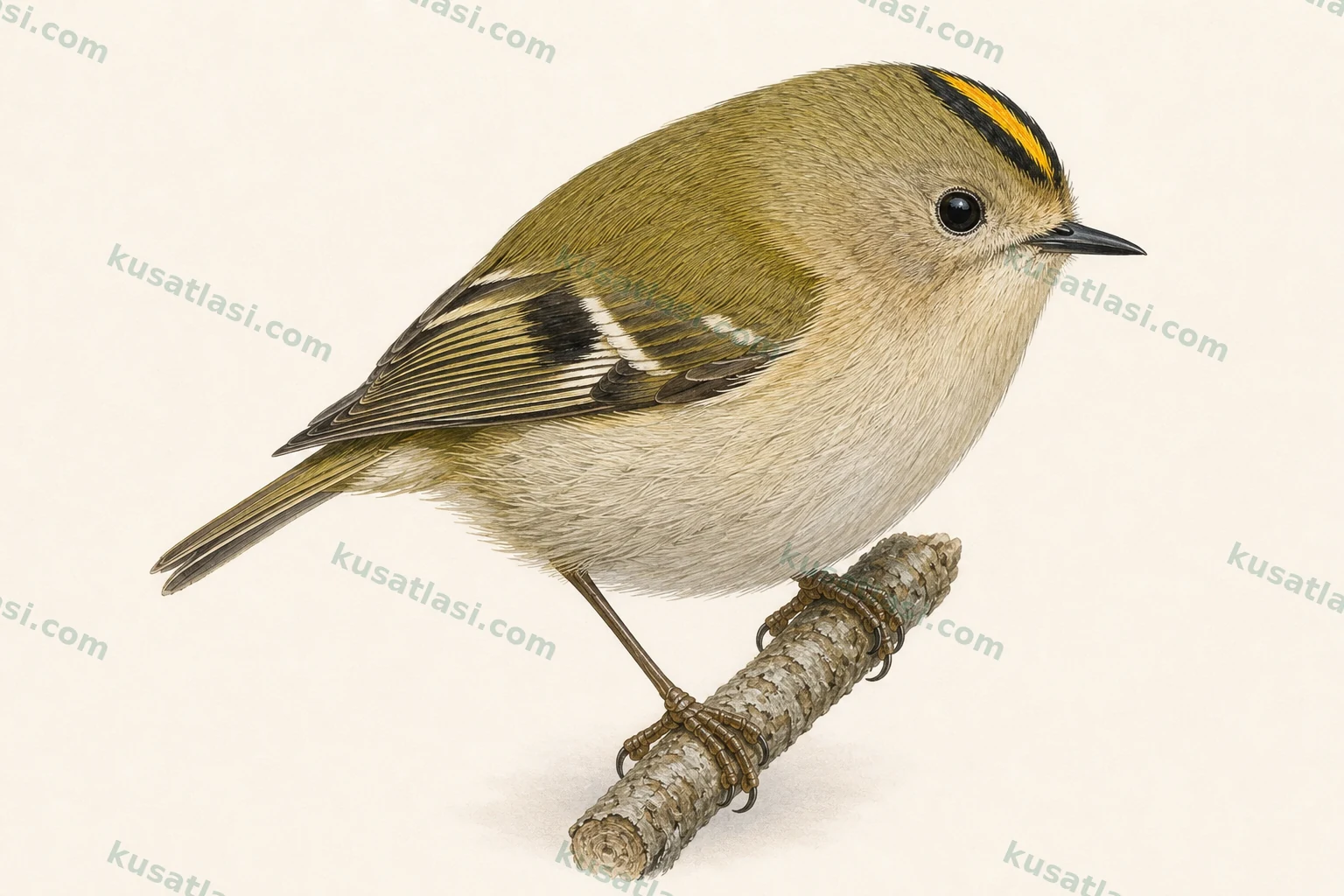
Goldcrest is a minute, round-bodied olive bird with a black-bordered yellow crown stripe, a plain pale face, two restrained pale wingbars and a small dark wing panel. Males have an orange centre within the yellow crown; females have yellow. The key distinction from Common Firecrest is the plain face: Goldcrest lacks Firecrest's long white supercilium and black eye-stripe. Confirm the plain face, crown, wing pattern, thin voice and active foraging behaviour together.
The neck looks absent, bill is needle-fine and tail short. Upperparts are olive-green, underparts pale buff-grey, wings and tail dark brown. Birds flick constantly through conifer tips, hang at odd angles and hover briefly. Plumage wear alters wingbar strength. The round dark eye and its fine pale eye-ring stand out on the otherwise plain face.
Adult body plumage is similar. A clearly seen orange crown centre supports male; an apparently yellow-only crown does not prove female when feathers are closed or the angle is poor. Juveniles initially lack the coloured crown and look plain-headed, retaining tiny proportions and wing pattern. BTO gives 6–8 eggs, female-only incubation for 16–19 days and fledging at about 16.5–18 days.
Flight is quick, fluttering and weak-looking between branches. Above, olive upperparts, dark wings and restrained pale bars can be seen; below, the body and underwing are plain pale without a unique patch. Neither surface separates Firecrest safely. Never flush this energy-limited bird for another angle.
Calls are very thin, high repeated notes; song is a high accelerating series with a short flourish. Some observers cannot hear the highest frequencies. Birds glean tiny arthropods from conifer needles, hang below twigs and hover. In winter they may join mixed-species flocks and move into parks or gardens.
Common Firecrest has a bold white supercilium, black eye-stripe and much more contrasting face. Chiffchaff and Willow Warbler are larger, longer and lack a black-bordered crown stripe. Pallas's Leaf Warbler has a strong supercilium, crown stripe, rump patch and stronger wing pattern. Use plain face, crown, double wingbar, size, voice and conifer-tip behaviour together. Never open hanging branches to find the suspended nest.
Yellow, with visible orange centre in male.
No long white brow and black mask.
Together with a dark panel and tiny body.
Male has an orange crown centre and female yellow; closed feathers or poor angle hide orange, so absence does not prove female.

Not sufficient on its own. Never flush in cold; underwing or one crown colour is not conclusive.
Monthly cards show the broad field expectation; timing may vary locally and between years.
Never flush in cold
Do not assign origin to a winter bird
One song is not breeding proof
Never lift hanging branches
Do not wait below a nest tree
Never remove a fledgling
Do not follow family groups
Record voice in mixed flocks
One record does not define a route
Do not assign foreign rings locally
A park record is not breeding
Avoid sustained playback
Scan the wider area first and do not approach possible nest sites.
Dense hanging branches for prey and nest.
Conifer component and varied canopy layers.
Temporary feeding in dense conifers.
Judge the complete structure and pattern, not one colour alone.
Nest site, eggs and incubation are summarised together.
Use rhythm and repetition together with visual identification.
Loading audio recordings...
Tap a number: the bird turns to the diagnostic angle, the field mark is highlighted, and every feature is explained in the panel beside it.


A yellow stripe runs down the crown centre between two black lateral lines; males show an orange core, females plain yellow. The stripe narrows forward and does not reach the forehead.
Field-guide thumbnails of species most often confused with Goldcrest. Open a box to compare.
All species in this family in the atlas.
