
World Birds
Field identification plates
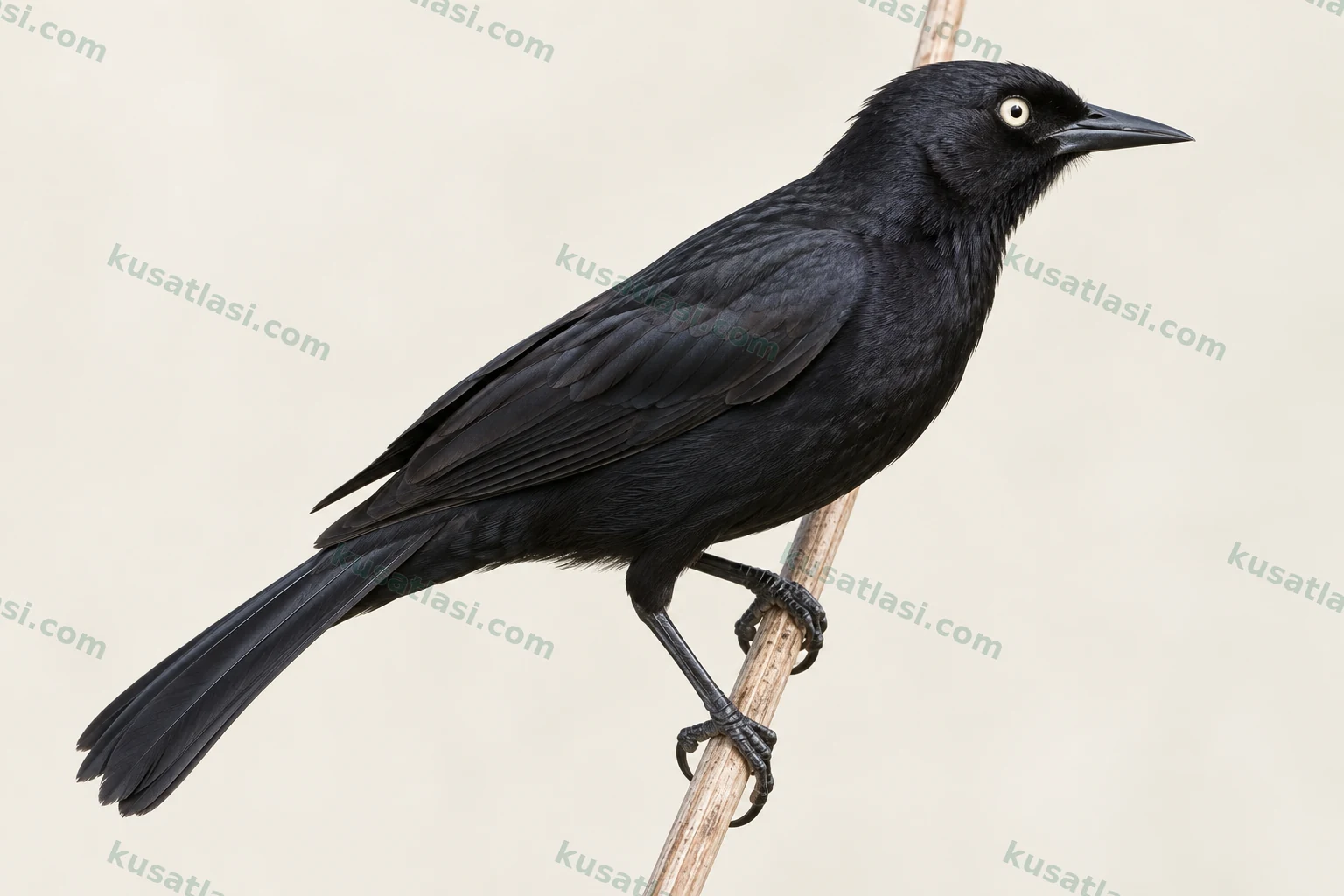
Swipe left or right between the two adult plates.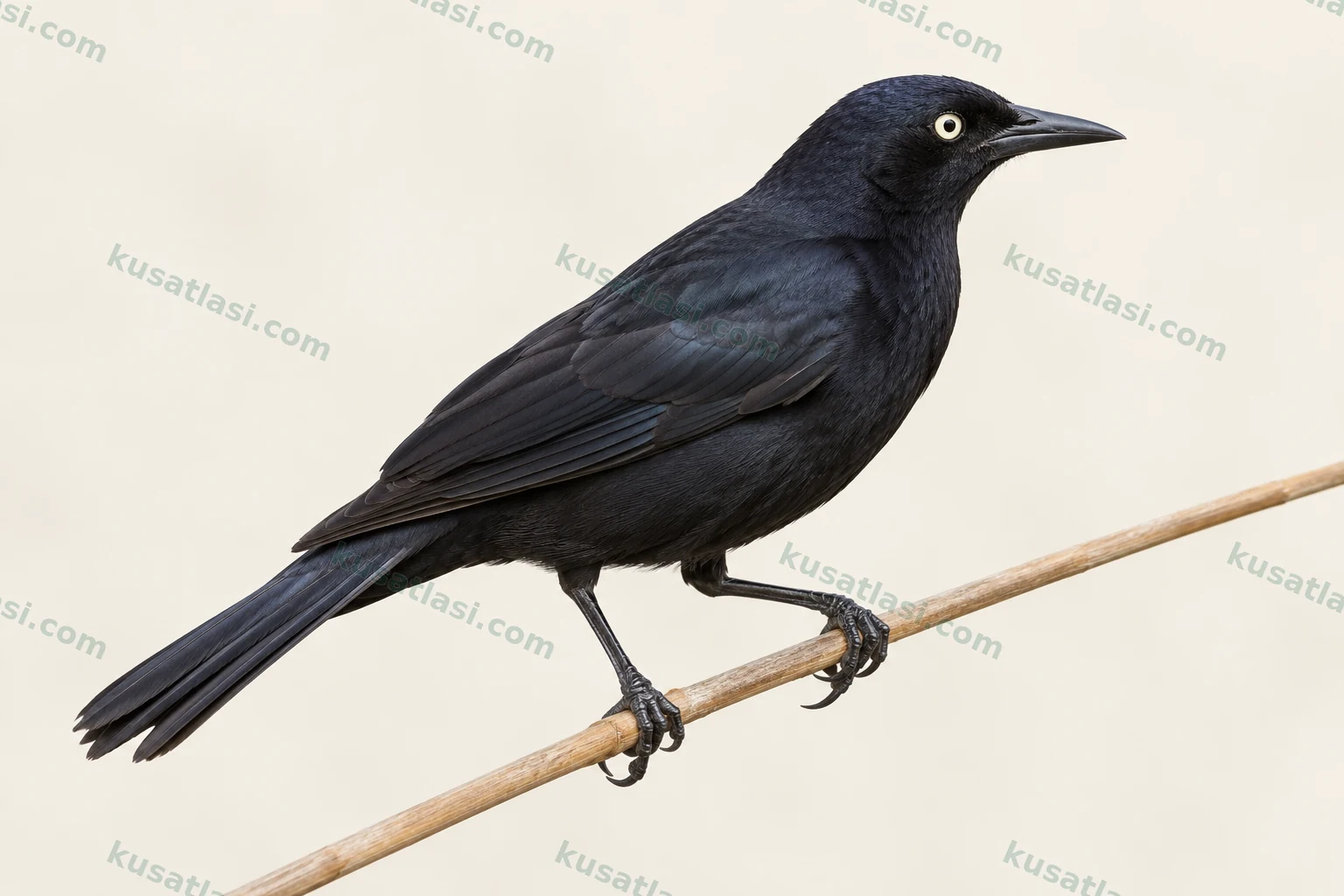
Icteridae
Pale-eyed Blackbird
Agelasticus xanthophthalmus
The pale orange-yellow eye is not a white eye-ring.
- Order
- Passeriformes
- IUCN status
- LC · Least ConcernGlobal IUCN. BirdLife v10 (2025); taxon matching: AviList 2026 / IOC 15.2; checked 29 October 2026. Checklist year is not the species assessment date. Source and method · BirdLife
At a glance
- Look at the coloured part of the eye
The pale orange-yellow eye is not a white eye-ring.
- Watch tail and bill together
Assess the long pointed tail together with the straight black bill.
- Wait for natural sounds
Listen to the pair singing spontaneously among wetland plants.
Biometrics
Length
- Male
- 20 cm
- Female
- 20 cm
Wing length
- Male
- 9.12 cm
- Female
- 9.12 cm
Weight
- Male
- 43 g
- Female
- Data unavailable
Length: Shared species value Wing length: Shared species value
World distribution
Pale-eyed Blackbird
Customise map layers
Observation points
Preparing globe…
Monthly record count
Bars show record counts in this sample, not bird abundance or a breeding calendar. They are affected by recording and observation effort.
Rotate the globe and compare layers. Coloured areas are not exact observation or nest locations.
The source does not provide verified monthly range boundaries. All areas are shown; the month slider and monthly playback are therefore disabled.
- Jan
- Apr
- Jul
- Oct
- Dec
Generalised data and method
Base map: Natural Earth · Public domain
Open central bibliography ↗Calendar
Limited Peruvian and Ecuadorian records do not provide a fixed year-round breeding calendar. Local observation months must not be confused with verified incubation dates.
All months: Monthly data unverified.
January
February
March
April
May
June
July
August
September
October
November
December
Habitat
Local wetlands of eastern Ecuador and eastern Peru
Among lake and marsh plants, watch the pale eye, straight black bill and long pointed tail together; listen to natural pair calls.
Sound
A fairly long, whistle-like song in the original observation; frequent pair duets in the Peruvian breeding study. Assess sound together with eye colour and body shape.
Do not play recordings to attract birds; observe quietly, especially near nests.
Breeding
Cocha Cashu, Peru: the first known nest and incubation by the female alone were published; the male stays nearby and the pair duets. Nest structure, typical clutch size, incubation and chick development periods could not be reliably verified from the accessible evidence.
Compare
Compare male and female
Assess the long pointed tail together with the straight black bill.
Species information
Quick identification
The Pale-eyed Blackbird is an apparently all-black passerine of some marshes and lake shores in eastern Peru and Ecuador. Assess the pale orange-yellow eye, black bill and legs, relatively short wings and long, pointed tail together. The pale eye colour is not a white ring drawn around the eye; it is the coloured part of the eye itself. Light and viewing angle can conceal it as the bird turns its head. A distant pale dot or black silhouette therefore does not justify certain identification.
General appearance and posture
Head, body, wings and tail are black, with soft-looking glossy feathers. The original description mentions limited greenish-blue reflections rather than strong iridescence changing dramatically with angle. A sunlit back shining above a shaded dark breast does not alter this overall black pattern. A broad yellow shoulder patch or pale body panel is not part of the basic description. Distinguishing feather reflections from true colour areas matters.
The bill is rather long, straight and pointed; it is not very deep in profile, looks broader from above and is slightly flattened towards the tip. Strong legs and feet were emphasised in the first scientific comparison. The tail is relatively long, its middle feathers longer than the outer ones and distinctly pointed. Catching the bird is unnecessary to see this; watching the head in profile, feet and tail outline when it naturally emerges onto a stem is a useful start.
Although its Turkish name contains karatavuk, or blackbird, this bird belongs to Icteridae. It does not share a family with the Common Blackbird, Turdus merula. That name similarity must not lead to transferring diet or nesting information. Its identity here is Agelasticus xanthophthalmus; Agelaius xanthophthalmus in older scientific texts is an earlier genus combination of the same species. Old records under Chrysomus are also matched carefully to the current taxon.
Males, females and young birds
Adult males and females are largely alike: both have black plumage, pale eyes and black bills and legs. The female specimen in the original description was slightly less glossy than the male. As the comparison involved only one pair, this is not a reliable sexing key for all birds. Light, feather condition and viewing angle also affect gloss. A duller-looking bird is not called female from that feature alone.
The 1968 description specimens differ in wing measurements and mass; they are individual measurements of one male and one female, not sex means from a large sample. Their two values are therefore not given on the cards as fixed male and female measurements. Two similar-looking birds side by side do not alone establish which is male either. Incubation and duet context helped clarify sex roles in a later Peruvian behaviour study; every distant pair should not automatically receive the same roles.
In the 2008 Ecuador observation, a male with a streaked throat was interpreted as a possible young adult. Its eyes were yellow and its remaining feathers, bill and legs black. This age interpretation is not a proven key for all young birds. Sufficient species-specific data were not verified to claim that young must have dark eyes or that these lighten in a particular month. Describe visible details when age is uncertain; an unseen age feature is not considered established.
Appearance in flight
Wing–tail proportions help understand the black silhouette: wings are relatively short, the tail longer and its feather tips pointed. A short movement may reveal tail outline and straight bill; eye colour can be much harder to see in flight. Watching the head side when it naturally perches again strengthens identification. Short-looking wings or a long tail alone do not exclude other black passerines.
Sources did not verify a distinctive underwing pattern shown in every situation, a numerical wingspan or definite migratory flight. The overall black is not described as a separate pale flight panel. Short movements along a lake shore are not evidence of intercontinental travel either.
Voice and behaviour
The first scientific observation recorded a prolonged, whistle-like song. Comparing it to a cardinal was an auditory analogy, not evidence of shared family or food. The later Cocha Cashu study reported Peruvian pairs moving together within restricted areas during and outside breeding, frequently communicating in duets. The female incubates; the male is usually near the nest. These results concern the study locality.
The original description recounts two birds spreading tails, fluffing feathers and directing open bills at each other in a short film. The observer explicitly said the encounter was too brief to determine the behaviour’s function. Calling it certainly a fight, courtship or a ceremony measuring pair bonds would be wrong. Waiting for natural song and movements among plants without playback, and observing without pressuring the nest or pair, is the appropriate approach.
Similar species
1. Agelasticus cyanopus may show a similar black body and long tail. The original comparison found its darker eye, narrower bill and weaker feet distinctive. Yellowish-olive areas of females matter even in dark forms. It is not assumed to occur at every Pale-eyed Blackbird site; range and several appearance features are checked together.
2. Agelasticus thilius has darker eyes and a relatively shorter tail; females are brown and dark-streaked. The original description compared these features and the clearer differences between sexes. A shoulder or tail seen poorly cannot identify a bird alone; geography also matters.
3. Other black Icteridae can have pale eyes or long tails. A pale eye is not a unique worldwide identifying feature of this species. Bill shape, tail, type of feather gloss, wetland use and natural voice are considered together. When uncertain, retaining a record of the features seen is more valuable than forcing the bird into a close view.
Global range
Current taxonomic sources place the species in local marshes of eastern Ecuador and eastern Peru. It is not spread across all of both countries; it has a patchy distribution in suitable wetlands on the western side of the Amazon basin. The original description came from a small marsh near Tingo María in Peru’s Huánuco region; the later breeding study came from Cocha Cashu in Manu National Park in southeastern Peru. These separate research sites must not be presented as one lake or an uninterrupted occupied area.
The 2008 study in Ecuador’s Pastaza region recorded three birds on an oxbow lake shore. The researcher did not find them at other similarly vegetated lakes and left the reason for scarcity unknown. The paper’s reference to the fourth national locality at that time is not today’s total number of sites. Occurrence at one lake does not prove occupancy of all neighbouring lakes.
Regional status
This regional assessment concerns the Peruvian and Ecuadorian wetlands where the species lives. Global LC status and rarity at one locality are different scales. The more cautious Ecuador conservation recommendation in the 2011 paper does not replace the current global category. Dates and observation conditions provide more detailed evaluation than country names alone.
Movements
Pairs used restricted areas in the Peruvian study. February and June records in Pastaza supported an interpretation of local persistence, explicitly presented as an interpretation. Two months are not a year of monitoring. No verified long migration route, monthly intercontinental journey or distance is available, so none is drawn; short movements among plants are distinguished from regular migration.
Breeding habitat
The habitat is dense emergent vegetation of lakes and marshes. The first Peruvian pair was observed in reed-like plants in a small marsh surrounded by secondary forest; it was not seen using the nearby tall trees. Documented breeding at Cocha Cashu and the Ecuador oxbow-lake record support the wetland association from different sites. Surrounding forest does not make it primarily a canopy bird.
Nest site
The Peruvian study reports the first known nest; its accessible original abstract confirms incubation by the female and the male’s nearby presence. Detailed nest structure, typical clutch size, incubation and nestling periods could not safely be established from the readable evidence. That limit is retained rather than borrowing another marsh bird’s nest measurements or durations. Shore vegetation is not entered to search for the nest.
Daily habitat use
Birds can be seen among thick grasses and reed-like stems, sometimes on a dry projection. Restricted pair areas are a direct Peruvian observation; the same area size is not assigned to every population. The fact that it was not found at every similar-looking Ecuadorian lake prevents predicting certain presence from vegetation appearance alone. Observe from an open shore at a distance allowing natural behaviour.
What does it eat?
A published ecological compilation classifies the Pale-eyed Blackbird as an invertebrate-feeding wetland bird. This supports the importance of insects and similar small invertebrates, not percentages of particular prey, their seasonal order or complete digestive contents. Without reliable species-specific detail, other Icteridae diets of seeds, grain or fruit are not transferred here. No proportion by which it reduces agricultural pests was verified either.
How does it feed?
Direct field records show the bird in reed-like marsh plants and on grassy, reedy oxbow-lake shores. Strong feet and a straight bill are visible there, but shape alone does not determine prey or frequency of a feeding technique. If food uptake is clearly seen after movements among plants, record the prey itself; not every peck is counted as a definite insect capture. Opening vegetation or offering food to expose the bird does not produce natural feeding evidence. As a detailed prey list and quantitative diet study were not verified, the account remains within this evidential limit.
The two birds that drew attention to a new species
On 17 August 1968, Lester L. Short was watching woodpeckers near Tingo María when two black birds in a small marsh attracted him. A whistle-like song and an appearance unlike familiar birds prompted detailed comparison; the scientific description appeared on 26 March 1969. Seeing only two that day does not prove that the marsh held only two individuals or that the entire species population was known.
Duets during incubation
The abstract of the Cocha Cashu study in Peru reports frequent duets between the incubating female and nearby male. Pairs moved together outside breeding too. This is a local example showing why two black birds should not simply be assumed random members of a large flock. However, the accessible study section does not yield an annual breeding calendar, clutch size or number of incubation days.
One lake record is not all lakes
In Pastaza in 2008, the researcher saw three birds among grasses and reeds but did not find the species at similar-looking lakes. A streak-throated individual was interpreted as a possible young adult, and the cause of scarcity left unresolved. Distinguishing record from interpretation shows why similar-looking habitat does not guarantee the same bird community. A historical national locality count is not today’s world population; overlooked birds and true scarcity require further investigation.