
World Birds
Field identification plates
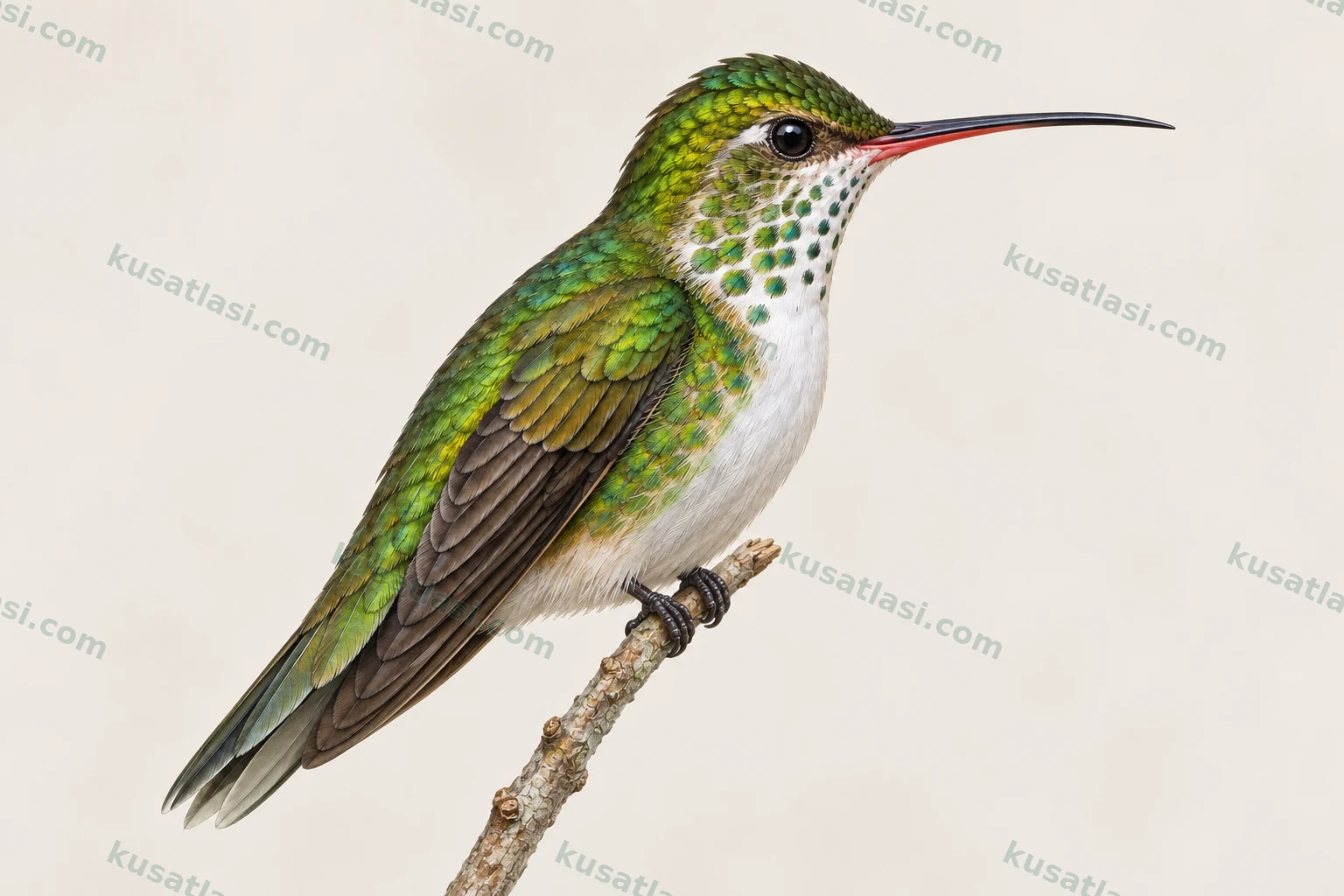
Swipe left or right between the two adult plates.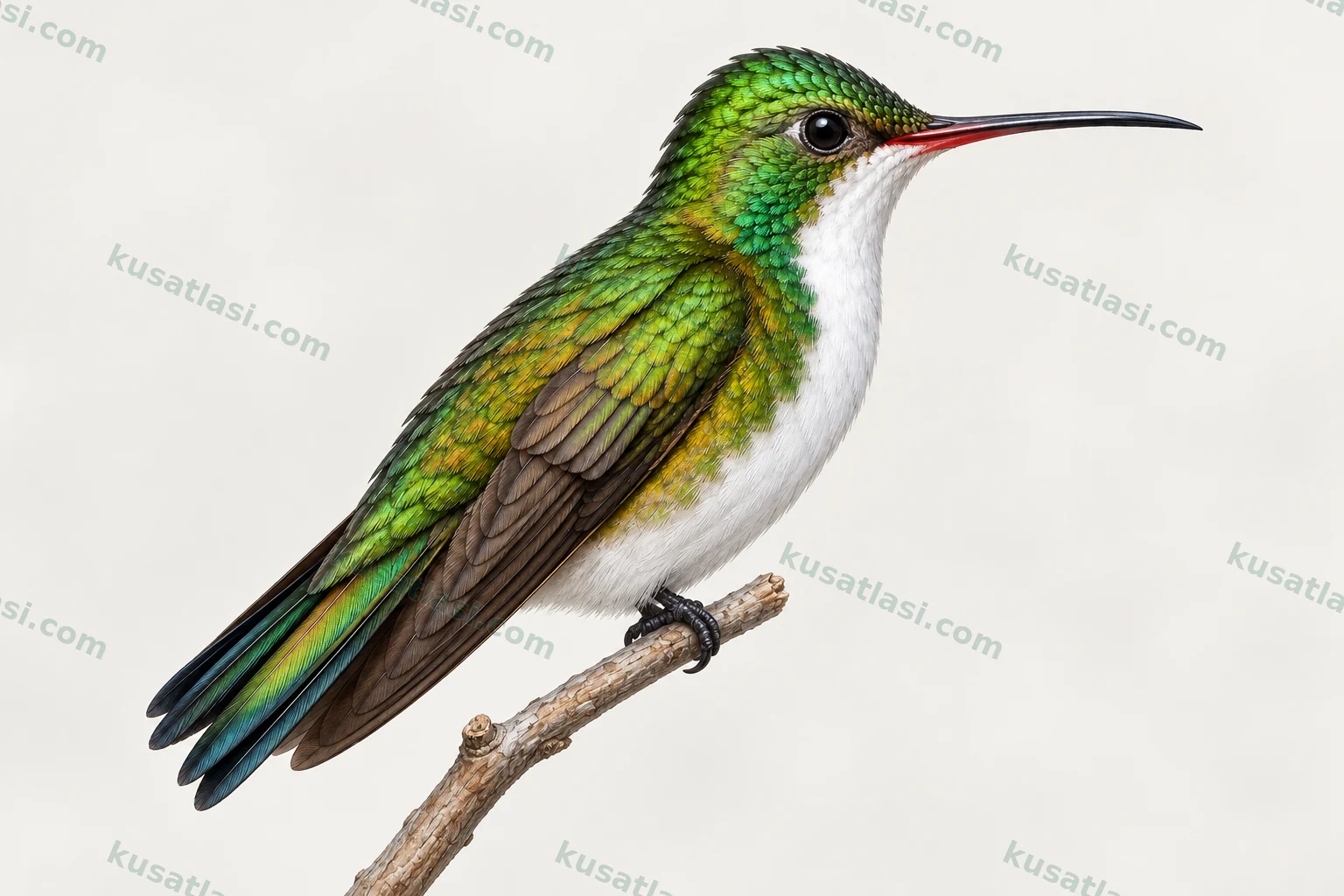
Trochilidae
Plain-bellied Emerald
Chrysuronia leucogaster
Compare the shining green back with white breast and belly.
- Order
- Apodiformes
- IUCN status
- LC · Least ConcernGlobal IUCN. BirdLife v10 (2025); taxon matching: AviList 2026 / IOC 15.2; checked 29 October 2026. Checklist year is not the species assessment date. Source and method · BirdLife
At a glance
- See green and white together
Compare the shining green back with white breast and belly.
- Check the facial details
A small white postocular spot and pink lower-bill base are supporting features.
- Distinguish similar females
Look for green spots on the female Chlorestes notata’s breast and throat.
Biometrics
Length
- Male
- 9–10 cm
- Female
- 9–10 cm
Wing length
- Male
- 5.33 cm
- Female
- 5.33 cm
Weight
- Male
- 4–4.5 g
- Female
- 4.3 g
Length: Shared species value Wing length: Shared species value
World distribution
Plain-bellied Emerald
Customise map layers
Observation points
Preparing globe…
Monthly record count
Bars show record counts in this sample, not bird abundance or a breeding calendar. They are affected by recording and observation effort.
Rotate the globe and compare layers. Coloured areas are not exact observation or nest locations.
The source does not provide verified monthly range boundaries. All areas are shown; the month slider and monthly playback are therefore disabled.
- Jan
- Apr
- Jul
- Oct
- Dec
Generalised data and method
Base map: Natural Earth · Public domain
Open central bibliography ↗Calendar
No verified monthly breeding calendar covering the entire range was found. João Pessoa flowering observations are not used as a breeding calendar.
All months: Monthly data unverified.
January
February
March
April
May
June
July
August
September
October
November
December
Habitat
Northeastern Venezuela, the Guianas and northeastern–eastern Brazilian coasts
In mangroves, coastal scrub and flowering gardens, look for green back and white underparts together.
Sound
In the João Pessoa flower study, birds vocally warned and chased visitors approaching the feeding area. This is not described as nest or mate defence.
Do not play recordings to attract birds; observe quietly, especially near nests.
Breeding
The institutional guide reports a near-ground cup of moss, lichen and spider web, usually two eggs and female incubation. Incubation and nestling periods were not verified for this species; other hummingbirds’ durations are not used.
Compare
Compare male and female
A small white postocular spot and pink lower-bill base are supporting features.
Species information
Quick identification
Assess the shining green back and white underparts together. Dark wings and tail, the small white spot just behind the eye and the pink base of the lower mandible support identification. The bill is generally black; pink does not cover it entirely. A pale belly alone is insufficient: females of other local hummingbirds can also look pale. If a flower visit is brief, check back, face and breast again after the bird perches.
General appearance and posture
The contrast between green back gloss and white body is the main pattern to assess on a perched bird. Dark wings and tail complete it. The photographed green's brightness changes with light; dullness in shade does not alone mean another species. First establish which parts are truly white. Do not confuse breast spots lost in an overexposed picture with naturally white feathers.
The small postocular spot may be concealed by leaf, branch or head angle. Not seeing it does not immediately exclude the species, and seeing it does not prove identity alone. Check the lower bill's pink base from several angles as the head turns. Before calling a reflection pink, establish the pale area's position. If head and belly are readable separately in a photo, compare features of that same bird.
A bird moving around flowers and one perching to watch its surroundings have different postures. In the João Pessoa study, individuals defending flowers waited on a high branch and descended to feed. This does not establish a fixed height at all times. A perch may serve to oversee the feeding area; calling it a nest or permanent roost requires separate evidence.
Males, females and young birds
The institutional guide reports no conspicuous adult plumage difference between sexes. Labelling a brighter bird male and a duller one female is therefore unreliable. Different male and female numbers in the measurement compilation do not make small photographic size differences a definitive sexing key. Two birds cannot be compared without accounting for branch distance, posture and image scale.
No detailed species-specific age key separating young reliably at every sighting was verified. A short bill, pale back or absent white spot are not presented as unverified juvenile features. A nestling and an independently flying young bird are different development stages. Observing parental feeding supplies information that plumage alone cannot. Leave age and sex uncertain without support.
Appearance in flight
Watch separately its approach, feeding in front of a flower and return to a branch. White underparts may stand out in brief flight while the tiny postocular spot or pink bill base remain invisible. Do not complete every diagnostic detail from one blurred frame. Recheck the boundary between green back and white breast and belly after landing for a sounder assessment.
No species-specific upperwing/underwing pattern key permitting definite identification from one movement was verified. A chase at flowers should not be labelled regular migration or courtship flight; preceding and following actions explain its context.
Voice and behaviour
The João Pessoa Heliconia study observed individuals warning approaching visitors vocally and chasing them from food. Two birds defended different sides of a flower patch. The study does not identify them as a confirmed male–female pair; defending food is not defending a nest or mate. Watch the bird returning to a branch and flowers together with other visitors.
Vocal use in behaviour is verified here, not a definitive syllable-by-syllable species key. Check that a sound belongs to the bird seen. Other hummingbirds and insects also visit, so not every short nearby sound belongs to this species. Chasing an insect does not prove eating it either. Keep observed behaviour separate from its interpretation.
Similar species
1. A female Chlorestes notata can mislead in a brief view through pale underparts. The institutional guide reports green spotting on her breast and throat; the male differs with shining blue chin and throat. Compare the Plain-bellied Emerald's white underparts against those spots. An overexposed white-looking breast does not prove spots absent. Both appear in the Cabedelo guide; regional occurrence does not prove coexistence in every garden.
2. Eupetomena macroura differs with a much longer forked tail and blue-violet head and breast. A closed or leaf-hidden tail may hide the difference initially. Inspect tail shape and underparts, not just green back. This comparison shows green-looking hummingbirds are not all one species; it is not an identification from one general colour.
Global distribution
The natural range extends across northeastern South America, from northeastern Venezuela through the Guianas to northeastern and eastern Brazilian coasts. The current taxonomy source places the southern limit in Espírito Santo. Much of the range is linked with coastal vegetation, but local occurrence in interior Guyana and Suriname is also mentioned. It is therefore neither Brazilian endemic nor exclusively coastal everywhere.
Two subspecies are recognized: leucogaster in the north, in Venezuela, the Guianas and northeastern Brazil; bahiae in eastern Brazil. Broad region names do not mean continuous occupation. National boundaries, suitable vegetation and confirmed observation sites are different kinds of information. Abundance in one Brazilian region must not be generalized across South America.
Status within its natural range
Cabedelo's institutional guide describes it as the reserve's most abundant hummingbird. This applies to one protected area, not equal abundance throughout the range. The separate João Pessoa feeding study recorded no visits late in flowering. Absence from one flower cluster does not mean all regional birds disappeared. Local abundance, plant visiting and large-area population are different measures.
Migration
AVONET classifies it as non-migratory; the sources do not establish a regular intercontinental migration route. Changing visibility at a food site as flowers decline is not migration evidence. The João Pessoa study recorded no visits during the last flowering phase; this local result does not show where birds went or disappearance throughout the region. Local movement, seasonal detectability and long-distance migration are assessed separately.
Breeding habitat
Mangroves and scrub–forest vegetation on coastal dunes are important Brazilian habitats. Brazilian sources call the latter restinga. It may also visit flower-rich gardens and yards. João Pessoa's feeding study took place in an urban secondary Atlantic Forest fragment, so it does not support restricting the species to untouched forest.
Nest site
The institutional guide reports a small cup near the ground made with moss, lichen and spider web; usually two eggs are incubated by the female. It gives no verified incubation or nestling periods for this species. Durations of neighbouring hummingbirds are not transferred. Rather than opening branches or waiting beside birds to find a nest, withdraw on noticing defence or agitation.
Daily space use
Flowers, nearby waiting branches and covered vegetation serve different functions. João Pessoa individuals used branches to watch before descending. Feeding and defence at a flower cluster do not prove spending the whole day or nesting there. Cabedelo abundance is local; equal density in every mangrove is not assumed.
What does it eat?
Species-specific observations verify flower nectar use. Regular Heliconia psittacorum visits were recorded in João Pessoa during peak flowering. This is one local food source, not exclusive reliance on the same flower throughout the range. Visit counts cannot be used as daily food mass or percentage of the whole diet.
How does it feed?
In the study, the bird entered the flower's natural opening for nectar and contacted reproductive structures; another hummingbird's flower-piercing behaviour is not transferred. Defending individuals displaced nearby visitors and moved between waiting branches and flowers. Chasing a bee or other insect does not document capture and swallowing.
Because nectar availability changes through the day, one hour's visit intensity is not a fixed daily consumption amount.
The same bird's older scientific name
Older studies use Amazilia leucogaster. The currently accepted combination is Chrysuronia leucogaster; the change does not assign old observations to a different bird. Classification work on hummingbird relationships shows appearance alone does not define genera. Matching the old name to the current taxon links feeding studies to the right species.
Two defenders at one flower patch
At João Pessoa, two birds defended different sides of the same Heliconia patch. This is a food-space finding, not a confirmed pair bond or shared nest. Distinguish flower defence from reproduction by observing branch location, flower visited and reaction to approaching animals together.
Abundance changes with place
Changes in flower resources elsewhere can alter detection probability. Failure to record the bird at one flower patch during a particular period should not be interpreted as local extinction or a major migration. Feeding record, nest evidence and long-term population trend answer separate questions.