
World Birds
Field identification plates
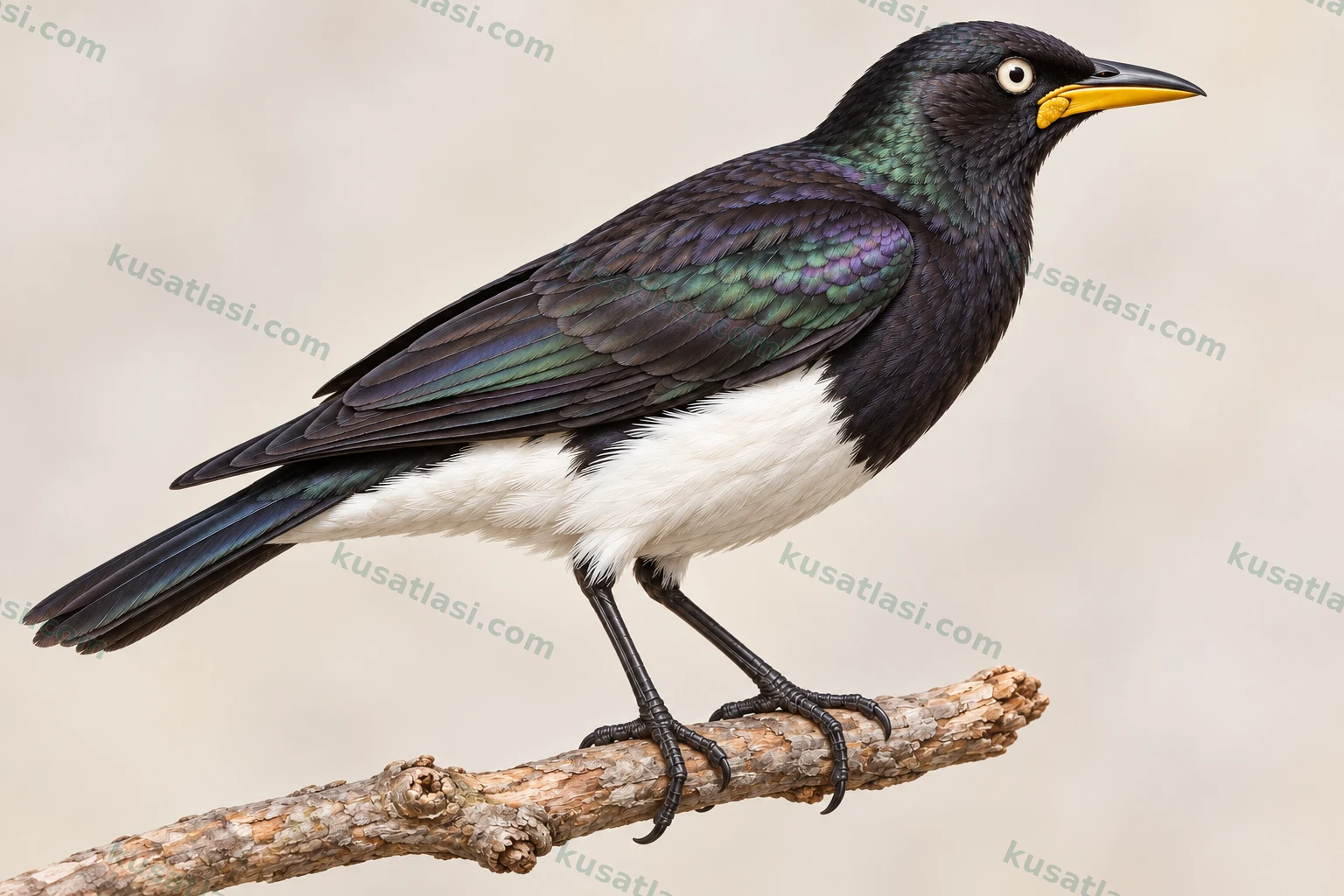
Swipe left or right between the two adult plates.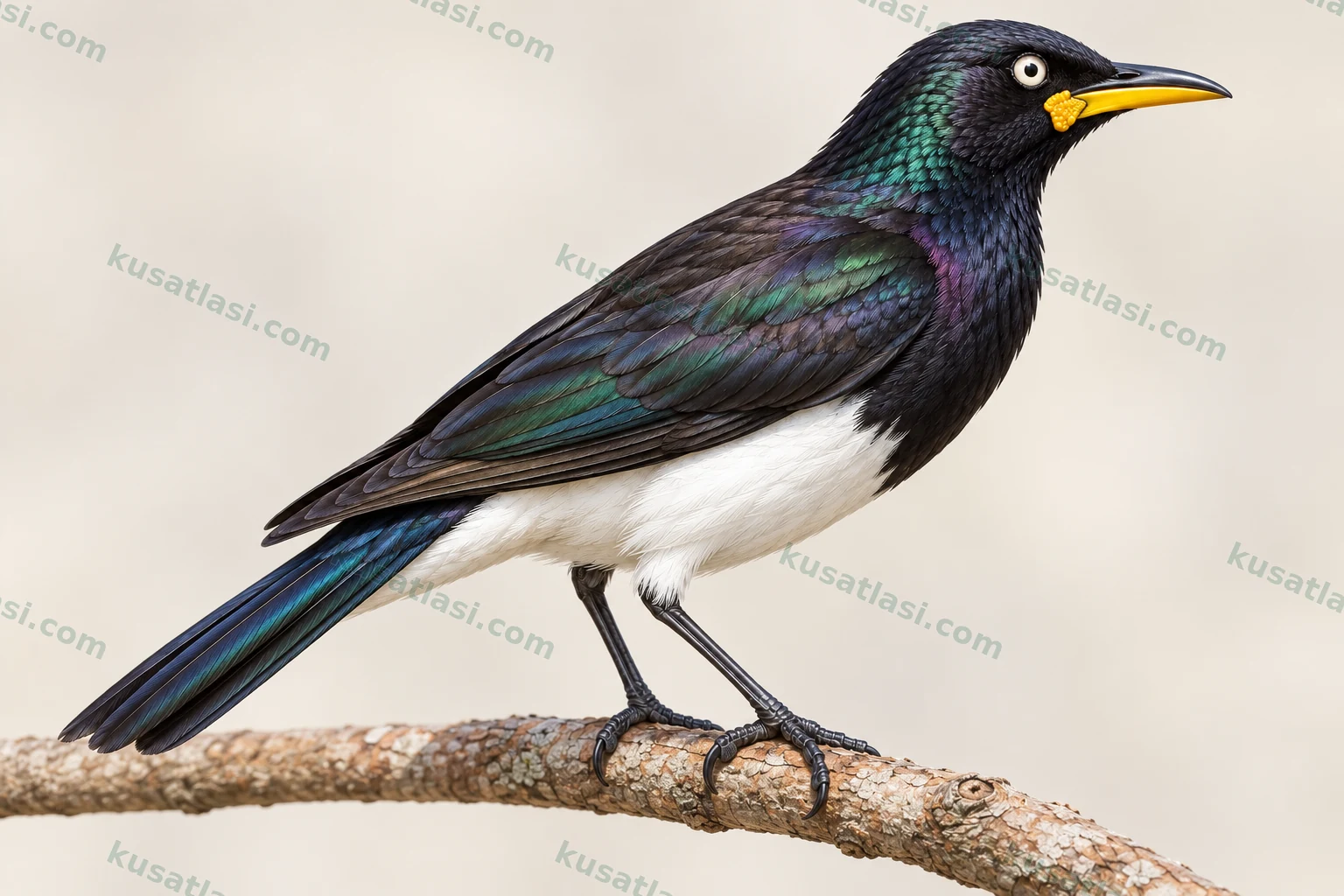
Sturnidae
Pied Starling
Lamprotornis bicolor
Look together for dark upperparts, yellow lower bill and gape.
- Order
- Passeriformes
- IUCN status
- LC · Least ConcernGlobal IUCN. BirdLife v10 (2025); taxon matching: AviList 2026 / IOC 15.2; checked 29 October 2026. Checklist year is not the species assessment date. Source and method · BirdLife
At a glance
- White lower belly and eye
Look together for dark upperparts, yellow lower bill and gape.
- Southern African bird
Its natural range is South Africa, Lesotho and Eswatini.
Biometrics
Length
- Male
- 25 cm
- Female
- 25 cm
Wingspan
- Male
- Data unavailable
- Female
- Data unavailable
Weight
- Male
- 93–94 g
- Female
- 105–112 g
Length: Shared species value
World distribution
Pied Starling
Customise map layers
Observation points
Preparing globe…
Monthly record count
Bars show record counts in this sample, not bird abundance or a breeding calendar. They are affected by recording and observation effort.
Rotate the globe and compare layers. Coloured areas are not exact observation or nest locations.
The source does not provide verified monthly range boundaries. All areas are shown; the month slider and monthly playback are therefore disabled.
- Jan
- Apr
- Jul
- Oct
- Dec
Generalised data and method
Base map: Natural Earth · Public domain
Open central bibliography ↗Calendar
Breeding time varies with rainfall region within South Africa; this is not a calendar for Türkiye.
All months: Monthly data unverified.
January
February
March
April
May
June
July
August
September
October
November
December
Habitat
South Africa
Grassland and Karoo areas of South Africa, Lesotho and Eswatini; local boundaries will be verified separately.
Sound
Do not play recordings to attract birds; observe quietly, especially near nests.
Breeding
BDI’s South African synthesis reports an earth tunnel, 2–6 eggs, female incubation of 14–16 days and a nestling period of 23–27 days.
Compare
Compare male and female
Its natural range is South Africa, Lesotho and Eswatini.
Species information
Quick identification
The Pied Starling Lamprotornis bicolor is recognised by the contrast between its nearly black-brown upperparts and white lower belly and undertail. A slight greenish gloss may show on the wings and upper tail. At close range, the adult's pale white eye, bill black above and yellow below, and yellow fleshy gape flange are strong clues. The specialist account from South Africa's Biodiversity and Development Institute (BDI) emphasises these features together. A black-and-white body alone is insufficient: light can conceal the gloss, and the white eye is not visible at a distance. Photographing a bird walking in grassland together with its location, accompanying flock, bill and eye colour strengthens identification.
The word “African” in the Turkish name does not mean that it ranges throughout the continent: its natural distribution is restricted to South Africa, Lesotho and Eswatini. It should not be assumed to share the habitat of the brilliantly blue-green forest starlings.
General appearance and posture
It looks like a large starling, with a dark neck and back and white lower belly and tail base. The greenish sheen of the feathers depends on the viewing angle. Legs and feet are black. It stands upright in open country and searches for food by walking or running. Association with sheep and cattle is documented; it can catch insects disturbed by the animals' movements.
Males, females and young birds
According to BDI, the adult sexes look alike; neither a white eye nor a white belly alone determines sex. Behaviour during breeding may offer clues, but understanding the role of a bird seen at a cavity or nest requires repeated observation. Even then, a single photograph cannot establish an adult's exact role or relatedness.
Young birds have duller, almost black plumage; their eyes are initially dark brown and become paler as they grow. The lower bill is also dark in young birds, with the yellow area developing over time. BDI reports that a pale fleshy gape flange can also be visible in juveniles. These differences help assess age but do not give an exact birthday; sunlight and moult affect appearance. The yellow below an adult's bill may be less obvious in a juvenile and should be considered alongside eye colour. Different ages can occur in one flock. After its first flight, a young bird may still receive food from adult helpers; flying alone does not prove independence.
Appearance in flight
As a flock flies, the white lower belly and undertail behind the dark body appear briefly. The greenish gloss on the upperwing and upper tail may be visible in direct light and disappear under cloud. A single distant bird looking white from below does not mean that all its surfaces are white. Flock behaviour over lawns, Karoo scrubland or fields provides useful context, but other starlings may also fly there. The flight direction of a bird leaving a nesting tunnel does not establish its identity or parental role without repeated observation. Identification is stronger if a clear side view also captures the white eye and two-coloured bill.
A bird's posture in a photograph can give a misleading impression of the distribution of black and white. Where possible, a flight photograph is matched with a resting bird's photograph, date and location.
Voice and behaviour
The species is social and noisy. BDI says that everyday flocks often contain 10–20 birds, while many more may gather at roosts; these are not compulsory sizes for every flock. Many birds may follow one another and move together as they approach a reedbed or wooded roost. BirdForum mentions a distinctive call heard before and during flight.
While foraging, one flock member may feed another. BDI suggests that this mutual feeding may help maintain bonds, but that interpretation is not the sole explanation of every event. Searching for ticks on domestic animals and following insects in pasture have been observed. Different rainfall regimes affecting breeding times in South Africa show why a single continent-wide calendar is inappropriate. At some nests, helpers other than the parents feed the chicks; this social arrangement cannot be established from one photograph. Human approach to a nesting colony can alter flight paths and feeding frequency, making distant observation important.
Species that may be confused
1. The Ashy Starling Lamprotornis unicolor is an East African species associated with Tanzania; it is not presented as a species expected alongside the Pied Starling in the latter's natural South African range. Its overall colour can be compared with the Pied Starling's conspicuous white lower belly. A dark silhouette alone is insufficient; the bird's region must also be verified.
2. The Cape Starling Lamprotornis nitens may be a brighter blue-green. Light alone is misleading; eye, bill and white lower belly should be checked together.
3. The Wattled Starling Creatophora cinerea may accompany it in flocks or at roosts. At close range, check head and facial features together with the distribution of white on the underparts.
World distribution
Lamprotornis bicolor is a southern African bird endemic to South Africa, Lesotho and Eswatini. BDI reports it in South Africa's nine provinces, with only limited occurrence in southern Limpopo, and notes avoidance of some eastern lowlands and the very arid northwest. BirdForum summarises its range as roughly south of 24.5° south in South Africa, Lesotho and western Eswatini.
Status within its natural range
Country names do not mean that all the land is occupied. The main setting is open grassland, Karoo scrub, farmland and the surroundings of rural settlements. A scientific map should be compared with point records and suitable habitat. The species' verified natural range does not cover all Africa.
Migration
Oiseaux.net does not classify it as a regular migrant; BDI describes it as mostly resident, sometimes forming widely wandering flocks in the dry season. These observations do not conflict: local foraging movements and scheduled intercontinental migration are different. Numbers arriving at a roost do not reveal how many kilometres one bird travelled. Agricultural change, drought and insect abundance may affect local movements, but the sources here do not quantify each effect. A point record and an area confirmed to be used throughout the year must be kept separate.
Breeding habitat
Open grassland, semi-arid Karoo scrub and rural farmland are its main habitats. BDI reports records up to 2500 m around the Drakensberg and down to sea level in the west and south; this does not mean equal density everywhere. It is not a forest-interior species and generally avoids very large urban centres. Grazed field edges and small towns may provide feeding areas. Steep earth faces on riverbanks or excavated slopes matter for nesting tunnels. Reedbed and woodland roosts serve different functions from breeding tunnels. A bird feeding over a field does not prove that it nests there.
Nest site
According to BDI, pairs usually nest in self-dug tunnels up to 1.5 m long in riverbanks, erosion gullies or quarry faces; sometimes they use building cavities, hay bales or tree holes. Grass, feathers, wool and other material line the nest. Breeding may be in isolated pairs or colonies. The expert synthesis gives 2–6 eggs per clutch, incubation by the female for 14–16 days, and 23–27 days spent by chicks in the nest. Large egg totals may include contributions from more than one female; not every end of a range is presented as typical of an ordinary single pair. Touching or opening the tunnel entrance may cause harm.
Daily habitat use
It feeds by walking on the ground, catches insects around grazing animals, and may return communally to reeds or trees in the evening. BDI reports some flocks of 10–20 birds and much larger numbers at major roosts. Flock size depends on local and seasonal conditions. Breeding may occur in August–November in the winter-rainfall southwest, November–March in the Karoo and over a wider period in the north; this regional calendar is not transferred to Türkiye. Feeding areas, communal roosts and nesting colonies are separate observation layers. Not all the birds around a tunnel are parents of a single nest.
What does it eat?
Various arthropods are major foods: BDI lists termites, ants, beetles, grasshoppers, spiders and ticks. It can also consume seeds, fruit and nectar. Oiseaux.net classifies it as omnivorous. This broad description does not mean equal shares of fruit and insects in every flock. Taking scraps around rural homes does not measure the composition of its natural diet. Insects may be important in feeding young, but a particular insect species should not be treated as obligatory prey in every season. If a tiny item in a photograph cannot be distinguished, its name is not invented.
How does it feed?
It mostly walks or runs on the ground and may take insects disturbed by farm animals. Perching on sheep and cattle to pick off ticks has been observed. BDI also describes turning dry dung to reach insects beneath it, joining locust swarms and searching for small animals under seaweed on the shore. These are different observed strategies, not tasks every bird performs daily. Mixed feeding flocks with Wattled Starlings occur; sharing a flock does not prove that species consume the same foods in the same proportions. Recording whether the feeding site is grassland, a field or the coast helps make sense of behaviour.
An older scientific name refers to the same bird
Spreo bicolor is the older scientific usage. Cornell's taxonomy update and the molecular study by Lovette and Rubenstein help explain the present name Lamprotornis bicolor. An old breeding observation is not discarded as another species, but its locality and source are checked. Pied Starling and African Pied Starling are English names used for the same record.
Helpers can feed the young
A species-specific paper published in Ostrich in 1987 under Spreo bicolor reports that the pair builds the nest and only the female incubates. BDI adds that helpers other than the parents may take part in feeding chicks and that feeding can continue briefly after leaving the nest. Three birds visiting a nest are not three parents; roles require repeated observation.
Nesting tunnels and regional seasons
In the expert synthesis for South Africa, breeding months differ between the winter-rainfall region, the Karoo and the north.
A bird of open country
“African” does not imply the entire continent, nor does “starling” imply every kind of forest. This species is associated with open grassland, Karoo and rural farmland in South Africa, Lesotho and Eswatini. Large roosting gatherings can form in reeds, but the size of a flock encountered is not the total population. A local conservation assessment and abundance in a single field are also different things.