
World Birds
Field identification plates
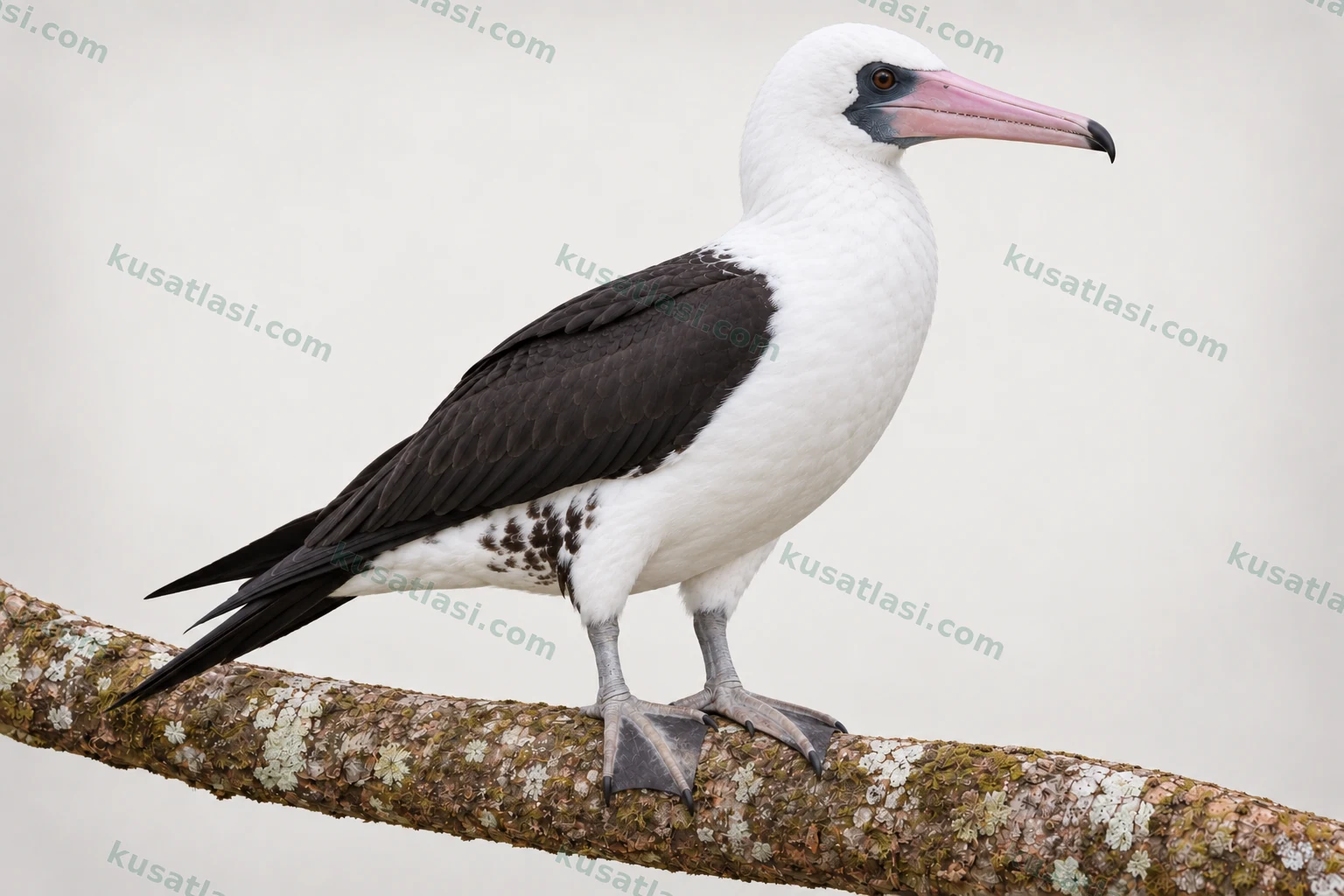
Swipe left or right between the two adult plates.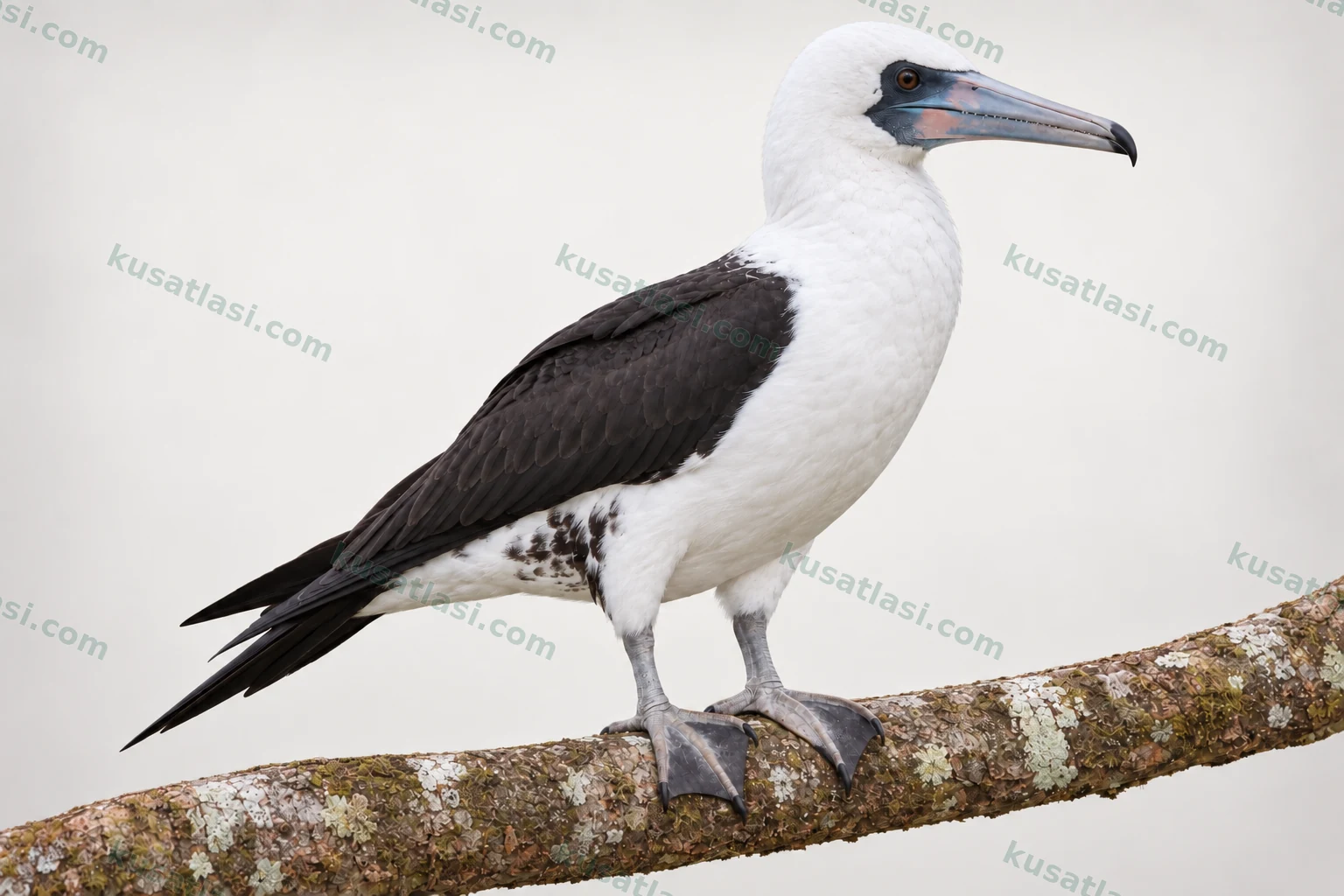
Sulidae
Abbott's Booby
Papasula abbotti
Look for the white head and body together with the dark upperwings and black tail.
- Order
- Suliformes
- IUCN status
- EN · EndangeredGlobal IUCN. BirdLife v10 (2025); taxon matching: AviList 2026 / IOC 15.2; checked 29 October 2026. Checklist year is not the species assessment date. Source and method · BirdLife
At a glance
- White body, dark wings
Look for the white head and body together with the dark upperwings and black tail.
- Bill colour and shared plumage pattern
The male’s bill may be grey-blue and the female’s pink. Both sexes share the same basic plumage pattern; lighting can make colours misleading.
- Long wings, mottled rump
Assess the long, narrow wings, large head and black-and-white mottling on the lower back and rump together.
Biometrics
Length
- Male
- 80 cm
- Female
- 80 cm
Wingspan
- Male
- 180 cm
- Female
- 180 cm
Weight
- Male
- 1.37–1.62 kg
- Female
- 1.47–1.7 kg
Length: Shared species value Wingspan: Shared species value
World distribution
Abbott's Booby
Customise map layers
Observation points
Preparing globe…
Monthly record count
Bars show record counts in this sample, not bird abundance or a breeding calendar. They are affected by recording and observation effort.
Rotate the globe and compare layers. Coloured areas are not exact observation or nest locations.
The source does not provide verified monthly range boundaries. All areas are shown; the month slider and monthly playback are therefore disabled.
- Jan
- Apr
- Jul
- Oct
- Dec
Generalised data and method
Base map: Natural Earth · Public domain
Open central bibliography ↗Calendar
The calendar summarises published breeding observations from Christmas Island. Egg laying has been reported from April to October, peaking from mid-May to mid-July. Prolonged parental care means that young may be seen throughout the year; not every pair is at the same stage in the same month.
January
Late broods and dependent juveniles may still need food from their parents.
February
Adults feed at sea; old nest sites may be retained as part of the pair bond.
March
Nest repair and pre-breeding behaviour become more evident in some pairs.
April
The laying season may begin; keep away from nest trees.
May
This is one of the peak laying months; both parents share incubation.
June
Incubation and the first hatchings may occur together; a single egg is usual.
July
Hatching continues; the naked chick is warmed on the webbing of the feet.
August
The chick grows rapidly but remains in the tree nest for a long time.
September
Large chicks with white down may be visible at the top of the nest; do not share sensitive locations.
October
Late-laying pairs may have hatching eggs; earlier chicks exercise their wings.
November
Some juveniles can fly but still return regularly to the nest to be fed.
December
The long period of dependence continues after fledging; not all pairs are at the same stage.
Habitat
Christmas Island and surrounding seas
On Christmas Island, watch the tall rainforest trees from open routes around The Dales and North-West Point Road. Birds may also be seen in flight in the afternoon. Do not approach nest trees.
Sound
Usually silent at sea. At nesting sites, adults have been reported to give deep, muffled calls reminiscent of cattle lowing, as well as grunts, moans and short guttural sounds. A written comparison describes only the low pitch and context; it does not replace a real recording. The page does not autoplay sound unless a recording with an individually verified licence has been added.
This page has no bird sound recording with a verified licence.
Do not play recordings to attract birds; observe quietly, especially near nests.
Breeding
Pairs build a sturdy twig nest 10–40 metres up in large rainforest trees with open crowns that rise above the surrounding trees, lining it with green leafy branches. The female lays a single white egg with a thick shell. Both parents warm the egg with the webbing of their feet for about 56 days. The chick fledges after an average of 151 days and may remain dependent on its parents for an average of another 230 days after fledging. Parks Australia summarises the entire breeding cycle, including nest preparation and care of the young, as 15–18 months; most pairs therefore cannot raise young every year. Approaching the nest, waiting beneath the tree or trying to make the bird fly is both dangerous and unethical. Sample averages for different developmental stages must not be added together to produce one duration for every chick. Nelson’s 1971 study on Christmas Island reports 56 days of incubation. The abstract of Nelson and Powell’s 1986 publication gives 57 days. These are findings from different studies; a fixed duration cannot be expected at every nest.
Compare
Compare male and female
The male’s bill may be grey-blue and the female’s pink. Both sexes share the same basic plumage pattern; lighting can make colours misleading.
Species information
Quick Identification
Abbott's Booby is a large tropical seabird with very long wings. At a distance, the first pattern to notice is its white head and body contrasting with almost black wings and a black tail. The upperwing looks like a dark covering; irregular black-and-white mottling on the lower back and rump creates a broken transition between the white body and dark wings. From below, the body and most wing coverts are white, while the long flight feathers form a broad black border. The head is large, the neck powerful and the bill very long and thick. Identification should rest on the combination of a large build, long bill, mottled rump, dark tail and the appearance of both wing surfaces, rather than a single white patch or a black wing.
General Appearance and Posture
When perched, the body looks long and heavy, the breast full and the head large in relation to the body. The feet are webbed. It rests and nests in tall rainforest trees; the posture of ground-nesting boobies should not be applied directly to this species. The folded wings form a long dark area extending towards the tail. The boundary between the white neck and dark wing is clean, but mottling breaks it up on the lower back. The tail looks black, narrow and almost pointed. The legs and feet are grey; the outer webbing may be darker.
Its proportions give Abbott's Booby a heavier-bodied, larger-headed appearance than many other boobies. The long bill darkens to black at the tip and has a slight hook. Fine serrations along the bill help it hold slippery fish. The dark brown eye sits within a narrow area of dark bluish facial skin. A resting bird may draw in its neck and look rounder; when alert, it stretches its neck and projects its bill forwards. A change in posture in a photograph should not be mistaken for a real difference in size or age.
Males, Females and Young Birds
Males and females share the same basic plumage pattern: a white head, neck and underparts; dark wings and tail; and irregular mottling on the lower back and rump. The reliable difference between the sexes lies more in bill colour than in plumage. An adult male has a blue-grey bill, sometimes with a pinkish wash, and a black tip. An adult female has a more distinctly pink bill, also tipped black. Light, distance and photographic colour settings can alter these shades, so a pale photograph alone should not be used to assign a sex with certainty.
A young bird resembles an adult male, but its colours may be duller and its bill greyer. Fresh feathers look clean; wear makes their edges appear less regular. The large white chick stays in the nest for months and continues to receive food from its parents even after learning to fly. A young bird approaching adult size in a treetop is therefore not necessarily independent. Approaching young birds or adults near a nest can disrupt this long, energetically demanding period of care.
Appearance in Flight
In the air, very long, relatively narrow wings extend in a straight line from either side of the large body. The wings may be held stiffly while gliding; active flight involves powerful but measured wingbeats. From above, the white body stands out against the dark wings, with the black tail and mottled rump completing the pattern. From below, the bird looks paler: the white wing coverts and body are bordered by the broad outer and trailing edge formed by the black flight feathers. If only a distant silhouette is visible, record the viewing distance, light, wing proportions and surface seen rather than claiming a definite species identification.
Voice and Behaviour
It is often silent at sea. At the nest tree, however, pairs may give deep, muffled sounds that resemble lowing from a distance; short grunts, guttural calls and moans have also been reported. Mutual wing-waving is one of the ritual behaviours through which partners recognise each other and maintain their pair bond. A bird approaching its nest must control its long wings; landing in a tall tree with an open crown requires ample room to manoeuvre.
At sea, it finds prey by sight and then enters the water head first. Fish and squid are often caught near the surface. Adult visits to the nesting area may be infrequent; the chick grows slowly and can withstand long intervals without food. A prolonged absence of an adult from a nest does not mean that the nest has been abandoned. Observers who are not conducting research should not wait beneath the tree, publicly share nest coordinates or obstruct the bird's landing approach.
Similar Species
Adult Masked Boobies and Nazca Boobies can also show white bodies and dark wingtips. In Abbott's Booby, a greater proportion of the upperwing is dark, the transition between lower back and rump is distinctly mottled, the tail is dark and the bill is very long and heavy. A Brown Booby has extensive brown on its head, neck and upper body, making separation easier in good light. At a distance, in an overexposed photograph or against the light, however, the colour boundaries may disappear.
Geography is a valuable aid, but is not an identification on its own. Although Abbott's Booby now nests only on Christmas Island, it can range widely at sea; young and non-breeding birds may travel farther. To verify a record, look for the bill's colour and shape, rump pattern, tail colour, difference between upperwing and underwing, and body proportions on the same individual. A sequence of images, flight direction, approximate size and behavioural notes are far more useful than a single blurred frame.
World Distribution
The only currently confirmed breeding location of Abbott's Booby is Christmas Island, an Australian territory in the eastern Indian Ocean. The species formerly nested across a wider belt of islands in the Indian and Pacific Oceans, but those colonies have disappeared. Breeding adults remain tied to their nests in the island's tall rainforest, while at sea they may travel hundreds of kilometres from the island to find food. Satellite and location-tracking studies show that the marine area used is not a single narrow corridor: the direction and length of trips change with water temperature and productivity.
Status Within Its Natural Range
Christmas Island is the species' only known breeding refuge today. Its tall rainforest and the surrounding tropical ocean complement each other: the birds nest in trees and feed at sea. Parks Australia recommends looking for birds in tall trees around The Dales and North-West Point Road; visitors should stay on open routes and avoid approaching nest trees. A sighting at sea away from the island does not demonstrate that a colony exists there. The disappearance of former populations on Assumption and the Mascarene Islands must also be distinguished from the present situation. Historical range, current breeding range and isolated distant records are different kinds of information.
Marine Journeys and Dispersal
Breeding adults return to Christmas Island between foraging trips; independent young birds and non-breeding individuals may disperse over wider marine areas. A thesis completed at Swansea University in 2022 documented seasonal non-breeding journeys in 22 adults tracked between 2007–2014. It is therefore not accurate to say that no individual of the species migrates. Movements should be considered in relation to age, breeding status and sea conditions. One bird's track is not a fixed route for the entire species, and observation points do not establish breeding areas. Only the known current breeding island is marked on the globe.
Breeding Habitat
The species breeds in mature tropical rainforest in the higher parts of Christmas Island. The most valuable trees are giants with strong branches and open crowns rising above the surrounding canopy. Open airspace around the crown is needed for a safe approach on long wings. Large clearings left by former phosphate mines do more than reduce the number of nest trees: turbulence and strong air currents at their edges can also affect nests that remain intact.
Nest Site
The nest is usually a sturdy bowl of twigs built in a large branch fork, 10–40 metres above the ground. Both partners carry dry sticks and line the inside with leafy green twigs. The same site may be used for years. A treetop nest may look small from a distance, yet the chick stays there for nearly five months. Going beneath the nest, touching the tree or using a drone for a better view is inappropriate.
Daily Use of Space
Breeding birds may spend substantial parts of both day and night on sea journeys; they return to the forest mainly for nest attendance, changes of partner on duty and chick feeding. Their marine habitat is the open tropical ocean. As the distribution of food changes, so do the direction and distance of their journeys. Although forest and sea may look like separate habitats, they work together in the species' life cycle: breeding is impossible without a safe tall tree, and prolonged chick care is impossible without sufficient food at sea.
What Does It Eat?
Fish and squid are the principal foods. Flying fish have been reported among its important prey, but the menu may change with year, season and conditions at sea. Tracking of adults raising chicks on Christmas Island between 2004–2010 showed that diet composition and trips changed in warmer, less productive waters. This result shows that the species does not depend on a single kind of fish; a prey list from one study should not be treated as an unchanging menu for every year. The chick receives soft food regurgitated from its parent's mouth or throat.
How Does It Hunt?
The bird finds prey by sight and enters the water head first. Dives recorded in adults raising chicks on Christmas Island between 2004–2010 were short and shallow. In the paper's comparison across studies, mean dive depth was greater than the means reported for some smaller boobies. Diving was concentrated in the morning and afternoon. When the sea was warmer and less productive, birds could increase their trip duration and the area searched. These findings apply to the birds and period studied.
A Seabird That Nests in Trees
While most boobies nest on the ground or rocky ledges, Abbott's Booby uses giant rainforest trees. This web-footed bird's use of both the sea and the high forest canopy within the same life cycle is striking. Open airspace around the nest is vital for landing and taking off with a wingspan approaching two metres. Protecting the nest tree alone is therefore insufficient; the surrounding forest structure and wind patterns must also be protected.
Exceptionally Long Parental Care
The single egg's incubation period of about 56 days is very long among boobies. The chick stays in the nest for an average of 151 days; after fledging, it may receive food from its parents for a further 230 days on average. Parks Australia summarises the entire breeding cycle as 15–18 months. This duration is not the same measure as incubation time. It explains why most pairs can raise a chick only every two years. The loss of a breeding attempt affects not just that season, but also long-term population replacement.
Why Is Wind a Conservation Issue?
Past phosphate mining created large openings in the forest. Air moves differently along the edges of clearings than it does within closed forest; turbulence and sudden downdraughts can make it harder for a heavy, long-winged bird to approach its nest tree. Research and restoration programmes therefore involve more than planting trees: they also consider the shape of the forest edge and future wind conditions. This connection shows how, in conserving a species, unseen physical processes can be at least as important as the number of trees.
The Sole Living Representative of an Ancient Lineage
Abbott's Booby is currently the only living species in the genus Papasula. Its scientific name derives from the naming of the species by Robert Ridgway in 1893; older publications may also use Sula abbotti. The older name reflects the historical classification of the same species, rather than a different bird. The current page matches the accepted name Papasula abbotti with the English name Abbott's Booby and the project's Turkish name Abbott Sümsüğü.
How Observers Can Help
The most useful record is a dated sequence of images from several angles, obtained without approaching the nest. At sea, record flight direction, flock size, feeding behaviour and approximate location; on land, record only general behaviour visible from authorised routes. Keeping sensitive nest locations out of public view directly helps conservation. Launching a drone, playing calls or trying to make a bird fly for a photograph does not increase its scientific value; instead, it can put the lengthy breeding cycle at risk.