

World Birds IUCN statusLC · Least ConcernGlobal IUCN. BirdLife v10 (2025); taxon matching AviList 2026 / IOC 15.2; checked: 29.10.2026. The list year is not the species’ assessment date. Source and method · BirdLife OrderApodiformesSwifts, hummingbirds and allies FamilyTrochilidaeTrochilidae
White-vented Plumeleteer
Chalybura buffonii
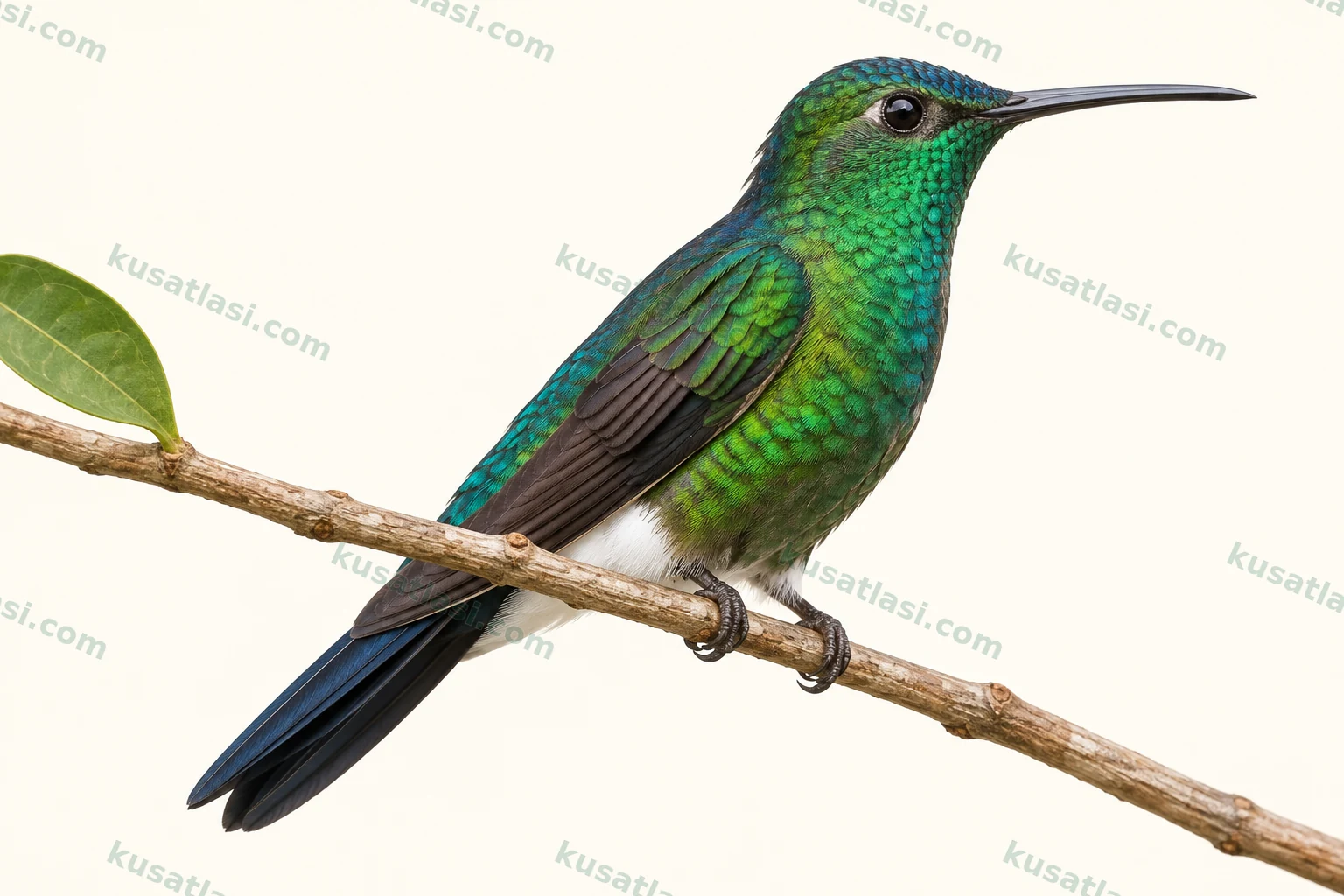
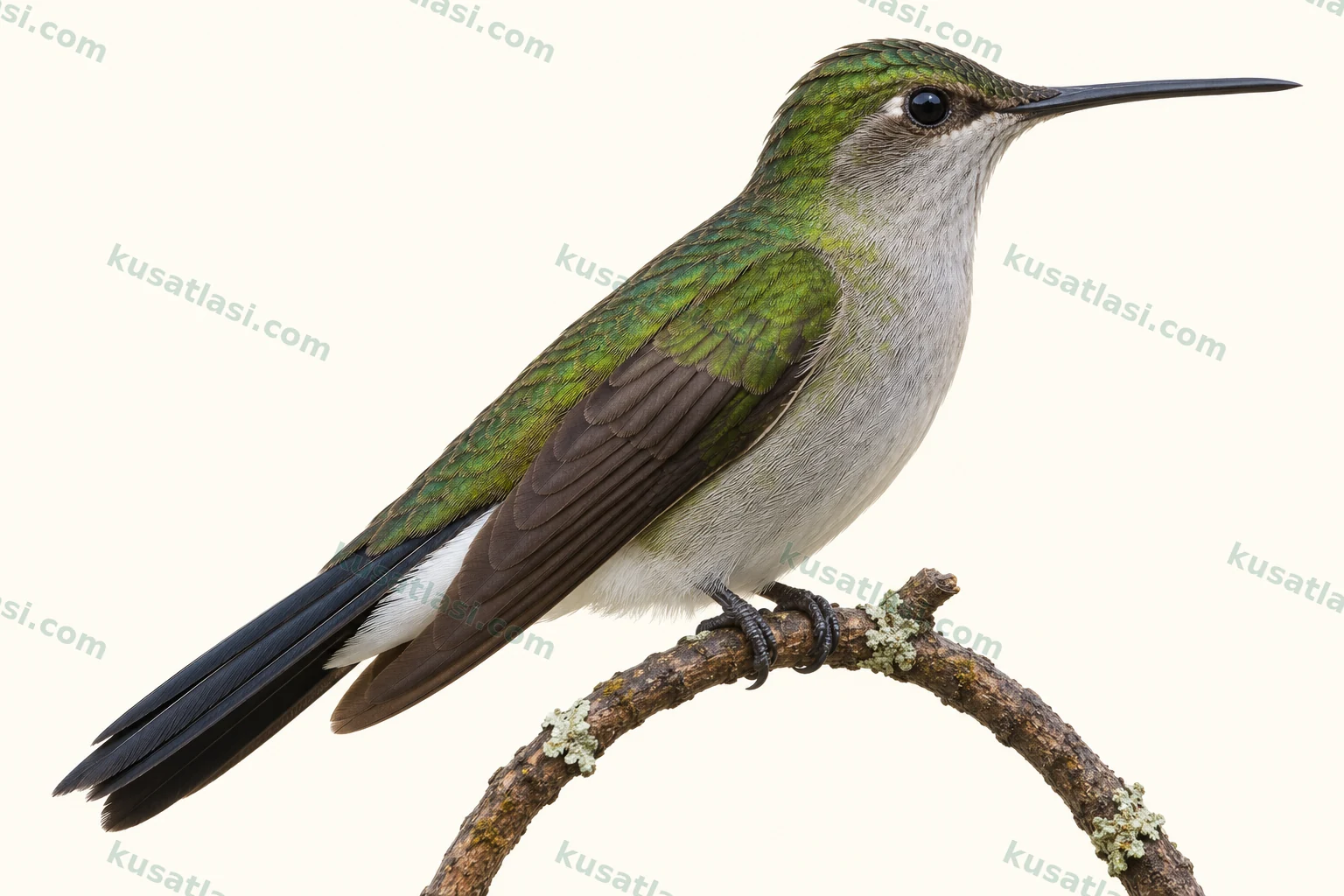
Male green–turquoise, female green above and grey below; look for white undertail coverts together with a dark blue–black tail.
Biometrics
Length
Male10–12 cm
Female10–12 cm
Shared species value
Wing length
Male6.39 cm
Female6.39 cm
Shared species value
Weight
Male6–8 g
Female5–8 g
White-vented Plumeleteer
Southern Central America and northwestern South AmericaObservation guide in its natural range
Look for three features together
Do not rely on a single featureWhite coverts are distinctive in both adult sexes.
Check the dark blue–black rather than bronze appearance in suitable light.
Male green–turquoise; female green above, grey below.
Compare male and female
 FemaleMale
Male green–turquoise, female green above and grey below; white undertail coverts are shared. Development at one nest is not a general age key in days.
Where to look in its natural range?
Flowering forest, forest edges and scrubby secondary growth.
Resident; the Colombian nest of February 2011 is a local example, not the breeding calendar of the entire range. Local flower visits are not a long-distance migration route.
January
Data unavailable
February
Ibagué, Colombia: nest observation dated 2011; local example.
March
Data unavailable
April
Data unavailable
May
Data unavailable
June
Data unavailable
July
Data unavailable
August
Data unavailable
September
Data unavailable
October
Data unavailable
November
Data unavailable
December
Data unavailable
Nest, egg and incubation
The Colombian observation recorded a fibrous cup nest, two white eggs and departure of the chick at 21 days; the total incubation period was not measured.
Confirm the caller by sight; no exact syllable key separating all similar species was found.
Do not play recordings to attract birds; observe quietly, especially near nests.
Species information
Quick identification
The White-vented Plumeleteer Chalybura buffonii is a medium-sized hummingbird of forests and their edges in southern Central America and northwestern South America. The male is largely green with turquoise reflections; the female is green above and grey below. In both adults, look for contrasting white coverts beneath the dark tail. Compared with the similar Bronze-tailed Plumeleteer Chalybura urochrysia, the dark blue–black rather than bronze appearance of the tail is important.
The white feature does not cover all the tail feathers: it is on the short coverts beneath the tail. This area may show better when the bird approaches a flower or naturally turns and spreads its tail. Instead of treating a flash of white as sufficient identification, use body colour, tail colour and actual geography together.
General appearance and posture
The hummingbird shape, movements at flowers and brief hovering direct the observer to this group. The male’s green does not look like a single unchanging coat of paint; turquoise tones can become prominent with the direction of light. Do not misinterpret the female’s grey underparts by expecting them to be as green as the male’s. White undertail coverts are an identification feature shared by both sexes.
At a flowering forest edge, first try to see the whole body and tail. Do not confuse the plant from which the bird takes nectar with a bright leaf behind it. Colours changing with the angle do not alone indicate moult or disease.
Males, females and young birds
Assess the adult male’s generally green–turquoise appearance and the female’s green upperparts and grey underparts together. Because both sexes have white undertail coverts, that feature alone cannot determine sex. If the underbody is shaded, grey and dark green may not be reliably separated.
The Colombian nest study directly followed the development of a single chick. The newly hatched bird had closed eyes and was largely naked; two rows of fine natal down were recorded on the back. Wing, tail and back feathers became more prominent later in development. These observations belong to that nest, not to a colour chart assigning an exact age in days to every young hummingbird seen at a distance. No detailed independent identification key for fledged young was verified in this review.
Appearance in flight
Body colour and white undertail coverts can sometimes be seen together during a flower visit. Wing movements are so rapid that a transparent or dark appearance in one image is not a definite feather pattern on the wing surface. A natural turn with the tail spread helps distinguish the dark tail from the white covert area.
No verified species-specific flight key giving certain identification solely from the upperwing or underwing was found. An arbitrary white wing stripe or fixed flight angle is therefore not added. If a briefly seen bird disappears from around flowers, the return of another bird must not be assumed to continue the first individual’s movements.
Voice and behaviour
Cornell’s specialist account describes the bird as usually solitary in flowering forest, edges and scrubby secondary growth. Feeder visits are infrequent, so the behaviour of other hummingbirds easily seen at feeders is not transferred unchanged to this species. One bird on a plant does not establish that it lives alone throughout the year or certainly defends the whole plant.
The records examined include various call contexts, but no independent syllable key separating all similar species was verified for this account. A heard call is more useful when connected to the bird’s natural flower visit. Do not play recordings near a nest. The Colombian observation followed the mother’s arrivals and the chick’s development; this particular care record is not presented as a visit frequency for the entire range.
Similar species
The Bronze-tailed Plumeleteer Chalybura urochrysia is the most direct comparison. White undertail coverts alone do not distinguish these two similar-looking birds. For Chalybura buffonii, check the dark blue–black tail against the other species’ bronze tail in suitable light and with an accurate locality.
Other green forest hummingbirds can also look similar in a brief view. Look together for the adult female’s grey underparts, white covert area and dark tail. Forcing the male pattern onto a female can cause a bird to be mistaken for a different species.
World distribution
The current taxonomic range covers southern Central America and northwestern South America. The specialist subspecies account extends from central Panama into northwestern Colombia, different parts of Colombia and northern and western Venezuela; intermedia is treated within southwestern Ecuador. Subspecies ranges are not drawn as an uninterrupted coloured area filling the entire continent. The scope of older, more narrowly defined taxonomic publications is also matched separately to the current list.
Status within its natural range
The current list gives the global category Least Concern. Use of forest edges and secondary growth does not mean that every open area is suitable or that forest loss has no effect. The detailed Colombian breeding record comes from streamside forest near Ibagué in Colombia. This single nest does not represent breeding success across all Colombia or all subspecies.
Migration
The specialist dataset treats the bird as resident. Movements between flower resources do not show that a regular intercontinental migration route exists. Common arrival and departure months for the whole range were not verified. Dated map records show observation sites, not a tracked journey by the same individual. The Colombian nest of February 2011 is a local breeding example; this single record does not fill the whole calendar with a breeding season.
Breeding habitat
The bird uses forest, forest edge and scrubby secondary growth. The published Colombian nest observation comes from a streamside setting near Ibagué in 2011 at 1,098 m elevation. Dense undergrowth and tall trees surrounded it. A streamside record does not mean that the species nests only in direct dependence on water.
Nest site
The observed nest was on a slightly drooping branch of a lemon tree, 1.5 m above the ground. The small cup woven from plant fibres and soft material contained spiderweb; dried leaves, moss and some lichen were recorded outside. One of the two white eggs did not hatch; the chick followed left the nest at 21 days. Because incubation had begun before the nest was found, this record cannot establish the total incubation period.
Daily use of space
Flowering plants, surrounding cover and perches are important together during feeding. Care movements at a single nest are not converted into a fixed number of visits for the whole area. Do not touch the nest branch, remove cover to inspect eggs or prevent the mother from approaching. Watch natural flower visits from a distance.
What does it eat?
Nectar is one of the main food resources. Cornell’s account describes the bird at flowers, and the specialist ecological dataset also indicates a nectar-feeding tendency. This review did not verify a plant list valid for all seasons, a nectar percentage or the proportion of small animal foods. Other hummingbirds’ detailed menus are not used as the definite dietary list of this entire species.
How does it forage?
Flower visits can be observed in forest, edges and secondary vegetation. Observe separately the approach to a flower, the nectar-taking movement and which flower is actually used. Seeing a flower visit does not on its own prove effective pollen transfer; the plant’s reproductive outcome requires a separate investigation. Because feeder visits are infrequent, visits to natural plants are especially useful. Do not place sugar water or an artificial feeder near a nest to watch feeding; wait quietly around existing flowers.
Tail feathers and tail coverts are different
The white in the species’ name points to the covert area beneath the tail. The tail itself looks dark blue–black. These two areas are not expected to have the same colour. In comparison with the similar Bronze-tailed Plumeleteer, examine the actual tail colour as well as the white coverts. A natural turn can show their boundaries better than one fixed photograph.
One nest’s story is not the whole species’ calendar
The nest followed near Ibagué in Colombia in 2011 contained two eggs, but only one chick developed. The study observed that chick’s departure from the nest; one of the eggs did not hatch. It would therefore be wrong to present one egg failing to hatch as the usual breeding outcome of the entire species. Because the start of incubation was unknown, the event does not provide a total incubation day count. The observed chick’s feather development is likewise not a common chart for ageing all young birds.
Outer nest covering belongs to a small structure
The outside of the small cup nest in the Colombian study carried material such as moss, leaves and lichen. These belong to the nest structure and must not be confused with the bird’s plumage colour. A nesting record in a lemon tree does not establish that every nest is built in that tree species. Use the published observation instead of taking nesting material or inspecting the structure closely.
Few feeder sightings do not mean no nectar use
The specialist account emphasizes feeding at natural flowers while noting infrequent feeder visits. Looking for such a bird only in feeder lists can give an incomplete impression. Flowers in forest edges and secondary growth are also watched. Visit frequency is considered together with the location of a particular feeder and the surrounding resources; one garden record is not a rule for behaviour throughout the range.