Length
Male60 cm
Female60 cm
Published approximate adult length used for both sexes.

CITES Appendix II regulates international trade; it is not a threat category.
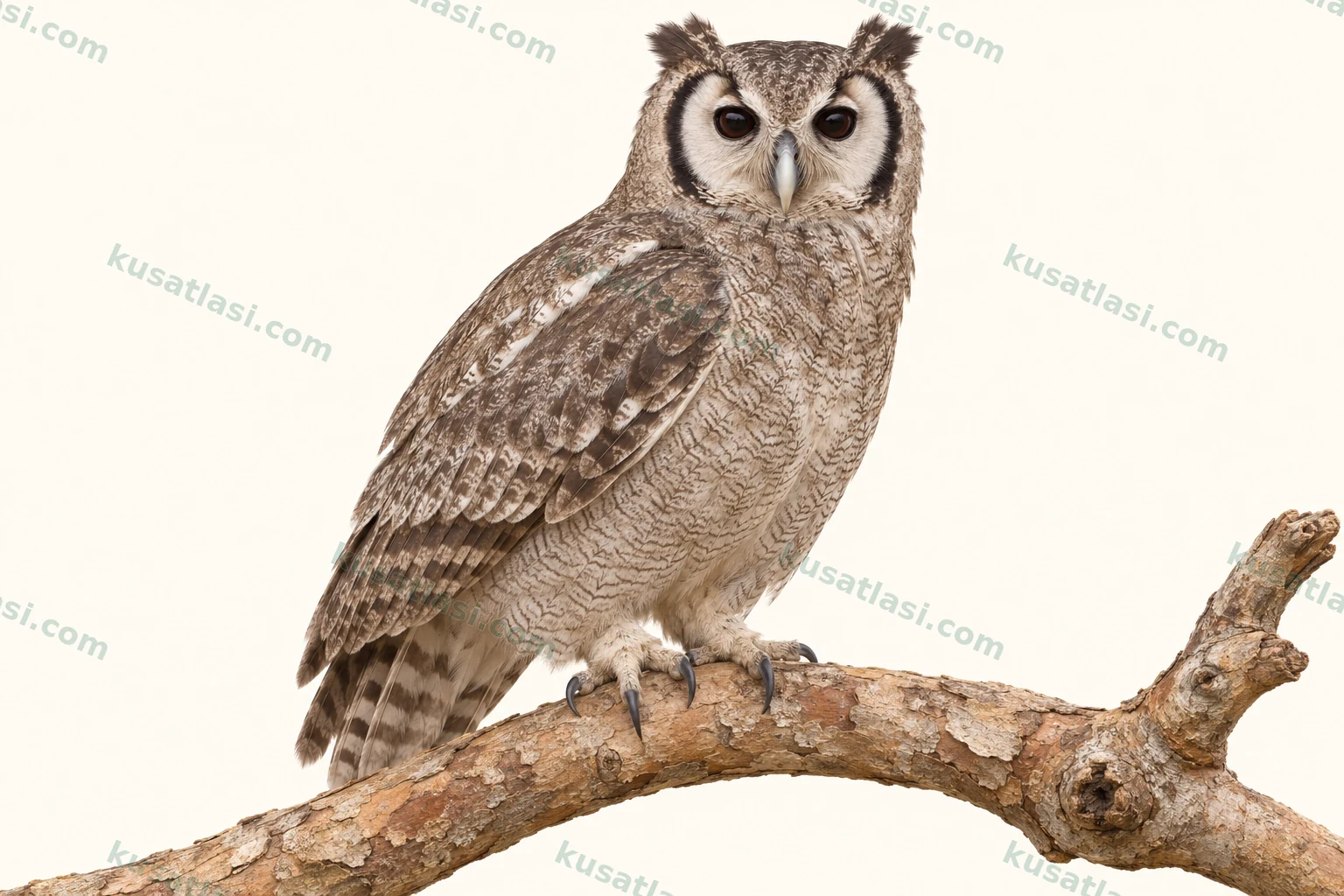
The hero image and adult-male perched plate use the exact same file.
Published approximate adult length used for both sexes.
No sex-specific single value has yet been verified in an accessible primary source.
Directly reported small-sample means from specialist handbook data, not midpoints of a range.
Three useful ideas before opening the detailed account.
Five clean working plates. Open the detailed image description below each plate for a non-visual equivalent.
The adult male is shown upright on a branch with a massive body. Its overall plumage is milky pale grey, with darker grey-brown mottling above. Pink upper eyelids sit above the very dark eyes; a dark rim borders the pale face and small ear tufts angle sideways. This is an AI-generated working plate, not a photograph of a real bird.
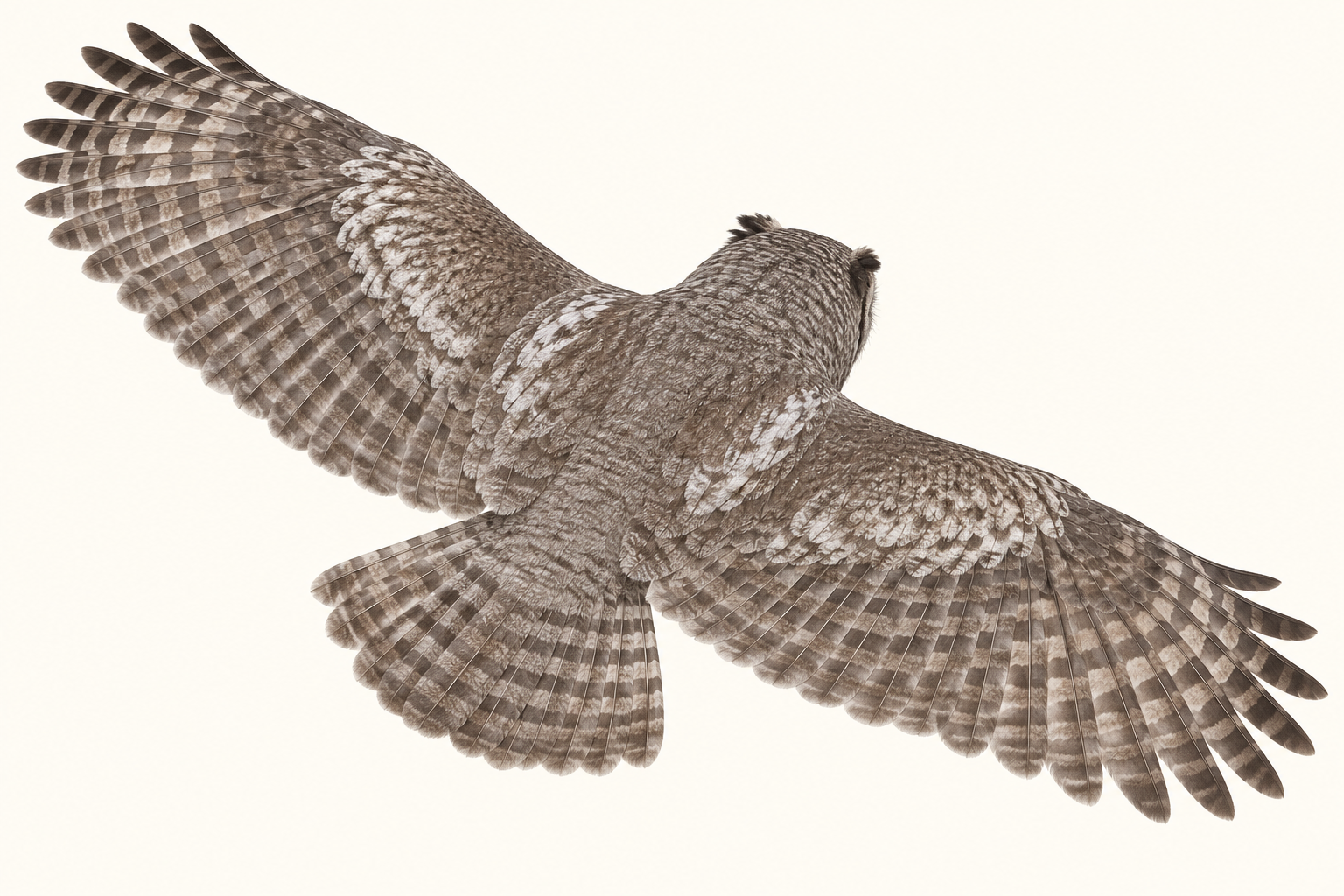
The bird is shown directly from above with broad rounded wings spread. Grey-brown upperparts and barred flight feathers are presented only as a study of angle and overall structure. Because no accessible primary source verified the upperwing pattern as a stand-alone diagnostic character, this plate makes no definitive identification claim and carries no diagnostic pins.

The owl is viewed from below with its broad wings spread. Pale underparts, restrained darker bars and a short tail convey the general flight silhouette. Underwing details have not yet been sufficiently verified against an accessible primary account, so no pins are used and the pattern is not presented as a definitive field mark.
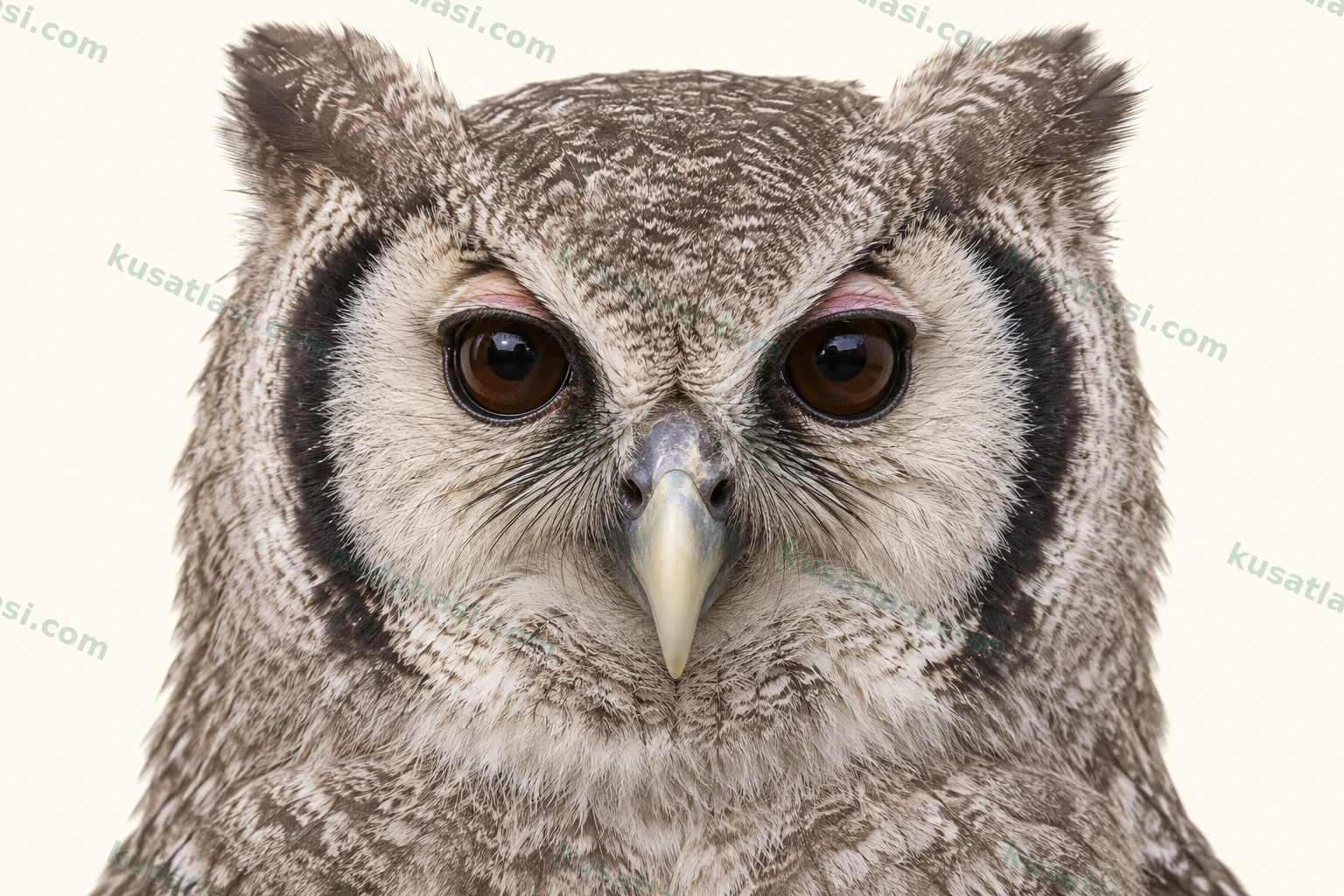
The close view shows very large dark eyes, fleshy pink upper eyelids, a thick dark border at the sides of the face, a short pale horn-coloured hooked bill and fine black bristle-like feathers around it. Small ear tufts sit at either side of the crown. Identification should use this combination rather than a single mark.
The adult female shares the male's pale grey, mottled plumage and no reliable field colour difference is implied. The plate conveys the female's greater average mass through heavier proportions. A lone bird should not be sexed from appearance alone.
The principal call is described as a very low, muffled, throaty two-beat phrase, roughly “ung—ung”. The two notes are similar, with the second sometimes sounding slightly more emphatic. It is not a high scream but a resonant, closely spaced call that can carry over distance. This text describes rhythm and quality; it does not replace an actual recording.
No licensed recording is attached; nothing plays automatically.The Turkish and English accounts cover the same evidence in natural language.
Verreaux's Eagle-Owl is one of the largest owls of sub-Saharan Africa. The first impression is of a heavy, tall, pale bird with a broad head and strikingly dark eyes. A dark border at each side frames the pale facial disc. The strongest clue is the fleshy pink upper eyelid above each dark eye. The pink may not be equally visible in every posture: it can be obscured when the bird narrows its eyes, turns its head or sits in poor light. Identification should therefore use a combination of size, pale grey overall tone, dark eyes, facial border and small ear tufts rather than relying on one patch of colour.
The body is powerful, the chest broad and the head large and nearly rounded. A perched bird may sit upright; raised feathers shorten the apparent neck and make the outline look blocky. The upperparts are grey-brown with pale mottling. The underparts are paler, crossed by fine, irregular dark streaks or bars. The bill is short, strong and pale horn-coloured, with blackish bristle-like feathers noticeable at close range. The ear tufts are not long upright horns: they are small, blunt and may angle sideways, almost disappearing when relaxed. The feet are powerful and adapted to seizing prey.
A day-roosting bird may remain motionless on a shaded large branch, its pattern blending with bark. A turn of the head, briefly opened eyes or feathers compressed against the body can rapidly change its apparent shape. These behaviours can make a distant bird look smaller, so branch thickness, head proportions and body volume matter. Approaching closely, using flash or trying to force the owl into the open is unethical; identification should be made remotely with binoculars or a telescope.
Males and females share the same basic plumage. The female is heavier on average, but distance, feather posture and stance change apparent size, so a lone bird cannot be sexed safely. Rules that invent a separate male colour or a separate female facial pattern should not be used. A size difference in a pair sitting together may help, yet an unmeasured field impression is not proof.
Young birds may appear paler and warmer brown than adults, with a weaker facial border and less obvious ear tufts. These age characters are reported in institutional accounts derived from regional handbooks; because an open primary growth series is limited, this page does not present them as an invariable ageing key. Feather wear, coloured light and a photograph's white balance can also alter the impression of age.
A departing bird presents a powerful, heavy silhouette formed by a large body, broad rounded wings and a short tail. This pilot separates dorsal and ventral views, but accessible primary sources did not verify either wing-surface pattern as a stand-alone species key, so the plates carry no pins. A flight observation should combine silhouette, overall pale tone, the way the head joins the body and any visible facial characters. A wing shape glimpsed alone at night is not enough for a definitive record.
The species is nocturnal and much hunting activity occurs during the early part of the night. eBird describes the main call as a very deep, guttural, two-syllable phrase resembling “unngh-unngh”. Kenyan observations found pairs roosting close together by day and sometimes on the same branch. Brown's 1965 report of injury-feigning near a nest is an important observation, not a universal rule followed by every bird at every nest. The distinction between a recorded event and a species-wide generalization must remain explicit.
Pel's Fishing-Owl is warmer rufous-cinnamon and lacks conspicuous ear tufts. Cape Eagle-Owl appears smaller and its orange-yellow eyes are a strong distinction. Shelley's Eagle-Owl is much darker overall, has heavy dark barring below and is more closely associated with closed forest. Geography helps but is not sufficient on its own because records can be mistaken and birds can wander. For Verreaux's Eagle-Owl, look for the combined pale grey appearance, dark eyes, pink eyelids, dark facial frame and small ear tufts.
Colours can appear unusually pale or warm during a brief night observation. Failure to see pink eyelids does not immediately exclude the species, while a pink reflection created by artificial light is not enough to confirm it. Record the time, lighting, approximate distance, behaviour, voice and structural features seen from more than one angle. An uncertain observation can remain at a broader owl-group level instead of being forced into a definitive species label. That approach reduces false certainty and makes later independent review more useful.
The species has a broad but discontinuous range across sub-Saharan Africa. It is recorded from Senegal and The Gambia in the west, through suitable parts of East and Central Africa, and south into southern Africa, with records extending towards portions of the Horn of Africa. The CITES country record lists many range states, but that list does not mean equal density or continuous occupation in every country. A mosaic of open ground and wooded areas with large trees helps shape its distribution; the interior of dense lowland equatorial forest is not generally considered typical habitat.
Verreaux's Eagle-Owl is not a regular member of the Turkish avifauna, and this World Birds page must not imply that it occurs in Turkey. The Turkish name supports language access and catalogue consistency. No Turkish observation map or local phenology is created without a verified natural record.
The Birds of the World range treatment presents the species as principally resident, with no evidence for a regular continent-scale seasonal migration. Dispersal by young birds or local movements in response to food and rainfall are not the same as a fixed migration route. The page therefore gives no invented sequence of countries, arrival dates or passage calendar. Any study reporting local movement must remain limited to its own region and sample.
Verreaux's Eagle-Owl occupies mosaics ranging from dry savanna to moister woodland, riverine forest strips and forest edges beside open country. The recurring requirement is a combination of trees large enough for daytime roosting and breeding with open ground suitable for hunting at night. Brown's Kenyan observations emphasize riverine Acacia strips and edges beside open land; that regional result is not copied unchanged to every population across Africa.
The owl does not build its own stick nest. Published accounts record use of old nests made by Hamerkops, weavers, crows and large raptors. Tree cavities or dense masses of vegetation are less frequent alternatives. Loss of large nest-bearing trees can remove breeding opportunities even where hunting ground remains.
By day the bird stays quiet and concealed on a shaded branch of a large tree. Around dusk it can search open ground, woodland edges and riverside corridors for prey. Saying only that it “lives in savanna” misses the importance of the tree-to-opening relationship. Approaching a roost or nest tree does more than make the owl visible; it can disrupt rest and breeding behaviour.
The diet is broad and opportunistic: mammals, birds, frogs, reptiles and invertebrates have been recorded, and carrion may occasionally be used. Of 59 prey records in Brown's 1965 Kenyan sample, 33 were mammals, 16 frogs, nine birds and at least one a snake; insect remains were also present. Those proportions belong to a particular Kenyan study area, not an unchanging diet for the species throughout Africa. In the De Hoop study, birds and mammals supplied most prey biomass, while the remains of an adult grysbok were interpreted as almost certainly scavenged. Together the studies show that diet varies with local prey and habitat.
Despite its great size, the owl can exploit prey of different sizes. At night it watches open ground and woodland edges, moving towards suitable targets; attacks launched from a perch or near the ground can vary with context. Reports of daytime hunting are exceptional observations and should not be presented as the normal activity period. Finding remains of a large animal does not by itself prove that it was killed alive; alternative explanations must remain open, as in the De Hoop researchers' carrion interpretation.
The pink upper eyelids are among the species' most familiar features, yet the sources used for this pilot did not establish a tested function for the colour. The page therefore invents no role in mate choice, communication or camouflage. The observed fact is that the eyelids look pink; their possible function remains a separate research question.
Reuse of nests built by other large birds reveals links among species in wooded savanna ecosystems. A substantial nest left by a Hamerkop or raptor can become a breeding site for a different user in a later season. This relationship shows why protecting the owl alone is not enough: large trees and the other nest-building species are also working parts of its habitat.
Mammals leading by number in the Kenyan study and birds leading by biomass at De Hoop need not conflict. “How many prey items?” and “how much of the total mass?” are different questions. Regions, seasons and collection methods also differ. Rather than turning local percentages into a single continental menu, this page keeps each result inside its own sample.
The species was long published as Bubo lacteus. IOC moved it to the combination Ketupa lactea in response to phylogenetic evidence and alignment among major world lists. Finding the older name in a source does not automatically mean that a different bird is being discussed; the source date and taxonomic treatment must be checked. A taxonomic name change also does not mean that the bird's biology changed overnight.
It does not build a stick nest of its own; it may occupy abandoned nests of large birds such as Hamerkops, weavers, crows or raptors. Tree cavities and dense plant masses are less frequent alternatives. Two eggs are usual in published accounts, though one also occurs. The female incubates while the male brings food at night. A Roberts-based institutional account gives approximately 38–39 days, but this pilot does not present a single exact figure without seeing the underlying handbook page. Breeding timing shifts with local dry seasons, so South African dates are not generalized across Africa.
Sources are maintained once in the central bibliography; they are not duplicated under species pages.
Open the central bibliography