

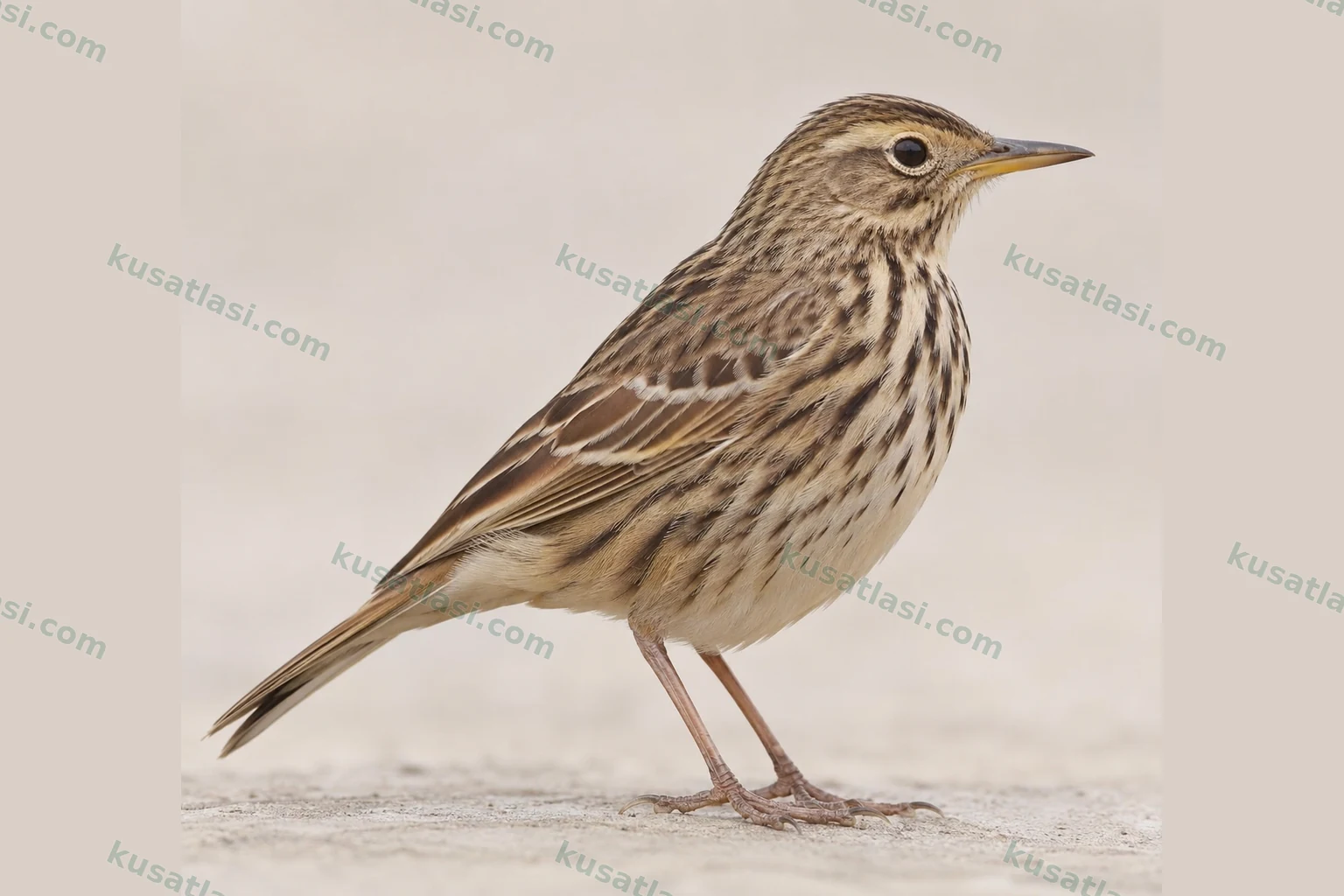
World Birds IUCN statusLC · Least ConcernGlobal IUCN category. BirdLife v10 (2025); taxon matching: AviList 2026 / IOC 15.2; checked: 29.10.2026. The list year is not the species assessment date. Source and method · BirdLife OrderPasseriformesPasserines FamilyMotacillidaeMotacillidae
African Pipit
Anthus cinnamomeus
A streaked brown back, pale underparts, distinct facial lines and a yellow bill base. Pale outer tail feathers are assessed together with the other marks.
Biometrics
Length
Male16–17 cm
Female16–17 cm
Shared species value
Wing length
Male8.68 cm
Female8.68 cm
Shared species value
Weight
Male18–31 g
Female18–31 g
Shared species value
African Pipit
Suitable open grasslands in Africa and southwestern ArabiaObservation guide in its natural range
Look for three features together
Do not rely on a single featureSee the pale eyebrow together with the breast pattern; a geographical difference in shade is not a sex difference.
If only the upper surface of the bill is seen, the colour of the lower base is not filled in.
Watch from the edge of the open area without approaching nests and young among the grasses.
Compare male and female
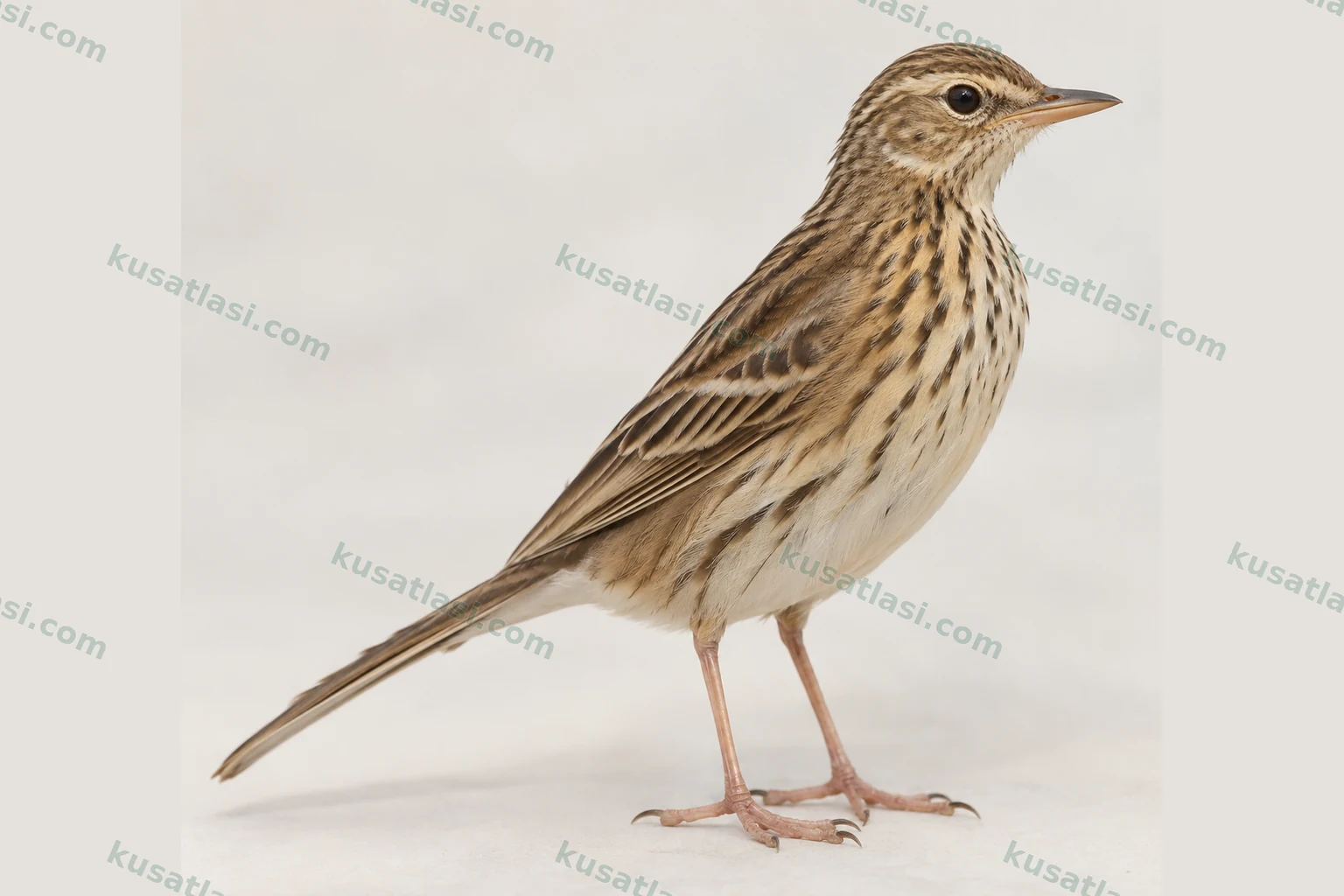 FemaleMale
Adults of both sexes have similar plumage. Young birds’ more conspicuous pale upperpart feather edges and breast pattern are assessed in their age context; body shade is not used to determine sex.
Where to look in its natural range?
Watch short-grass areas from the edge. Check face, back, bill base and tail together; do not follow ground-nesting birds on foot.
Resident populations and partial seasonal movements both occur. The southern African atlas’s regional peak egg-laying intervals are shown separately; no single migration or breeding calendar is drawn for the whole range.
January
Resident populations and populations with partial seasonal movements occur; assess them using records from the relevant region. Former Transvaal region atlas example: within the peak egg-laying interval. Namibia and Botswana atlas example: within the peak egg-laying interval.
February
Resident populations and populations with partial seasonal movements occur; assess them using records from the relevant region. Namibia and Botswana atlas example: within the peak egg-laying interval.
March
Resident populations and populations with partial seasonal movements occur; assess them using records from the relevant region. No verified regional date specific to this month was supplied; this does not mean local absence.
April
Resident populations and populations with partial seasonal movements occur; assess them using records from the relevant region. No verified regional date specific to this month was supplied; this does not mean local absence.
May
Resident populations and populations with partial seasonal movements occur; assess them using records from the relevant region. No verified regional date specific to this month was supplied; this does not mean local absence.
June
Resident populations and populations with partial seasonal movements occur; assess them using records from the relevant region. No verified regional date specific to this month was supplied; this does not mean local absence.
July
Resident populations and populations with partial seasonal movements occur; assess them using records from the relevant region. No verified regional date specific to this month was supplied; this does not mean local absence.
August
Resident populations and populations with partial seasonal movements occur; assess them using records from the relevant region. Southwestern Cape atlas example: within the peak egg-laying interval.
September
Resident populations and populations with partial seasonal movements occur; assess them using records from the relevant region. Southwestern Cape atlas example: within the peak egg-laying interval. Zimbabwe atlas example: within the peak egg-laying interval.
October
Resident populations and populations with partial seasonal movements occur; assess them using records from the relevant region. Southwestern Cape atlas example: within the peak egg-laying interval. Zimbabwe atlas example: within the peak egg-laying interval. Former Transvaal region atlas example: within the peak egg-laying interval. Namibia and Botswana atlas example: within the peak egg-laying interval.
November
Resident populations and populations with partial seasonal movements occur; assess them using records from the relevant region. Southwestern Cape atlas example: within the peak egg-laying interval. Zimbabwe atlas example: within the peak egg-laying interval. Former Transvaal region atlas example: within the peak egg-laying interval. Namibia and Botswana atlas example: within the peak egg-laying interval.
December
Resident populations and populations with partial seasonal movements occur; assess them using records from the relevant region. Zimbabwe atlas example: within the peak egg-laying interval. Former Transvaal region atlas example: within the peak egg-laying interval. Namibia and Botswana atlas example: within the peak egg-laying interval.
Nest, egg and incubation
A cup on the ground in a shallow hollow at the base of grass or a bush. The South African specialist synthesis gives one to four eggs, rarely five, about 13–14 days of incubation and 11–17 days in the nest. Nest departure is not independent feeding; durations from different sources have not been averaged.
Calls are short and sharp, with repeated song sequences in flight. Match the sound to the individual producing it.
Do not play recordings to attract birds; observe quietly, especially near nests.
Species information
Quick identification
African Pipit Anthus cinnamomeus is a ground-walking pipit of open grasslands, with brown streaked upperparts and pale underparts. Its conspicuous pale eyebrow, dark-and-light facial lines, yellow at the bill base and pale areas in the outer tail feathers are assessed together. Similar pipits may share these marks; a streaked back or presence in grassland alone does not identify this species. Whenever possible, the face, breast, bill base and tail of a perched bird should all be seen.
The accepted scientific name is Anthus cinnamomeus and the English name African Pipit. The older southern African atlas uses Grassveld Pipit. Older, more broadly defined pipit groups and present-day taxa do not have identical scope. The page’s map retains the Anthus cinnamomeus scope matched to the record. Merely seeing the bird in Africa does not automatically exclude similar pipits.
General appearance and posture
Because colour and size vary geographically, the appearance of one individual is not treated as a uniform model for the entire species.
Dark feather centres can be seen against the brown back. Light-and-dark lines around the head and neck contribute to the distinctive face. The eyebrow is pale, the eye dark and the bill slender and rather long; yellow may occur on the lower part of its base. If only the upper side of the bill is visible, the yellow base cannot be declared absent. Facial lines may be obscured from different angles as the bird lowers its head to search for prey; watching natural movement is more useful than relying on one frame.
The underparts are pale, with dark streaks on the breast. Streak density can vary with age and geographical form. Some birds look sandier, others warmer brown or reddish. That variation does not mean every dark bird belongs to another species or every warm-toned bird is male. Checking back streaking and breast pattern together is more useful when assessing similar, plainer pipits.
The outer tail feathers usually look pale and whitish; these areas may be hidden in a closed tail. Spreading the tail or a short flight can show the mark better. One photograph is not assumed to represent the same shade and extent of pale colouring in every geographical form. White along the outer tail is not sufficient on its own either: other pipits also have pale outer tail feathers. The apparently long legs and ground posture provide context that complements the identification marks.
Males, females and young birds
Adult males and females are not conspicuously different in plumage. A male may be recognised by song and display flight; body colour alone is not equally reliable. Standing more upright or showing a darker breast does not establish a sex difference compared under unchanged lighting and viewing conditions.
Pale feather edges and dark centres on the upperparts can give young birds a more conspicuous pattern. Their breast pattern may also differ from the more regular adult appearance. Age-related appearance, back pattern, face and tail should be seen together when assessing such a bird. A young bird’s pale feather tips must not be confused with another species’ permanent adult wing pattern. An incomplete rear view does not provide all the information required for age and species identification.
Wear can weaken the pale feather edges. It is therefore wrong to interpret a pattern difference between fresh- and worn-plumaged birds directly as a sex difference. Nor does a young bird on the ground immediately mean it has fallen from a nest or been abandoned: this species’ young receive care nearby after leaving the nest. Instead of approaching or lifting a bird to determine its age, watch the adults’ behaviour from a distance.
Appearance in flight
It may rise and descend during song flight; repeated vocal sequences in open ground make it easier to notice. This is a behaviour distinct from an ordinary short flight between places. A walking bird may take off briefly and land among grasses again. Although wing and tail details can become visible, a distant silhouette is not always enough to separate it conclusively from similar pipits.
Seasonal movements in some populations do not make every short flight migration. If pale areas of the outer tail feathers are seen in flight, record that mark; if the bill and face were not seen, retain that limitation in identification. Rather than force another flight, watching from outside the place where the bird has landed again is enough.
Voice and behaviour
The call is described as short and sharp, and the song as consecutive sequences given in flight. Song and short contact calls do not have the same function. Written syllables cannot capture every stress and tonal quality of the real voice. Match the sound source with the bird seen and consider the presence of other pipits nearby. This section provides written information about the natural voice.
When searching for food it walks or makes short runs on the ground. Outside breeding it may occur in the same place as other small birds of open country. Feeding together does not make them the same species or family. Ground nests and young can easily be hidden among grasses; waiting at the edge is better than walking through the area to search for birds. Do not follow an adult pretending to be injured, as this may be a distraction behaviour drawing attention away from young.
Similar species
In comparison with Plain-backed Pipit Anthus leucophrys, assess the adult’s less patterned back. African Pipit’s streaked back alone is not enough in every age and lighting condition; the face, bill base and tail are needed too. A young bird of another species may not fit the plain-back rule given for adults. Age is not left as an afterthought added only after comparison.
Bill and body proportions are important in comparison with Long-billed Pipit Anthus similis, but apparent size in a photograph is not converted into an exact measurement without knowing the distance. Richard’s Pipit Anthus richardi also matters when avoiding confusion among older, broadly defined taxonomic headings. Similar pipits require voice, an adequate overall view and local taxonomic scope together; a single eyebrow line does not establish certain identification.
Global distribution
African Pipit occurs widely in open country in eastern and southern Africa, also in suitable western African highlands and southwestern Arabia. The southern African atlas describes a range extending north to Sudan, Ethiopia and Somalia and east of the Red Sea to southwestern Arabia. More restricted areas around Nigeria and Cameroon north of the equatorial forests are considered within the same taxonomic context. This broad geography does not mean uninterrupted breeding across the whole surface of every country.
Status within its natural range
It may be a common bird of open grassland, but abundance varies with aridity and vegetation structure. The southern African atlas specifically notes scarcity or absence in the very arid western regions. Specialist accounts give the global category Least Concern; that category does not directly measure changes in every local population. Use of farmland does not mean it benefits from every agricultural practice.
The map area is a licensed model, not a breeding boundary or an annual population census. Observation points are also selected examples of records. A point without known age, season and subspecies scope is not evidence of a seasonal movement route. Natural areas in southwestern Arabia are not removed from the map simply because of the name African Pipit.
Migration
Movement patterns differ among populations. The older southern African atlas distinguishes postbreeding movements by some plateau birds towards coastal and northeastern regions from the more resident behaviour of some coastal populations. It also describes the movements as partial. Thus neither complete residency nor one fixed long-distance migration route is assigned to the entire species. Some changes in monthly visibility can also relate to song and moult; few records should not be treated directly as absence.
Breeding habitat
Open grasslands, floodplains with short vegetation, lightly wooded savanna and some agricultural edges are used. The southern African atlas also describes avoidance of dense tall vegetation. Birds may occur on recently burnt ground; that is not a recommendation to burn during nesting or to assume every fire is beneficial. Short feeding grassland and the vegetation covering a nest may have different functions within the same area.
Nest site
The nest is a cup in a shallow hollow on the ground, at the base of a grass tuft or bush; dry grass and fine roots are used. The South African specialist synthesis reports one to four eggs, rarely five, about 13–14 days of incubation and 11–17 days in the nest (regional values, not a new average combined with durations from other sources). After leaving the nest, young may continue to receive food from adults nearby for a time.
Daily space use
A foraging bird moves close to the ground and may sing from a low rock, bush or another suitable raised position. There is no need to follow it on foot to locate its nest. A young bird among grasses should not be considered in need of intervention simply because it is on the ground. If an adult tries to distract attention, move the observation position farther away. For a ground-nesting bird, the observer’s walking route matters as much as the observation itself.
What does it eat?
Small insects and other arthropods form the main diet. The South African specialist synthesis lists prey groups including beetles, grasshoppers, caterpillars, flies, termites and spiders. Another specialist account also includes seeds; without a specific source sampling context, no fixed percentage is assigned to them for the entire species. AVONET’s invertebrate-feeding category is a broad summary of the main food group.
How does it feed?
Most food is sought while walking or making short runs on the ground, with the bird responding to small movements. The expert account also reports occasional capture of airborne prey. Picking up an object from the ground does not mean that the type of food can always be identified in a photograph. Only visible prey details are recorded; an indistinct dark shape is not turned into an insect species by guessing.
Short grass may affect prey visibility, but feeding in mown or burnt ground does not prove equal suitability for breeding. Nest cover and feeding substrate are considered separately. A sighting in a farm field does not establish economic benefit, pest control or a positive effect under all farming systems. Food records are kept with age, date and observational context.
Being seen less does not always mean moving away
Clancey’s southern African atlas account describes seasonal movements of some plateau populations while also stating that not all birds migrate at the same time. Song flight and visibility during breeding can influence record frequency; postbreeding silence or moult can make birds less conspicuous. A month with few records is therefore assessed without attributing everything to migration. Evidence of movement and detection rate are not the same thing.
The calendar varies by region
The atlas’s regional egg-laying data identify concentrations in August–November for southwestern Cape, September–December for Zimbabwe, October–January for the former Transvaal region and October–February for Namibia and Botswana. These differences are not compressed into one breeding month for all Africa. The names of the regional examples are retained in the calendar; a peak month in one area is not used as an absence month in another.
A young bird on the ground has not necessarily fallen
The specialist breeding account reports continued feeding of young nearby after they leave the nest. This shows that nest departure and independence are different stages in a ground-nesting bird’s life cycle. Taking a young bird just because it is on the ground may interrupt adult care. Moving away often lets adults resume natural behaviour; definite judgements about age and health must not exceed what the image can establish.