

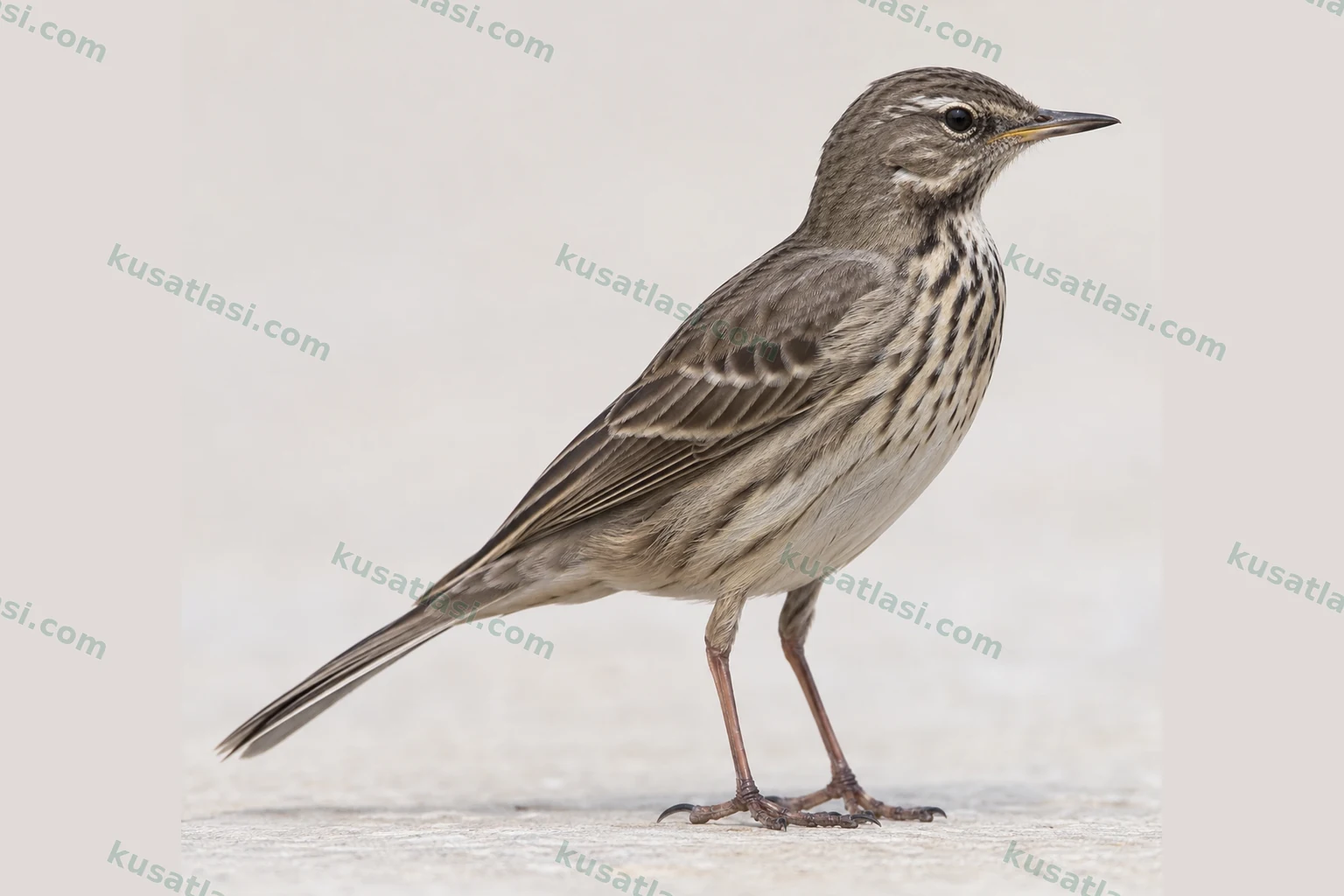
World Birds IUCN statusNT · Near ThreatenedGlobal IUCN. BirdLife v10 (2025); taxon matching AviList 2026 / IOC 15.2; checked: 29.10.2026. The list year is not the species’ assessment date. Source and method · BirdLife OrderPasseriformesPasserines FamilyMotacillidaeMotacillidae
African Rock Pipit
Anthus crenatus
A robust brown body, pale eyebrow, yellowish wing edges and a song beginning with a whistle; characteristic of southern African rocky country.
Biometrics
Length
Male17–18 cm
Female17–18 cm
Shared species value
Wing length
Male8.43 cm
Female8.43 cm
Shared species value
Weight
Male26–38.5 g
Female28–39 g
African Rock Pipit
Rocky slopes of South Africa and LesothoObservation guide in its natural range
Look for three features together
Do not rely on a single featureAssess the pale eyebrow, dark eye line and diffuse breast streaks together.
Yellow-green edges help, but Striped Pipit has similar colours.
Match the song to the visible bird; look on slopes combining rocks and grass cover.
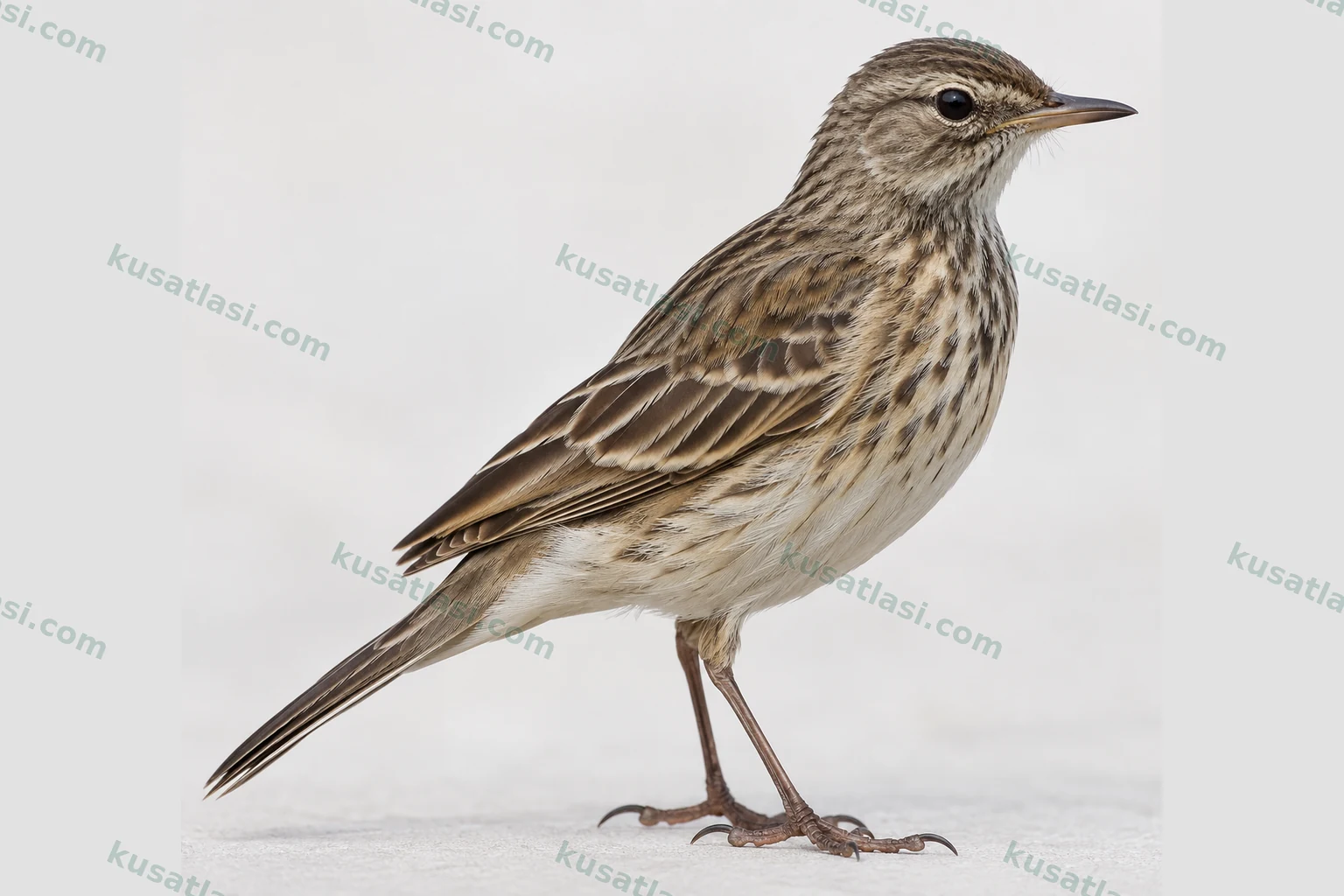
Compare male and female
 FemaleMale
Adult males and females are similar; the wing difference in the sample does not allow certain sexing from a photograph.
Where to look in its natural range?
Search slopes where large stones, grass tufts and visible rocks used as song posts occur together.
The egg-laying period in the South African specialist account is considered in relation to local conditions.
January
It is essentially resident; some local movements and occasional wandering have been recorded. South Africa, specialist account: egg-laying, peaking in November.
February
It is essentially resident; some local movements and occasional wandering have been recorded. No verified regional date specific to this month was provided; this does not mean local absence.
March
It is essentially resident; some local movements and occasional wandering have been recorded. No verified regional date specific to this month was provided; this does not mean local absence.
April
It is essentially resident; some local movements and occasional wandering have been recorded. No verified regional date specific to this month was provided; this does not mean local absence.
May
It is essentially resident; some local movements and occasional wandering have been recorded. No verified regional date specific to this month was provided; this does not mean local absence.
June
It is essentially resident; some local movements and occasional wandering have been recorded. No verified regional date specific to this month was provided; this does not mean local absence.
July
It is essentially resident; some local movements and occasional wandering have been recorded. No verified regional date specific to this month was provided; this does not mean local absence.
August
It is essentially resident; some local movements and occasional wandering have been recorded. No verified regional date specific to this month was provided; this does not mean local absence.
September
It is essentially resident; some local movements and occasional wandering have been recorded. No verified regional date specific to this month was provided; this does not mean local absence.
October
It is essentially resident; some local movements and occasional wandering have been recorded. South Africa, specialist account: egg-laying, peaking in November.
November
It is essentially resident; some local movements and occasional wandering have been recorded. South Africa, specialist account: egg-laying, peaking in November.
December
It is essentially resident; some local movements and occasional wandering have been recorded. South Africa, specialist account: egg-laying, peaking in November.
Nest, egg and incubation
The nest is a cup hidden in a grass tuft among rocks, with 2–3 eggs. The regional specialist account gives incubation of at least 12–13 days and about 12–13 days for the young in the nest; both adults feed the young.
A prolonged whistle is followed by a trilling passage; the song varies among individuals and populations.
Do not play recordings to attract birds; observe quietly, especially near nests.
Species information
Quick identification
The African Rock Pipit Anthus crenatus is a strongly built brown pipit of rocky slopes in South Africa and Lesotho. A pale eyebrow, dark line at eye level and apparently short tail provide initial clues. Yellow-green feather edges in the wing may be visible at close range; the breast streaking is more diffuse than in some other pipits. A whistle from a rock followed by a trilling song section can help locate the bird. Colour, structure, voice and rocky surroundings must be considered together.
African Rock Pipit and Yellow-tufted Pipit are names for the same scientific taxon. “African” does not mean that it lives throughout the continent: its natural range is restricted to two southern African countries. Nor is every brown bird on a rock this species. Striped Pipit is a different species sharing some features. If the bird is unseen, following a distant whistle and confirming the head and body is more reliable than assigning a certain name to the sound alone.
General appearance and posture
The back is olive-brown, with feather centres appearing diffusely streaked or finely spotted. The underparts are paler, ranging from warm cream to cinnamon tones. The pale chin and throat are seen with a dark moustachial line. Dark marks on the breast and sometimes the flanks form streaks of varying sharpness. The bird should not be described as entirely unstreaked or equally streaked in every individual. Yellow visible on the small wing coverts and edges is different from brown feathers looking reddish in sunlight.
The bill is strong and mostly dark, although the base of the lower bill may be paler. The eye is hazel-brown and the feet pale brown. Leg and toe structure can be easier to see on stony ground than among grass. The apparent neck and body proportions of a bird standing upright on a rock can differ from those of the same bird bending to feed. Rather than estimating size through binoculars to separate it from other pipits, check eyebrow, moustachial line, breast and wing edges together.
Males, females and young birds
Males and females have similar basic plumage. A female may be slightly smaller, but two birds at different distances can give the same impression. In a 2022 study, males in the sample had longer wings and tails, while no clear sex difference in mass was demonstrated. This does not make a large-looking bird in a photograph certainly male. Measurement distributions also overlap; a single cutoff for folded-wing length is not a field rule separating every individual without error.
Young birds and those not yet in fully adult plumage may look paler and more spotted on the upperparts. The tail can be shorter, with cream-white pale portions on the outer tail feathers. A pale appearance alone does not prove youth; strong daylight also washes out adult colours. When observing differences between new and worn feather edges, assess head, upperparts and tail together. There is no need to assign an exact month or age-year to a bird whose age is uncertain.
Leaving the nest need not coincide with flight or independence. Adults carrying food may show that care continues. A young bird alone on a rock does not establish that its parents have gone. Watching nearby adults is useful, but following them towards the grass tuft concealing a nest is inappropriate.
Appearance in flight
Warm and yellowish edges to dark wing feathers may show briefly on take-off. Pale yellow tips to underwing coverts are a helpful detail, although shade or rapid wingbeats may hide them. Visibility of pale outer tail portions depends on how the tail opens. These colours must not be filled in as though present in a blurred flight frame. Identification becomes more reliable when the pale eyebrow, breast pattern and strong build seen on the ground are connected with the flying bird.
A short flight between rocks does not show range expansion or the start of migration. The species is generally considered resident; some records support local dispersal and wandering. Where a bird lands after flying from a rocky hill onto an open plain can be more useful than compass direction alone.
Voice and behaviour
A prolonged whistle followed by a more trilling section is conspicuous in the song. Researchers have studied differences in sound structure among individuals and populations. This variation means that every recording cannot be written as the same syllable sequence. A rock, shrub or small tree may serve as a song post. Seeing which bird opens its bill while following the sound prevents assigning a neighbouring pipit's song to it. Voice is a strong clue used with body pattern and natural surroundings.
The bird may descend to feed between rocks and use rock tops as lookout points. Showing less of the conspicuous tail-wagging of other pipits may help, but one momentary tail movement does not exclude the species. A bird singing from one place for a long time is not assumed to feed there all day. Recording song and feeding observations separately helps explain space use. Silent individuals can be easily overlooked, especially on extensive stony slopes.
Similar species
Striped Pipit Anthus lineiventris may also occur on rocky slopes and show yellow-green edges on feathers at the front of the wing. This shared feature prevents the yellow edge alone from being diagnostic. Its strong underpart streaks extend onto the belly; compare them with the African Rock Pipit's more diffuse breast and flank marks. Do not separate the species solely by brown back and rocky habitat without seeing the breast.
African Pipit Anthus cinnamomeus uses open grassy places over a much wider area. A streaked back, distinct face, yellow at the bill base and white outer tail feathers matter in comparison. Geographical colour variation means that paleness or darkness alone is insufficient. Look together for the African Rock Pipit's strong build, apparently short tail, wing edges and distinctive song; identification should remain cautious unless ground appearance and voice are linked to the same individual.
Global distribution
The core of its natural range lies in the rocky mountain areas of South Africa and Lesotho. The Lesotho mountains, Drakensberg surroundings and various rocky uplands in South Africa are important. More isolated populations occur on suitable Northern Cape hills. Sparse records from the southwestern Cape Fold Mountains do not imply continuous dense occupation of the entire southwest. Separation of suitable stony habitat on a map is an ecological division independent of national borders.
Status within its natural range
The 2025 regional assessment classifies the species as Least Concern, whereas the 2021 global assessment cited here carries Near Threatened. Assessments with different dates and scopes must not be confused. The newer regional result rests on improved information about population and distribution; it does not show a certain rapid increase in birds. A population estimate obtained by counting songs in mountains is not a direct count of every individual either. Broad uncertainty intervals and the sampled region must remain part of interpretation.
Movements and migration
It is considered mainly resident and associated with the same general area over long periods. Local movements and sparse records outside ordinary areas suggest some wandering, but no regular intercontinental migration route has been verified. The lack of a record at a mountain's foot does not prove that birds higher up left the region that month. Difficult access and song activity also affect detectability. Gaps between isolated Northern Cape hills and the broader eastern range should be assessed through unsuitable plains, rather than administrative boundaries alone.
Breeding habitat
The species is closely associated with steep slopes covered in rocks and large stones, scree and rocky outcrops. In the west it may use uplands around semi-arid Karoo, and in the east stony slopes within wetter mountain grasslands. This diversity does not mean occurrence in every open grassland. It reaches high mountains in Lesotho, but no identical elevation boundary for all birds or restriction to the highest summits should be imposed. Stony ground and sufficient grass cover together are important.
Nest site
The nest is a shallow cup concealed by a grass tuft among rocks. Grass, rootlets and fine plant fragments are used, with finer material lining the interior. The South African specialist account gives 2–3 eggs, incubation reported as at least 12–13 days, and a nestling period of about 12–13 days for African Rock Pipit. The source's “at least” must not become a definite upper limit. Both adults feed the young; this does not establish equal incubation duties. Opening a grass tuft to search for eggs is not an appropriate observation method.
Daily space use
Prominent rocks, sparse shrubs and small trees may be used as song posts. These points and ground feeding surfaces have different functions. A conspicuously singing male does not require its mate to stand in the same opening. Walking off the slope's path can flatten cover and damage a concealed nest; distant watching from a fixed point is more appropriate. Conserving rock surfaces alone is insufficient: intervening grass tufts, natural food and surrounding habitat connections are also parts of the habitat.
What does it eat?
The specialist account lists insects, spiders and seeds among its foods. These records do not show that one food group is used in identical proportions every season. A small item taken from the ground should not be recorded as an insect or seed without seeing what it is. Food brought to young and food adults eat themselves may also differ in size. No exact percentage breakdown is supplied because detailed proportions representative of the entire range have not been verified.
How does it forage?
It takes food from the ground between stones and along grass edges. A bird lifting its head at intervals as it moves can view its surroundings; not every pause is prey capture. Watching bill contact with the ground and swallowing together helps distinguish a real feeding event. Watching a bird only while it sings on a rock may not reveal its feeding area adequately; keep your distance when it descends.
Small grassy and bare patches within stony country can offer different foods. Treating all hills as one habitat type hides this detail. Fire or grazing may increase open ground while reducing concealment and nesting cover; short-term feeding visibility alone is not enough to judge a benefit. Attracting birds to food or water changes their natural daily movements. Recording feeding time, substrate and weather without disturbance is more meaningful.
Ringed birds and museum specimens
The 2022 measurement study considered ringed birds and museum specimens together. Museum collections broaden measurement information for a species difficult to catch; information from an old specimen and a current population census are not the same thing.
Males having longer wings and tails does not require their mass also to be clearly greater. Wing ranges overlap between the sexes as well.
Rocky habitat islands and voice differences
Some Northern Cape uplands form habitat islands within surrounding unsuitable plains. Research has examined differences among these populations' songs. The suggestion that isolated habitats could contribute is an explanation, not proof that every sound difference marks a new species or definite genetic separation. Comparing the whistle and trilling sections among individuals gives more detailed information than judging whether the whole song simply sounds similar or different.
Why can a conservation category change?
The lower threat category in the 2025 regional assessment is associated with broader information than earlier estimates. Subtracting old and new population estimates to produce a certain growth percentage would be wrong: method, region and uncertainty have changed. Atlas reporting rate, likelihood of seeing the bird in habitat and actual individual numbers are separate concepts. A lack of records in difficult mountain terrain must also be distinguished from genuine absence.
Monitoring isolated populations and conserving suitable slopes therefore remain important. Future climate models can assess possible risks, but a model's predicted loss is not an event that has already occurred. Recording grass cover among rocks, local land use and repeated observations together provides more detailed natural knowledge than reading one conservation label.