

World Birds IUCN statusLC · Least ConcernGlobal IUCN category. BirdLife v10 (2025); taxon matching: AviList 2026 / IOC 15.2; checked: 29.10.2026. The list year is not the species assessment date. Source and method · BirdLife OrderPasseriformesPerching birds FamilyFringillidaeFringillidae
White-throated Canary
Crithagra albogularis
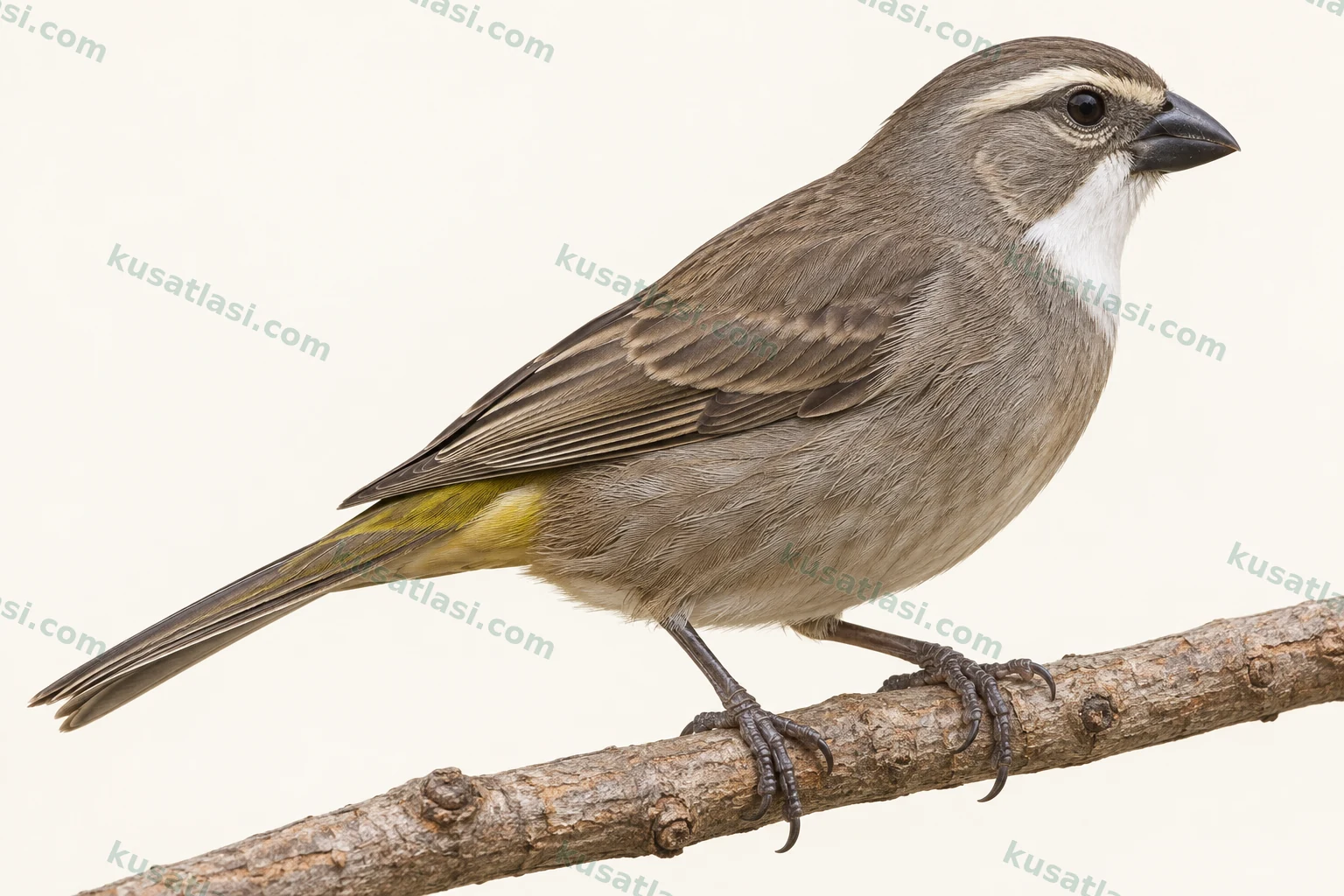
Look for a grey-brown body, white throat and pale eyebrow, together with a strong conical bill and a yellow-green rump.
Biometrics
Length
Male13–15 cm
Female13–15 cm
Shared species value
Wing length
Male7.88 cm
Female7.88 cm
Shared species value
Weight
Male23.5 g
Female25.9 g
Male weight is the published mean for 130 adult males ringed in Namibia during 2002–2022, with subspecies pooled. It is not a range-wide species mean. The female value has a separate source.
White-throated Canary
Namibia, southwestern Angola and South Africa, with scattered records in LesothoObservation guide in its natural range
Look for three features together
Do not rely on a single featureThe throat is white and the body is generally grey-brown.
The yellow-green rump is separate from the dark tail.
The bill is strong and conical. This feature alone cannot identify the species.
Compare male and female
 FemaleMale
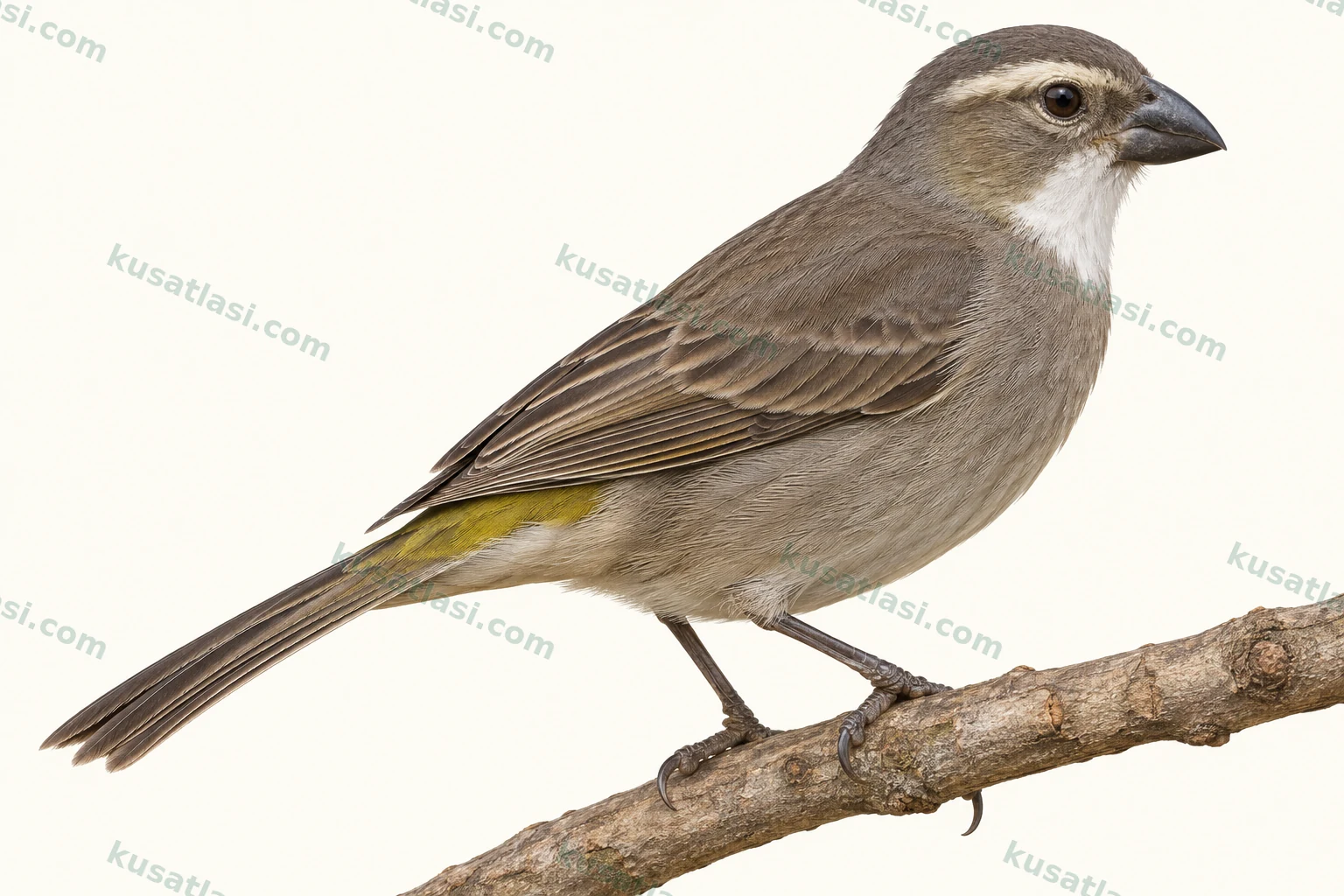
Adult males and females look alike. The female may be paler, and the yellow on a young bird’s rump may be less intense.
Where to look in its natural range?
Look in arid and semi-arid scrub, vegetation along stream beds and suitable Cape shrub communities.
The southwestern atlas gives August–December as a regional breeding season. Timing in other dry regions varies with rainfall, so this is not a calendar for the whole continent.
January
The species is resident and locally nomadic, with no verified fixed annual migration route. No verified regional date is given for this month. That does not imply local absence.
February
The species is resident and locally nomadic, with no verified fixed annual migration route. No verified regional date is given for this month. That does not imply local absence.
March
The species is resident and locally nomadic, with no verified fixed annual migration route. No verified regional date is given for this month. That does not imply local absence.
April
The species is resident and locally nomadic, with no verified fixed annual migration route. No verified regional date is given for this month. That does not imply local absence.
May
The species is resident and locally nomadic, with no verified fixed annual migration route. No verified regional date is given for this month. That does not imply local absence.
June
The species is resident and locally nomadic, with no verified fixed annual migration route. No verified regional date is given for this month. That does not imply local absence.
July
The species is resident and locally nomadic, with no verified fixed annual migration route. No verified regional date is given for this month. That does not imply local absence.
August
The species is resident and locally nomadic, with no verified fixed annual migration route. Regional breeding records come from this period in the southwestern African atlas region. The period does not represent the entire range.
September
The species is resident and locally nomadic, with no verified fixed annual migration route. Regional breeding records come from this period in the southwestern African atlas region. The period does not represent the entire range.
October
The species is resident and locally nomadic, with no verified fixed annual migration route. Regional breeding records come from this period in the southwestern African atlas region. The period does not represent the entire range.
November
The species is resident and locally nomadic, with no verified fixed annual migration route. Regional breeding records come from this period in the southwestern African atlas region. The period does not represent the entire range.
December
The species is resident and locally nomadic, with no verified fixed annual migration route. Regional breeding records come from this period in the southwestern African atlas region. The period does not represent the entire range.
Nest, egg and incubation
The nest is a plant-material cup in the fork of a shrub or small tree. A specialist account gives 2–5 eggs, 14–18 days of incubation and 15–17 days in the nest for the young. Regional conditions may vary.
The bird gives sweet canary song and a distinctive three-syllable call.
Do not play recordings to attract birds; observe quietly, especially near nests.
Species information
Quick identification
The White-throated Canary Crithagra albogularis is a finch with a white throat, a pale eyebrow, a strong bill and a yellow-green rump. Most of the body looks grey-brown. Assess the bright rump, white throat and thick bill together. The whole bird is not bright yellow. Distinguish the dark feather centres on the back from the plainer underparts. A yellow patch alone is insufficient to identify a canary.
The English name is White-throated Canary and the current scientific name is Crithagra albogularis. Serinus albogularis in the old atlas and the spelling albigularis in some historical accounts refer to the same bird when correctly matched. Smith's original description also uses Crithagra. Accounts of white-eyes or laughingthrushes with the same epithet albogularis do not supply the biology of this finch.
General appearance and posture
Sharpe's original museum description gives ash-toned brown upperparts streaked by the dark feather centres. The crown has a pattern similar to the back. The streaks can be hard to distinguish in a small image taken from far away. Their presence does not make all the underparts heavily streaked. Upper and lower surfaces are different areas of plumage. First assess the overall grey-brown colour, then the surface on which the streaks occur.
The rump and upper tail coverts are greenish yellow. This pale area stands apart from the back and can be visible in flight.
The small coverts of the folded wing are brown, while the larger coverts are dark brown with pale edges. The flight feathers have dark centres and pale brownish-white edges. Overlapping edges can produce faint pale lines, less prominent than the two clear wingbars of the Protea Canary. The tail is dark brown with pale, slightly yellowish edges. The yellow of the rump does not extend over the whole tail.
A white eyebrow lies above the darker feathers between the bill and eye. The cheek and ear coverts are grey-brown, and the area in front of the cheek can be paler. The throat is white. The front of the neck, sides of the breast and flanks grade into pale ash brown, while the lower breast and belly centre are whiter. The undertail coverts are also pale. These areas can merge visually in some light without making all the underparts plain white or yellow.
The bill is strong and conical. Its shape helps distinguish the bird from similar canaries, but a thick bill alone does not identify the species. A shaded image can make the bill look darker. Assess the size, head proportions, pale eyebrow, white throat and rump on the same bird. Comparing apparent size with a nearby slender-billed bird does not provide a reliable measure if their distances are unknown.
Males, females and young birds
Adult males and females have a similar overall plumage pattern. A current specialist account says the female can be a little paler, but that alone does not establish sex. Sharpe's older account raised a possibility about female throat markings and expressly said that no specimens with known sex were available to him. That suggestion is not repeated as a confirmed black throat present in every female.
A young bird's olive-yellow rump can be duller. This is not a detailed key to all areas of juvenile plumage. Do not identify a bird with a dull rump as definitely young without considering its geographical form and the light. When age and sex are reliably known from the record, consider them with appearance. Otherwise keep the uncertainty.
Appearance in flight
In flight the yellow-green rump can stand out from the dark wing and tail. Seeing only the underside of the tail as the bird turns does not show the colour above it. The historical account describes pale ash-brown underwing coverts, darker flight feathers and pale inner edges. It does not support a broad white underwing or a newly specified black wingtip pattern.
Voice and behaviour
Cornell's specialist account describes sweet canary song, passages that imitate other birds and a distinctive three-syllable call. A written approximation is not an exact transcription of a recording. The birds occur in pairs and small groups. Wandering outside breeding does not mean that all birds take a fixed annual route. In a mixed flock, match each call with the bird observed making it instead of assigning all calls to one species.
Similar species
Compare the Protea Canary Crithagra leucoptera by its darker chin and two pale wingbars. In the White-throated Canary, assess the distinct white throat, pale eyebrow and yellow-green rump together. The historical museum account also describes the Protea Canary's rump as closer to the colour of its back. A wingbar that cannot be seen on a single distant bird does not suffice for identification.
When comparing with the Streaky-headed Seedeater Crithagra gularis, look for its slimmer bill and rump without yellow-green colour. Head streaks or a pale eyebrow alone do not identify the White-throated Canary. Look at overall proportions, the bill and the rear colour patch from different angles. Several finches can occur in the same dry area, so the habitat name alone is not identification evidence.
Global range
The natural range is in southwestern and southern Africa. The current subspecies account places crocopygia in northern Namibia and southwestern Angola, and sordahlae in southern Namibia and the northern and northeastern Cape. Orangensis occurs in southern North West and western Free State in South Africa, and the nominate form extends from the western and southwestern Cape to the Eastern Cape and Griqualand. The listed places do not imply occurrence everywhere in each country.
Status within its natural range
The southern African atlas describes the Cape and Namibia as the main range, with scattered records in Lesotho and some inland areas. The range extends into Angola, so the species is not endemic to the Republic of South Africa. Assess the natural origin of any record outside the normal range separately. The atlas discussion also mentions escaped captive birds. A predicted map cell is not a verified breeding record.
Movements and migration
The atlas does not support a regular fixed annual migration. It describes local nomadism and regional movements. An increase in reporting during one season does not show where all birds entering that region came from. Winter rainfall in the southwest and different rainfall and feeding conditions elsewhere do not produce a single calendar. Observation points are not joined to create an exact migration route or movement distance. Failure to see a pair on the next visit is not proof of long-distance migration.
Breeding habitat
The atlas account describes use of arid and semi-arid scrub, vegetation around stream beds and local Cape shrub communities. Low inland cover and areas with taller shrubs may not be equally suitable. A country being dry does not make all its deserts breeding habitat for the species.
Nest site
The specialist institutional account describes a cup nest made by the female from dry plant stems and lined with soft plant material. It sits in the fork of a shrub or small tree. The account gives 2–5 eggs, 14–18 days of incubation and 15–17 days in the nest for the young. These are ranges from the species account and not fixed values measured in the same sample across all regions. The female incubates, and both parents feed the young.
Daily use of habitat
Consider scrub cover, open feeding areas and access to water together. Local conditions related to rainfall can alter regional breeding. Do not open shrubs to look for nests or interrupt the birds' natural feeding. A bird at a nearby water source does not mean its nest is right there.
What does it eat?
Published trait data emphasise plant seeds. A specialist institutional account also lists small fruits, buds, flowers and some small insects. The list does not mean that all prey and plants are eaten in the same proportions throughout the year. Body size is not used to calculate daily intake. Classification as a seed eater does not imply dependence on one plant.
How does it forage?
It can look for food on the ground or in the upper parts of shrubs and small trees. The strong bill helps handle hard plant material. Do not name a seed with certainty unless it has actually been seen. Removing a seed, handling its coat and swallowing it are separate stages. Not every movement of a bird on the ground means it is catching insects. Record the surface used and the food that can actually be distinguished. Food carried by a parent is considered separately from an adult's own intake.
The original and current names are close
Smith's original description of 1833 uses Crithagra albogularis. Later atlas and museum accounts can use Serinus. The use of Crithagra again in the current list does not erase earlier valid observations. Check which taxon they describe. Sharing a species epithet across genera does not make the birds one species.
The early debate did not establish sex
The account of 1833 records that another researcher thought the bird was a female of a different yellow canary. Mentioning an opinion in a historical publication does not establish it as true. The currently accepted taxon is a separate species. Likewise, Sharpe's suggestion about female throat markings without known-sex specimens does not provide a definite visual key.
Northern colour variation does not identify a female
The old museum account describes the northern form crocopygia with paler brown upperparts and a brighter yellow rump. The current list treats it as a geographical subspecies. Automatically labelling the paler of two birds from different regions as female turns geographical variation into a sex difference. A reliable identification also takes the location into account.
The position of a colour patch matters as much as its colour
The yellow-green rump and dark tail are separate areas. The bright patch can look less obvious when the bird is seen from the side or when the wing covers it. A pale area seen from above in flight is not the same mark as the throat seen from below. This distinction is more helpful than a colour name alone when comparing similar finches.
Atlas reporting rates are not counts of birds
More frequent reports from a habitat do not give the number of all individuals there. Visit frequency, visibility and detection can influence the result. Atlas reporting rates are interpreted separately from direct counts. For the same reason, seasonal changes in reporting do not give a tracked migration route for all birds.