

World Birds IUCN statusLC · Least ConcernGlobal IUCN. BirdLife v10 (2025); taxon matching AviList 2026 / IOC 15.2; checked: 29.10.2026. The list year is not the species’ assessment date. Source and method · BirdLife OrderPasseriformesPasserines FamilyFringillidaeFringillidae
White-vented Euphonia
Euphonia minuta
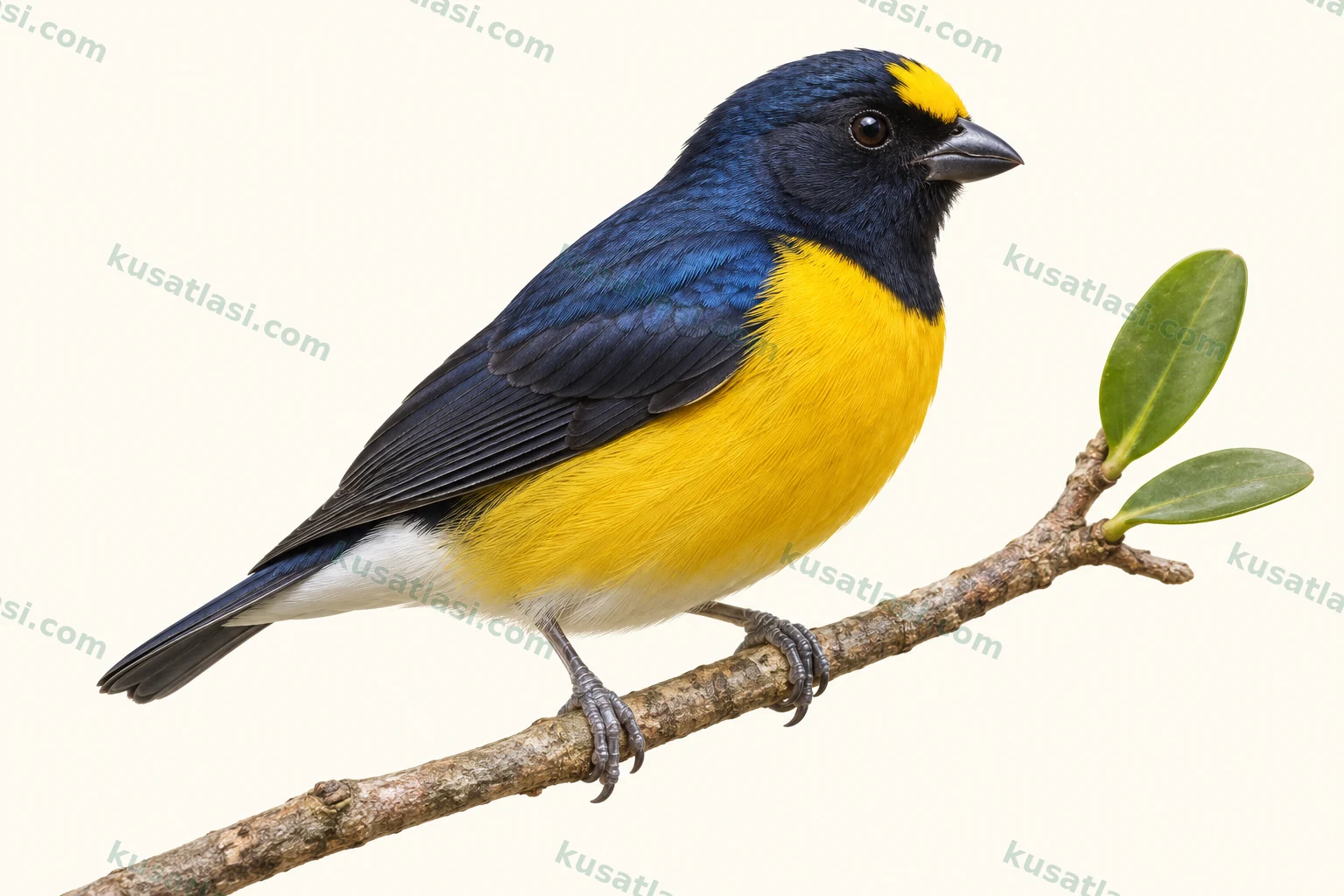
Very small forest songbird; male with dark throat, small yellow forehead and white undertail; female with pale grey throat.
Biometrics
Length
Male9 cm
Female9 cm
Shared species value
Wing length
Male5.14 cm
Female5.14 cm
Shared species value
Weight
Male7.9–11.5 g
Female7.9–11.5 g
Shared species value
White-vented Euphonia
Humid forests of Central America and northern South AmericaObservation guide in its natural range
Look for three features together
Do not rely on a single featureSee the small yellow forehead and dark throat together with the yellow breast.
White is distinctive; Scrub Euphonia has yellow undertail.
Assess pale grey throat, yellowish breast and white undertail together.
Compare male and female
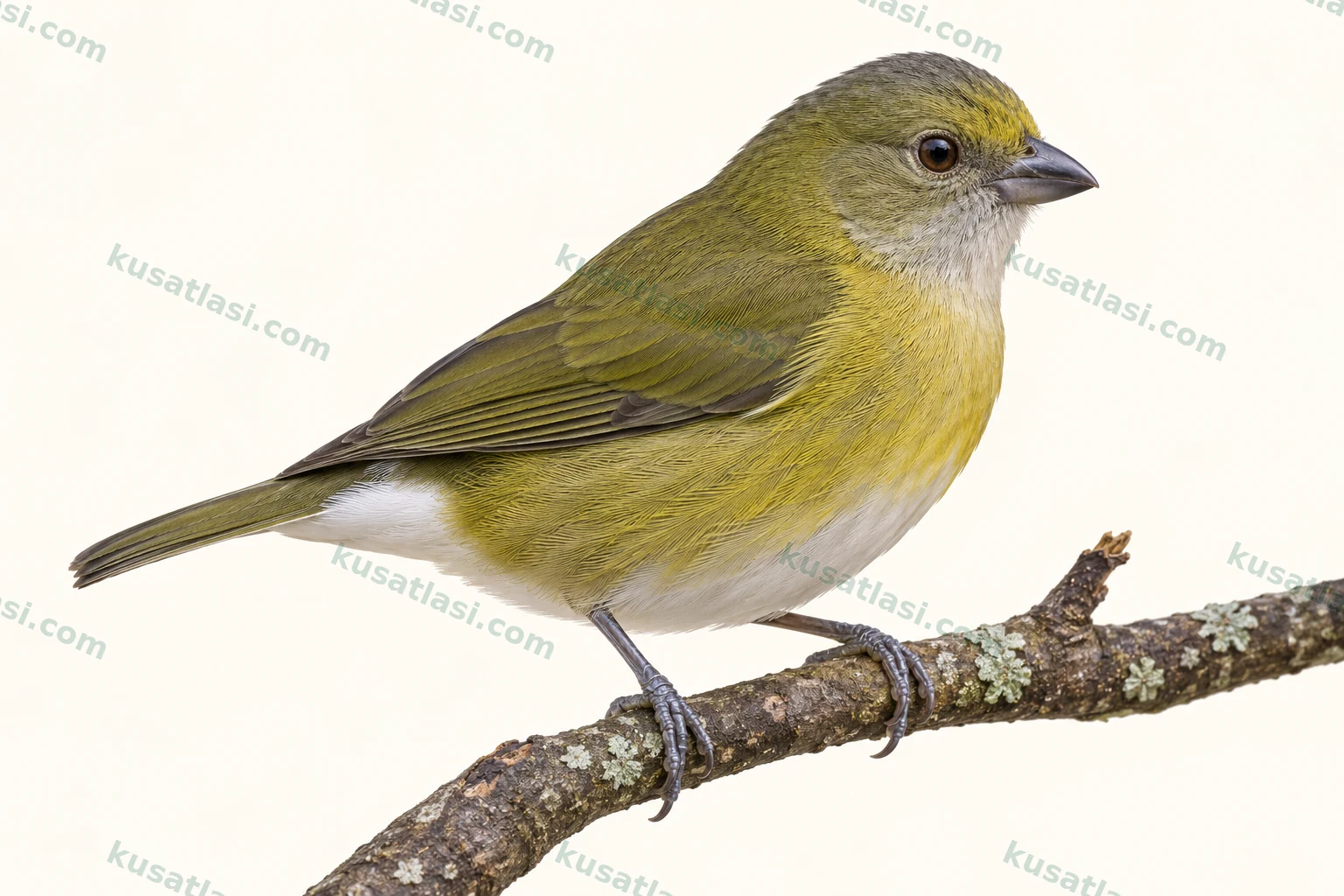 FemaleMale
Male dark-headed with yellow underparts; female pale-grey-throated with yellower breast. No detailed juvenile key was found.
Where to look in its natural range?
Forest canopy, edges and fruiting trees; different humid forest types in Bolivia.
Mainly resident; common exact breeding months throughout the range were not verified. Uses local fruit resources.
All months: Data unavailable
January
February
March
April
May
June
July
August
September
October
November
December
Nest, egg and incubation
Compilation: three eggs, incubation 17 and nestling period 20 days. A comparative publication gives 15–17 and 18–20 days. Nest structure and placement were not sufficiently verified.
A detailed vocal key for certain identification was not verified; view the caller’s head and undertail together.
Do not play recordings to attract birds; observe quietly, especially near nests.
Species information
Quick Identification
The White-vented Euphonia Euphonia minuta is a very small songbird of humid Central and South American forests. Identify the adult male by its dark head and throat, small yellow forehead patch, yellow breast and white undertail together. The female is duller, with a pale grey throat contrasting with a yellower breast; the white undertail remains important.
The undertail can be hard to see on birds high in fruiting trees. As the bird naturally turns its head and body, follow where the pale area begins. The male’s forehead patch is small; the whole head is not expected to be yellow.
General Appearance and Posture
Its small, compact body is an initial clue among thick foliage. The male’s small yellow forehead patch is not as extensive as the broad yellow underparts. The head may appear almost entirely dark in shade while the breast is easier to see.
The Bolivian account describes feeding in and below the canopy, sometimes lower at edges. It also notes sideways tail movements. These can briefly expose the undertail, but the movement itself is not a certain identification mark. If other euphonias share the branches, follow one individual long enough to view head, throat and undertail together.
Males, Females and Young Birds
Adult male and female appearances differ clearly. In the male, dark head and throat contrast sharply with yellow underparts. The female’s pale grey throat is distinguishable from the yellower breast. The Bolivian specialist account particularly emphasizes her yellow breast band. Do not distort this distinction by making the whole breast uniformly grey or adding the male’s yellow forehead patch to the female.
The white undertail is a shared aid when comparing the sexes. A bird lacking the adult male’s strong colours is not automatically a young male; a female may be in the group too. The examined sources provided no detailed developmental plumage profile or reliable key separating young males from females.
Comparative tables in breeding studies report female incubation, a male accompanying her and both parents taking part in visits to young. Seeing a male approach a nest does not show him sitting on eggs. Accompanying, watching and actual incubation are separate behaviours. Visual sex identification and recording nest roles complement each other.
Appearance in Flight
Short flights between trees and fruit clusters can reveal the small body and yellow–dark contrast. Yet the size impression of a flying yellow bird is insufficient. The male’s forehead patch and undertail require the right angle; the female’s paler throat may disappear during a quick passage.
The examined sources yielded no special pattern for certain identification from one wing surface in flight. Failure to see white undertail is not recorded as absence if the area was never visible.
Voice and Behaviour
It may occur alone, paired or in small groups and share fruit with other euphonias. The Bolivian account suggests with a question mark that some groups may be families; not every group is a proven family. Mistletoe-bearing trees help narrow the canopy search. Nevertheless, the bird is not expected to remain at the same tree all day.
No detailed vocal key giving certain separation from other euphonias in every situation was verified here. Where possible, identify the caller in a busy fruiting tree visually. Assess head and underpart patterns with voice; a similar chirp alone does not establish an unseen bird’s sex or age. Watch natural feeding and care instead of playing sound near nests.
Confusable Species
The Scrub Euphonia Euphonia affinis is especially relevant where the ranges overlap. Its undertail is yellow; look for white in the White-vented Euphonia. General similarity in male yellow breasts and dark heads does not remove the need to see the small forehead patch and undertail.
Against the Yellow-throated Euphonia Euphonia hirundinacea, throat colour matters. In White-vented Euphonia, assess the male’s dark throat, or the female’s throat paler than her breast, together with white undertail. Other euphonias’ clutch sizes or incubation periods do not substitute for species identification.
World Distribution
Its natural range follows humid forests from southern Mexico through Central America to northwestern South America and Amazonia. The specialist subspecies account places humilis from Chiapas to northwestern Ecuador and minuta in the Guiana Shield and western and central Amazonia. Country names between these regions do not imply uninterrupted identical forest. The Bolivian account specifically describes a patchy local distribution.
Status in Its Natural Range
The global category is Least Concern. Bolivia’s specialist account reports local situations from rare to uncommon. Scarcity in one country alone does not change a global category; nor does that broad category make local forest loss insignificant. Detecting a small canopy-feeding bird may depend on the forest layer observed and fruit availability.
Migration
Specialist data treat it as mainly resident. Daily or local transfers among fruiting plants do not establish a regular long-distance migration route. Fixed arrival and departure months across the range were not verified. Dated points on a map are not a tracking study showing individuals using the same tree or path; they indicate observed places.
Breeding Habitat
Humid lowland forests and edges are the main settings. The Bolivian account lists unflooded Amazonian forest, seasonal flood forest, transitional forest, humid lower-Yungas forest and semi-humid northern-Chiquitano forest. This shows that it is not tied to one forest structure alone, without making every open agricultural area equally suitable.
Nest Site
Scientific compilations give three eggs, 17 days of incubation and a 20-day nestling period. A later comparative publication reports ranges of 15–17 and 18–20 days. These do not mean that every nest finishes on the same day. This work did not sufficiently independently verify species-specific nest shape, material and placement; a general nest design from other euphonias is not inserted directly.
Daily Habitat Use
It searches for fruit in the canopy and branch layers below, sometimes lower at edges. Small groups at a fruit cluster do not make that tree necessarily a nest tree. Parents arriving together are distinguished from actual incubation or feeding. Do not follow birds to the nest; watch foraging from a distance.
What Does It Eat?
Fruits, particularly mistletoe berries, are main resources. Cornell and the Bolivian specialist account describe this independently. A single general database diet label therefore does not justify portraying it as mainly insect-eating. Mistletoe use does not mean it never eats other fruits. No definite fruit percentage for every season and region was verified.
How Does It Feed?
Feeding is mainly among branches and fruit clusters. It moves through the canopy taking reachable small fruits and may visit lower plants at edges. Sharing fruiting plants with other euphonias does not show identical amounts or simultaneous feeding. Sideways tail movement is assessed separately from actually swallowing fruit.
Seeing a fruit in the mouth and identifying its plant are different tasks. If the plant cannot be identified, record only fruit consumption. To watch natural feeding, observe taking and swallowing in existing trees rather than offering new food or placing fruit near nests.
The White Undertail Is Small but Valuable
If branches hide the marking, wait for a natural turn rather than treating it as absent.
Accompanying Is Not Incubating
The scientific comparative table treats the female on eggs and the male accompanying her as separate roles. A male arriving first does not mean he sits on eggs. Recording the order of visits and actual care matters for understanding breeding. The result is not automatically transferred to males of other species.
A Single Day Count in a Compilation Is Not a Limit
Interpret sources giving one day count and wider ranges together. The account does not average them into a new value. Different durations observed in a neighbouring euphonia’s study are not assigned to this species; check every table’s scientific name. Parental roles must likewise be assessed from observations of the relevant species.