

World Birds IUCN statusAccording to the source taxonGlobal IUCN. BirdLife v10 (2025); taxon matching AviList 2026 / IOC 15.2; checked: 29.10.2026. The list year is not the species’ assessment date. Source and method OrderPasseriformesPasserines FamilyEmberizidaeEmberizidae
Cinnamon-breasted Bunting
Emberiza tahapisi
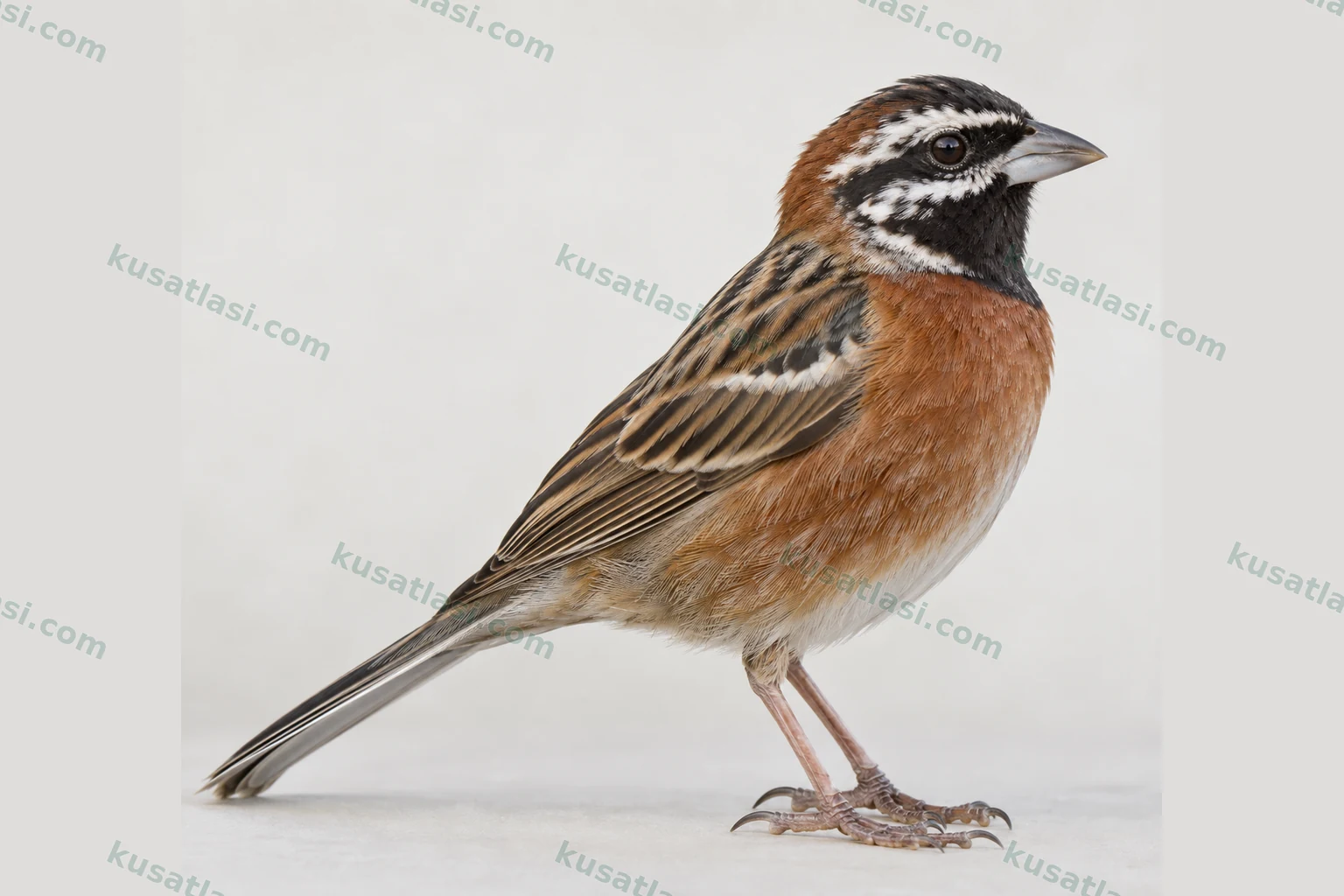
Cinnamon-coloured body, striped head and short, two-coloured bill; a bunting of open stony slopes.
Biometrics
Length
Male13–15 cm
Female13–15 cm
Shared species value
Wing length
Male7.7 cm
Female7.7 cm
Shared species value
Weight
Male11.6–22 g
Female11.6–22 g
Shared species value
Cinnamon-breasted Bunting
Africa’s stony openings, southwestern Arabia and SocotraObservation guide in its natural range
Look for three features together
Do not rely on a single featureRead the central head line, eyebrow and cheek lines separately.
Assess the yellow-orange lower bill together with the cinnamon underparts.
Do not treat the variable throat colour in northeastern Africa as a certain identification mark on its own.
Compare male and female
 FemaleMale
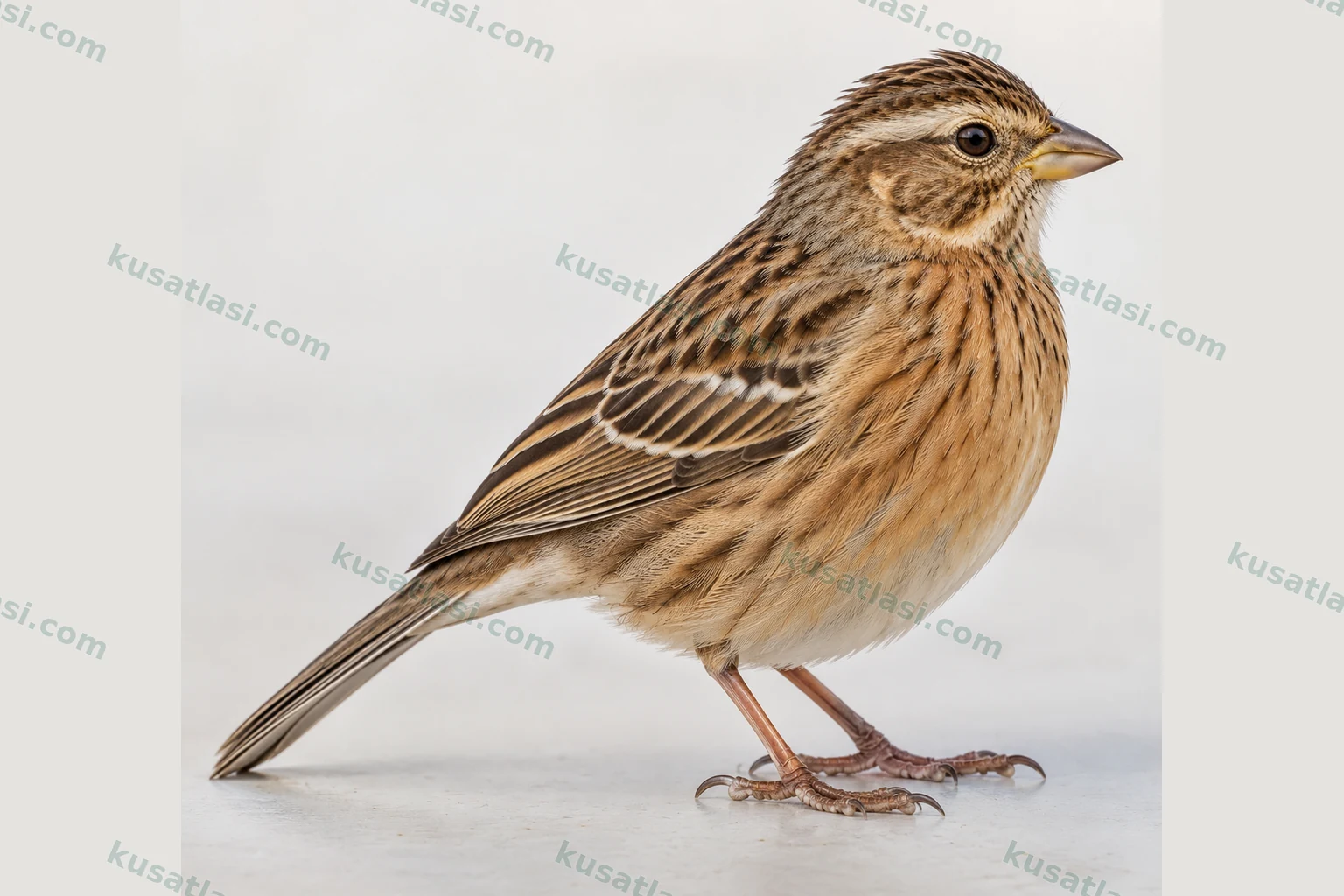
The male’s head is more contrasting, while females and young are paler; regional throat differences are retained.
Where to look in its natural range?
Look on slopes combining bare stony ground, sparse grass and shrubs.
These are regional egg-laying periods from a dated atlas; they are not generalized to the entire range.
January
Residency, seasonal movements and local nomadism vary by region. Transvaal, dated atlas: this is within the egg-laying period, with greater activity in December–March. Zimbabwe, dated atlas: this is within the egg-laying period, with greater activity in January–April.
February
Residency, seasonal movements and local nomadism vary by region. Transvaal, dated atlas: this is within the egg-laying period, with greater activity in December–March. Zimbabwe, dated atlas: this is within the egg-laying period, with greater activity in January–April.
March
Residency, seasonal movements and local nomadism vary by region. Transvaal, dated atlas: this is within the egg-laying period, with greater activity in December–March. Zimbabwe, dated atlas: this is within the egg-laying period, with greater activity in January–April.
April
Residency, seasonal movements and local nomadism vary by region. Transvaal, dated atlas: this is within the egg-laying period, with greater activity in December–March. Zimbabwe, dated atlas: this is within the egg-laying period, with greater activity in January–April.
May
Residency, seasonal movements and local nomadism vary by region. Zimbabwe, dated atlas: this is within the egg-laying period, with greater activity in January–April.
June
Residency, seasonal movements and local nomadism vary by region. Zimbabwe, dated atlas: this is within the egg-laying period, with greater activity in January–April.
July
Residency, seasonal movements and local nomadism vary by region. No verified regional date specific to this month was provided; this does not mean local absence.
August
Residency, seasonal movements and local nomadism vary by region. No verified regional date specific to this month was provided; this does not mean local absence.
September
Residency, seasonal movements and local nomadism vary by region. No verified regional date specific to this month was provided; this does not mean local absence.
October
Residency, seasonal movements and local nomadism vary by region. Transvaal, dated atlas: this is within the egg-laying period, with greater activity in December–March.
November
Residency, seasonal movements and local nomadism vary by region. Transvaal, dated atlas: this is within the egg-laying period, with greater activity in December–March. Zimbabwe, dated atlas: this is within the egg-laying period, with greater activity in January–April.
December
Residency, seasonal movements and local nomadism vary by region. Transvaal, dated atlas: this is within the egg-laying period, with greater activity in December–March. Zimbabwe, dated atlas: this is within the egg-laying period, with greater activity in January–April.
Nest, egg and incubation
The female builds a shallow cup of grass, rootlets and fine twigs, placed at the base of grass or rock, in an earth bank or in a crevice. The regional specialist account gives 2–4 eggs, about 12–14 days of incubation and 14–16 days for the young in the nest; both adults feed the young.
Rapid short notes with a rough or buzzing ending; check the appearance of the bird to confirm which individual is calling.
Do not play recordings to attract birds; observe quietly, especially near nests.
Species information
Quick identification
The Cinnamon-breasted Bunting Emberiza tahapisi is a small bunting to look for in open, stony country. The adult male's black-and-white head stripes, cinnamon underparts and short, thick, seed-cracking bill are striking in combination. Distinguish the fine pale stripe along the centre of the head from the eyebrow and cheek stripes. The female's head is paler, with brownish stripes; lacking the same strong contrast does not prove that she belongs to another species. Assess the colour of the underparts, the two-toned appearance of the bill and the entire head pattern together.
The English name Cinnamon-breasted Bunting refers to this taxon. AviList v2026 gives the scientific name Fringillaria tahapisi; Emberiza tahapisi, used in the sources and catalogue record, is the previous generic combination for the same species. The older southern African atlas calls it Rock Bunting; this should not be confused with Emberiza cia of Europe and Asia. The former broad species concept may also include records of what is now Gosling's Bunting Emberiza goslingi. It would be wrong to assign an old distribution or behaviour statement, particularly one from western Africa, to this species without checking the name. Record locality and the taxonomic concept used are as much part of identification as the head stripes.
General appearance and posture
The pale stripes on the male's dark head extend towards the nape. In the nominate form the throat is dark, and the breast and belly are cinnamon. The upperparts show a brown background, dark feather centres and warm, pale edges. With the wing closed these edges may make the bird look reddish overall; do not conclude that the back is actually uniform. The tail is also brown and may show narrow pale edges. The eye is brown, the upper mandible dark, and the visible part of the lower mandible yellowish orange. Shade falling on the bill may hide its two-toned appearance.
A bird feeding on the ground may disappear among stones and short grasses. When it raises its head, there is a good opportunity to examine bill structure and facial stripes. A bird on top of a rock may look more upright and elongated, while one bending to collect seeds may look smaller. Do not interpret this difference in posture as a difference in body size. A stony clearing is not an identification in itself: Cape Buntings and other small seed-eaters may occur in the same surroundings. Habitat is only a clue to use alongside appearance and sound.
Males, females and young birds
The adult male usually has conspicuous black-and-white head stripes. Grey, brown and cream tones dominate the female's head, and her body may also appear paler. It is difficult to assess how black a head is from a single shaded photograph. Compare the illuminated and shaded sides of the same bird. Assess sex using the head pattern, underparts and overall plumage together; a warm-coloured back alone is not a male character.
Young birds look duller and resemble females; small brown spots may occur on the underparts. Do not expect these spots to look the same at every age. Newly growing feathers and worn adult feathers also create different contrasts. Seeing a food-carrying adult beside a bird may support its being young, but not every bird in a family group is automatically a chick. If the view does not provide enough evidence of age or sex, leaving both uncertain is a more accurate record.
Forms from different parts of the range do not all have exactly the same head and throat colours. Distinguishing grey-throated birds in northeastern Africa from Gosling's Bunting requires particular care. This variation prevents a rule that every Cinnamon-breasted Bunting must have a black throat. Hybridisation proposed to explain intermediate appearances in northeastern Africa is a research hypothesis; a grey throat alone does not prove hybrid ancestry. Record locality and several characters together.
Appearance in flight
Warm brown wing edges and the tail may be visible at take-off, but the head stripes are often harder to read than on the ground. Reddish colour in flight does not identify the species by itself; Cape Bunting also has conspicuously warm wing colouring. Following a bird whose head and underparts were seen at take-off until it lands is more reliable than naming a small passing silhouette. A spreading tail or a flashing feather edge is not used as a new diagnostic character unsupported by the source.
A short flight is not the start of migration. A pair changing feeding sites on the same rocky slope, a small group going to water and an individual dispersing farther away may be making different kinds of movement. Ringing data from South Africa have demonstrated long-distance displacement, but the same annual journey cannot be drawn for every individual. Flight direction, date and landing place can be added to the observation. Flying north for a moment does not prove that the bird will breed to the north or use the same route every year.
Voice and behaviour
A song of rapidly delivered short notes, sometimes ending roughly or with a buzz, may reveal the bird. Look for the singing individual on a rock, shrub or exposed branch. Do not expect precisely the same sequence of syllables throughout the range; a brief human rendering is only a rough approximation of the real sound. When other buntings are nearby, linking the sound to a bird actually seen is especially important. Record calls and longer songs separately; do not rely on a single brief sound to establish the species with certainty.
The birds may occur in pairs, small family groups or small gatherings. Larger concentrations have also been recorded in some areas. These differences make it difficult to give every observed group the same social explanation. Birds gathering to drink do not necessarily have adjacent nests. A breeding male singing from the same rock demonstrates use of the area, not that the nest is directly beneath that rock. Do not follow the bird into grassy cover to find its nest.
Similar species
Cape Bunting Emberiza capensis may occur in similar stony places. Its head stripes and warm wings create an initial resemblance; greyer underparts, a pale throat and the details of the head pattern matter. Consider the Cinnamon-breasted Bunting's cinnamon body, yellow-orange lower mandible and pale central head stripe together. If only a reddish wing is seen at a distance, it may not be possible to separate the two reliably.
The male Gosling's Bunting Emberiza goslingi has a paler grey throat; warm wing colour also helps the comparison. However, because throat appearance varies in northeastern Africa, do not reach a firm conclusion from that colour alone. The less contrasting heads of females and the dull appearance of young birds make separation harder. Check which present-day species concept an old record used, its geography and the entire head-and-body pattern together.
Global distribution
It occurs in suitable open, stony areas of eastern and southern Africa, and in westward extensions such as Angola and Gabon. The eastern half of South Africa, Lesotho, Zimbabwe and neighbouring regions are important parts of the range. The current taxonomic concept does not include every western African record published under the same name in older sources. Do not transfer a country list made before Gosling's Bunting was split unchanged to the new species boundary. Occurrence in a country also does not mean that it inhabits every part of that country.
Southwestern Arabia and Oman's Dhofar region belong to the natural range. OSME's regional taxonomic list also treats the birds on Socotra as Emberiza tahapisi. Looking only at continental Africa would therefore leave part of the natural range out. Occurrence on Socotra does not mean that the species is endemic to that island; nor should another bunting there be assumed to be its island form. Coastlines, mountains and the distribution of dry clearings help in considering where suitable habitat is interrupted.
Status within its natural range
Rocky slopes and stony clearings stand out in the southern African atlas; very extensive sandy deserts and some coastal areas are not used to the same extent. Aridity alone does not make a place suitable habitat: stones, open feeding ground, sparse cover and access to water need to be considered together. It may be locally common or scarce. Converting a country record into a continent-wide measure of abundance is misleading, particularly when old and current species limits differ.
Movements and migration
Resident populations, seasonally moving birds and drought-related movements all occur. The dated southern African atlas associates lower winter reporting rates in some eastern areas with possible northward movement; it does not claim regular annual migration by every individual. A bird ringed in Northern Cape and later recovered in Zimbabwe confirms long displacement, but one recovery is not a complete migration route. Local detectability may also change as rainfall, surface water and seed resources vary; monthly records should be read separately from evidence of breeding and migration.
Breeding habitat
Rocky ridges, eroded stony slopes and gullies may be suitable where sparse shrubs or trees grow nearby. The species is not confined to pristine mountains; disused quarries and excavation pits also appear in specialist accounts. These records do not mean that every new excavation benefits the bird. Natural food and cover for concealment are needed alongside open ground. The same months of seasonal breeding in South Africa's summer-rainfall regions cannot be applied throughout Arabia and eastern Africa.
Nest site
The female builds a shallow cup of grasses, fine twigs and rootlets, lined with finer material. The nest may be in a hollow at the base of a grass tussock or rock, in an earth bank or in a rock crevice. Regional specialist accounts report 2–4 eggs and an incubation period of about 12–14 days (specialist information for Cinnamon-breasted Bunting). Descriptions of participation in incubation vary by source and region; seeing both sexes at a nest does not prove that care is shared equally. Keep your distance from the nesting rock and grass tussock.
Daily use of the area
Feeding ground, an elevated song post and a drinking site fulfil different functions within the same small area. Young birds that have left the nest may continue to beg from adults for a time. The regional account's 14–16-day nestling period does not mean that all young become independent on the same day. Observe without trampling grassy ground cover, opening gaps between rocks or preventing nearby birds from reaching water. Protecting a song post alone does not protect the entire feeding and nesting surroundings.
What does it eat?
Seeds of grasses and other herbaceous plants are among its main foods. Insects, small beetles and winged termites have also been recorded. Regional specialist accounts report that young are fed seeds and insects. The presence of these two food groups does not establish a constant proportion throughout the year. Cracking a seed husk and swallowing a small insect are different feeding events; do not count every downward bill movement as the same food. Do not identify an item carried to a chick unless it is clearly seen.
How does it find food?
It usually collects food on bare or sparsely covered ground between rocks and may take seeds from low grasses. It is also reported to catch winged termites in short flights. It would therefore be wrong to describe it as a bird that eats only seeds and never takes animal food. Equally, a record of catching a termite does not show that aerial hunting is the dominant method every day. Watching both where it stands and what it swallows while feeding from a grass seed head is informative.
Finding it on burnt or open ground does not prove that fire is beneficial at every scale. While open ground changes access to food, it may also remove nesting and hiding cover. Feeding observations should be made under natural conditions; attracting birds with bait changes those conditions. Because the birds need to drink regularly, drying surface waters may affect their use of the area. The number visiting water should not be taken as the number of all breeding pairs nearby.
Reading old names correctly
Finding Rock Bunting in an old publication does not necessarily mean the text concerns Emberiza cia. The southern African atlas used that name for Emberiza tahapisi. Reading the scientific name alongside the publication's geography resolves confusion caused by similar English names. Species limits have also changed: today's Gosling's Bunting was once included in the same broad species. To retain the value of an old study, check which birds were sampled; a name change does not make the research worthless, but changes the scope to which it applies.
A genetic study published in 2013 examined species limits in the brown buntings using mitochondrial and nuclear DNA data. A sample in a phylogenetic tree does not represent every individual across an entire continent. Limited sampling and intermediate appearances, particularly in northeastern Africa, call for careful assessment rather than a fixed colour formula. A proposed hybridisation explanation and a directly demonstrated genetic relationship are not the same level of evidence. An individual's genetic ancestry cannot be determined from a head photograph alone.
What does a ringing recovery tell us?
A bird ringed in South Africa's Northern Cape was recovered in Zimbabwe about ten months later. The atlas reports 1,037 km between the two recording locations; this is not the bird's entire actual journey. These two records cannot show which valleys it passed through, how often it stopped or whether it followed the same route the next year. Nevertheless, it is valuable evidence from an individual showing that the birds are not confined to a single rocky site.
Breeding months do not form a single calendar
Dated egg-laying records from Transvaal cover October–April, especially December–March; Zimbabwe records cover November–June, especially January–April. The source separates these periods by region. Seeing young at a site does not mean eggs were laid that day; the nestling period and subsequent care intervene. Giving wet and dry areas the same calendar colour conceals this difference. Reading the calendar alongside the conditions of the region to be visited and the type of record is more useful.
Rocky habitat may make a bird easy to see from a distance, whereas a feeding female or young bird may be difficult to pick out among stones. Not hearing song does not demonstrate absence either. Visiting the same area on different dates and noting water and vegetation conditions is more informative than a single visit. Repeated observations that leave the nest surroundings unchanged put less pressure on the birds and make records easier to compare.