

World Birds IUCN statusVU · VulnerableGlobal IUCN category. BirdLife v10 (2025); taxon matching: AviList 2026 / IOC 15.2; checked: 29.10.2026. The list year is not the species assessment date. Source and method · BirdLife OrderAnseriformesWaterfowl FamilyAnatidaeAnatidae
White-headed Steamer-Duck
Tachyeres leucocephalus
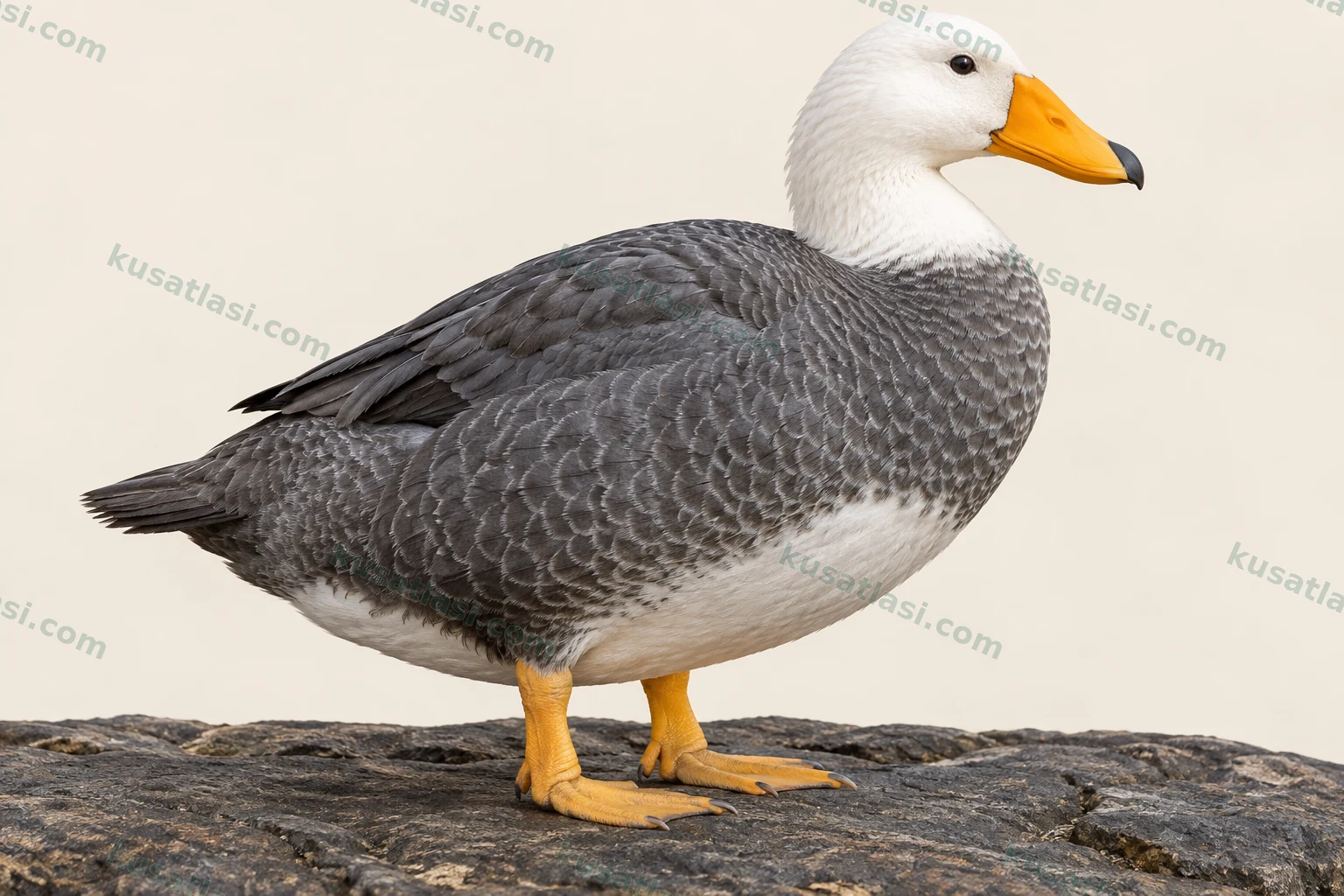
A large, flightless sea duck tied to Patagonia’s Atlantic coast; in the adult male, the pale head, heavy body and thick bill stand out together.
Biometrics
Length
Male61–74 cm
Female61–74 cm
Shared species value
Wing length
Male28.15 cm
Female27.28 cm
Weight
Male2.6–4.4 kg
Female2.45–3.55 kg
White-headed Steamer-Duck
Argentina; Atlantic coast of Chubut and Santa CruzObservation guide in its natural range
Look for three features together
Do not rely on a single featureLarge body, short wings and thick bill.
Particularly pale head, grey body and white belly.
Rapid progress on the water using wings and feet; no ordinary flight.
Compare male and female
 FemaleMale
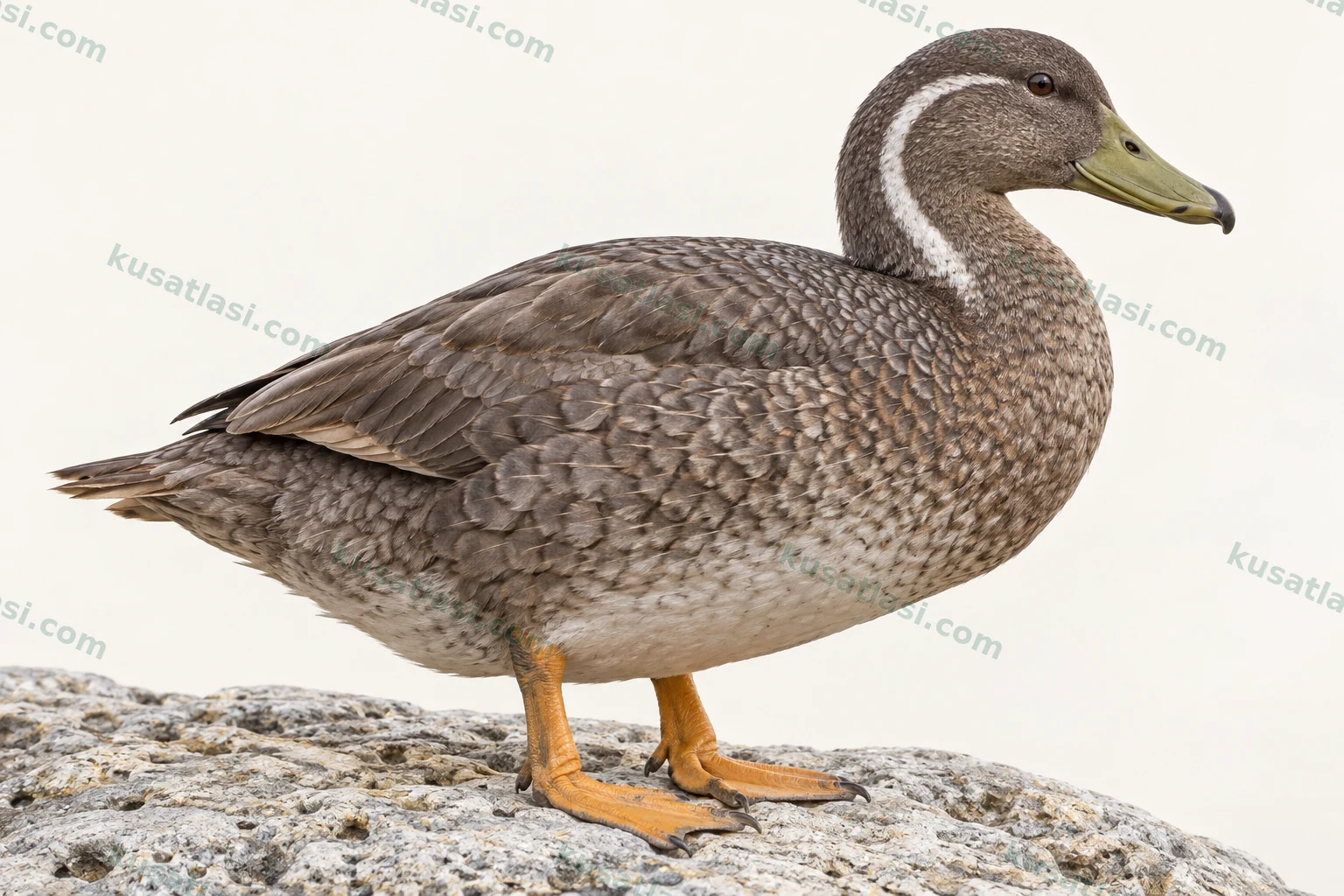
The adult male’s pale head is useful; females and young are identified with certainty through species-specific features seen at close range. A sex’s role is not established from its position at one instant.
Where to look in its natural range?
Rocky shores, coastal islands, sheltered bays and shallow feeding waters.
The regional breeding season from studies in the northern Gulf of San Jorge. The same dates do not necessarily apply along the whole coast.
January
It is a resident tied to the coast; no shared long-distance migration route was verified. No verified regional date specific to this month was given; this does not mean local absence.
February
It is a resident tied to the coast; no shared long-distance migration route was verified. No verified regional date specific to this month was given; this does not mean local absence.
March
It is a resident tied to the coast; no shared long-distance migration route was verified. No verified regional date specific to this month was given; this does not mean local absence.
April
It is a resident tied to the coast; no shared long-distance migration route was verified. No verified regional date specific to this month was given; this does not mean local absence.
May
It is a resident tied to the coast; no shared long-distance migration route was verified. No verified regional date specific to this month was given; this does not mean local absence.
June
It is a resident tied to the coast; no shared long-distance migration route was verified. No verified regional date specific to this month was given; this does not mean local absence.
July
It is a resident tied to the coast; no shared long-distance migration route was verified. No verified regional date specific to this month was given; this does not mean local absence.
August
It is a resident tied to the coast; no shared long-distance migration route was verified. No verified regional date specific to this month was given; this does not mean local absence.
September
It is a resident tied to the coast; no shared long-distance migration route was verified. Northern Gulf of San Jorge: months of egg laying and incubation followed in the 2015, 2016 and 2018 studies.
October
It is a resident tied to the coast; no shared long-distance migration route was verified. Northern Gulf of San Jorge: months of egg laying and incubation followed in the 2015, 2016 and 2018 studies.
November
It is a resident tied to the coast; no shared long-distance migration route was verified. Northern Gulf of San Jorge: months of egg laying and incubation followed in the 2015, 2016 and 2018 studies.
December
It is a resident tied to the coast; no shared long-distance migration route was verified. Northern Gulf of San Jorge: months of egg laying and incubation followed in the 2015, 2016 and 2018 studies.
Nest, egg and incubation
The nest is on the ground, protected by vegetation; typically 4–6 eggs, with 3–9 in the original 2023 sample. The female incubates; the same study gives a mean of about 34 days and an observed range of 21–44 days. The flightless young’s total time to independence was not directly verified here.
A detailed species-specific vocal description was not verified in the direct sources consulted.
Do not play recordings to attract birds; observe quietly, especially near nests.
Species information
Quick identification
White-headed Steamer-Duck Tachyeres leucocephalus is a large, flightless sea duck of Argentina’s Patagonian coast. Particularly in the adult male, the pale head, thick bill, heavy body and short wings stand out together. The grey body and white belly are assessed alongside the head’s pale appearance at a distance. Not every pale-headed duck on a rocky shore belongs to this species; similar steamer ducks can occur nearby.
When moving rapidly at sea, it uses its wings as well as its feet, producing the surface movement suggested by its name. Flapping on the water does not mean it has taken flight. Forcing a bird to fly must not be used as an identification method. Feeding near the shore, body proportions and the structure of the head and bill at close range provide more useful information.
General appearance and posture
Its body is full, and its neck and bill look stronger than those of the similar flying steamer duck. The short wing occupies a small part of the body’s outline. Its tail also looks shorter than that of its flying relative. An alert posture, with the neck extended and back raised, makes these proportions easier to see; the neck of a bird swimming low in the water can look misleadingly short.
The adult male’s very pale head is a strong feature against the grey body. The British Waterfowl Association emphasises how particularly pale-headed the male is among species of the same genus. Nevertheless, at a distance it is not always possible to tell whether a bright head is truly white or very pale grey. The bulky body and thick bill should also be recorded on the same individual.
It walks on the shore, searches for food in shallow water and travels across the water. Moving between rocks and water allows its posture on land and in the water to be observed. The heavy appearance of a bird on a rock is not simply an estimate of its weight; fluffed feathers, a drawn-in neck and the viewing angle change its silhouette.
Males, females and young birds
The adult male’s pale head is useful for identification, but all sexes and ages are not reduced to the same appearance. Researchers conducting the original coastal census examined the plumage of breeding females and young separately to prevent confusion with the flying steamer duck. Assigning the sex of an uncertain individual from bulk alone is unreliable; a brief view may not reveal the bird’s age either.
Female incubation is documented in direct research on this species. During this time the male uses the shallow water in front of the nest and its surroundings. This division of roles does not mean that every behaviour seen each day is performed by only one sex. The sex of an adult standing alone beside a nest is not established from its position alone; continuity of behaviour and recognition of the individual matter.
The young have greyish down. Non-breeding young can occur in groups; use of the same coastal points over several years does not prove that the same individuals remained there. Researchers could not recognise members of unmarked groups individually between years. Group size is not substituted for the number of eggs in a nest either; several families may gather together.
Appearance in flight
An ordinary account of aerial flight is not given for this species: it is a flightless sea duck. It uses its wings while moving on the water’s surface. The resulting rapid, bounding progress should not be confused with the impression that its wings are useless. Flightlessness does not mean that a wing has lost all its functions in movement.
Because Flying Steamer-Duck Tachyeres patachonicus can occur nearby, a steamer duck in the air is not automatically entered as the same species as White-headed Steamer-Ducks on the ground. Nor is every individual of the flying species expected to fly during every observation. An uncertain bird remaining on the water is not proved to be a White-headed Steamer-Duck solely because it does not fly.
Voice and behaviour
Pairs show conspicuous territorial defence; feeding areas near the coast can be defended against other birds. The British Waterfowl Association describes long-lasting pair bonds and grouping among non-breeding birds. Seeing many pairs around one island does not mean that all share a nest or form a single social family. Nest density and the area defended by pairs are different matters.
An incubating female does not spend the whole day on the nest without leaving. A study of the northern Gulf of San Jorge published in 2023 measured night-time recesses and returns towards dawn. The relationship of this pattern to egg predators active by day is the researchers’ explanation; it is not presented as a sole cause proved by a direct experiment. No reliable, comprehensive description of this species’ detailed vocal repertoire was verified here; the voice of another duck is not transferred to it.
Species that may be confused
Flying Steamer-Duck Tachyeres patachonicus looks thinner-necked, longer-winged and longer-tailed, with a less thick bill. The two species can occur in small mixed groups. At close range, body proportions, head and bill are assessed together; being on the shore alone does not distinguish them. An uncertain female or young bird should not be recorded with a definite species name before reliable details have been seen.
Other seabirds and ducks with young may occur on the same shore. The presence of an adult beside young helps follow family relationships, but neighbouring pairs can approach one another. Avoid combining the head, body and young of separate individuals in a photograph as though they were characteristics of one bird. Identification uses the whole set of features seen on the same individual.
World distribution
It is endemic to Argentina, associated with Chubut and Santa Cruz on Patagonia’s Atlantic coast. Rocky shores, coastal islands and sheltered bays are used. The northern Gulf of San Jorge is an important study area for direct research on distribution and breeding. Neither the whole country nor all of Patagonia’s inland lakes are presented as its natural habitat.
Status within its natural range
Its global conservation category is Vulnerable. A coastal study published in 2012 showed that the ducks did not occur at equal density along every stretch of coast. Bahía Melo, Camarones and Bustamante were important concentrations in the study. Population calculations for uncounted shores are not a current result in which every individual was counted directly.
Oil pollution, changes to coastal habitat and human pressure matter for a sea duck with a narrow range. Drawing a protected-area boundary does not automatically remove all these risks. Retaining the dates of studies prevents an old coastal density from being presented as an unchanging value today. The coastal marine area on the map is not a guarantee of birds permanently occupying every bay either.
Movements
It has a resident life tied to the coast; no verified shared long-distance migration route is available. Groups of non-breeders and movements along the coast do not require an intercontinental migration line. Observation points are kept separate from breeding islands. A single record on a shore does not mean that a nest occurs in that bay or that the species remains at the same point all year.
Breeding habitat
Islands and small islets near rocky shores are important nesting places. Sheltered shallow water, coastal plants and the nest site on land can form the surroundings used by one pair. Differences in density between islands and mainland shores were found in the northern Gulf of San Jorge. This local result does not show that all islands lack predators or that every island has equal value.
Nest site
The nest on the ground can be made from grass, small twigs and pieces of coastal plants; shrub cover provides protection. The specialist review gives a typical 4–6 eggs. Examples in the 2023 study contained 3–9 eggs; these different scopes are clearly distinguished. The female incubates. The same study reported a mean of about 34 days and an observed range of 21–44 days; these are not a compulsory single duration for every nest.
Daily use of space
Shallow water near the coast and feeding surfaces exposed by the tide are used. A female going to sea during a nest recess has not necessarily abandoned incubation. Approaching the nest, cutting across a pair’s path by boat or separating young from an adult disrupts observation. Watching through binoculars from land allows natural use of the area to be seen.
What it eats
Molluscs and crustaceans are the main documented foods. In the original study of the northern Gulf of San Jorge, female droppings were examined and fragments of crabs, mussels and marine annelid worms were found. Preservation of hard parts in droppings can make soft prey appear less important than they are. Record frequency is therefore not described directly as a percentage of annual food weight.
How it feeds
It can take food in shallow water near the shore by putting its bill, head and neck into the water; it also dives completely. Among females followed during the 2007 breeding season, dipping the head and neck was the most frequently used technique. This does not show that the same share of time applies in all seasons or in males. The same bird can switch techniques under different conditions of depth and prey.
The study compared small-animal communities on coastal surfaces used for feeding with those on unused surfaces. Prey availability, water level and shore structure matter together. Seeing many mussels does not mean that the bird eats only mussels. If underwater prey cannot be seen during a feeding observation, its species is not guessed and entered as a definite food record.
A flightless bird’s wing still moves
A steamer duck can move rapidly across the water using wings and feet together. This shows the limits of thinking that wings are useful only for flight through the air. Movement on the water and true flight are observed separately; a brief rise of the body amid splashes is not recorded as sustained aerial flight.
Many pairs do not mean one shared nest
On suitable islands, nests can lie relatively close together. Nevertheless, pairs defend their own surroundings. An island’s limited nesting space may contribute to birds being close to one another. Density and social cooperation are not the same characteristic; nesting side by side alone does not prove communal feeding of young.
The counting method affects the result
In the original distribution study, counts made by boat and from land did not give the same results. Assessing differences in visibility, researchers applied a correction to some groups. This explains why the number of birds seen on one coastal walk cannot be converted directly into the whole population. Counted birds, an adjusted estimate and a calculation for uncounted surroundings are different kinds of information.
A nest recess is also part of incubation
A female briefly leaving her eggs can be part of natural care. Direct monitoring showed that night-time recesses ended towards dawn. An observer who decides a nest has been abandoned on seeing it empty at one moment may reach the wrong conclusion. Even so, touching eggs to check an empty nest or waiting on the bird’s return path is inappropriate.
The date of an old estimate is retained
The narrow coastal range makes conservation research especially important. Old population calculations provide a baseline for comparison; they do not replace a current census. Seeing the same groups at the same coastal point over several years does not measure the lifespans of unmarked individuals either. Population change and an individual’s life history require different research.