

World Birds IUCN statusLC · Least ConcernGlobal IUCN category. BirdLife v10 (2025); taxon matching: AviList 2026 / IOC 15.2; checked: 29.10.2026. The list year is not the species assessment date. Source and method · BirdLife OrderPasseriformesPasserines FamilyPasserellidaePasserellidae
White-throated Sparrow
Zonotrichia albicollis
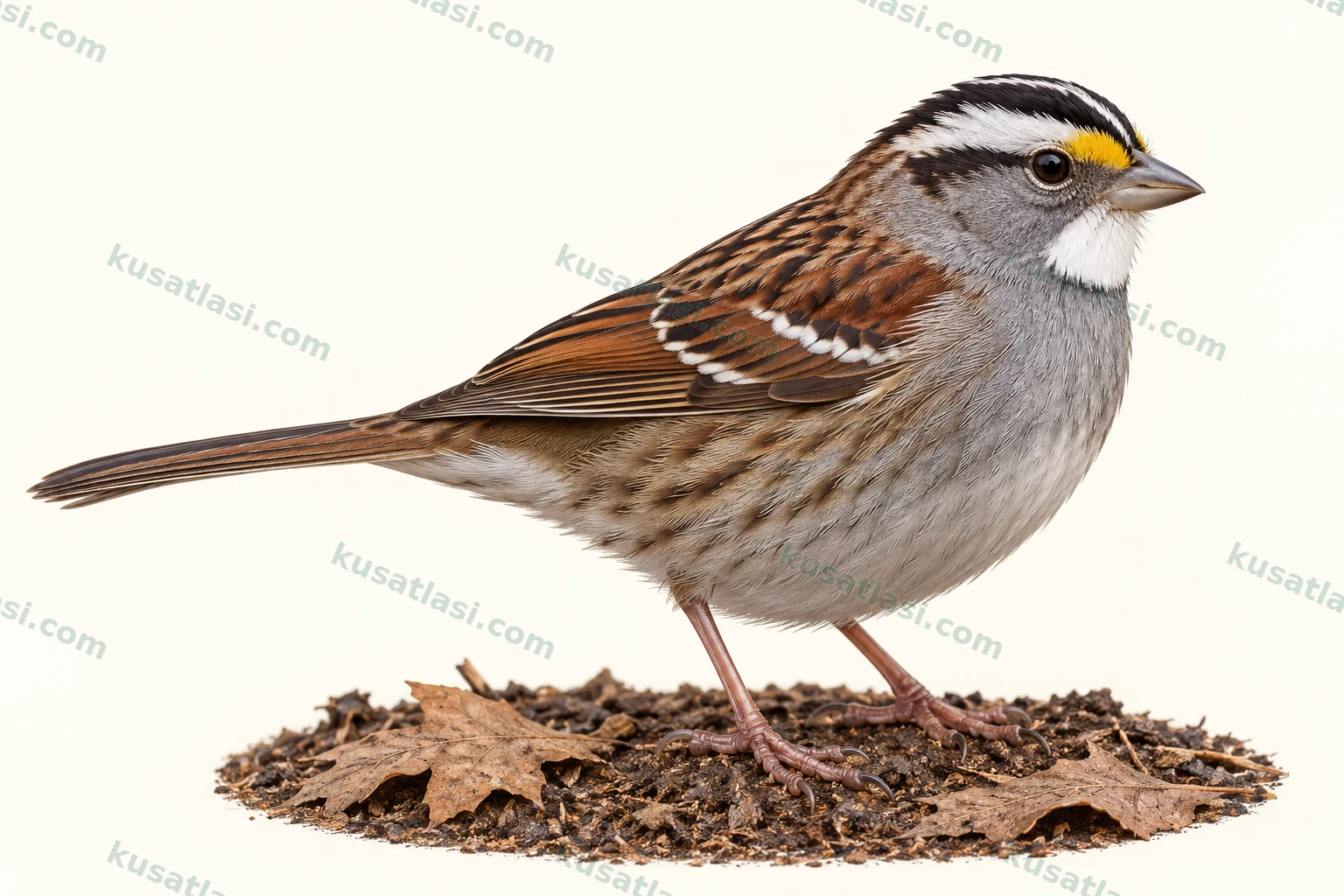
Look for a white throat, a yellow patch in front of the eye and a dark bill. The two colour forms of the head stripes do not indicate sex.
Biometrics
Length
Male15–17 cm
Female15–17 cm
Shared species value
Wingspan
Male20–23 cm
Female20–23 cm
Shared species value
Weight
Male23–36.1 g
Female20–31.4 g
White-throated Sparrow
North American forests and wintering habitats farther southObservation guide in its natural range
Look for three features together
Do not rely on a single featureCheck that the yellow patch is in front of the eye, and look for the white throat.
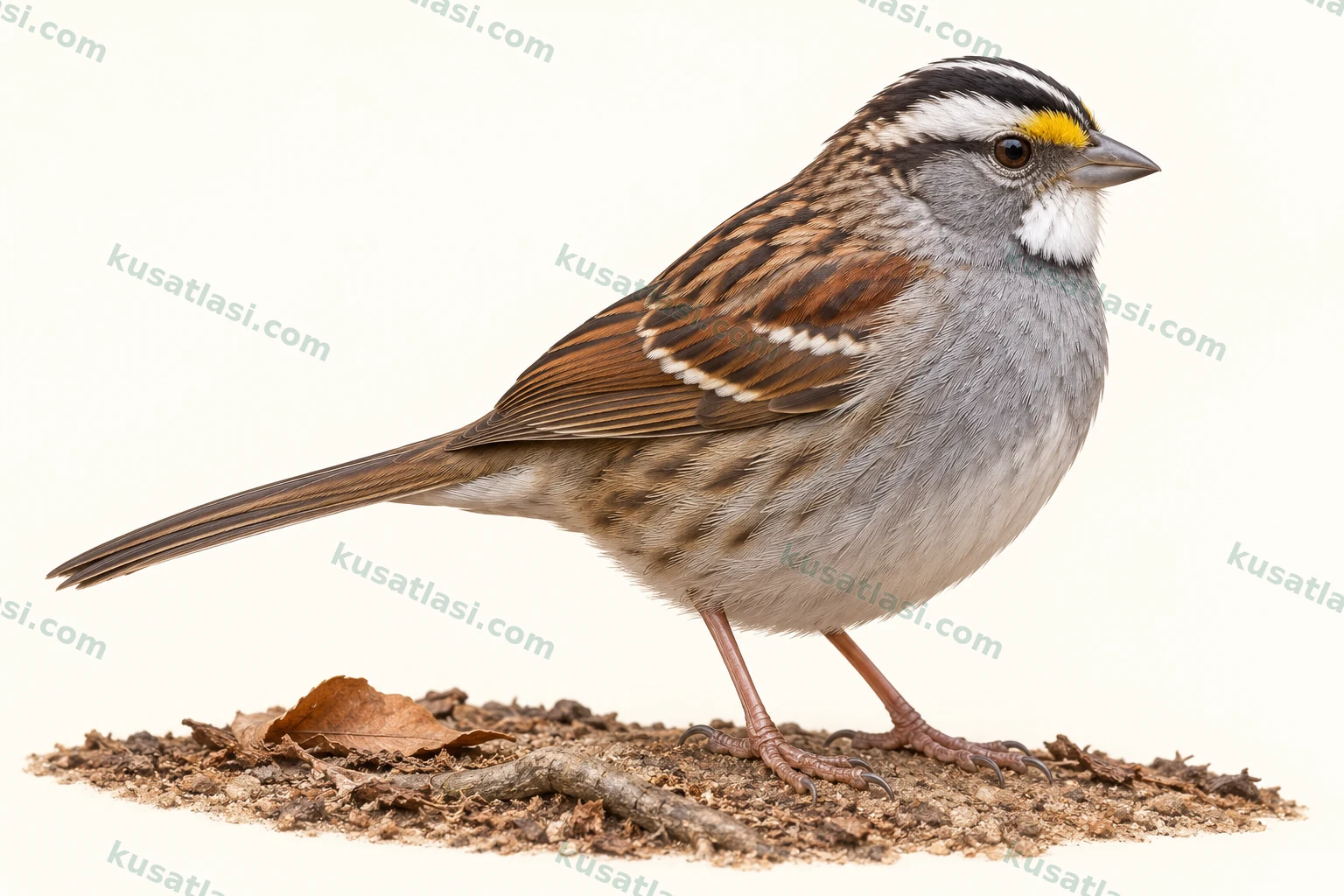
The white or tan stripes do not indicate a different species or sex.
It feeds on the ground, scratching leaves backwards with both feet.
Compare male and female
 FemaleMale
Both males and females occur in both colour forms. Do not identify the white-striped form as male or the paler form as female.
Where to look in its natural range?
Watch beneath shrubs and in leaf litter along woodland edges.
In North America, the birds return in spring, breed from May to August and move south in autumn. Timing varies by region.
January
The species migrates. The calendar shows the seasons in its native North America. No verified regional date was given for this month. This does not imply local absence.
February
The species migrates. The calendar shows the seasons in its native North America. No verified regional date was given for this month. This does not imply local absence.
March
The species migrates. The calendar shows the seasons in its native North America. No verified regional date was given for this month. This does not imply local absence.
April
The species migrates. The calendar shows the seasons in its native North America. No verified regional date was given for this month. This does not imply local absence.
May
The species migrates. The calendar shows the seasons in its native North America. Breeding period reported in North America.
June
The species migrates. The calendar shows the seasons in its native North America. Breeding period reported in North America.
July
The species migrates. The calendar shows the seasons in its native North America. Breeding period reported in North America.
August
The species migrates. The calendar shows the seasons in its native North America. Breeding period reported in North America.
September
The species migrates. The calendar shows the seasons in its native North America. Southward passage in autumn, with timing that varies by region.
October
The species migrates. The calendar shows the seasons in its native North America. Southward passage in autumn, with timing that varies by region.
November
The species migrates. The calendar shows the seasons in its native North America. Southward passage in autumn, with timing that varies by region.
December
The species migrates. The calendar shows the seasons in its native North America. No verified regional date was given for this month. This does not imply local absence.
Nest, egg and incubation
It builds a cup nest on or low above the ground, concealed by vegetation. The typical clutch is 3–5 eggs. Cornell gives an overall range of 1–6. Incubation lasts 11–14 days, and the young stay in the nest for 7–12 days.
The song is clearly whistled. The repeated endings can have three or two notes. Short calls differ from the song.
Do not play recordings to attract birds. Observe quietly, especially near nests.
Species information
Quick identification
The White-throated Sparrow Zonotrichia albicollis is a North American songbird of wooded and shrubby habitats. Look for the white throat, the yellow patch in front of the eye, the striped head and the dark bill together. The back is brown with dark streaks, and the breast is generally grey. The Turkish word for sparrow in its name does not place it in the same family as the House Sparrow. Current classifications place it in Passerellidae. Seeing the pale throat and yellow facial marking at the same time is more useful than looking at the striped head alone.
The head stripes can be white or tan. These are two colour morphs of the same species, and both males and females occur in each. White-striped birds can show a sharper black-and-white contrast, while tan-striped birds have softer brown tones on the head. The throat and yellow patch in front of the eye help identify both morphs. A less conspicuous bird should not be called a juvenile or a female on the strength of its colour alone.
General appearance and posture
Examine the central crown stripe, the stripes beside it and the eyebrow separately. The dark crown stripes are more prominent in the white-striped morph. The tan-striped morph has a similar pattern with less contrast. A dark line at the lower edge of the white throat can accentuate the transition to the grey breast. The belly is paler. The tail and wings show shades of brown, the legs are pinkish and the bill is dark. Sunlight can brighten the head stripes without changing the morph. Check the colour from more than one angle on the same bird.
When feeding on the ground, it usually moves by hopping. Watch for the bird to scratch leaves backward with both feet and return to the newly exposed spot. The movement can briefly conceal the head and breast. The facial markings are easier to see when the bird straightens up. A glimpse of a brown back beneath a shrub is insufficient for identification. Other sparrow-like birds can join the same flock, so check the head of each individual.
Males, females and young birds
Both sexes occur in the white-striped and tan-striped morphs. Genetic research links the morphs to different arrangements on the second chromosome. Colour alone does not indicate a bird’s biological sex. Two birds of the same colour need not both be male or both be female. Plumage colour is associated with behavioural tendencies, but it does not establish what an individual will do at a particular moment.
First-year birds can show stronger streaking on the breast and flanks. Their yellow facial patch and throat pattern may be less distinct than in adults. An adult of the tan-striped morph can also look pale in shade. To assess age, look at the entire underside, the head pattern and the condition of the feathers together. A dark-looking breast or a yellow patch that cannot be seen in one photograph is insufficient to establish that a bird is young. When watching a recently fledged bird, record food-begging and interactions with its parents separately.
Appearance in flight
In short flights between shrubs and neighbouring branches, the brown wings, body and tail pass quickly. The head markings can be hard to see. If a bird darts into a shrub with rapid wingbeats, wait for it to perch again. This is more reliable than looking for a white throat in a flight image. The outline in flight alone does not reliably separate the White-throated Sparrow from other North American sparrows.
The species also migrates at night, but a short flight in daylight is not necessarily a migratory movement. Moving among a few shrubs while feeding and travelling between countries with the seasons are movements on different scales. A straight line between observation points on a map may not match the route an individual took. Use flight observations alongside the head stripes, yellow facial patch, white throat and natural range.
Voice and behaviour
The song begins with clear, whistled notes and continues with repeated short groups of notes. Older identification accounts emphasise three-note endings. Original research showed that a two-note ending could spread across Canada. A genuine song need not match one mnemonic phrase or contain a fixed number of notes. Calls can be shorter and drier than the song. Do not attribute every short call within a flock to this species.
Outside the breeding season, it can form mixed flocks with other sparrow-like birds. Several birds turning over leaves on the ground may belong to different species. Territorial defence in the breeding season differs from feeding together in winter. Behavioural differences found between morphs do not mean that every white-striped bird will dominate every tan-striped bird. Record the individual’s behaviour, colour and surroundings separately.
Similar species
1. Zonotrichia leucophrys can look similar because of its striped head. Check the White-throated Sparrow for the yellow patch in front of the eye, a distinct white throat and a dark bill together. Black-and-white head stripes alone are insufficient. Compare young and pale individuals as well. Both species can occur in the same flock, which makes it especially important to check the markings on each bird.
2. When comparing it with Zonotrichia atricapilla, check the colours in the centre of the crown, the yellow patch in front of the eye and the throat. The position of the yellow on the head is more distinctive than the mere presence of yellow. Pale plumage at different times of year and age differences can make identification harder. A similar size does not resolve an uncertain sighting.
3. Breast streaking may be the first feature noticed on small streaked birds such as Melospiza melodia. Young White-throated Sparrows can also be streaked, so that feature alone is insufficient. Examine the facial pattern, yellow patch, throat and bill together. If only the back can be seen beneath the leaves, wait for the bird to come into view again before identifying it.
World distribution
The natural range is in North America. Breeding extends across the broad Canadian forest belt and into suitable forests in the northeastern and northern United States. Some mountain forests farther south also form part of the breeding range. Much of the population winters farther south, especially in the eastern and southern United States, with smaller western wintering areas considered separately. National borders do not divide breeding and wintering areas into two entirely distinct blocks.
Status in the natural range
During breeding, it can use forest openings with dense undergrowth. In winter and on passage it can use hedgerows, scrub, parks and gardens. A winter observation does not establish that the species also nests there in summer. A frequently encountered species need not have the same population trend everywhere. Observation totals reflect both the presence of the bird and the number of visitors and their recording effort. A dense cluster of map points is therefore not a direct population count.
Migration
In autumn, especially after September, birds move from their breeding areas to wintering grounds farther south. They return north in spring, with timing that varies by latitude and year. An individual briefly stopping at a woodland edge may be passing through. Tracking data are needed to establish an exact route. The calendar describes the seasons in its native North America. It does not supply breeding months or migration routes for Türkiye. Rare vagrant records in Europe do not make it a native European bird.
Breeding habitat
Openings with dense low vegetation are important in coniferous, deciduous and mixed forests. The species can use pond edges, small openings becoming overgrown with shrubs, and forest margins. Breeding habitat includes the cover it uses on the ground and plants that can conceal a nest, as well as tall trees.
Nest site
The female usually builds a cup nest on or very close to the ground, concealed by vegetation. Grass, small twigs, bark and fine plant material are used. An expert account gives a typical clutch of 3–5 eggs, and Cornell gives a wider observed range of 1–6. Incubation lasts 11–14 days, followed by 7–12 days with the young in the nest. These are different consecutive stages. Leaving the nest does not mean full independence. Keep the approach used by parents carrying food to the young clear.
Daily habitat use
Leaf litter and the ground beneath shrubs are main feeding areas. In winter, birds can also use cover in parks and gardens. A nest or young birds may be on the ground. Observe from an existing opening without entering the shrubs and parting the cover. Seeing the bird in a garden does not establish that its nest is in the same garden.
What does it eat?
Grass and other plant seeds, fruit and small invertebrates are all part of the diet. Their proportions vary by season, and animal foods become more important when adults care for young. The species does not live on seeds alone throughout the year. Taking fruit from a shrub and extracting an insect from the ground illustrate different feeding opportunities. Foods listed in the sources should not be treated as a daily menu for every region.
How does it forage?
It scratches leaf litter backwards with both feet and searches the exposed ground. It can also toss leaves aside with its head and take small prey from low vegetation. If the item is not visible at the end of the movement, leave its identity unknown. Do not assume that every bird in a flock is taking the same food at the same time. Visits to feeders are a separate observation that complements observations of natural ground foraging. Mouldy or contaminated feed should not replace the natural feeding environment.
The two colour morphs do not indicate sex
White and tan head stripes represent genetically linked colour morphs. Both males and females occur in each morph. Long-term field research documented that the great majority of pairs contained birds of different morphs. It does not show that same-colour pairings never occur. The study does not allow the biological sexes of a pair to be determined from their colours alone.
The link between genes and behaviour is under study
Original genetic research examines how a different arrangement on the second chromosome relates to a large region that carries many genes together. Behavioural tendencies associated with morph are more complex than using a single gene to predict what each bird will do. The study also discusses ancient hybridisation as a possible explanation. This is a proposed mechanism, distinct from a directly observed historical event.
A song variant can spread over time
A study based on twenty years of recordings documented a two-note ending spreading from west to east. Tagged birds were also shown to share wintering areas with birds using different song variants. Learning on the wintering grounds is one possible explanation for the spread. The study did not directly observe every learning event. An older mnemonic based on groups of three notes is therefore insufficient as the sole standard for recognising the song.
Leaving the nest does not mean independence
After a short period in the nest, the young bird can move into nearby cover. This transition does not show that feeding by its parents ends that day. A young bird seen on the ground should not immediately be taken away on the assumption that it has been abandoned. Observing from a distance allows the attending adult to return and makes it possible to see the natural family interactions while keeping a safe distance.