

World Birds IUCN statusLC · Least ConcernGlobal IUCN. BirdLife v10 (2025); taxon matching AviList 2026 / IOC 15.2; checked: 29.10.2026. The list year is not the species’ assessment date. Source and method · BirdLife OrderPasseriformesPasserines FamilyPasserellidaePasserellidae
White-headed Brushfinch
Atlapetes albiceps
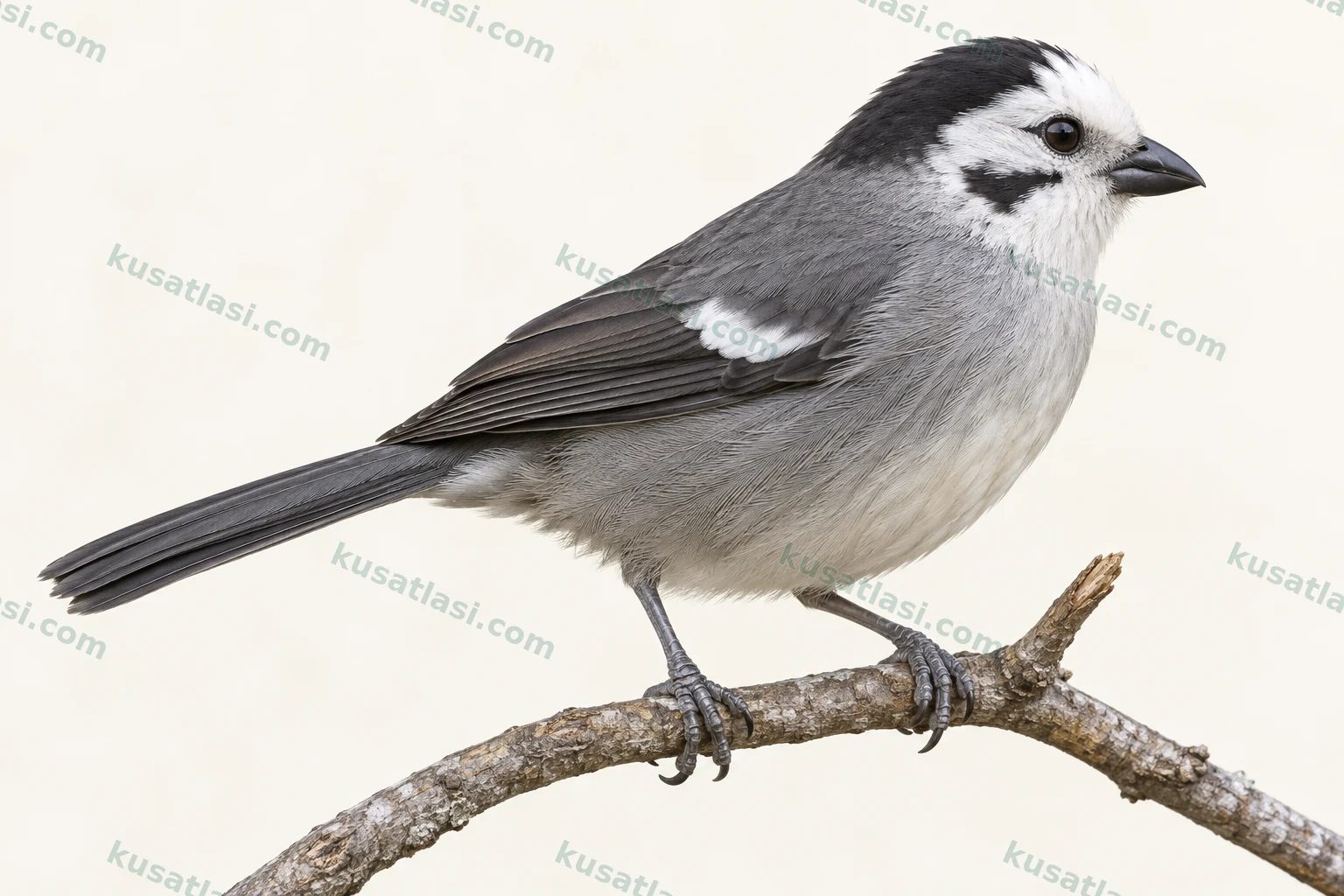
A dry-forest bird combining a white face and throat with a black crown, a dark moustachial stripe and a white wing patch.
Biometrics
Length
Male16 cm
Female16 cm
Shared species value
Wing length
Male7.3 cm
Female7.3 cm
Shared species value
Weight
Male36.6–39 g
Female34.9–36.1 g
White-headed Brushfinch
Dry forests of northwestern Peru and southwestern EcuadorObservation guide in its natural range
Look for three features together
Do not rely on a single featureThe face is white, the crown and nape dark, and the moustachial stripe distinct.
A white wing patch contrasts with the grey body.
Look for pairs or small groups and for scratching through leaf litter.
Compare male and female
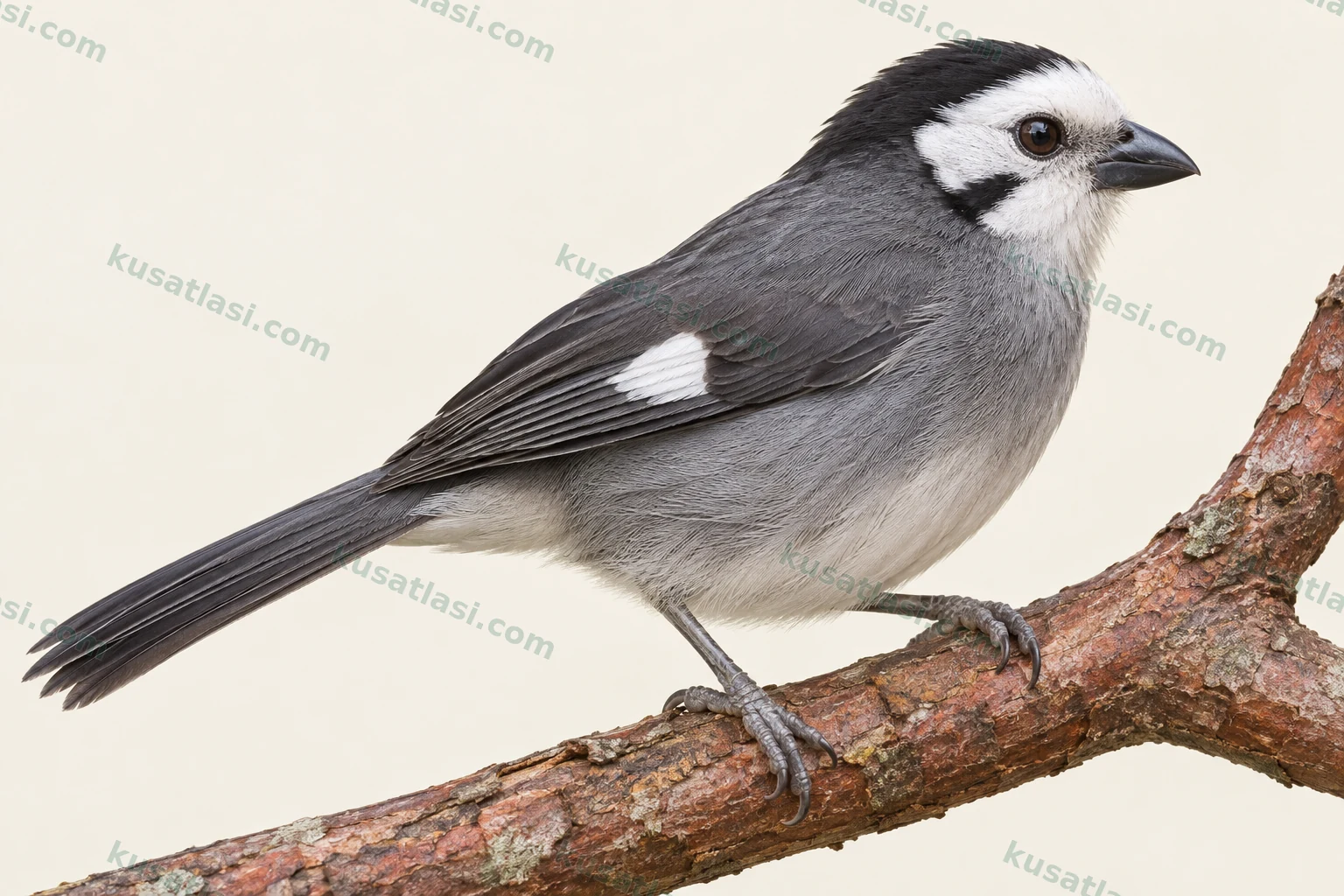 FemaleMale
This research did not verify a reliable plumage key for separating adult males and females or a detailed sequence of colours in young birds. Age and sex are not assigned with certainty.
Where to look in its natural range?
Look on low slopes, coastal hills and in scrub on the west side of the Andes, where leaves cover the ground.
No verified monthly breeding calendar was found for the species. Dated forest observations are not counted as breeding months.
All months: No regular long-distance migration route was verified. No verified regional date specific to this month was given. This does not mean the species is absent locally.
January
February
March
April
May
June
July
August
September
October
November
December
Nest, egg and incubation
Reliable species data were not found for nest structure and site, egg count, incubation duration or time spent in the nest by the young. Values from closely related brushfinches are not used.
The specialist Piura guide describes fine, high, variable whistles ending in short repeated notes.
Do not play recordings to attract birds; observe quietly, especially near nests.
Species information
Quick identification
The White-headed Brushfinch Atlapetes albiceps lives in dry forests and scrub in northwestern Peru and southwestern Ecuador. A broad white face contrasts with the black crown and dark moustachial stripe. The wing bears a conspicuous white patch. The Turkish name refers to a white head, but the dark crown and nape are important parts of the pattern.
The most useful view shows the face, crown and wing pattern on the same individual. A white face or wing patch may appear first through the scrub. A single feature does not identify the bird with certainty before the rest is seen. Other brushfinches occur in the region. Seeing the bird move on the ground in dry forest helps narrow the possibilities, but the distinctive plumage pattern remains essential.
General appearance and posture
The upperparts are grey and the underparts paler. White covers much of the face, forehead and area around the throat, bordered by the dark crown and nape. A dark moustachial stripe forms a separate mark within the white face. The white wing patch stands out against the grey body. When the face is in deep shade, the boundaries between the dark stripe and pale feathers may be less distinct. A second view of the same bird from a different angle can help.
When the bird feeds on the ground, leaves and low vegetation can partly hide its body. Sometimes it climbs onto the top of a shrub and looks around. The face and wing patch may be clearer in this posture. A pause on a shrub does not show that it collects all its food on branches. Changes of perch and the actual taking of prey or seeds are observed separately.
Males, females and young birds
This research did not verify a reliable plumage key for distinguishing adult males and females. The depth of grey or extent of the white face alone is therefore not presented as a certain sex character. Even in the same light, the angle of the head, position of the feathers and how much of the bird is visible affect comparisons. Labelling one of two neighbouring individuals male and the other female requires stronger evidence than a difference in shade.
A detailed sequence of colour changes at different stages of development has not been verified for young birds of this species. Juvenile features of related species are not transferred to it. A bird with a white wing patch and a poorly seen face is not assumed to be a young White-headed Brushfinch merely because it fails to match the full adult description. Establish species identity before considering age and sex.
Field records include pairs and small groups. Two birds moving together do not by themselves reveal their sex, relatedness or breeding activity on that day. Clear behaviour such as receiving food from a parent may help assess age. Proximity alone does not establish a family group. When a view is incomplete, leaving age and sex undetermined makes a more accurate record than assigning them with false certainty.
Appearance in flight
The white wing patch can help identify a bird moving between branches or making a short flight. A single bright view of the wing is insufficient. The patch should be linked to a white face and black crown on the same individual. If the bird is visible only briefly as it leaves a shrub, details of the upper and lower wing surfaces are left undetermined.
This research did not find a separate verified flight pattern applicable to all individuals or a long-distance migration route. A short flight between low branches is not evidence of seasonal migration. Seeing the wing patch can contribute to species identification.
Voice and behaviour
A specialist guide to the birds of Piura describes the song as fine, high whistles ending in short repeated notes. The sequence varies, so the same unchanging syllable order should not be expected from every bird. A written imitation of the sound cannot replace an actual recording. If the source is unclear, do not automatically attribute a call to a white-faced bird nearby.
Original observations from Peru recorded pairs and small groups in deciduous forest. One observation between Olmos and Abra Porculla specifically notes vigorous scratching on the ground. Rustling leaves below a shrub can help locate a bird, but do not identify the species before seeing the source. Watch the clearing from a distance so the bird can continue its natural movements without disturbing leaf litter or drawing it out with sound.
Similar species
Atlapetes seebohmi is another brushfinch found in Andean scrub in northwestern Peru and southwestern Ecuador. Its crown is reddish brown, its face darker and its wing lacks white. The black crown, extensive white face and white wing patch of White-headed Brushfinch distinguish it from that combination. The presence of both species in the same broad region does not mean they always occupy the same elevation or forest patch.
A white wing patch alone is insufficient in comparison with Atlapetes leucopterus. The Piura guide warns of possible confusion with that bird. Check the crown, face and moustachial pattern together. If the head is hidden, a distinguishing feature of White-headed Brushfinch remains unseen. Do not infer the face pattern of a bird behind a shrub from its elevation.
World distribution
Its natural range is in northwestern Peru and southwestern Ecuador. It is known from dry forests and scrub on low slopes on the western side of the Andes and on coastal hills. This range does not cover all mountains in Peru and Ecuador or the humid forests on the Amazonian side. Occurrence in hills near the coast does not establish that it is common on every coastal plain. A specialist account notes that it generally does not descend to the lowest plains.
Status within its natural range
The current global assessment is Least Concern. Original conservation research on dry-forest birds of Tumbes–Piura considers the region’s distinctive bird communities and the importance of forest conservation. A percentage reported for the region’s birds as a whole is not applied to this brushfinch as a population decline or breeding-success figure. A pair in one forest patch does not show that the entire slope is occupied.
Dated observations in Peru confirm occurrence in deciduous forest at Sauce Grande and along the Olmos–Abra Porculla route. The map’s existing estimates are restricted to this broad geography. Retaining a cell does not establish it as breeding habitat. A dated observation and the broad outline of the natural range carry different information.
Movements
This research did not verify regular long-distance migration or a monthly route followed by all individuals. Records in the same region in different years do not show that an individual never moves. Daily movements within dry forest are distinct from seasonal changes in range. The map does not include arrows or separate monthly boundaries without source support.
Breeding habitat
Dry forest and scrub are the verified surroundings of the species. The Piura guide describes dry hill forest, lower montane forests and stream surroundings. Original field notes place the bird in deciduous forest. These observations do not establish exact nesting conditions. Treating a shrub where the bird was seen as a breeding site requires separate evidence of a nest or young.
Nest site
Nest structure, usual nest height, egg count, incubation period and time spent in the nest by young have not been verified in reliable species sources. Cup nests, eggs and durations reported for other Atlapetes species are not transferred to this one. The breeding calendar is consequently not filled with definite months. Egg measurements in a passage about a different bird immediately preceding this species cannot be used without checking the species identity.
Daily use of space
Scratching through leaf litter and sometimes climbing onto a shrub shows that the bird uses both the ground and low vegetation. Trees alone do not describe the habitat adequately. Scrub and ground cover are also relevant during observation. Watch from far enough away for the bird to continue moving naturally, without entering the clearing it has reached or lifting the leaves.
What it eats
A specialist database classifies the species among ground-feeding birds with a seed-dominated diet. AVONET's broad ecological classification places it in a mixed-diet group. These are categories, not field measurements of the contents and proportions of every meal. An original observation reviewed for this work explicitly records scratching on the ground, but does not identify items taken in the bill or their annual proportions. No unverified list of seeds or insects is added.
How it forages
It searches for food on the ground beneath shrubs, scratching through leaves. Some individuals can also climb to the top of a shrub. Looking around from there does not prove that the bird is feeding on the branch. When interpreting feeding behaviour, distinguish reaching towards the ground, scratching and seeing what the bird actually swallows.
From far away, a bird eating a seed on the ground may look like one picking up a small animal from beneath a leaf. If the item cannot be identified, the record should describe only foraging. Food seen in one observation should not be treated as the sole food of every individual across the range.
A white face and a white crown are different marks
Although the bird is named white-headed, its black crown and nape border the white face. The distinction shows why the areas of the head should be examined separately. An individual seen only well enough to make out a pale face gives less identification information than one whose crown is also visible. The white wing patch is a third point to check. Assess the overall pattern rather than relying on one feature.
Mountain birds do not all live at the same elevation
Research on brushfinch evolution links this species with the tropical deciduous forests of Tumbes–Piura. Membership in a bird group associated with the Andes does not confine every species to high, humid mountain forest. The White-headed Brushfinch's use of dry lower slopes shows why it is misleading to assign all members of the genus to one habitat.
Head colour alone does not establish a family tree
A study published in 2015 investigated brushfinch relationships by comparing a portion of mitochondrial DNA and discussed the relationship between colour and geography. Similar pale head colours do not automatically identify the two closest relatives. The study’s estimates of divergence times do not describe the migration dates of present-day birds. They are model-based interpretations of historical relationships.
Old field notes can document behaviour directly
Lüthi's notes from Peru describe pairs or small groups at Sauce Grande in 1964 and an individual scratching on the ground between Olmos and Abra Porculla in 1967. Such a dated observation documents a behaviour at a specific place. Treating the observation month as the breeding season of the whole species would be a different inference. Presence in forest, foraging and breeding require different evidence.