

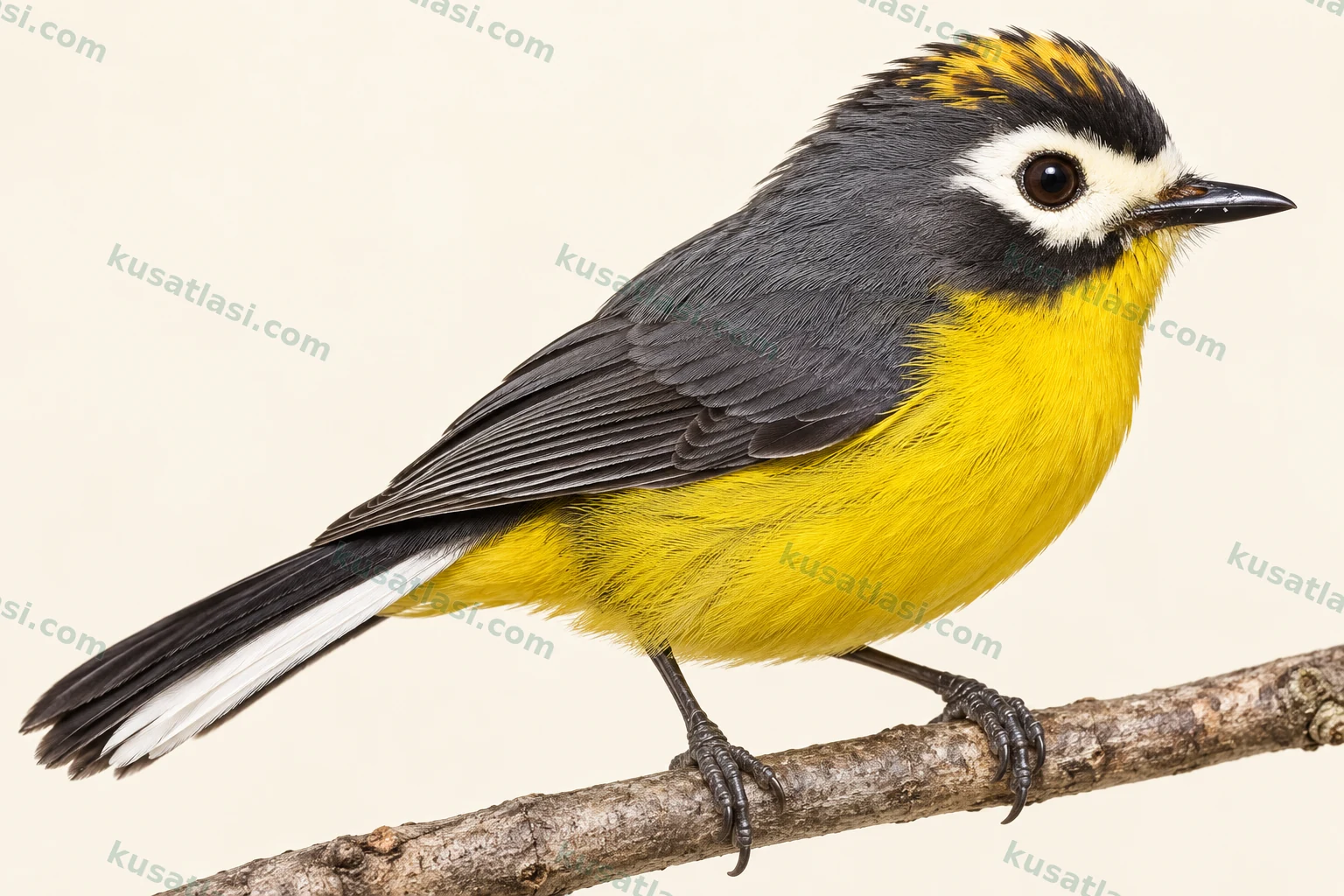
World Birds IUCN statusNT · Near ThreatenedGlobal IUCN. BirdLife v10 (2025); taxon matching AviList 2026 / IOC 15.2; checked: 29.10.2026. The list year is not the species’ assessment date. Source and method · BirdLife OrderPasseriformesPasserines FamilyParulidaeParulidae
White-fronted Whitestart
Myioborus albifrons
An active New World warbler endemic to high Andean forests of western Venezuela, with yellow underparts and a white forehead and spectacles.
Biometrics
Length
Male13–14 cm
Female13–14 cm
Shared species value
Wing length
Male6.7 cm
Female6.7 cm
Shared species value
Weight
MaleData unavailable
FemaleData unavailable
White-fronted Whitestart
The Mérida Andes of western VenezuelaObservation guide in its natural range
Look for three features together
Do not rely on a single featureWhite forehead and broad white spectacles.
A rufous patch on black; some feather tips are black.
Dark centre and white outer feathers, conspicuous when spread.
Compare male and female
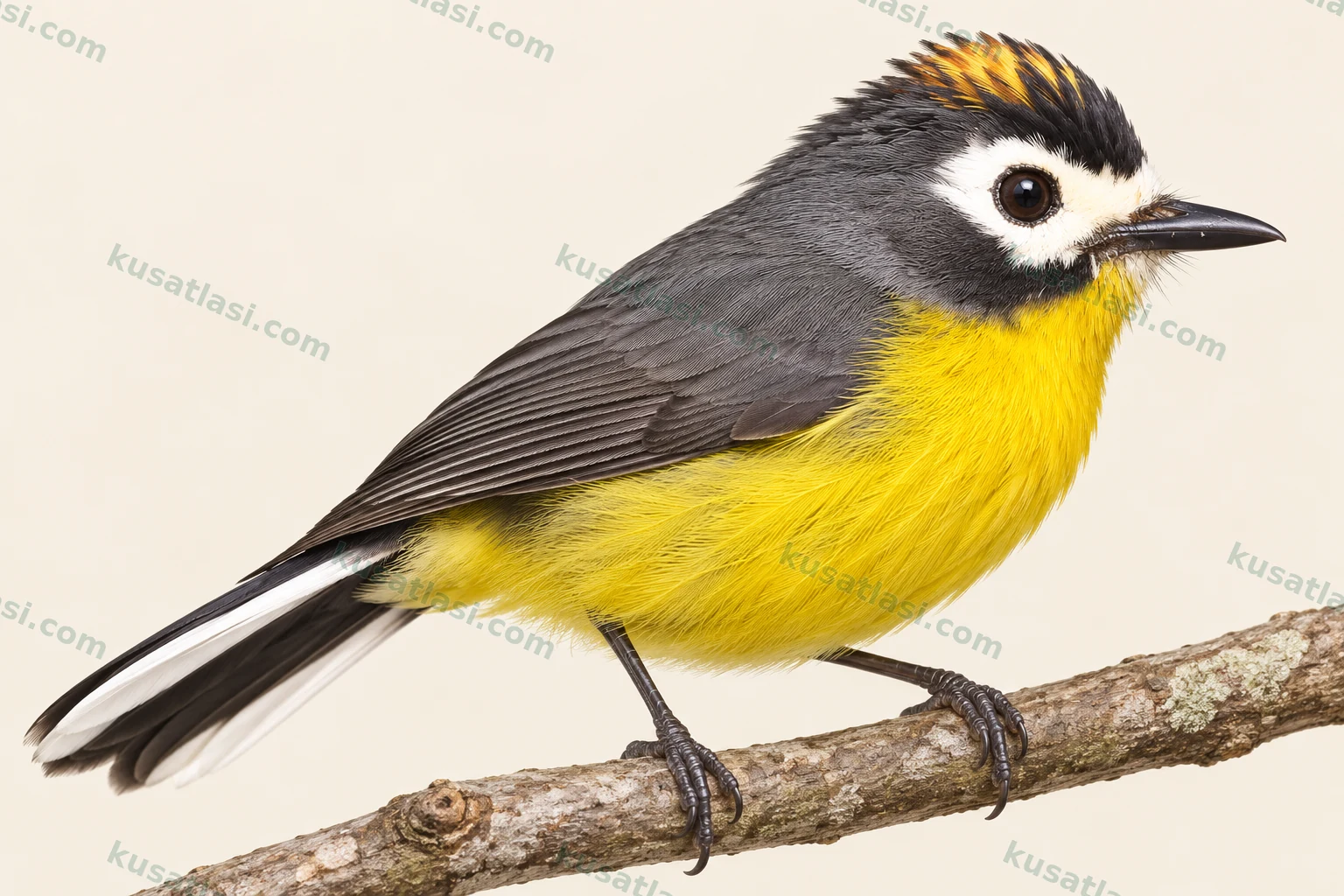 FemaleMale
Males and females are similar; crown brightness and yellow tone do not establish sex. The juvenile moult calendar could not be verified.
Where to look in its natural range?
Middle and canopy branches of high humid forest; mixed feeding flocks.
The species is resident; a verified monthly nesting calendar was not found.
All months: A long-distance migration route was not verified. No verified regional date specific to this month was provided; this does not mean local absence.
January
February
March
April
May
June
July
August
September
October
November
December
Nest, egg and incubation
Species-specific nest structure, typical egg number, incubation duration and time to first flight could not be verified.
A song sequence of melodic, winding notes.
Do not play recordings to attract birds; observe quietly, especially near nests.
Species information
Quick identification
The White-fronted Whitestart Myioborus albifrons is a small, active bird confined to high Andean forests in western Venezuela. Yellow underparts, dark slate-grey upperparts, conspicuous white forehead and eye surrounds, and a white-marked tail support identification together. Despite the word meaning warbler in its Turkish name, it does not belong to the Old World warbler family; it is a New World warbler.
Seeing the whole head pattern matters. White on the forehead and around the eyes joins into spectacles. A rufous patch lies within the black crown, and some rufous feathers have black tips. Neither an entirely black crown nor an entirely rufous head should therefore be expected. Check dark face, pale eye surrounds and yellow lower body on the same bird.
General appearance and posture
It is a forest songbird that changes position frequently while actively searching around branches for food. Dark grey on the head and upperparts contrasts with bright yellow breast and belly. The dark tail centre and white outer feathers become clearer when the tail is spread. White hidden in a closed tail may suddenly appear during a movement.
It may be sought in mixed-species feeding flocks in high cloud forest. Cornell describes use of the middle layer and canopy branches, avoiding an impression of a bird that moves only on the ground. Finding a striking yellow bird in the flock is a beginning; without seeing its white eye surrounds and tail pattern, it may be confused with another yellow New World warbler.
Males, females and young birds
Males and females have similar overall plumage. Male and female labels on two boxes do not mean the birds must be different colours. An apparently brighter individual may simply be differently lit or angled; yellow saturation alone does not establish sex. Without natural behaviour and reliable individual records, two birds in one flock need not be treated as a male–female pair.
White on the forehead, above the eye and around it joins into a broad mark across the dark face. The visible amount of rufous crown can change with feather position; black-tipped feathers may cover some of it. The specialist ornithologist's detailed description explains this black-and-rufous combination. A dark-looking crown in a distant frame alone does not exclude the species.
Sufficient species-specific information describing all juvenile moult stages and their months was not found. Applying another Myioborus species' young pattern directly here is inappropriate. For a duller bird, consider age, light, feather wear and photographic quality together; lack of vivid colour alone does not establish female or young.
Appearance in flight
While foraging it makes movements that spread and display the wings and tail feathers. White on the outer tail can be readily noticed in a short flight or landing, but looks narrower when the tail is closed. Compare the dark tail centre separately from the pale outer feathers. A single flight photograph without the head and forehead is often insufficient.
Short passages within a flock are not interpreted as long-distance migration. One can follow whether the bird moves with the same feeding group, the next branch it lands on and the tail it spreads again.
Voice and behaviour
Its song is a sequence of melodic, winding notes. The singer may remain behind branches and leaves; seeing the white eye surrounds connects the sound record with visual identification. The specialist introduction gives the general voice structure, but every different note should not be used as a code uniquely diagnostic of this species. Where possible, verify both the recording locality and the singing individual.
Active searching in mixed feeding flocks makes it easier to observe. The flock does not consist solely of this species; the leading bird's name cannot be assigned to the whole group. While scanning middle and upper branches, check each bird's head, lower body and tail separately. A feeding flock is not a nesting community or migratory caravan.
Similar species
Myioborus miniatus may initially look similar with its dark head and colourful underparts. The White-fronted Whitestart's broad white spectacles and forehead mark are important clues, requiring a clear view of the front of the head. Warm crown colour or general yellowness alone does not separate the species. Natural geography and elevation also enter the comparison.
Myioborus ornatus is compared through the extent of facial white and arrangement of the head pattern. In Myioborus chrysops the yellow nature of the pale forehead and face also matters. Photographs of Ecuador's rufous-crowned Myioborus bairdi cannot substitute for the full appearance or range of Venezuela's endemic White-fronted Whitestart. Check which bird occupies which region under the current taxonomic separation.
Global distribution
It is restricted to the Mérida Andes of western Venezuela. High forests around Táchira, Mérida and Trujillo form its core natural range. This does not mean it lives in every Venezuelan forest. Distinctions among mountain chains, dry valleys and forest layers within the Andes matter; colouring the whole country does not show the species' real habitat.
Status within its natural range
Its current global category is Near Threatened. BirdLife's 2022 assessment highlights the narrow range and possible forest degradation from agricultural expansion outside protected areas. Important parts of the range being protected does not mean every threat has disappeared. Since no verified total population figure was found, observation density is not presented as the number of birds in the entire species.
It uses mountain forest, woodland and scrubby edges; the specialist account gives an elevation belt of 2,200–3,200 metres. This helps habitat searches, but is not an experiment measuring the same lower and upper limits at every site. This western Venezuelan bird is not treated as sharing the geography of a hybrid zone involving other Myioborus species along the Colombia–Ecuador border.
Migration
It is considered resident. No verified long-distance seasonal route or separate continental wintering area was found. A mixed feeding flock moving from tree to tree is daily habitat use; it should not be turned into an international migration line. The map helps explain the natural mountain belt, but does not prove breeding in every valley without records.
Breeding habitat
High Andean cloud forests and their wooded and scrubby edges are its principal habitat. Feeding in middle and upper branches of humid forest shows that forest structure is more than tree numbers alone. Low, hot coastal forest is not the same habitat as Mérida's high mountain forest. Geography and elevation are checked together.
Nest site
Nest location and structure, typical clutch size, full incubation duration and time to first flight could not be verified in reliable, inspectable species-specific sources. A close relative's ground nest or two-week duration is not transferred here. Nest details in general internet texts without stated sources are not substituted for confirmed information. A bird's presence in a flock is not a nest finding either.
Daily habitat use
It searches around branches and leaves with mixed bird groups. Middle forest layers and canopy branches can be watched together; losing sight of the bird does not mean it immediately left the area. Reappearing at a scrubby edge may be a daily feeding movement. Especially near possible nests, observe natural movements without opening vegetation or repeatedly calling birds with sound.
What does it eat?
Insects and other small invertebrates form the basic food group. Cornell's species account describes insect feeding, and the large ecological compilation describes searching trees for invertebrates. These two statements prevent portraying it as a bird that eats only seeds. Sufficient species-specific research giving annual shares of each insect group or a required proportion of particular prey was not found.
How does it hunt?
While actively searching leaves and branches, it spreads and displays its wings and tail. This movement is an observable part of the feeding sequence. Results from experiments on other Myioborus species must not be presented as though separately tested here; this account uses the movement and food group directly described for the species.
A mixed flock may help locate it, but different flock species do not all take the same prey by the same method. If a capture is visible, record prey identity, the surface it came from and the bird's movement separately. Fruit near the tree does not prove the bird ate it. Because seasonal changes in food preference were not verified, no year-round percentages are given.
The white tail explains the name
The English name Whitestart refers to the white outer tail feathers. Redstart also occurs in older and some current sources; checking Myioborus albifrons establishes that they refer to the same species. Migration and breeding information for Türkiye's redstarts cannot be transferred to this New World warbler merely because the English name resembles theirs. A name's meaning supports identification but does not replace taxon matching.
Black and rufous share one crown
Short guide sentences sometimes summarise the crown as rufous and sometimes black. The detailed specialist comparison describes a rufous patch in a black crown and black tips on some feathers. The visible colour proportions can change as feathers move. Rather than expecting an entirely single-coloured head, consider the white forehead and spectacles with the crown's internal pattern.
Hybridisation in neighbouring species is not hybridisation in this species
Hybridisation has been studied among Andean warblers in Colombia and Ecuador. The 2023 taxonomic review states that the separate identity of Venezuela's endemic White-fronted Whitestart is retained under those alternative classifications. Presenting a hybrid zone of neighbouring species as somewhere this bird regularly hybridises broadens the scientific scope. Read the research question, sampled species and geography separately.