

World Birds IUCN statusLC · Least ConcernGlobal IUCN category. BirdLife v10 (2025); taxon matching: AviList 2026 / IOC 15.2; checked: 29.10.2026. The list year is not the species assessment date. Source and method · BirdLife OrderApodiformesSwifts and hummingbirds FamilyTrochilidaeTrochilidae
White-throated Hummingbird
Leucochloris albicollis
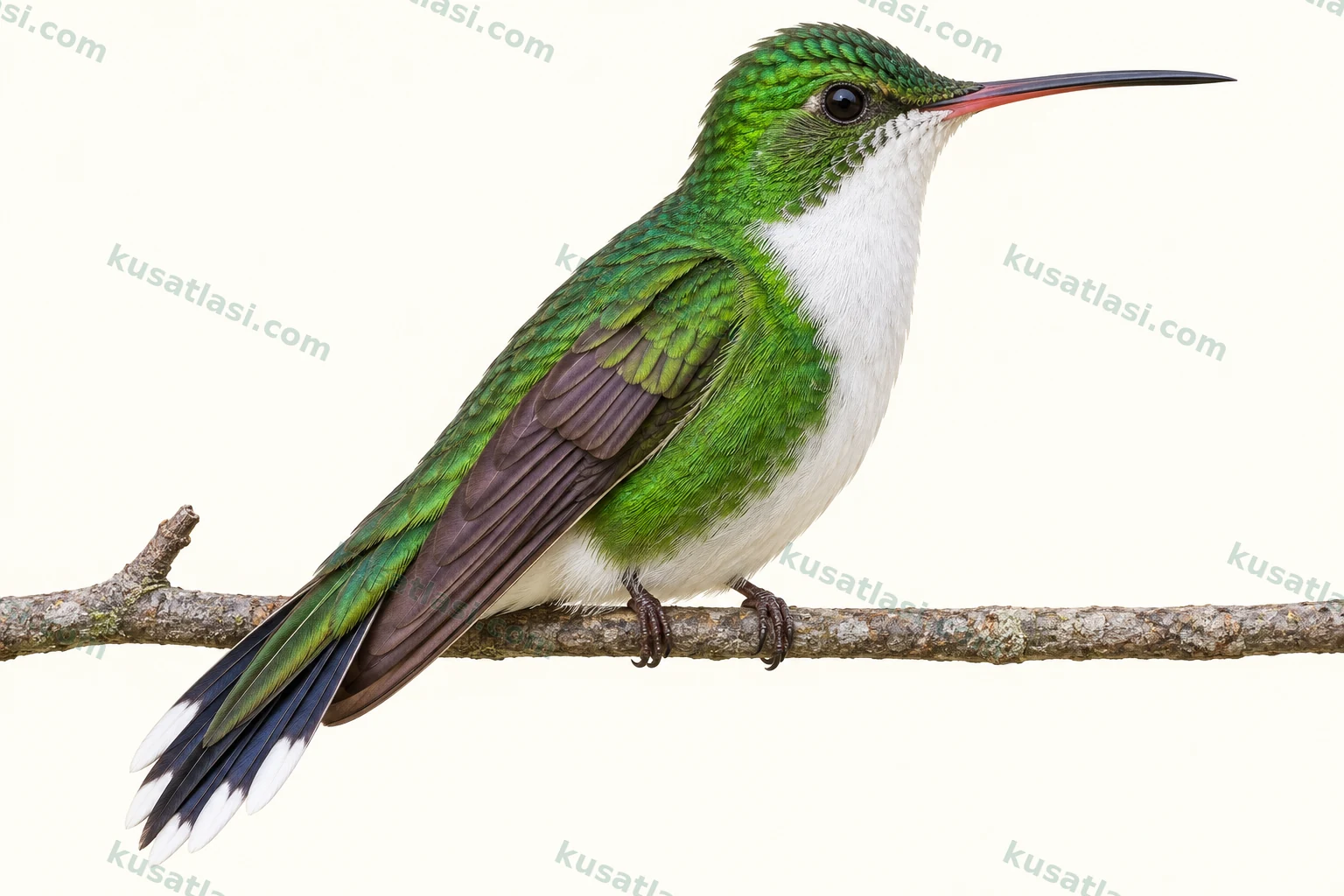
Look for a green body with a white throat and belly separated by a green breast, a straight two-coloured bill and pale tail tips.
Biometrics
Length
Male10–12 cm
Female10–12 cm
Shared species value
Wing length
Male5.88 cm
Female5.88 cm
Shared species value
Weight
Male5–8 g
Female4.5 g
White-throated Hummingbird
Flowering woodland of eastern and southeastern South AmericaObservation guide in its natural range
Look for three features together
Do not rely on a single featureLook for the green area between the white throat and white belly.
Compare the dark upper mandible with the pinkish-red lower mandible.
Look for the pale mark behind the eye and the white tips of the outer tail feathers.
Compare male and female
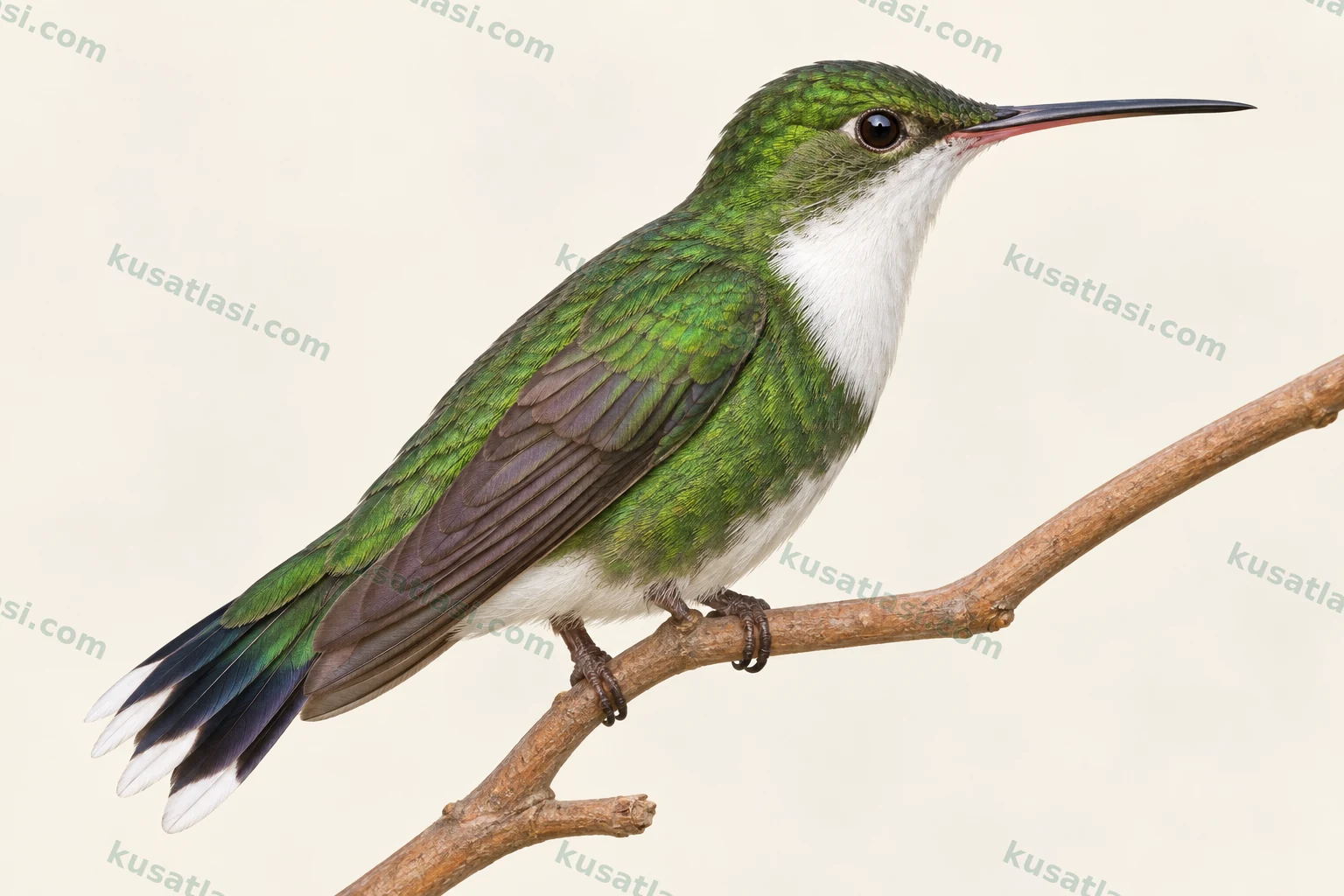 FemaleMale
Adults share the same basic pattern. Sheen alone does not determine sex, and detailed juvenile stages have not been verified.
Where to look in its natural range?
At forest edges and in gardens, check the pattern of birds that land on a branch after visiting flowers.
Some populations are resident and others move locally. Shared breeding months have not been adequately verified.
All months: Regional nest records exist, but no single breeding or migration calendar is given for the whole range. No verified regional date is given for this month. That does not imply local absence.
January
February
March
April
May
June
July
August
September
October
November
December
Nest, egg and incubation
A small nest of moss, fibres and spider silk sits on a branch. The original Mar del Plata record had two young. A review gives two eggs, and development durations have not been verified.
Listen for short, dry, irregular calls. Distinguish them from wing hum and the calls of other hummingbirds nearby.
Do not play recordings to attract birds; observe quietly, especially near nests.
Species information
Quick identification
The White-throated Hummingbird Leucochloris albicollis lives in woodland, forest edges and flowering gardens in eastern and southeastern South America. A white throat and white belly stand out on the green body, separated by a green breast. The bill looks straight, with a dark upper mandible and much of the lower mandible pinkish red. Look for the white throat, belly and two-coloured bill together. A green hummingbird alone is not enough to identify the species.
While the bird hovers at a flower, the throat and belly may not be visible at the same time. When it leaves the flower and lands on a nearby branch, it is easier to see the green breast separating the two white patches. A pale mark behind the eye is another clue. The green can lose its sheen in shade, so identification does not depend on the hue of the sheen alone. If the lower mandible’s colour is unclear, do not assume it is all black because it looks dark. Wait for the bird to turn its head.
General appearance and posture
A long, nearly straight bill in proportion to the small body, narrow wings and a relatively short tail make up the basic shape. The upperparts, breast and flanks look green. The white centre of the belly contrasts with the green around it, and the white throat is a separate patch. The flight feathers are darker. The tail has dark bluish areas and white tips to the outer feathers. The central feathers can look greener from another angle. Some of the outer tips can be hidden in a closed tail.
When the bird perches on a thin branch, the bill forms a conspicuous line in front of the head. When it hovers at a flower, fast wing motion can make the body look different in a single frame. As head direction and light change, the hue of the metallic feathers also changes. A bluer green or duller view of the same bird does not create a new colour form. The actual positions of the white areas are more reliable starting points.
Males, females and young birds
Adult males and females share the basic green, white and two-coloured bill pattern. A Brazilian research and conservation institution’s guide describes the two sexes together under this pattern. A brighter-looking individual should not be called male on brightness alone. Light, viewing angle and feather posture can magnify small differences in colour. When a bird returns to the same flower, compare its appearance from different angles.
This review could not verify a reliable key to all stages of juvenile moult. A bird that looks paler or shorter is not automatically female or young. Seeing an adult directly feed a chick in the nest or a juvenile that has recently left it can provide evidence of age. Two birds at the same flower at the same time should not be assumed to be parent and young. If age or sex cannot be established, leave it unspecified in the record.
Appearance in flight
The bird can hover as it approaches a flower, then make a short flight to another flower or a branch. The white throat and belly may be seen together or separately depending on the angle. The outer white tips can be clearer when the tail opens. If it holds the tail closed, failure to see the tips does not rule out the identification by itself. Watch its natural feeding sequence rather than assigning a species based solely on fast wing movement.
The rapid wingbeats are recognisable in all hummingbirds and do not distinguish this species. Check the green breast separating the two white patches and the bill colours again once the bird lands. Short flights in a garden are not evidence of a regular migration route. Some regional sources mention elevational movements, which do not mean all birds travel the same distance or direction. Keeping enough distance among flowers allows natural hunting and nectar feeding to be observed.
Voice and behaviour
The specialist Cornell account describes the calls as irregular, dry and short sounds. When several hummingbirds are around a cluster of flowers, check that the sound belongs to the bird you see. The humming of wings at a flower and the call are different sounds. A brief sound alone does not settle the identification. Look for the white throat and belly and the bill pattern as visual evidence.
The bird can feed in flowering forest edges, gardens and orchards. Perching between flower visits allows it to rest and watch its surroundings. Its occurrence in areas with changed vegetation in one study does not show that it benefits from all forest loss. The Santa Teresa study separately considers the possibilities that it colonised scrubby pasture and edges later and that it was already present in rocky scrub. These interpretations are not combined as definitive historical evidence.
Similar species
1. Other green hummingbirds in the region look similar from a distance. Compare the green breast separating the white throat and belly, the two-coloured bill and the tail tips together. White underparts or a reddish-looking bill alone are insufficient.
2. Light can make bronzy hummingbirds with reddish bills look green. The two separate white patches on the front of the White-throated Hummingbird are particularly useful here. If they cannot be seen, do not decide by the shade of the sheen or a single view of the bill.
3. Young or poorly seen small hummingbirds can remain uncertain, especially when they pass a flower quickly. Wait for the bird to land again and check the head, breast and tail. Keep the supporting details without forcing a firm identification from a brief view.
Global range
Its natural range is in eastern and southeastern South America. Main areas include southeastern and southern Brazil, Paraguay, Uruguay and suitable areas in northeastern and eastern Argentina. Current taxonomy treats it as monotypic, with no separately named subspecies. Records from a country do not establish continuous presence across the whole country. The distribution of flowering woodland and suitable edges matters.
Status within its natural range
It can use forest edges and shrubby clearings in the mountains of southeastern Brazil. It also visits gardens and orchards. Original Argentine publications compare older records around Buenos Aires with later records farther south. A nest at Mar del Plata establishes local breeding, unlike merely seeing a visiting bird. A single nest does not mean the species breeds at the same density throughout Buenos Aires Province.
Movements and migration
It is considered resident in many places, with local and elevational movements reported. The Santa Teresa review gives a regional example of descent to lower terrain around Petrópolis. The older publication from Mar del Plata says that residence and seasonality at the southern limit need further investigation. These are not combined into a single continental migration line. No common arrival month, route or distance was adequately verified for all populations. The map shows the approximate areas of licensed records.
Breeding habitat
It uses semi-open woodland, forest edges, well-developed secondary vegetation, gardens and orchards. Flowering plants provide nectar, and nearby small invertebrates provide additional food. The Brazilian guide describes habitats in southeastern mountains without implying that the species lives only high in the mountains. Records also come from lowland areas and planted woodland in Argentina.
Nest site
The original record from 21 March 1991 at Mar del Plata describes a small nest on a walnut branch. It was made of moss, plant fibres, spider silk and plant fragments, with lichens on the outside. There were two well-developed young. The nest measured 3.9 cm across and 1.6 cm deep inside. These are measurements of one nest, not a species mean. A life-history review gives two eggs. Incubation and nestling durations were not verified in this review.
Daily use of habitat
The bird moves between flowering plants and branches where it can perch. A continuing supply of nectar plants and the woodland cover around them matter. Do not bend or move a branch to see the small nest. If the observer interrupts an adult’s access to the young, step farther back. Watch without touching the lichen-covered nest.
What does it eat?
It feeds on nectar and small insects. An original Argentine note from 1965 reports that birds observed at Zelaya took food from flowers and also took insects. AVONET’s classification among nectar feeders supports this broad pattern without supplying detailed dietary percentages. Watching a flower visit does not mean the bird never eats insects. Nectar and small prey can contribute to different nutritional needs.
How does it forage?
It approaches a flower, reaches nectar with its bill and flies a short distance to another feeding spot. It also takes small insects. This review did not verify the share of each prey group or a single capture height for the entire range. Record which flower the bird visits and any hunting behaviour separately. Hovering alone is not counted as taking prey when no small insect is seen in the bill. Watch without altering flowers or natural perches to understand what the behaviour means in its own setting.
Green between two white patches
The green breast between the white throat and white belly is as important for identification as the white throat itself. The front is not one large white patch. Either patch can be hidden when the bird lowers its head or is behind a flower. Waiting for a fuller view of the perched bird makes it easier to compare colours among hummingbirds.
What one small nest demonstrates
The original nest record from Mar del Plata documents two well-developed young and the adult flying with a young bird on later days. The observer did not watch egg laying or measure the full development period from start to finish. The date the nest was found is therefore not the start of incubation, and seeing a young bird a few days later does not give the full nestling duration. The single nest is valuable evidence that breeding occurred locally.
Occurrence and nesting are different
The author of an older field note from Zelaya thought that a female returning to the same surroundings might have nested but did not find a nest. The record establishes feeding and presence without confirming a nest. At the later Mar del Plata nest, the structure and young were seen directly. Distinguishing a possibility from a direct record helps interpret the distribution.
Using woodland edges does not make up for all forest loss
The Santa Teresa study describes the bird’s use of scrubby edges and examines changes in the local bird community separately. One species using changed habitat does not replace all the forest birds that were lost. Seeing a White-throated Hummingbird in a garden likewise does not make natural woodland unnecessary. Areas that one species uses and conservation of an entire ecosystem are considered at different scales.