

World Birds IUCN statusLC · Least ConcernGlobal IUCN category. BirdLife v10 (2025); taxon matching: AviList 2026 / IOC 15.2; checked: 29.10.2026. The list year is not the species assessment date. Source and method · BirdLife OrderAnseriformesWaterfowl FamilyAnatidaeAnatidae
Radjah Shelduck
Radjah radjah
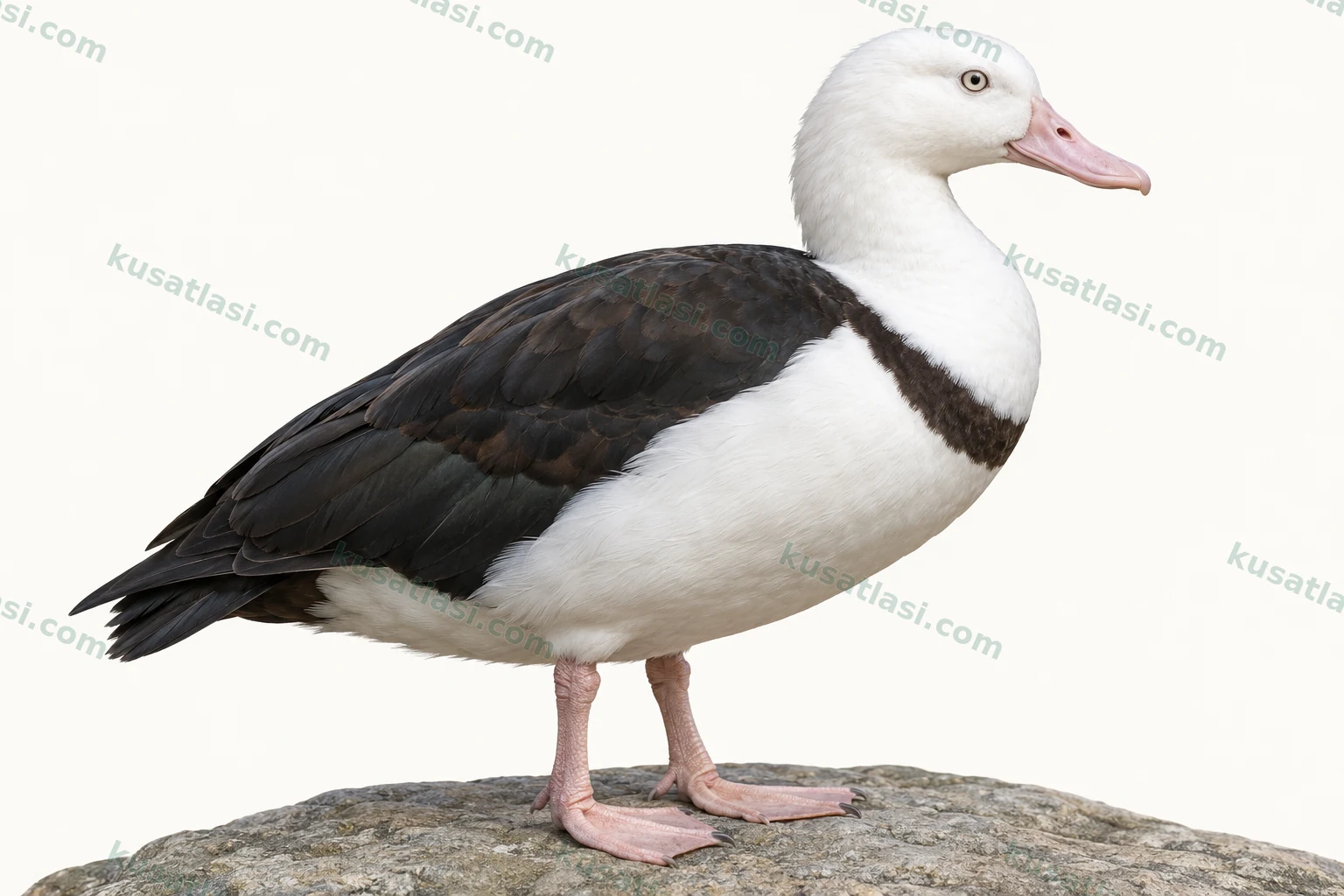
A shelduck of tropical northern coasts with a broadly white head and neck and a dark breast band. The pale eye, flesh-coloured bill and flesh-coloured legs help identify it in combination.
Biometrics
Length
Male48–61 cm
Female48–61 cm
Shared species value
Wingspan
Male90–99 cm
Female90–99 cm
Shared species value
Weight
Male750–1101 g
Female600–1130 g
Radjah Shelduck
Northern Australia, New Guinea and the MoluccasObservation guide in its natural range
Look for three features together
Do not rely on a single featureThe head and neck are white, and the adult’s eye is very pale.
A dark band crosses the breast. It is relatively broad in males but does not establish sex by itself.
The bill is pale flesh-pink, and the legs are strong.
Compare male and female
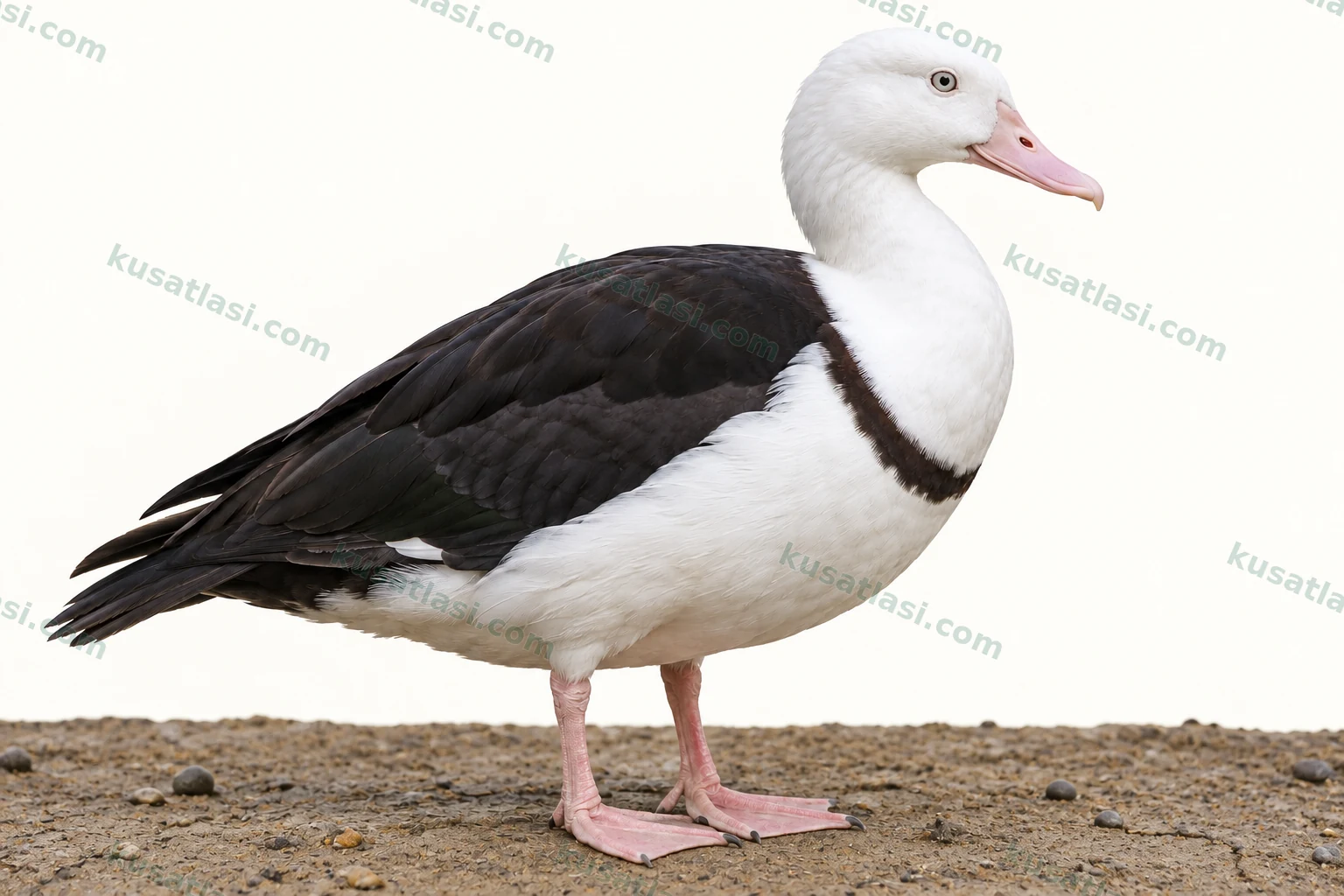 FemaleMale
Adults look alike, although the male’s breast band is relatively broad. Young birds may have a brownish crown and nape and an interrupted band.
Where to look in its natural range?
Mangrove margins, shallow coastal wetlands, riverbanks and mudflats.
The rainy season and local water conditions matter. No single monthly breeding calendar was verified across the whole range.
January
The species is largely resident, but local movements are possible. No verified regional date is given for this month. This does not imply local absence.
February
The species is largely resident, but local movements are possible. No verified regional date is given for this month. This does not imply local absence.
March
The species is largely resident, but local movements are possible. No verified regional date is given for this month. This does not imply local absence.
April
The species is largely resident, but local movements are possible. No verified regional date is given for this month. This does not imply local absence.
May
The species is largely resident, but local movements are possible. No verified regional date is given for this month. This does not imply local absence.
June
The species is largely resident, but local movements are possible. No verified regional date is given for this month. This does not imply local absence.
July
The species is largely resident, but local movements are possible. Yeppoon, Queensland, 1990: On 31 July a pair inspected a cavity. This is not evidence of a completed nest or of eggs.
August
The species is largely resident, but local movements are possible. No verified regional date is given for this month. This does not imply local absence.
September
The species is largely resident, but local movements are possible. No verified regional date is given for this month. This does not imply local absence.
October
The species is largely resident, but local movements are possible. No verified regional date is given for this month. This does not imply local absence.
November
The species is largely resident, but local movements are possible. No verified regional date is given for this month. This does not imply local absence.
December
The species is largely resident, but local movements are possible. No verified regional date is given for this month. This does not imply local absence.
Nest, egg and incubation
The nest is in a tree cavity near water. A specialist synthesis reports 6–12 eggs and about 28–30 days of incubation. The old numerical evidence is limited, and another source gives 12–15 eggs. The time to first flight was not verified.
A rough whistle is reported for the male and a harsh duck call for the female. Do not determine sex with certainty without seeing the bird that made the sound.
Do not play recordings to attract birds; observe quietly, especially near nests.
Species information
Quick identification
The Radjah Shelduck Radjah radjah is a large black-and-white waterbird of northern Australia and the New Guinea region. The adult has a broadly white head, neck and underparts, with a dark band across the breast. Its pale eye, flesh-pink bill and strong legs of the same colour stand out against the white head. With the wings folded, the upperparts look dark. Consider the pale head, breast band and bill colour together. The black-and-white body alone is insufficient at a distance.
The accepted English name is Radjah Shelduck. Tadorna radjah in older studies is a previous genus combination for the same species. Northern Australian birds belong to rufitergum, and birds of New Guinea and the Moluccas to radjah. The chestnut colouring around the back of the Australian form should not be taken as a fixed difference between the sexes. The island and coastal locations on the map help put this geographic variation in context.
General appearance and posture
The bird has a full body, a prominent neck and strong legs. The white head and neck form a pale area above the dark-winged upperparts. Australian birds have chestnut-brown coverts at the front of the back and around the shoulders, while the rest of the back, the rump and the tail look dark. The breast band is not a patch covering all the underparts. Look at where it crosses the white breast, how it extends on both sides and how it appears when the bird turns.
The bird may stand at the edge of shallow water, walk over mud or be seen on the water. The pale legs help show the proportions of a bird standing on land. Resting in trees is also known. A pair perched in a tree beside the water illustrates that the species is not confined to open lakes. A resting place, feeding surface and nest cavity can be recorded separately during the same observation.
Males, females and young birds
Adult males and females share the same basic colour pattern. The ABSA synthesis says the male’s breast band is usually broader. A regional specialist account describes the female’s band as a little narrower. This relative difference calls for a good angle and comparison. Turning sideways, fluffing the plumage or changing neck posture can alter the band’s apparent width. A narrow band in a single poor photograph does not establish the bird’s sex.
The crown and nape of a young bird are brownish. The clean white head and neck of the adult have not yet developed fully. The breast band may be interrupted. The specialist species account also reports a brown wash on the white areas and a duller wing speculum. The dark brown eye of a young bird differs from the very pale iris of the adult. Together these traits help assess age. The signs of youth may become less visible as the moult progresses.
A newly hatched chick does not look like a miniature adult. Moving towards the water after leaving the cavity does not mean that a chick can fly. The sources examined do not provide a reliable age guide for first breeding. A bird nearing full adult colour should not be assigned a fixed age in years for that reason alone. Observe the postures, head colours and following behaviour of the birds in a family group together.
Appearance in flight
When the wings open, the white coverts contrast clearly with the dark flight feathers. The Australian form may show a white border around a metallic green speculum. The green gloss depends on the angle of the light and will not look equally bright in every image. The pale head and neck, white underparts and dark tail complete the flight pattern. When describing the upper or lower wing, specify which surface was actually seen.
The broad white area seen in flight helps identify the bird.
Voice and behaviour
Specialist accounts describe a rough whistle from the male and harsher, broken duck calls from the female. This contrast does not reliably assign sex to every call when the source is unseen. Other ducks may be calling at the water’s edge at the same time. It is more useful to match the call with the bird seen moving its head and opening its bill. Increased calls and chasing while a breeding territory is defended may make the birds easier to find from a distance.
The species is usually seen in pairs or families, though larger groups can form during dry periods. The coastal habits described in the regional account do not mean every group stays at the same site all year. When the water recedes, suitable shallow edges change. Local movements are compatible with residency. A bird flying to a different pool is not by itself evidence of long-distance seasonal migration.
Similar species
1. The Australian Shelduck Tadorna tadornoides has a dark and rusty-brown body. The male has a black head, and the white around the female’s eye and bill does not extend as far as the extensive white head and neck of the Radjah Shelduck. White on the wings may create a similar first impression. Examine the head, breast and pale pink bill together and consider the southern Australian range of the Australian Shelduck.
2. The Magpie Goose Anseranas semipalmata is another large black-and-white bird of northern Australian wetlands. Its prominent head knob and orange legs differ from the white head and pale pink legs of the Radjah Shelduck. Where many waterbirds gather, check head shape and leg colour as well as body colour. Seeing a bird in a tree does not by itself distinguish these species, as both can perch on branches.
Global range
The native range lies around northern Australia, New Guinea and the Moluccas. The Australian form occurs on the tropical northern coast and in some eastern coastal areas. New Guinea and Moluccan birds are placed in a separate subspecies. Shallow wetlands near the coast are important, and the range does not imply that the bird occurs throughout a country’s interior. The use of Tadorna in an old book is not in itself a reason to exclude the record from the current species account.
Status in its natural range
The global assessment places the species in Least Concern. Regional monitoring is still needed. Queensland’s 1990 observation report lists records near Townsville, Bundaberg and Yeppoon by locality and date. On 31 July a pair inspected a cavity in Yeppoon. This is neither an egg count nor a count of young. Historical records are not presented as the current population size. The map also distinguishes the meaning of modelled areas from direct observations.
Movements and migration
The species is largely resident and can move in response to local water conditions. Genetic research in 2023 found geographically related differentiation between New Guinea and Australian samples and within Australia. The effects of the Torres Strait and Carpentaria region exceeded the differences expected from distance alone. The finding is consistent with limited dispersal, but does not show an annual migration route tracked by satellite. The map does not plot a dated route or a strait crossing taken by all birds.
Breeding habitat
Tropical coastal wetlands, mangrove margins, riverbanks and shallow marshes are suitable habitats. A regional specialist account from Australia links the establishment of breeding territories with the start of the wet season. Rainfall patterns and the timing of receding water vary from place to place. Australian monthly dates are not automatically applied to New Guinea. A resting group and a territory defended by a pair can be observed separately in the same wetland.
Nest site
The nest is usually in a tree cavity near water. Specialist sources report 6–12 eggs and incubation of about 28–30 days, as in the compiled species account from Perth Zoo. A current scientific assessment from Queensland notes that older sources also give 12–15 eggs and that the numerical evidence is limited. The figures do not establish one fixed clutch size or a precise duration. The time to first flight was not verified. A chick leaving the cavity soon after hatching does not establish the age at first flight.
Daily use of habitat
Shallow water margins and nearby trees meet different needs. Mudflats and banks may provide feeding sites, while tree or mangrove branches may serve as resting places. Watch the bird’s movements without approaching the cavity. Do not separate young from the water or displace a resting pair for a better photograph. A bird inspecting a cavity does not establish that there are eggs inside.
What does it eat?
A regional specialist account reports molluscs and aquatic insects as animal foods. An institutional specialist account also lists algae and reed-like plants as plant foods. These sources do not give measured dietary proportions for every island, age group and season. A mixed diet does not tell us which food a particular bird has just taken. Even if the bill movement is visible, an exact prey name should not be inferred when the item is too small to see.
How does it find food?
It searches for food by walking along shallow edges and directing its bill towards water or soft ground. When the surface is visible, its feeding movements are easier to follow. A small item taken from water may be difficult to identify as a mollusc or plant material. Feeding the birds to draw them to the shore is not a reliable way to find out what they naturally choose. The water depth, shore type and food actually seen can be recorded separately.
Water edges that remain in the dry season can bring birds together. Use of shallow areas can change as they expand after rain. This differs from the behaviour of a seabird that dives for prey in deep open water. The feeding description belongs in the context of shorelines and shallow wetlands. Long dives by other ducks are not attributed to this species.
The same geography does not affect all ducks equally
The 2023 study examined the Radjah Shelduck with three other waterbird species from Australia and New Guinea. Geographic differentiation was marked in the Radjah Shelduck, while the result was weaker in other species from the same broad region. The study shows why the presence of sea between populations is insufficient to assume that all waterbirds become equally differentiated. The authors suggest that a species’ ability to move and its use of habitat may modify the effect of a geographical boundary.
A genetic sample count is not a population count
The study initially examined 32 individuals of this species. After excluding closely related samples, the main population structure analysis used 29 individuals. These are not the total number of Radjah Shelducks worldwide. The four principal genetic clusters do not in themselves represent four new bird species. Current taxonomy retains two subspecies. Sample locality, method and the limits stated by the researchers are considered alongside the result.
Inspecting a cavity differs from proving breeding
The 1990 Queensland report of a pair inspecting a cavity gives useful place and date information. If eggs or young were not seen, however, the record does not tell us how many were present. An observation made without approaching the nest still provides valuable information. Young seen on a later date can be added as new evidence, without retrospectively assigning unseen details to the earlier record.
The white head is only one clue
The extensive white head, pale eye and flesh-coloured bill are assessed together in an adult. Brownish colour on the head of a young bird does not make it a different species of shelduck. The amount of white does not give an exact age in years either. Describing the colour in its anatomical position and age context helps explain why the same mark can look different across photographs.