

World Birds IUCN statusLC · Least ConcernGlobal IUCN category. BirdLife v10 (2025); taxon matching: AviList 2026 / IOC 15.2; checked: 29.10.2026. The list year is not the species assessment date. Source and method · BirdLife OrderCuculiformesGuguksular FamilyCuculidaeCuculidae
Black Coucal
Centropus grillii
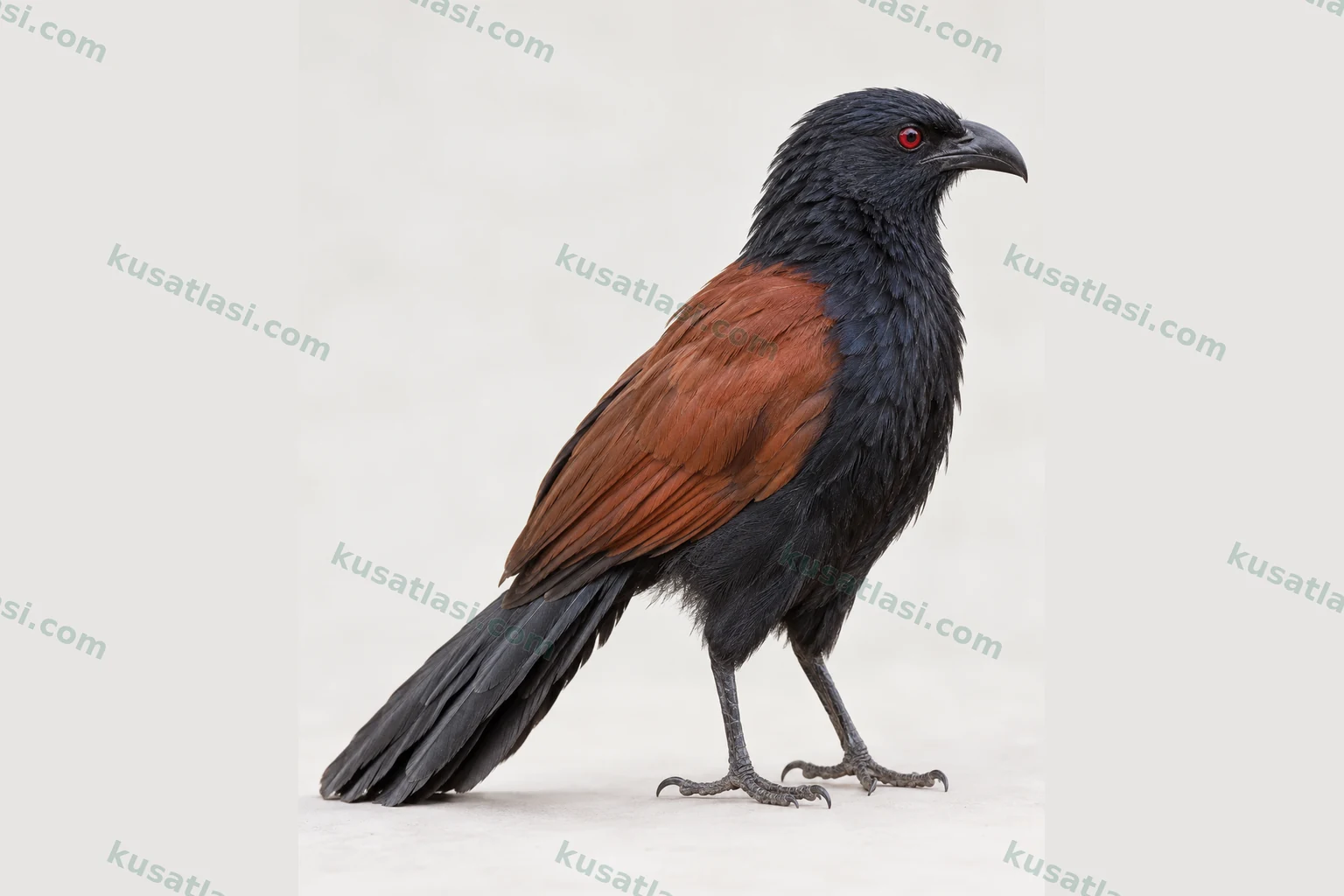
Breeding black body and rusty chestnut wings; pale and streaked outside breeding. Long-tailed bird of dense tall grass.
Biometrics
Length
Male30–34 cm
Female30–34 cm
Shared species value
Wing length
Male15.98 cm
Female15.98 cm
Shared species value
Weight
Male94–108 g
Female151 g
Black Coucal
Moist tall grassland of sub-Saharan AfricaObservation guide in its natural range
Look for three features together
Do not rely on a single featureBlack breeding plumage differs from pale streaked non-breeding appearance.
Check whether a conspicuous white eyebrow can actually be seen.
The male incubates and feeds young; plumage alone does not determine sex.
Compare male and female
 FemaleMale
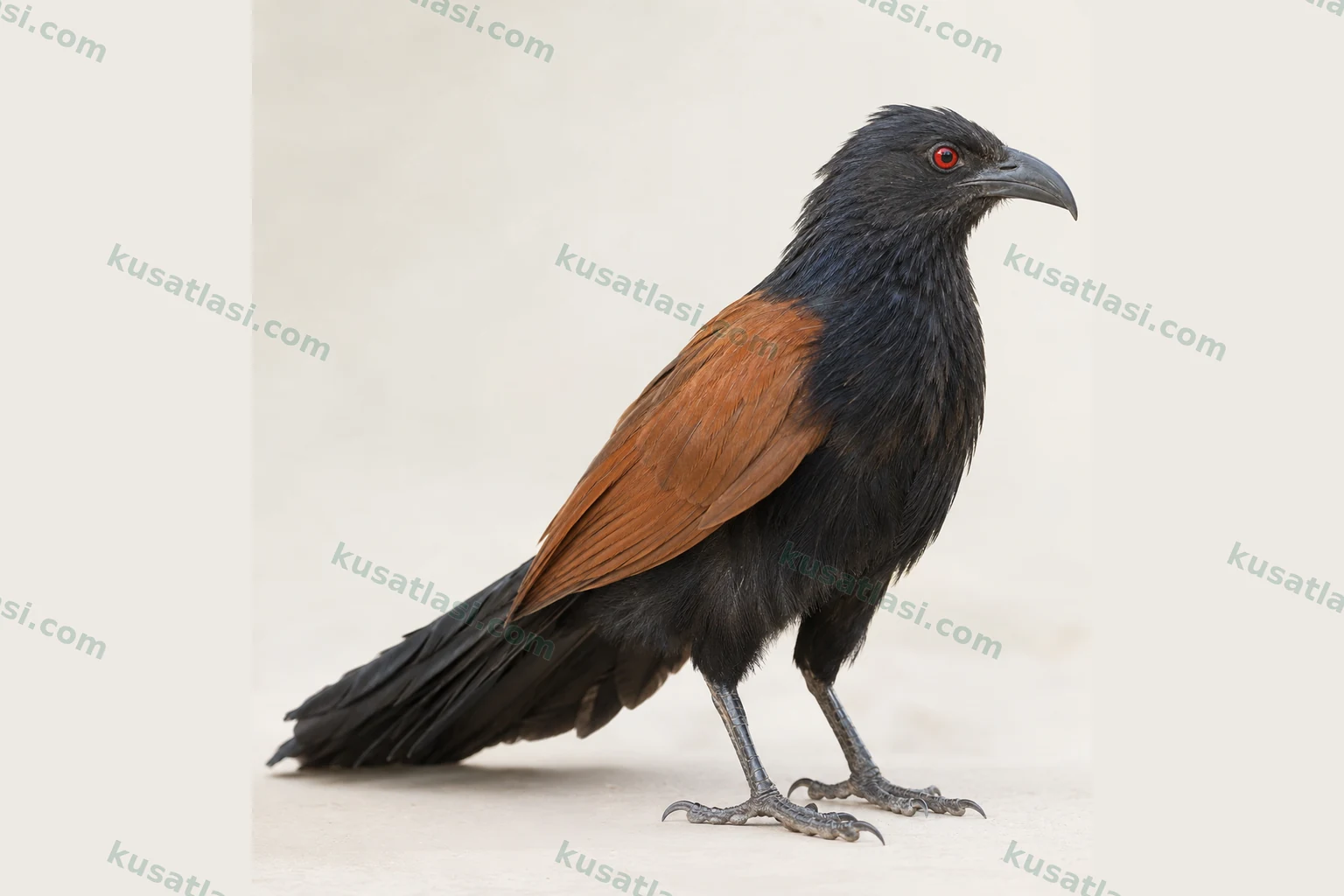
Female larger; breeding colour alone does not determine sex. Young and non-breeding birds are more streaked.
Where to look in its natural range?
Watch natural grass openings and briefly used tall stems from afar.
Local breeding periods are shown; Tanzania and southern Africa are not forced into the same months. Atlas breeding activity is distinguished from egg-laying dates.
January
Some populations move seasonally; no route shared by the whole continent has been verified. Zimbabwe, dated atlas records: these are breeding records, not just egg-laying dates. Botswana, three dated breeding records: breeding in January–February, not a definite country-wide time boundary.
February
Some populations move seasonally; no route shared by the whole continent has been verified. Tanzania, Usangu study site: local breeding, usually from mid-February to mid-June. Zimbabwe, dated atlas records: these are breeding records, not just egg-laying dates. Botswana, three dated breeding records: breeding in January–February, not a definite country-wide time boundary.
March
Some populations move seasonally; no route shared by the whole continent has been verified. Tanzania, Usangu study site: local breeding, usually from mid-February to mid-June. Zimbabwe, dated atlas records: these are breeding records, not just egg-laying dates.
April
Some populations move seasonally; no route shared by the whole continent has been verified. Tanzania, Usangu study site: local breeding, usually from mid-February to mid-June.
May
Some populations move seasonally; no route shared by the whole continent has been verified. Tanzania, Usangu study site: local breeding, usually from mid-February to mid-June.
June
Some populations move seasonally; no route shared by the whole continent has been verified. Tanzania, Usangu study site: local breeding, usually from mid-February to mid-June.
July
Some populations move seasonally; no route shared by the whole continent has been verified. No verified regional date specific to this month was given; this does not mean local absence.
August
Some populations move seasonally; no route shared by the whole continent has been verified. No verified regional date specific to this month was given; this does not mean local absence.
September
Some populations move seasonally; no route shared by the whole continent has been verified. No verified regional date specific to this month was given; this does not mean local absence.
October
Some populations move seasonally; no route shared by the whole continent has been verified. No verified regional date specific to this month was given; this does not mean local absence.
November
Some populations move seasonally; no route shared by the whole continent has been verified. No verified regional date specific to this month was given; this does not mean local absence.
December
Some populations move seasonally; no route shared by the whole continent has been verified. Zimbabwe, dated atlas records: these are breeding records, not just egg-laying dates.
Nest, egg and incubation
A low, covered nest is built in tall grass. The male incubates and feeds the chicks. In the Tanzanian sample, the median was 4 eggs and the observed range was 2–7. The exact incubation period and age at first flight were not verified.
Two-part calls and descending accelerating sequences; territorial females may call from high points.
Do not play recordings to attract birds; observe quietly, especially near nests.
Species information
Quick identification
The Black Coucal Centropus grillii is a long-tailed cuckoo relative living in tall dense grass. In breeding plumage, head, neck and body are mostly black and wings rusty chestnut. This is a strong starting combination, but not every African black-headed chestnut-winged coucal belongs here. Assess relatively small body, long tail, face markings and seasonally changing plumage together. Locality helps where similar coucals occur, without replacing colour evidence.
Non-breeding appearance is very different: a pale brownish streaked bird replaces the black body. Do not read this only as a sex difference. If grasses hide the head, a conspicuous white eyebrow may be impossible to assess. Wait for face and body together rather than naming a briefly seen brown bird from size or tail length alone. A tail outside the frame makes it seem smaller.
General appearance and posture
It may hold low while moving in dense grass; on a stem or bush its long tail is more visible. A high perch is not always a hunting lookout. Tanzanian fieldwork distinguished females singing and monitoring territory on tall grass or small bushes from males foraging. Long presence at one spot does not mean the whole day there. Once down in grass, head and tail tip may appear through different gaps.
Dark breeding plumage may shine in strong light or look plain black in shade. The chestnut wing often appears as one large area beside the body. Its shape changes when spread; folded and open wings are not the same pattern chart. Concealment does not erase colours but makes visible anatomy uncertain. A rusty wing alone is insufficient without bill, head and body.
Males, females and young birds
The adult female is larger, supported by field measurements rather than drawings alone. Different distance or posture can still mislead. Black breeding plumage is not unique to one sex. Behaviour does not invariably reveal sex either: male care provides context for actual food-carrying, but an ordinary bill movement is not care.
Young and non-breeding streaked appearances differ markedly from black breeding adults. Warm pale brown, dark streaks and obscured face marks may suggest other coucals. Record visible head parts and streak locations rather than force all ages into the adult scheme. No reliable month-by-month moult table for all African young was verified. Month alone therefore does not determine age or breeding condition; seasons differ across the range.
The study found young females reached greater absolute mass yet could leave the nest less developed relative to adult female size. This is not contradictory: a heavier chick destined for a larger adult size may have reached a smaller fraction of its final size. Departure does not mean adult dimensions. Growth-curve numbers cannot replace adult mass cards.
Appearance in flight
Long tail and rusty wings may appear first on rising from grass. Dark breeding body combines with them; streaked non-breeding birds show weaker contrast. Plumage phase matters. A brief spread does not calculate true wingspan. Do not add unseen white marks behind grasses or branches.
A short move between cover and migration are separate. Regional seasonal movement does not make every short flight a migration start. Failure to see a white eyebrow is not definite absence; the head often looks smallest. After landing in grass, perched or walking views may better separate relatives. Wait for natural views without repeatedly flushing the bird.
Voice and behaviour
Two-syllable-like calls and descending accelerating sequences may be heard. Territorial females may call from prominent high points. Tanzanian research found males incubating and feeding young, while females can mate with several males. Each male cares for his own nest, not as a shared team of one female's mates at one nest. This also corrects the assumption that a cuckoo relative must lay in another species' nest.
Multi-year work strongly supports male care. A rare female-feeding event was nevertheless recorded in one study, so no behaviour is declared impossible under all conditions. General pattern and rare exception are retained. Explanations for the evolution of mate-seeking and territoriality are tested hypotheses. An association between abundant food and female multiple mating does not prove one cause controls every individual.
Species that may be confused
1. White-browed Coucal Centropus superciliosus: a strong pale eyebrow and larger robust appearance matter. The streaked non-breeding Black Coucal may resemble it; check whether the head was truly visible. Streaked body and upper-tail bars are also assessed. Rusty wing or grassland alone does not separate them.
2. Senegal Coucal Centropus senegalensis: typical adults have black crowns and pale underparts, young more streaked backs. Darker-underpart forms in West Africa prevent a rule that all have white bellies. Whole head/body, plumage phase, voice and place are needed. If a young or covered bird is uncertain, coucal-level identification is appropriate.
World distribution
The species has a wide but patchy sub-Saharan range where tall grass and seasonal wet habitat suit it. This does not mean all intervening dry ground is equally occupied. Its current identity is Centropus grillii. Centropus bengalensis in the old southern African atlas is historical naming in that African account; biology of the separate Asian taxon currently bearing that name is not imported.
Status within its natural range
The southern African atlas describes local, easily overlooked occurrence even around Zimbabwe and Okavango. Cover and unfamiliar calls influence reporting. More wet-year records and fewer after drying may reflect seasonal habitat use. Globally Least Concern, it may still lose local habitat to burning, drainage and agricultural conversion. Old atlas habitat-loss discussion is not a current exact population percentage.
Migration
Not all populations are resident. Some southern ones breed in rainy-season habitat then leave as it dries. At Tanzania's Usangu study site, breeding usually runs from around mid-February to mid-June, with most birds leaving afterwards. Zimbabwe's timing differs. These are not country-by-country tracked routes; no route showing every bird's destination after departure was found. Summer visitation in one country does not prove shared migration months across Africa.
Breeding habitat
Dense tall grass on wet and seasonally flooded plains is central. In Tanzanian work it shared a broad wetland with White-browed Coucal but nested and fed in denser grass. Shared area does not mean identical branch, prey size or nest site. Rain-created habitat drying can change how long it remains.
Nest site
It builds a low concealed roofed nest in grass. Studies show male care in its own nest, not obligate laying in another species' nest. Tanzanian clutch median was four, range two–seven; not seven in every nest. Exact incubation was not directly verified with sufficient evidence. A study's 14 days used in retrospective date calculation is not presented as a measured duration for all nests.
Daily habitat use
Male provisioning and female calling from high points are different tasks within one place. In the 2016 study, fewer nestling measurements after about day 13 were linked to early departure, not an exact first-flight age for every chick. A departed youngster can still receive care in cover. Parting grass to find nests or keeping birds exposed disrupts this use; watch natural appearances from afar.
What does it eat?
It particularly eats small animals among grasses. Usangu researchers saw males delivering mostly grasshoppers or mantises to chicks. This direct delivery evidence is not a continental adult-diet percentage; nest food differs from what males eat themselves. White-browed Coucals there can bring larger items, so the two diets are not assumed identical.
How does it hunt?
It searches dense tall grass; a visible high perch is not necessarily for hunting. Researchers separated resting, preening and territory-watching without food on stems from foraging. Waiting with food in the bill before going to the nest can be part of care without food search. A billful cannot be weighed by sight alone. Frequent small and fewer large items do not directly establish equal delivery. Visit counts without prey size and content are not the sole measure explaining growth.
Males caring for the young
Unlike the expectation of two-parent care, this well-studied coucal has females mating with several males, each tending his own nest, potentially several within one female's territory. The male incubates and feeds. This matters for understanding female territoriality and mating. Nearby birds alone do not reveal who is whose mate.
Care and genetic fatherhood differ
A 2018 genetic study found the caring male need not father every chick. Researchers compared young and adult genetic samples, not appearance or the carrier's colour. Loss of later-hatched chicks can affect incompletely sampled nests. Results did not support a simple explanation requiring all cared-for chicks to be his. Possible behavioural causes are less certain than observed care itself.
More visits do not always mean faster growth
The 2016 study compared intensive male provisioning, but two coucal species' growth differences were not explained by visit counts alone. A grasshopper and larger frog are not equal meals. Size, divisibility and contents differ, so no simple visit-growth equality. Food-content explanations are tested possibilities, not a definite claim that one nutrient controls all populations.