

World Birds IUCN statusLC · Least ConcernGlobal IUCN category. BirdLife v10 (2025); taxon matching: AviList 2026 / IOC 15.2; checked: 29.10.2026. The list year is not the species assessment date. Source and method · BirdLife OrderCuculiformesCuckoos and allies FamilyCuculidaeCuculidae
Blue Malkoha
Ceuthmochares aereus
A yellow-billed, dark blue-grey forest bird that hides among vines and searches for insects. Old Yellowbill records are read in light of the current two-species separation.
Biometrics
Length
Male33 cm
Female33 cm
Shared species value
Wing length
Male11.72 cm
Female11.72 cm
Shared species value
Weight
Male54–74 g
Female52–80 g
Blue Malkoha
Western and central African forest belt, reaching western Kenya, northern Zambia and AngolaObservation guide in its natural range
Look for three features together
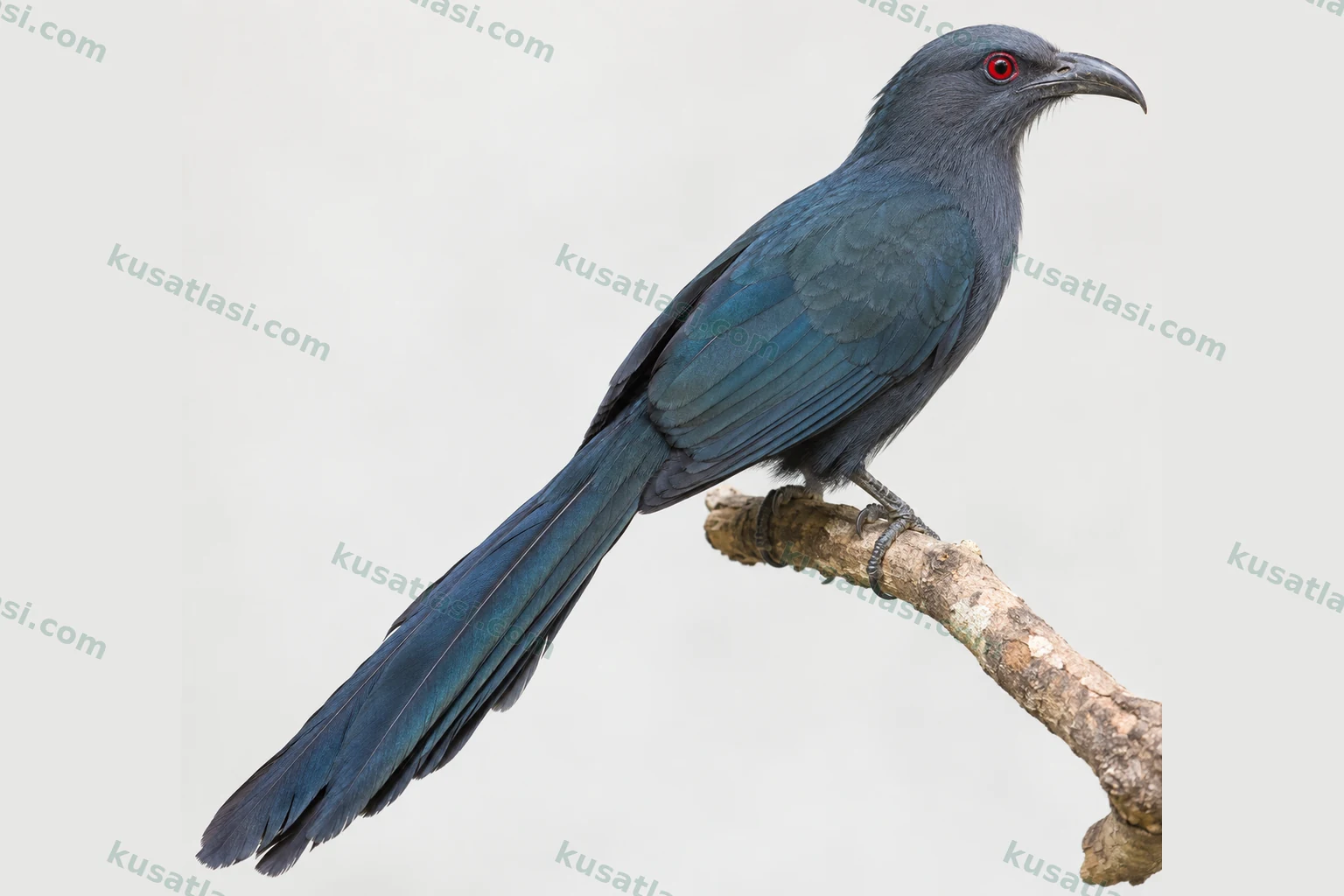
Do not rely on a single featureA conspicuous yellow bill in front of a dark head.
Dense vine connections in forest and at its edge.
Thin opening notes lead into an accelerating trill; a whistle rises and falls.
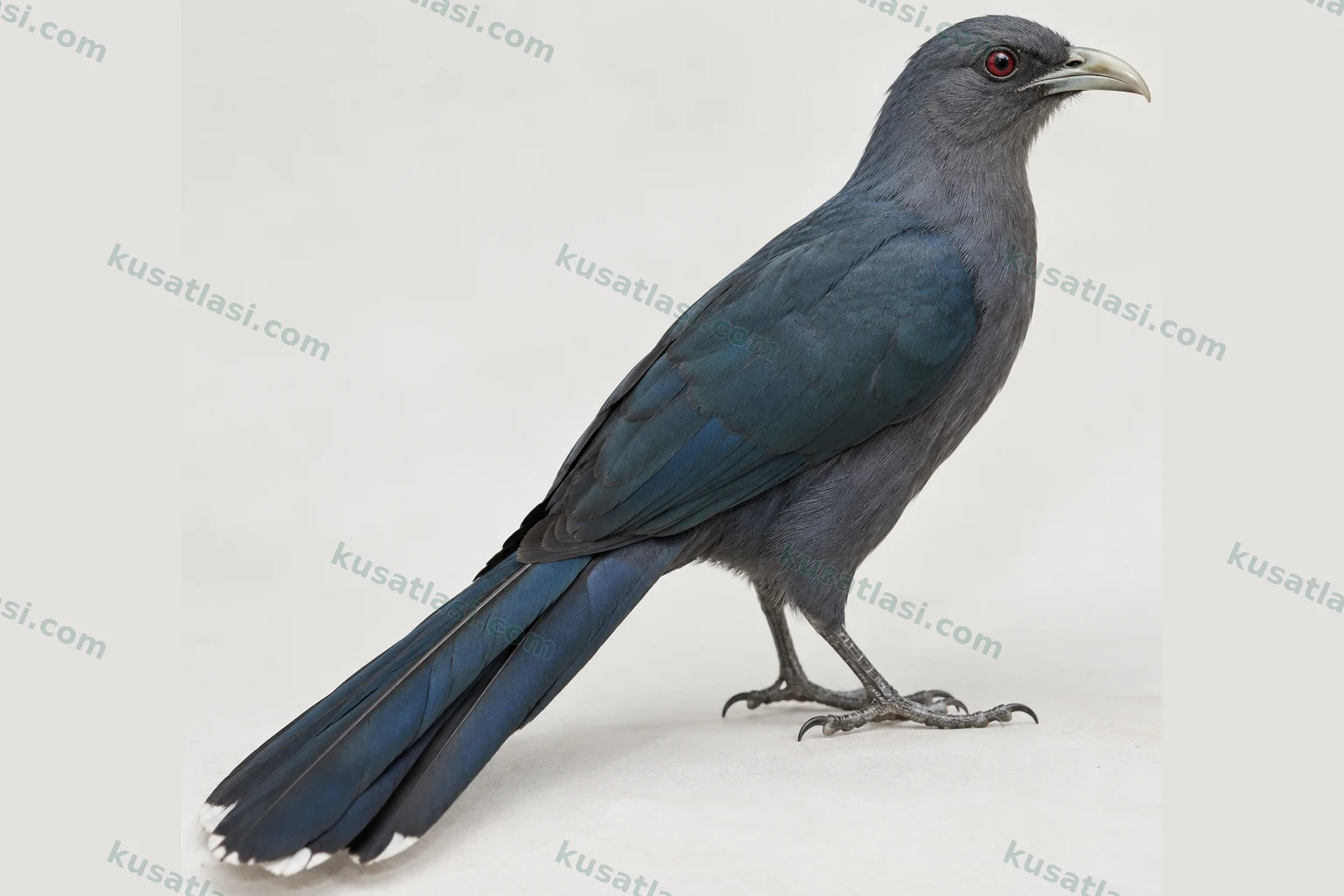
Compare male and female
 FemaleMale
Reliable sex identification at a distance was not verified; light and posture affect size and colour comparisons.
Where to look in its natural range?
Listen and watch the vine cover through natural openings along a forest path.
One January nest-building observation comes from Gabon; this month is not the egg-laying season throughout the range.
January
Described as resident; a regular long-distance migration route was not verified. M’Passa, Gabon: one nest-building observation.
February
Described as resident; a regular long-distance migration route was not verified. No verified regional date specific to this month was provided; this does not mean local absence.
March
Described as resident; a regular long-distance migration route was not verified. No verified regional date specific to this month was provided; this does not mean local absence.
April
Described as resident; a regular long-distance migration route was not verified. No verified regional date specific to this month was provided; this does not mean local absence.
May
Described as resident; a regular long-distance migration route was not verified. No verified regional date specific to this month was provided; this does not mean local absence.
June
Described as resident; a regular long-distance migration route was not verified. No verified regional date specific to this month was provided; this does not mean local absence.
July
Described as resident; a regular long-distance migration route was not verified. No verified regional date specific to this month was provided; this does not mean local absence.
August
Described as resident; a regular long-distance migration route was not verified. No verified regional date specific to this month was provided; this does not mean local absence.
September
Described as resident; a regular long-distance migration route was not verified. No verified regional date specific to this month was provided; this does not mean local absence.
October
Described as resident; a regular long-distance migration route was not verified. No verified regional date specific to this month was provided; this does not mean local absence.
November
Described as resident; a regular long-distance migration route was not verified. No verified regional date specific to this month was provided; this does not mean local absence.
December
Described as resident; a regular long-distance migration route was not verified. No verified regional date specific to this month was provided; this does not mean local absence.
Nest, egg and incubation
A nest-building record from Gabon concerns a vine tangle four–five metres high in dense cover. Egg number, full incubation duration and age at first flight could not be verified for the current taxon.
Thin, initially spaced notes lead into an accelerating trill; it also gives a long rising and falling whistle.
Do not play recordings to attract birds; observe quietly, especially near nests.
Species information
Quick identification
The Blue Malkoha Ceuthmochares aereus should be sought in densely leafy parts of the forest, where its dark blue-grey appearance and conspicuous yellow bill are useful clues. This long-tailed relative of the cuckoos moves among tangles of vines rather than remaining exposed for long. It helps to see the yellow bill first, then follow the body colour and long-tailed outline. A dark tail alone among the leaves does not identify it: other cuckoo relatives use the same cover.
Its current English name is Blue Malkoha. Older Yellowbill records may have a wider scope: Ceuthmochares australis, formerly included in the same species, is now separated as Green Malkoha. Thus, finding Ceuthmochares aereus in an old book does not guarantee that every detail describes the western and central African bird shown here. The locality and classification used must be read together. In particular, egg numbers and development times in southeastern African accounts must not simply be transferred to this species.
General appearance and posture
The yellow bill contrasts strongly with the dark head. Blue-grey feathers can look blacker in forest shade and more colourful in the open. Do not treat the colour temperature of one photograph as the bird's unchanging overall colour. If a leaf covers the bill, the yellow mark disappears; continue watching until the bird turns or raises its head. Green light reflected by a nearby leaf can mimic the sister species' colour, so geography is also part of the assessment.
Among vines, it does not merely sit horizontally on a branch: its body angle can change as it works upwards and sideways through branching cover. When head, body and tail are not visible together, the bird can appear shorter or longer than it really is. Recording which part was actually seen is more reliable than mentally completing an incomplete view. Waiting in dense vegetation for the bird to move naturally into another opening gives a better observation than parting the cover to drive it out.
Males, females and young birds
The current identification account used here gives the yellow bill and dark blue-grey colour pattern as species characters; it provides no reliable way to distinguish males from females at a distance. Without a verified distinction, an apparently brighter or larger body is not a sex character. Even side-by-side birds can be at different distances or adopt different postures, affecting size comparisons. Recording the sex as unknown does not devalue the other details of an observation.
No threshold is used to assign a young bird's age in days from tail length or pale feathers alone. Moult, wear and light can also affect appearance. If detailed age characters were not seen, age can be recorded as uncertain rather than assigning adult or young with confidence. Another bird beside it is not necessarily its chick. Singles, pairs and small groups were seen in the Gabon study, but the relationships between all group members were not determined.
A bird nesting in Gabon in January provides local evidence that this species uses its own nest. However, that observation does not establish the nest-builder's sex, the division of incubation duties or the young bird's development time. Nor is it correct to describe every member of Cuculidae as laying eggs in other birds' nests. Preserve what observations of this taxon actually show instead of deriving behaviour from the family name.
Appearance in flight
During a short passage through the forest, the long tail and dark body may be seen together, but leaves often obscure detailed wing colour. A tail seen separately from the body can be mistaken for another bird's wing, or every dark silhouette may be called a malkoha without the yellow bill being seen. Following the same individual from take-off to landing provides more identification information than a single brief view. Do not invent markings for the final part of its journey that was hidden from view.
Crossing a path or a gap over a stream is not, by itself, long-distance migration. A change of position within the same forest patch and a seasonal journey operate on different scales; record the flight direction only as the short movement actually observed.
Voice and behaviour
The Cornell account describes a call in which thin, initially spaced notes lead into a long, increasingly rapid trill, and a long whistle that rises and falls. In dense cover these sounds can help locate a bird before it is seen. Following the direction of the sound and linking it to a visible yellow-billed bird helps distinguish other sounds nearby. One similar syllable is not a substitute for the whole sequence: consider its rhythm and continuation too.
The Gabon researchers recorded sounds maintaining contact within small groups. Calling loudly does not necessarily mean seeking a mate or defending a nest; the researchers did not establish the function of some powerful sounds. Observers likewise should not infer breeding from loudness alone. Finding the bird feeding in the same cluster of leaves as other insectivorous birds may indicate a shared feeding opportunity; it does not make them all nesting partners.
Similar species
The Green Malkoha Ceuthmochares australis is the closest comparison in both appearance and name. It too is a yellow-billed bird of dense vine tangles, but its body is described as greener. Current Cornell accounts state that the two species' natural ranges do not overlap. This comparison does not imply that both are normal alternatives at the same site; it is particularly useful for assigning old, broadly defined Yellowbill records to the right taxon. The country of the record and date of the classification matter as much as photographic colour.
The Blue-headed Coucal Centropus monachus may come to mind during a brief glimpse because it has a dark head and lives in cover. It is larger and heavier-billed, with a notable association with wet scrub and swamp margins. Cornell describes blue reflections on the head and heavier, deep calls that accelerate downwards. Consider the Blue Malkoha's yellow bill, smaller build and different call sequence together. A blue gleam on the head alone is not enough to separate the two.
Global distribution
Its natural range extends from the forest belt of western and central Africa east to western Kenya and south to northern Zambia and Angola; Bioko is included. In the current classification, the western form flavirostris occurs from The Gambia to southwestern Nigeria, while aereus extends east and south from southeastern Nigeria. This broad geography does not mean that every intervening area is suitable habitat or continuously occupied. Open areas under intensive human use and dense forest cover are not equivalent.
Status within its natural range
The original study around M'Passa and Bélinga in Gabon regularly observed the bird in old secondary forest and natural forest. Research in the Lesio-Louna and Lefini reserves in the Republic of the Congo also recorded singles or pairs in forest and forest edge. Findings from these two regions support its association with forest cover; frequent sightings in one place do not demonstrate equal abundance across the continent. Concealment among dense leaves can also explain failure to see it during a short visit.
Birds described as aereus in older southern African sources may now fall within the separate Green Malkoha. This name change matters when interpreting maps: adding every old record to one current polygon could merge two species' ranges. An identical old scientific name is insufficient without reading the country and subspecies information. A current observation on the map must also be assessed with its own date and location.
Migration
The Gabon study described it as resident. The sources used do not provide a regular long-distance migration or monthly boundaries applicable throughout its range. Moving to another feeding opening within the forest is not migration. Connecting points on a map does not demonstrate that an individual followed that route; sighting localities and movement research convey different information. Regional observations are valuable for understanding the conservation of the forest and the layer of cover it uses.
Breeding habitat
Forest with dense vegetation and well-developed secondary woodland are the main places to search. Use of old secondary forest does not make newly cleared bare ground equivalent. Vines, leafy branches and connections between patches of cover affect where the bird can move. It may be seen around natural tree-fall gaps in forest; that observation must not be interpreted as evidence that extensive clearing is beneficial.
Nest site
At M'Passa in January, one bird was observed building a nest in a vine tangle within dense forest cover, four–five metres above the ground. This single record provides a nest site and a local date; it does not show that every nest of the species is at the same height. The egg number, full incubation period and age at first flight could not be verified for the currently separated taxon. Do not add its close relative's durations here or open foliage around a nest to seek missing information.
Daily habitat use
First listen for the bird along vine connections in the middle and upper forest cover, then patiently watch the same opening. Natural gaps visible without leaving a path are suitable observation points. Entering the sound source's immediate vicinity or breaking branches to expose the bird changes its behaviour. Keeping forest-edge and forest-interior records separate helps reveal which cover it uses.
What does it eat?
Direct feeding observations in Gabon and the stomach contents of two individuals revealed insects such as caterpillars, grasshoppers and praying mantises. These samples directly support insectivorous feeding, but do not provide prey proportions for every region of the continent or an unchanging menu. Instead of guessing the species of a small prey item that cannot be distinguished in the bill, record only the prey group that can be verified. A few feeding events are also insufficient to calculate total daily consumption.
How does it hunt?
Movement through leafy branches and vines is part of its feeding. The Gabon researchers observed instances in which tail movements flushed concealed insects and the bird turned to take them. Other insectivorous birds also benefited from the resulting prey opportunities. The direction of this relationship matters: the malkoha was the bird flushing insects in these observations; they do not show that it necessarily feeds by following another bird.
Not every movement by birds feeding side by side represents cooperation. Searching for the same prey, taking prey flushed by another bird, and sharing nest care are different behaviours. When leaves interrupt the view of a feeding event, which bird found the prey first may also remain uncertain. Protecting branches and leaf clusters preserves its searching environment; offering prey or flushing insects in the wild makes an observation less representative of natural feeding.
One old name, two current species
Ceuthmochares aereus was long used for a broader group of birds. Cornell's 2016 classification update explicitly records the separation of Blue Malkoha and Green Malkoha. Such a change does more than alter a name label: it requires reconsidering which population previously published breeding, distribution and measurement data describe. An old source does not become scientifically worthless, but its information cannot be transferred to a current species account without understanding its scope.
A feeding opportunity that starts with the tail
The long tail is more than part of the bird's outline in flight or at rest. Fieldwork in Gabon also recorded tail movements while searching for prey among leaves. Other birds can benefit from insects exposed by these movements. Following what each bird does, rather than merely listing different species seen together, reveals this relationship. Recording the bird that flushes prey separately from the one that catches it prevents the behaviour being described backwards.
Voice: a window onto a hidden bird
It is not always possible to see the entire bird inside the forest. The thin opening notes of its call and the increasingly rapid section that follows can help locate the vine cluster to watch. Still, locating a sound does not locate the bird's nest. Echoes in the forest, interruptions by other birds and moving leaves affect observation conditions. Listening without trying to drive the bird out of cover, and waiting at a natural opening, disturbs its behaviour less.
The limits of one nest observation
A bird building a nest in January is concrete evidence of local breeding activity. Turning that record into a fixed breeding calendar for all western and central Africa exceeds the evidence. Nest building, egg laying, incubation and first flight are separate stages; the date of one does not supply the duration of another. This distinction is especially valuable for rarely seen forest birds. Leaving a missing duration open until more detailed research is available gives a more accurate species account than filling it with a number belonging to the sister species.