

World Birds IUCN statusLC · Least ConcernGlobal IUCN category. BirdLife v10 (2025); taxon matching: AviList 2026 / IOC 15.2; checked: 29.10.2026. The list year is not the species assessment date. Source and method · BirdLife OrderCuculiformesCuckoos FamilyCuculidaeCuculidae
African Emerald Cuckoo
Chrysococcyx cupreus
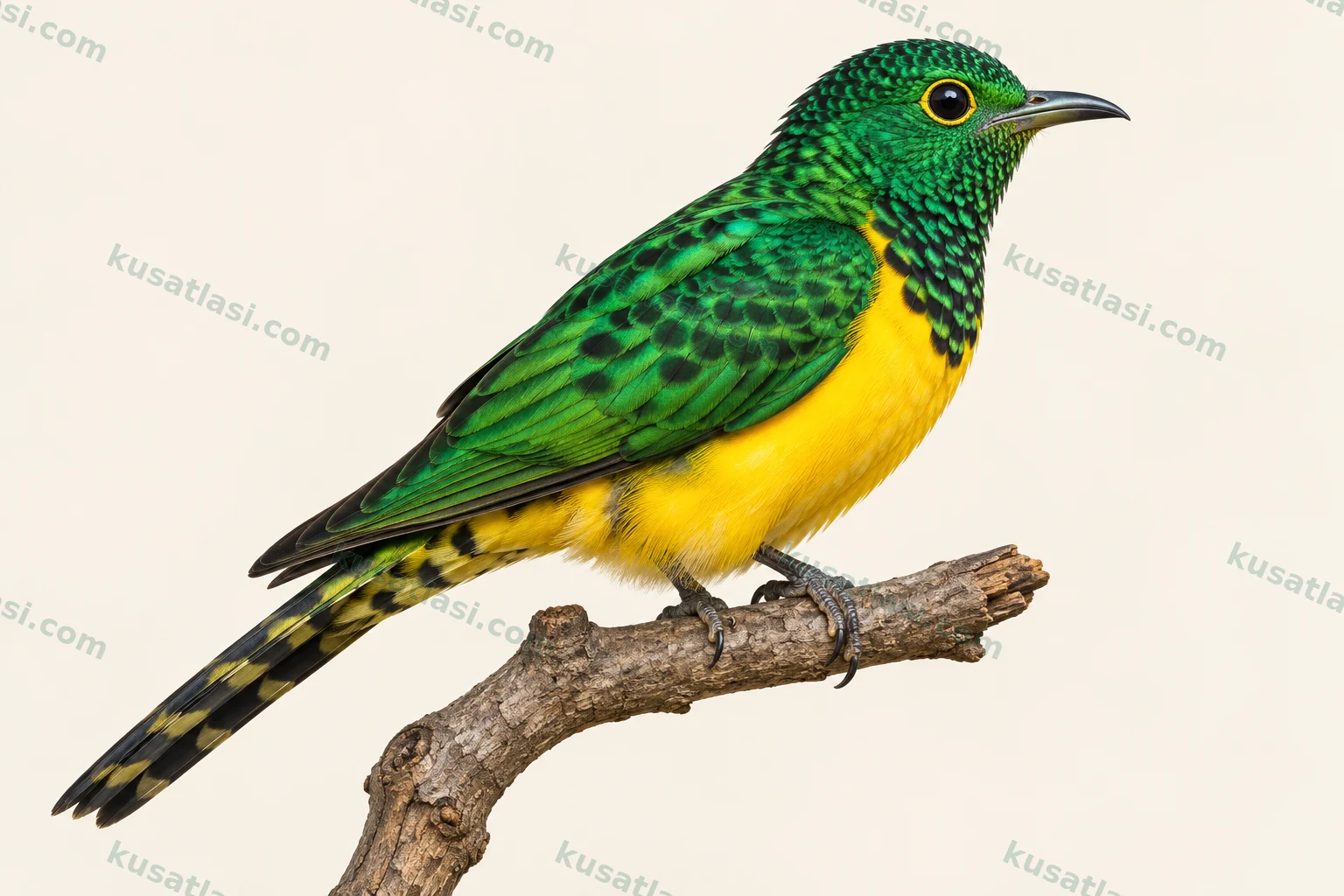
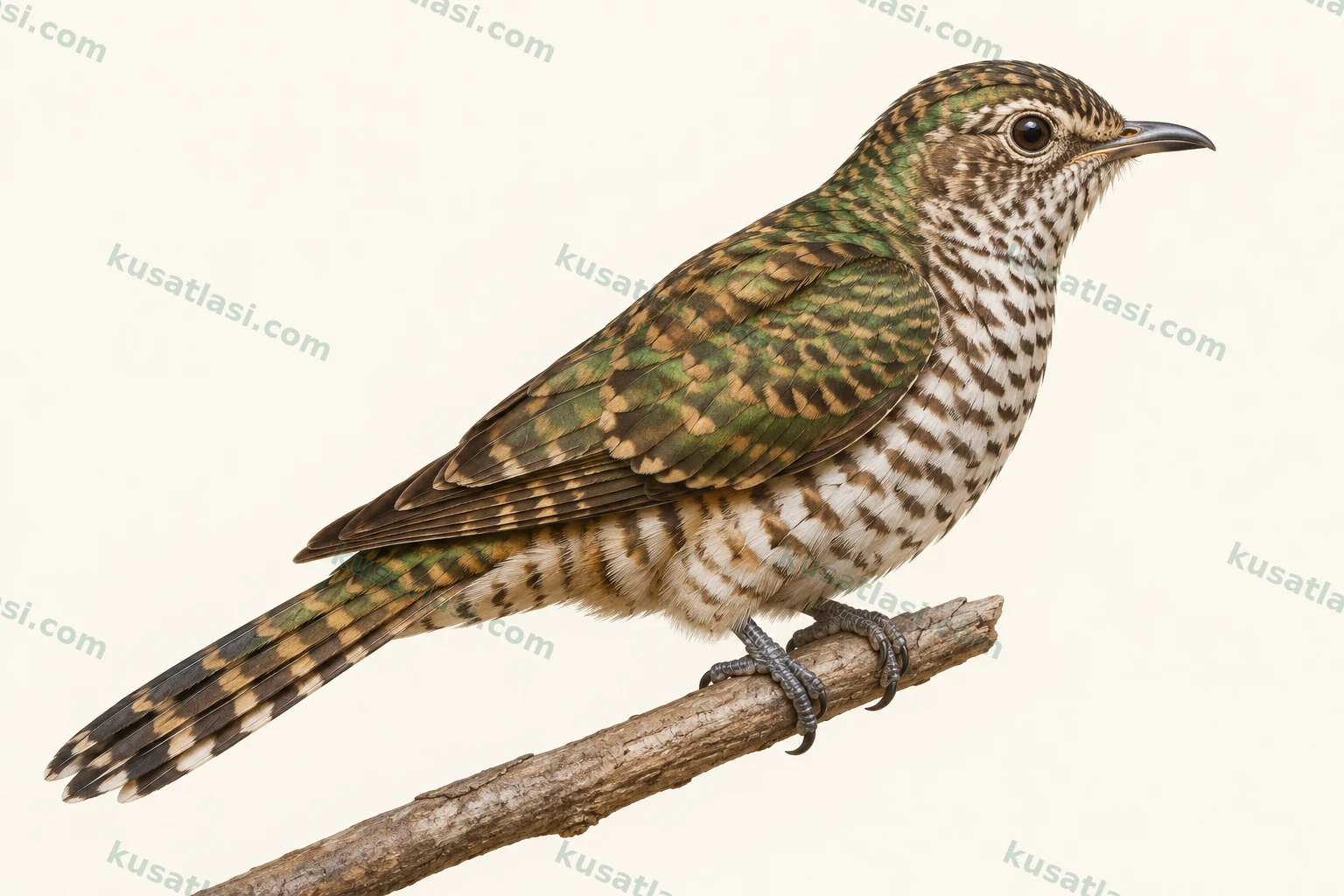
The male has a green head, upperparts and throat and a yellow belly; females and young are barred. This small forest cuckoo lays eggs in other songbirds’ nests.
Biometrics
Length
Male20 cm
Female20 cm
Shared species value
Wing length
Male10.57 cm
Female10.57 cm
Shared species value
Weight
Male30–46 g
Female30–46 g
Shared species value
African Emerald Cuckoo
Forests and dense woodland of sub-Saharan AfricaObservation guide in its natural range
Look for three features together
Do not rely on a single featureSee the boundary between the male’s green throat and yellow belly.
Head and throat pattern must be checked together on barred birds.
The small bird feeding a chick may be a host; identity is verified separately.
Compare male and female
 FemaleMale
The male is green-and-yellow, females and young more transversely barred; do not apply the plain male pattern to every age.
Where to look in its natural range?
Watch the bird in middle-to-upper foliage and the direction of its voice.
Egg-laying and atlas breeding records for southern Africa are shown separately; they are not one migration period for the whole continent.
January
Depending on region, residency or intra-African breeding migration; silence is assessed separately from actual movement. Southern African regional specialist account: The period when eggs are laid in host nests. Southern Africa, SABAP1: Reported breeding records, not just egg-laying dates.
February
Depending on region, residency or intra-African breeding migration; silence is assessed separately from actual movement. Southern Africa, SABAP1: Reported breeding records, not just egg-laying dates.
March
Depending on region, residency or intra-African breeding migration; silence is assessed separately from actual movement. No verified regional date specific to this month was provided; this does not mean local absence.
April
Depending on region, residency or intra-African breeding migration; silence is assessed separately from actual movement. No verified regional date specific to this month was provided; this does not mean local absence.
May
Depending on region, residency or intra-African breeding migration; silence is assessed separately from actual movement. No verified regional date specific to this month was provided; this does not mean local absence.
June
Depending on region, residency or intra-African breeding migration; silence is assessed separately from actual movement. No verified regional date specific to this month was provided; this does not mean local absence.
July
Depending on region, residency or intra-African breeding migration; silence is assessed separately from actual movement. No verified regional date specific to this month was provided; this does not mean local absence.
August
Depending on region, residency or intra-African breeding migration; silence is assessed separately from actual movement. No verified regional date specific to this month was provided; this does not mean local absence.
September
Depending on region, residency or intra-African breeding migration; silence is assessed separately from actual movement. No verified regional date specific to this month was provided; this does not mean local absence.
October
Depending on region, residency or intra-African breeding migration; silence is assessed separately from actual movement. Southern African regional specialist account: The period when eggs are laid in host nests.
November
Depending on region, residency or intra-African breeding migration; silence is assessed separately from actual movement. Southern African regional specialist account: The period when eggs are laid in host nests.
December
Depending on region, residency or intra-African breeding migration; silence is assessed separately from actual movement. Southern African regional specialist account: The period when eggs are laid in host nests. Southern Africa, SABAP1: Reported breeding records, not just egg-laying dates.
Nest, egg and incubation
It builds no nest of its own, generally laying one egg in a host songbird’s nest. A foreign specialist account gives about 13 days of incubation and 18–20 days in the nest for the young; another regional account gives about 22 days. The host provides care.
Mainland populations have a clear four-part whistled song; voices vary regionally and quiet periods occur.
Do not play recordings to attract birds; observe quietly, especially near nests.
Species information
Quick identification
African Emerald Cuckoo Chrysococcyx cupreus is a small cuckoo of sub-Saharan African woodland. In an adult male, the glossy green head and upperparts, green throat and breast and vivid yellow belly attract attention together. Green often looks very dark as the light changes; a head appearing almost black in shade does not change the bird’s basic colour pattern. Females and young are more barred, so not every individual resembles the plain green-and-yellow male.
The bird can remain among dense leaves and is often heard before it is seen. Good identification requires seeing the boundary between head, throat and belly colours on the same individual. Many small cuckoos have a green back; that colour alone is not a certain identity mark. A pale spot behind the eye and underpart barring help comparisons with other species, especially for females and young.
General appearance and posture
The male’s head and upperparts are emerald green; parts of the wing-coverts may show more golden reflections and the back may look darker. Throat and breast remain green, while the belly beginning below the breast and feathers around the legs are yellow. The undertail may have dark green bars on white. This must not be simplified into an entirely yellow underside; throat and breast need separate views.
In adults, the bill and bare ring around the eye are reported in blue-green tones. This ring is not the same anatomical area as the iris. Seeing a bright eye-ring does not justify assigning that colour to the whole eye. Head angle, reflected light and leaf shade can alter the apparent green. If head colour is unclear in one dark frame, seek a lighter view supported by belly and barring pattern.
Males, females and young birds
The female differs from the male’s plain green-and-yellow appearance. The upperparts may show green, olive and coppery-brown tones with bars; dark green or bronze transverse bands can be seen on the whitish underparts. Throat bars may look closer together and belly bars more widely spaced. The wings also have green and rufous bands. A white or barred belly alone does not automatically make the bird another cuckoo species.
Young may have green-brown upperparts and green-and-pale head markings; light and dark transverse bands below are conspicuous. Females and young can give a similar first impression. The male plate’s plain yellow belly is not required in these ages and sexes. Age assessment needs several areas to be seen; barring alone does not establish that the bird is young or female.
Females and young of Chrysococcyx klaas especially need comparison. A small pale spot behind the head and the tone of the throat bars may help in a good view. A light dot created by leaf shade is not a real feather patch, however. Check whether the patch persists as the same bird turns its head. If the area behind the eye is missing from the image, retain uncertainty rather than concluding that the mark is absent.
A small songbird feeding a young cuckoo need not be its biological parent. This species lays its egg in another species’ nest; the host undertakes incubation and care of the young. A small bird carrying food to a relatively large young cuckoo provides a valuable record of the breeding relationship. Even so, similar young cuckoos may be difficult to identify to species; the adult cuckoo’s identity is not inferred only from the species feeding the young.
Appearance in flight
The male’s green upperparts and yellow underwing-coverts are different surfaces. Yellow may be seen during a display with the wings open; this does not mean all flight feathers have the same yellow colour. Females and young may look more barred. A short passage among leaves may be insufficient to resolve detailed wing surfaces. Checking head and underpart pattern when the bird perches again is more reliable than a single flying silhouette.
The tail appears broader or narrower as it opens and closes in flight. That angle difference alone is not treated as evidence of another species. Everyday travel between treetops and seasonal movement are different events. Reports of migration in some southern populations do not make every observed flight a northward or southward migratory journey.
Voice and behaviour
A clear, whistle-like, four-part song is a commonly used identification clue in mainland populations. Voices vary regionally; differently divided songs have been described for São Tomé. Comparing a call to human words can help recall, but does not replace a recording or direct listening. Evaluate its parts and repetition together with the bird’s geography.
Becoming quiet outside breeding and remaining hidden in treetops can reduce detection. Few sound records in a month therefore do not establish the exact start of migration. Males defending a calling area do not prove the presence of a nest they built themselves; mate attraction and the host nest receiving an egg are not the same behaviour. Watch normal activity without approaching a nest or bird to hear its voice.
Similar species
1. An adult male Chrysococcyx klaas is compared through its green upperparts, white underparts and small white spot behind the eye; the male African Emerald Cuckoo differs in its yellow belly. For females and young, the pale spot behind the head and the colour of throat bars are evaluated together. A distinction easy between adult males is not applied unchanged to all ages; a good view is needed.
2. A barred female or young bird compared with another small cuckoo cannot be identified from green back and white barred belly alone. Pale head patches, throat, wing and tail pattern are checked on the same individual. A host feeding a chick also does not prove by itself that the chick is an African Emerald Cuckoo. If details remain unresolved, retain the observation and photo sequence without forcing a species identification.
World distribution
Its natural range extends from Senegal and Gambia to South Sudan and Ethiopia, and southwards to Angola and eastern South Africa. Forest and suitable wooded habitats determine distribution; very dry areas within this broad geography are not equally suitable. Gulf of Guinea island populations also feature in specialist sources. A country list does not imply use of every elevation and habitat within each country.
Status within its natural range
The southern African atlas emphasises eastern coastal forests, montane forests, riverside woodland and densely wooded savannas. Large trees in some settlements may also be used. Forest loss and fragmentation can affect not only a visible perch but the surroundings used by hosts too. The global category is Least Concern; this does not guarantee use of a particular forest fragment or the security of host nests there.
Seasonal movements
In southern Africa it is mostly described as a breeding visitor, with some individuals also recorded in winter. Farther north, populations may remain year-round or move with rainfall. The dated atlas specifically notes that seasonality in records cannot be fully separated from actual migration because of calling and concealment. This uncertainty argues against giving one arrival-and-departure calendar to the entire continent. A mapped record sample is not equivalent to current presence or breeding evidence, and model colour is not a certain distribution of host nests. No fixed route is drawn without tracking evidence.
Breeding habitat
Evergreen forest, riverside woodland, dense moist savanna and suitable secondary woodland are principal environments. Most feeding occurs in the middle and upper tree layers. Calling in large settlement trees does not imply equal breeding opportunities in every open garden. The nest habitat of host species receiving the egg is also part of the breeding relationship; the adult’s song perch alone does not represent the whole breeding area.
Nest site
Instead of building its own nest, it lays an egg in a small songbird’s nest. Host evidence in southern African sources is not uniform: some hosts are verified, others listed as possible. Thus, without converting possible hosts into a confirmed list, the account explains that generally one cuckoo egg is laid per host nest. A foreign specialist account gives about 13 days of incubation and 18–20 days for the young’s development in the nest; another regional account reports about 22 days (different source scopes for African Emerald Cuckoo). These durations are not averaged and are not all described as ages of independence.
Daily habitat use
High foliage used by the adult for feeding, a male’s song site and the host nest may be in different places. Repeated returns to one branch do not mean returning to its own nest. Do not assign a nest to the cuckoo without observing food delivery by the host; resemblance between chicks can add identity uncertainty. Approaching a nest can also affect the small host’s care of the young. A distant food-delivery observation may suffice to understand the relationship; opening the nest is unnecessary.
What does it eat?
Caterpillars and other insects are important in adult food. Specialist accounts include grasshoppers, larvae and some butterflies; fruit is also used occasionally. A long list in one source does not mean every bird eats that mixture every day. Foliage conditions and local season influence available prey. Simply perching in a fruiting tree is not direct evidence of eating fruit either.
Because a host feeds the chick, the adult cuckoo’s prey list and the menu delivered to young need not be the same. Assessing the relationship requires seeing who brings the food and which bird receives it. A host’s broad feeding category does not establish the contents of every transfer; an invisible morsel is not assigned a definite prey name.
How does it find food?
It gathers small prey among leaves and branches in the middle and upper tree layers. A brief bill movement in dense cover does not always show an actual capture. If a caterpillar or other prey is visible, capture and swallowing can be recorded separately. Repeatedly reaching its head in one direction may be only searching; a short view does not establish daily prey counts or success rates.
The observer should follow normal movement without trying to draw the bird out of the leaves. Moving between trees while foraging is not migration, and descending does not show that the whole population has changed habitat. An adult feeding itself and a small host feeding a cuckoo chick are described as different behaviours. This distinction makes one of the species’ most important life-cycle features clear.
Who provides care?
After the cuckoo lays its egg, the host undertakes incubation and care. The feeding bird’s appearance therefore does not mean the chick will grow into the same species. Host lists for African Emerald Cuckoo distinguish documented from merely possible relationships. Resemblance to other small cuckoo chicks may also require older host records to be reassessed.
Quiet periods and migration
A strong song helps locate the bird, while silence can make the same individual almost invisible. The dated atlas notes that part of the seasonal increase in records may reflect increased calling. This does not deny real migration; both factors may influence records together. Converting the number of visible records directly to the number of individuals in a month would lose this uncertainty.
Green changing with light
The male’s glossy green feathers may darken as its angle changes. The arrangement of yellow belly and green throat needs to be read separately from changing brightness. Rather than immediately naming a new colour form from one dark-headed image, watch the same bird turn naturally. Not assuming a colour for an unseen surface is particularly important beneath leaf shade.
One nest’s egg and annual production
A single cuckoo egg in a host nest does not mean the female lays only one egg all year. Likewise, an annual egg-production figure in a source does not give the number of eggs in each host nest. These different quantities are not mixed in one breeding box. Nest development and care after nest departure are distinct intervals too; differing specialist durations are explained in context rather than turned into a new average.