

World Birds IUCN statusLC · Least ConcernGlobal IUCN category. BirdLife v10 (2025); taxon matching: AviList 2026 / IOC 15.2; checked: 29.10.2026. The list year is not the species assessment date. Source and method · BirdLife OrderAnseriformesDucks, geese and allies FamilyAnatidaeAnatidae
Green Pygmy-Goose
Nettapus pulchellus
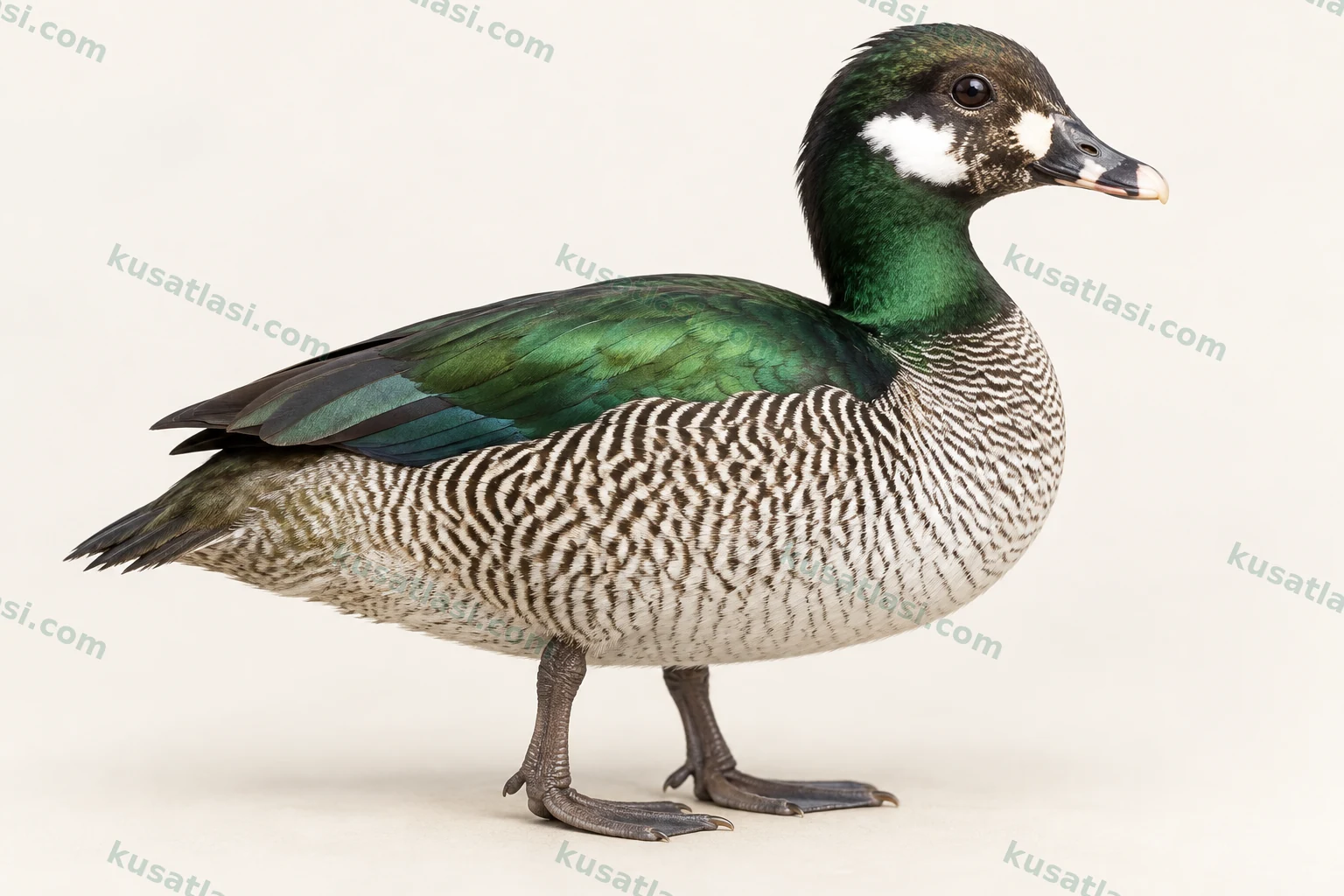
It is a small, short-billed waterbird with a green head and neck, white cheek and finely patterned pale flanks. Look for it on waterlily-covered fresh waters around northern Australia and New Guinea.
Biometrics
Length
Male30–36 cm
Female30–36 cm
Shared species value
Wingspan
Male48–60 cm
Female48–60 cm
Shared species value
Weight
Male300–430 g
Female245–340 g
Green Pygmy-Goose
Tropical northern and eastern Australia, southern New Guinea and surrounding islandsObservation guide in its natural range
Look for three features together
Do not rely on a single featureObserve the green head and neck together with the pale cheek area.
Examine the fine dark arc-shaped pattern on the pale flanks.
This record is Green Pygmy-Goose, Nettapus pulchellus.
Compare male and female
 FemaleMale
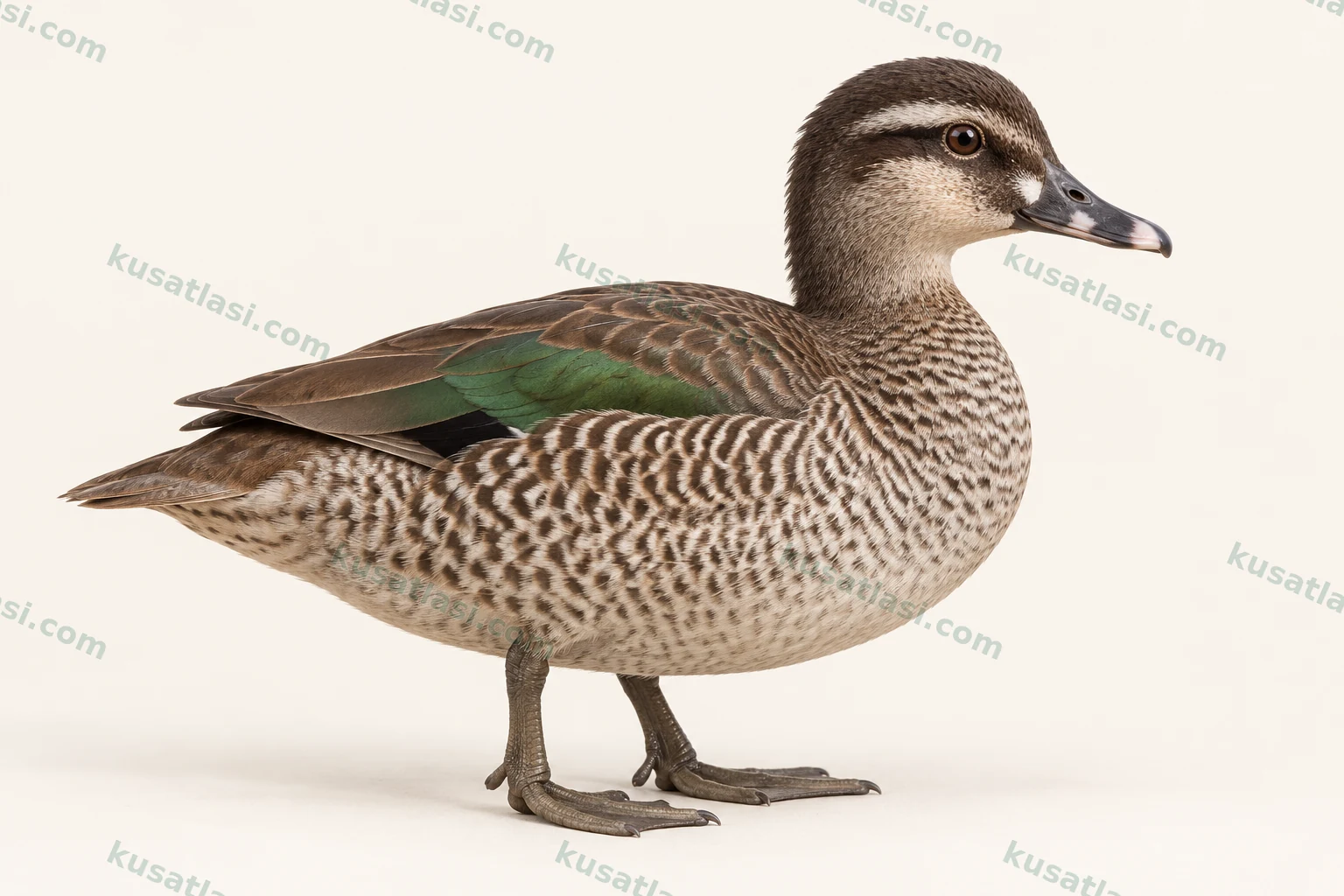
The sexes share the same basic colour pattern; the female’s white cheek patch may be more conspicuous. A single colour tone does not determine sex with certainty.
Where to look in its natural range?
Watch the water surface in lagoons, ponds and swamps with waterlilies.
A shared sequence of breeding months for the islands and Australia was not verified. The dated Sumbawa observation does not substitute for seasonal occurrence or a breeding calendar.
All months: regular presence in suitable fresh waters; movements and breeding status on islands vary regionally. No verified regional date specific to this month was provided; this does not mean local absence.
January
February
March
April
May
June
July
August
September
October
November
December
Nest, egg and incubation
Nest sites are tree hollows above water or concealed grassy places near water; the regional guide gives 6–12 eggs. The female incubates, the male keeps watch and both parents care for the young. The number of incubation days was not verified.
A detailed sound description distinguishing the species was not verified in this work; another duck’s voice is not transferred to it.
Do not play recordings to attract birds; observe quietly, especially near nests.
Species information
Quick Identification
The Green Pygmy-Goose, Nettapus pulchellus, is a small waterbird. This page concerns N. pulchellus of tropical northern and eastern Australia, southern New Guinea and some surrounding islands. Assess its small size, short deep bill, green head and neck and finely patterned pale flanks together.
It looks very small and compact on the water. Green gloss on the head and back may darken with the light angle; an almost black appearance in shade does not make it another species. Fine wavy patterning formed by dark feather edges on a grey-white background is important on the flanks. A white cheek patch is particularly apparent in the female. Cheek, neck colour and body pattern should be seen on the same bird.
General Appearance and Posture
The head, neck and back are glossy dark green, while the continuation of the neck, breast and flanks bear paler grey-white patterning. Green or brownish dark feather edges form overlapping small arcs. This fine flank pattern can merge into a uniformly grey-looking surface at a distance. The small bill is short and deep, resembling a goose’s bill. The feet are webbed and grey-green. Its appearance on the water is more commonly encountered than its somewhat clumsy appearance on land.
The bird may lower its head among water-lily leaves or dive and surface again. Water reflections and wet feathers can alter the apparent head colour. Watch it turning its head to distinguish a broad white cheek patch from a light reflection around the eye. Feet and short steps may be observed ashore, but driving the bird onto land or making it swim solely for a photograph disturbs natural behaviour.
Males, Females and Young Birds
Adult sexes share the basic green and pale grey-white colour arrangement. The regional guide emphasizes the female’s more obvious white cheek patch. This feature helps when the whole head is visible; a tiny white reflection or blurred frame does not determine sex conclusively. Wet feathers, light direction and head angle affect the visible patch size. Assigning every darker bird as male and every paler bird as female is unreliable.
Juveniles should not be forced into an adult male key in every detail. For a bird of unknown age, first assess small body, short bill, flank pattern and visible wing areas. Nearby adults provide context, but do not alone establish kinship or exact age. Direct feeding, protection or following young moving together better supports a family group. No unverified juvenile day count or definite eye colour different from adults is given here.
Pairs and small family parties may be seen. Two adults beside one another on the water cannot be sexed from their positions alone. A female incubating and a male keeping watch during breeding provide behavioural information; not every quiet wait proves incubation. Climbing a tree, looking into a hollow or displacing birds to see a nest is unnecessary.
Appearance in Flight
Pale wing areas may show briefly in flight. The regional guide describes them as white wing windows. Seeing which feathers carry white across several angles is more useful than one distant flash. In the study of the first Sumbawa record, the white seen was considered with the white area on the inner part of the flight feathers and formed part of separation from Nettapus coromandelianus. Identification used the complete appearance, not one mark.
The short bill and small compact body remain useful in flight. White wing areas may be hidden in a frame; not seeing them does not prove absence. A flight over water to another water-lily patch is daily feeding movement. Occurrence among islands suggests wider movements may occur, but no precise migration line is drawn where the source did not track it. Recording the arrival direction at the time does not establish the starting island or the whole journey.
Voice and Behaviour
Feeding is most often observed on quiet waters containing aquatic plants. A pair or small family party may disappear among leaves. A resurfacing bird is not counted as new without checking whether it is the one that just dived. Diving and resting are distinguished by continuously following the head entering and leaving the water. A clumsy-looking stance on land does not imply poor flight ability.
No detailed species-distinguishing vocal account was verified in the foreign specialist sources checked for this work. This section is therefore not filled with calls of other small ducks. A heard sound may be added to a note if visually linked to the same individual; one written syllable does not represent every call type. Feeding, swimming and family behaviour can be observed independently of this lack of vocal information.
Similar Species
1. Nettapus coromandelianus is a small waterbird that may occur in the same regions. For Green Pygmy Goose, look for the green head and neck together with finely lined pale flanks. The position of the white wing area matters in flight. The Sumbawa observation used small rounded head, short bill, white cheeks, fine flank lines and white in the flight feathers together; small size alone is not identification.
2. Nettapus auritus can cause confusion with this species because of the old Turkish catalogue name “African Pygmy Goose”.
Global Distribution
The main natural range of Green Pygmy Goose is tropical northern and eastern Australia and southern New Guinea. The current taxonomic list specifies Australia from the Kimberley to central-eastern Queensland, southern New Guinea, the eastern Lesser Sundas and southern Moluccas. These broad regional names do not imply equal abundance or breeding status on every island. Resident, seasonal and rare visitor status on islands must be evaluated separately.
Status Within Its Native Range
It occurs regularly in suitable freshwater habitats of northern Australia and southern New Guinea. The southern New Guinea lowlands and rare northern records do not have the same level of abundance. Around Townsville, pairs or small family parties can be seen on water-lily lagoons, ponds and swamps. The current list gives Least Concern on the status card; this does not make damage to one pond insignificant.
Migration
No single verified annual route applies to all individuals between Australia and the islands. The bird recorded on Sumbawa in 2014 was the first published record for that island. The study discussed a possible link between Indonesian records and the northern Australian dry season, but called for more research into visitor and resident status. This is a movement hypothesis, not definite breeding on Sumbawa or a fixed migration calendar. The map therefore draws no definitive route; the coloured range model and dated observation cells are shown as different evidence.
Breeding Habitat
Freshwater lagoons, ponds and swamps covered with water lilies and other aquatic plants are important environments. Deep water together with surface vegetation offers opportunities for both swimming and diving to feed. Open water alone is insufficient; the plant community and nearby nest opportunities matter too. Presence in a reservoir does not prove that every artificial lake serves the same function.
Nest Site
The Townsville regional guide reports tree hollows above water and nest sites hidden by dense grass near water. The same account describes 6–12 eggs, incubation by the female, the male keeping watch and both parents caring for young, regional specialist information for Green Pygmy Goose. Incubation duration in days was not verified here; it is not borrowed from another pygmy goose. Watch the family from a distance on the water rather than opening a hollow or approaching young.
Daily Space Use
While feeding, it moves among water-lily leaves, lowers its head or dives to reach plant material. Different plant patches in one pond may be used at different times. Resting on a shore does not locate a nest there. Adult behaviour around a tree hollow is not asserted as nesting without direct evidence either. Following water level and vegetation structure together provides a more meaningful habitat record than measuring pond area alone.
What Does It Eat?
Aquatic plants, plant seeds and grass seeds are the main verified foods. It may eat water-lily buds and plant parts within reach. The regional guide also describes filtering seeds at the water surface. This does not imply equal consumption of every plant in the water. One feeding observation cannot establish the whole year’s diet proportions; unverified percentages of animal food are not given here.
How Does It Obtain Food?
It swims among leaves to reach buds, dives for submerged plants and picks up small floating foods with the bill. The feeding heading does not claim that the species mainly hunts animals; it describes how food is reached. The distance between diving and surfacing points does not reveal the whole underwater path. In turbid water, the plant taken may be impossible to name with certainty.
An approaching boat or person on the shore may direct a feeding bird to another plant patch. This altered movement must not be interpreted as natural habitat preference. Offering food may simplify observation but changes food choice. Watching without damaging the plants it uses gives more reliable information about behaviour and habitat. An adult keeping watch in a family group and another individual feeding can be recorded as different behaviours.
The Scientific Name Resolves a Geographical Error
The old Turkish catalogue name meaning “African Pygmy Goose” did not match this record’s scientific name. Nettapus pulchellus is Green Pygmy-Goose; the African N. auritus is a different species. A local name suggesting a continent does not replace verified taxonomic identity. Linking title, distribution and breeding information to the same scientific record also prevents the map from showing the wrong continent.
Water Lilies Provide a Feeding Environment
Water-lily water is not merely an attractive backdrop. Buds, submerged plant parts and seeds at the surface offer different feeding opportunities. Diving and merely lowering the head into water are different movements. Continuous observation of both shows the food’s origin better than one still photograph.
The Limits of One Predator Encounter
In a published Australian observation, Brown Goshawk, Accipiter fasciatus, attacked a Green Pygmy Goose, which escaped. This directly documents an attempted attack, not the species’ main cause of death or every predator’s success rate. Knowing an event occurred and knowing its frequency in a population are different. Natural observations should retain that distinction. Movement towards water or another safe place was also behaviour observed in this one event; not every individual is assumed to choose the same escape route in every attack.