

World Birds IUCN statusLC · Least ConcernGlobal IUCN category. BirdLife v10 (2025); taxon matching: AviList 2026 / IOC 15.2; checked: 29.10.2026. The list year is not the species assessment date. Source and method · BirdLife OrderCuculiformesGuguklar FamilyCuculidaeCuculidae
African Cuckoo
Cuculus gularis
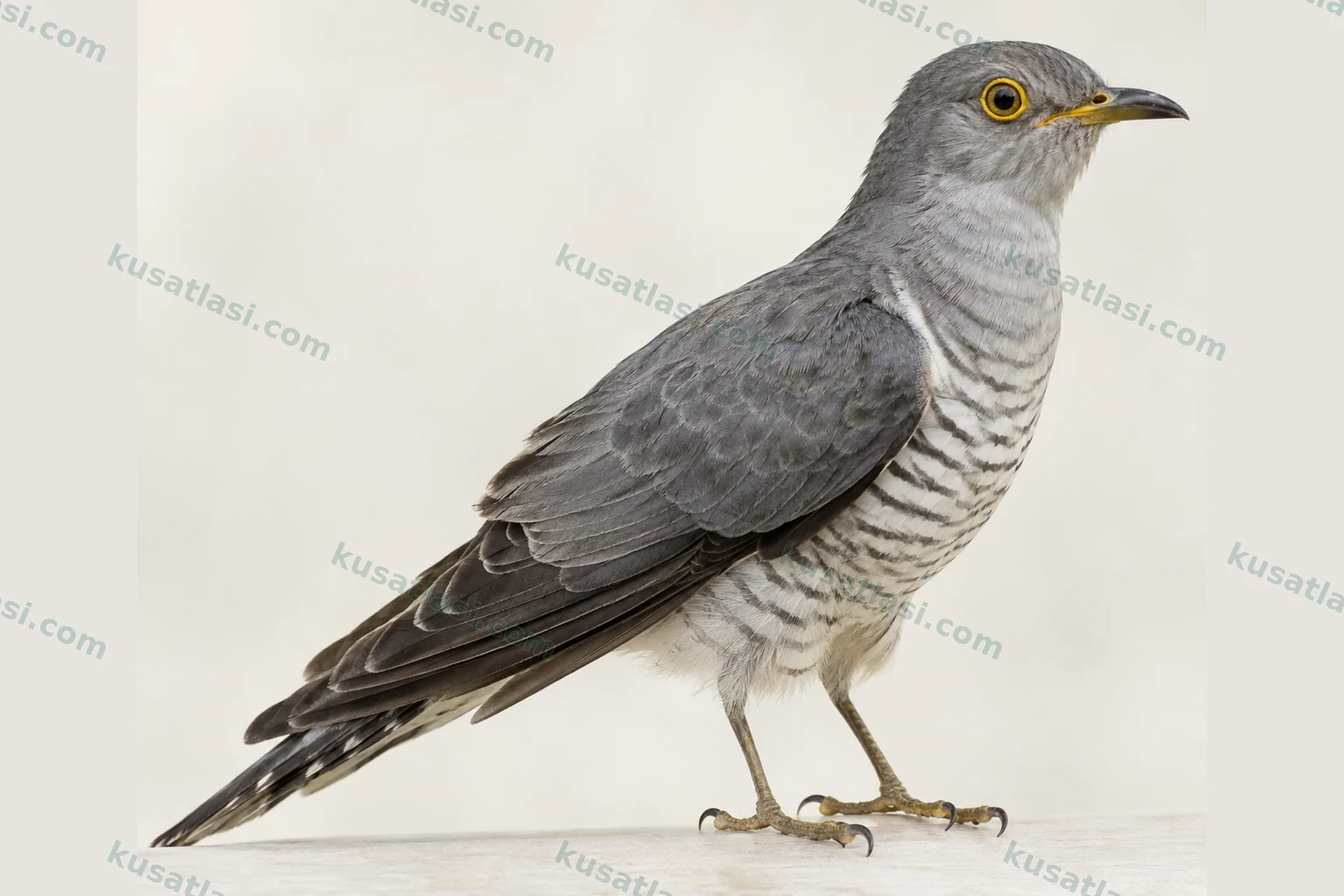
A grey cuckoo with long wings and tail. The adult’s extensive yellow bill base and different call are used together when comparing it with the similar Common Cuckoo.
Biometrics
Length
Male32 cm
Female32 cm
Shared species value
Wing length
Male20.9 cm
Female20.9 cm
Shared species value
Weight
Male95–115 g
Female95–115 g
Shared species value
African Cuckoo
Suitable savannas and open woodlands of sub-Saharan AfricaObservation guide in its natural range
Look for three features together
Do not rely on a single featureThe whole bill must be visible from a suitable side view; a yellow tip alone does not confirm identification.
Assess these with the long tail and wings; young birds look different.
Check that the voice belongs to the bird seen; a written imitation does not replace a recording.
Compare male and female
 FemaleMale
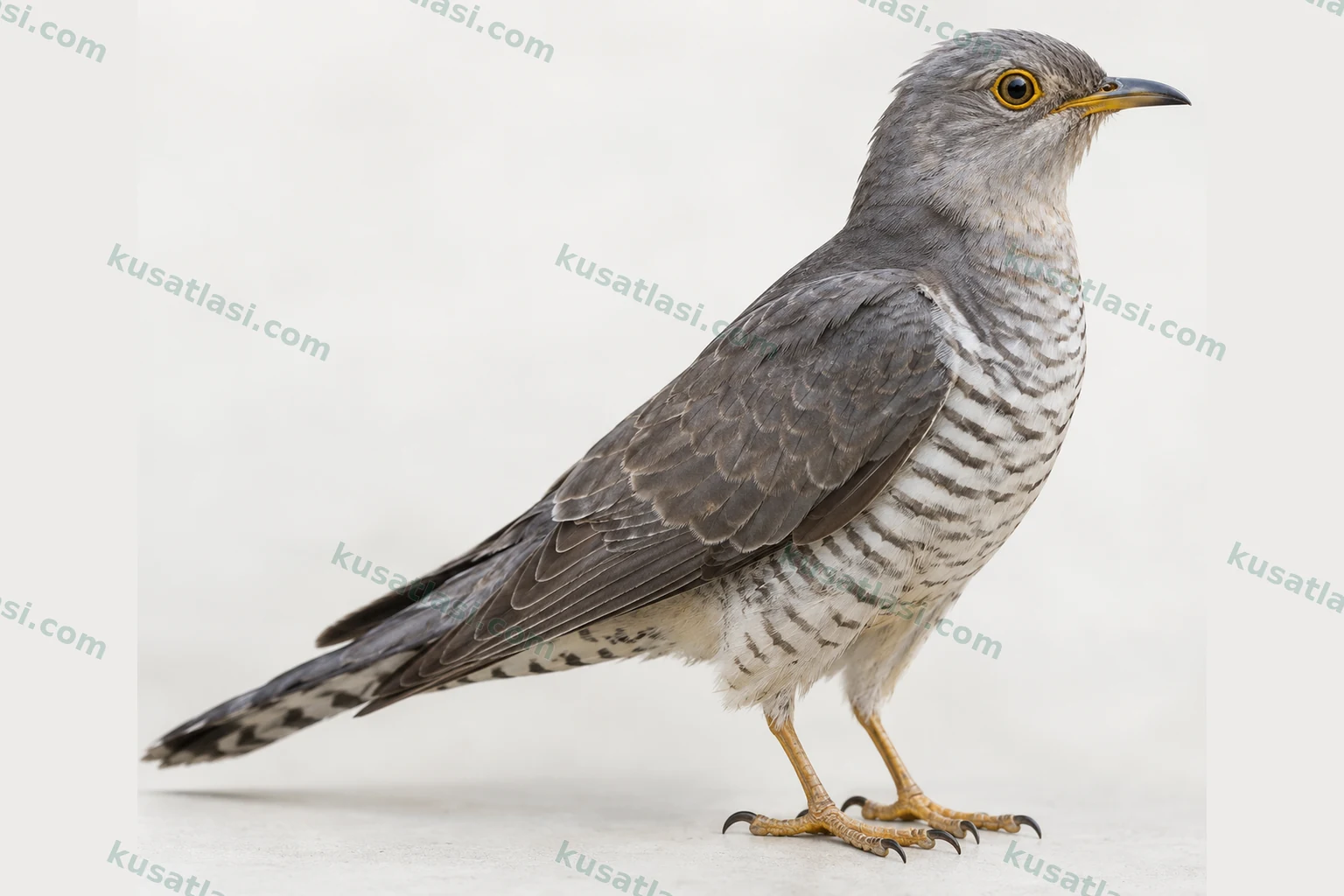
Adults share the basic grey appearance; the female’s slight throat-colour difference is not a reliable sex key in poor light. Young can be dark with pale feather edges.
Where to look in its natural range?
Follow the source of the voice in open woodland. Do not approach drongo nests; identification is not made by touching an egg or chick in a nest.
It migrates within Africa. The arrival, egg-laying and departure intervals in the South African account are separate regional examples; no single route or monthly absence is drawn for all Africa.
January
An intra-African migrant; local breeding and nonbreeding status is assessed using actual regional records. No verified regional date specific to this month was supplied; this does not mean local absence.
February
An intra-African migrant; local breeding and nonbreeding status is assessed using actual regional records. No verified regional date specific to this month was supplied; this does not mean local absence.
March
An intra-African migrant; local breeding and nonbreeding status is assessed using actual regional records. The South African specialist account places this month within its examples of departure.
April
An intra-African migrant; local breeding and nonbreeding status is assessed using actual regional records. The South African specialist account places this month within its examples of departure.
May
An intra-African migrant; local breeding and nonbreeding status is assessed using actual regional records. No verified regional date specific to this month was supplied; this does not mean local absence.
June
An intra-African migrant; local breeding and nonbreeding status is assessed using actual regional records. No verified regional date specific to this month was supplied; this does not mean local absence.
July
An intra-African migrant; local breeding and nonbreeding status is assessed using actual regional records. No verified regional date specific to this month was supplied; this does not mean local absence.
August
An intra-African migrant; local breeding and nonbreeding status is assessed using actual regional records. The South African specialist account places this month within its examples of arrival.
September
An intra-African migrant; local breeding and nonbreeding status is assessed using actual regional records. The South African specialist account places this month within its examples of arrival. The South African specialist account places this month within its examples of egg-laying.
October
An intra-African migrant; local breeding and nonbreeding status is assessed using actual regional records. The South African specialist account places this month within its examples of egg-laying.
November
An intra-African migrant; local breeding and nonbreeding status is assessed using actual regional records. The South African specialist account places this month within its examples of egg-laying.
December
An intra-African migrant; local breeding and nonbreeding status is assessed using actual regional records. The South African specialist account places this month within its examples of egg-laying.
Nest, egg and incubation
It does not build its own nest; it lays in a host’s nest. Fork-tailed Drongo is a principal verified host. The South African synthesis reports 11–17 days of incubation by the host and nest departure at about 23 days; this is not incubation by the female cuckoo herself.
The hollow-sounding two-part call differs from that of Common Cuckoo; it can be conspicuously vocal during breeding.
Do not play recordings to attract birds; observe quietly, especially near nests.
Species information
Quick identification
African Cuckoo Cuculus gularis has a grey head and upperparts, pale barred underparts, a long tail and long wings. The yellow area at the base of an adult’s bill is extensive, reaching about half its length in most suitable views. This helps comparison with the very similar Common Cuckoo Cuculus canorus. A distant grey silhouette alone does not separate the two. Head, bill, underparts and tail are examined together; the bird’s voice, if heard, provides additional identification information.
The accepted scientific name is Cuculus gularis and the English name is African Cuckoo. This page does not include other African cuckoos bearing similar names. Especially among similar-looking migratory cuckoos, a geographical name must not be confused with species identity. Seeing a cuckoo in Africa does not automatically make it an African Cuckoo; other Cuculus species can occur on the same continent. Identification relies on marks actually seen and heard rather than name or location alone.
General appearance and posture
The tail makes up an important part of the long silhouette.
Adult upperparts are grey, the throat and upper breast paler grey, and the belly has dark transverse bars on a whitish background. The anatomical location of the bars matters. A turned flank or a wing shadow may hide the true underpart pattern. A photograph showing a single dark band is therefore not read as though the whole belly pattern had been seen. Waiting for a natural change of posture may be more useful than greatly brightening the image.
The extent of yellow at the bill base is assessed from a suitable side view. Light and angle can blur the boundary between the black tip and yellow base. If the whole bill is not visible, its proportions cannot be judged with certainty. A yellow eye and pale eye surround may be seen on the grey head, and yellow feet may also be visible. Neither a yellow eye nor yellow feet alone reliably separates closely similar cuckoo species. Bill colour pattern is used with the other marks.
White marks on the lateral feathers of the long tail are easier to see when it spreads. Overlapping feathers can alter the pattern with wings closed. White tail areas and belly bars are not the same anatomical surface; seeing one does not mean the other has been seen. A perched bird may stretch its body or look more compact. Such posture differences make size comparison in photographs harder.
Males, females and young birds
Adult males and females share the basic grey appearance. The specialist synthesis notes that a female may have a rufous tinge to the throat and upper breast; this subtle difference is not a reliable sex key in poor light. A cuckoo with an entirely different-looking body is not added to this species simply by assuming it is female. Age, the possibility of another species and the pattern actually seen are assessed first. The appearance of the yellow bill base is not attributed solely to sex either.
Young may look darker than adults with conspicuous pale feather edges, and may have dense barring on head and underparts. The adult’s plain grey breast is therefore not required in the same way in a young bird. A juvenile’s pattern must not be forced into an adult identification key before age is considered. Pale feather tips, dark upperparts and the whole head-and-body appearance are checked together. A photograph showing only one wing does not provide the complete age-related appearance.
A drongo feeding a large youngster may suggest a cuckoo chick, but the host alone does not prove the youngster’s species. The fed bird’s own appearance and the locally possible species are also needed. Identification is not completed by approaching the nest or handling the chick. If images and behaviour are insufficiently clear, a record can remain uncertain; that is more reliable than inventing a missing detail.
Appearance in flight
The long wings and tail can give a falcon-like silhouette in powerful flight. Cornell also emphasises this resemblance; it does not make the bird a predator. Even if wing shape and underpart bars are seen together, a distant flight view is not always enough to identify the cuckoo species with certainty. If head and bill details cannot be resolved in flight, looking from outside towards its landing place is more useful.
The flight direction of a migrating individual does not represent the migration route of the whole species. Long, powerful flight is not substituted for actual movement data. A short passage between trees and seasonal movement are different behaviours; only the movement actually seen is recorded in a single observation.
Voice and behaviour
It can call conspicuously during the breeding period. The call is described as a hollow-sounding two-part note and differs from the familiar Common Cuckoo call. A written sound imitation does not fully convey rhythm and emphasis. Without seeing the source, the voice should not be assigned to another bird nearby.
The species is a brood parasite: rather than building her own nest and raising young, the female lays in another species’ nest. Fork-tailed Drongo Dicrurus adsimilis is a principal host confirmed by peer-reviewed field research. Studying this relationship does not mean that every drongo nest is parasitised. A cuckoo near a nest is not certain evidence that she has laid there either. Egg mimicry and the host’s discrimination against foreign eggs are discussed in the interesting facts section with the limits of the evidence.
Similar species
Common Cuckoo Cuculus canorus is one of the closest field comparisons. The adult African Cuckoo’s more extensive yellow bill base and different call are assessed together. Two distant silhouettes looking equally large cannot become a measurement comparison without a photographic scale. When the bill tip is hidden, the yellow–black proportion is unreliable; wait for a natural side view for identification.
When comparing Lesser Cuckoo Cuculus poliocephalus and Madagascar Cuckoo Cuculus rochii, African Cuckoo is assessed as larger, with tail and rump not creating a much blacker contrast with the rest of the bird. Size comparison is not applied alone without knowing age and observation distance. A record in which a mark was not seen is not a record of its definite absence; voice, bill and the complete plumage pattern are needed together.
Global distribution
African Cuckoo occurs across a large part of sub-Saharan Africa, with open woodland and savanna providing its main geographical setting. The southern African specialist account lists suitable areas of northern and central Namibia, Botswana, Zimbabwe, Mozambique and northeastern South Africa. The same prevalence is not assumed in the closed forests of the Congo Basin or some parts of Somalia. A broad continental range does not mean continuous occupation at every point.
Status within its natural range
Specialist accounts give the global conservation category as Least Concern. That category and local breeding success describe different scales. The results of the egg-mimicry research in one area of Zambia cannot be used as the population trend of the whole continent. Similarly, hearing it often in one protected area does not show equal abundance everywhere. Observation date, calling season and cover affect how readily the bird is noticed.
The map layer shows modelled area separately from licensed observation samples. The model is not presented as an actual breeding boundary, and an observation point is not evidence of a resident natural population or nest. Keeping breeding and nonbreeding records apart is especially important for a widespread migratory bird. No new seasonal polygon is drawn where verified seasonal boundary data are lacking.
Migration
The species migrates within Africa. The southern African account reports arrival in August–September and departure after breeding in March–April (a regional example, not a single date for all Africa). These dates do not yield a route connecting particular countries in sequence or a total distance. The calendar distinguishes regional arrival and egg-laying information; not hearing the bird in a month is not treated as certain absence. Rainfall-related breeding patterns do not establish an individual’s movement direction without actual records.
Breeding habitat
Open woodland and acacia savanna are the main surroundings listed in the specialist account. A preference for more open wooded areas rather than closed evergreen forest is reported. The cuckoo’s presence alone is not sufficient for breeding; a suitable host and its nesting habitat matter too. That relationship does not justify treating every place with trees as equally suitable breeding habitat.
Nest site
African Cuckoo does not build its own nest. The female lays in a host’s nest, and the host carries out incubation and chick care. The southern African specialist account reports about 11–17 days of host incubation of the singly laid egg and nest departure at about 23 days (a regional synthesis, not the female cuckoo’s own incubation or a fixed duration for the whole species). Differing durations in compilations were not averaged. A compiled egg total is not confused with the number laid in one nest either.
Daily space use
The bird seeks food in leafy parts of trees and bushes and may occasionally descend to the ground. An observer must not put pressure around nests on either cuckoo or host. Touching a nest or conducting an egg experiment to check for a foreign egg is inappropriate. Permitted methods used in scientific research are not transferred to everyday birdwatching. Feeding behaviour can be watched from outside; move away if an adult cannot reach its nest.
What does it eat?
The regional specialist synthesis describes caterpillars as the basis of the diet. Beetles, grasshoppers, termites and winged ants are also recorded prey. Some records include eggs and small young birds; their presence does not mean that the entire diet consists of birds. AVONET’s invertebrate-feeding category gives a broad ecological summary, not prey percentages for individual regions.
How does it hunt?
Food is mainly sought among leaves of trees and bushes. An individual seen on the ground is also compatible with the brief descents reported in the specialist account; food type is not deduced solely from the surface on which it sits. If prey is visible in the bill, record the details that can genuinely be distinguished. An unclear dark shape in a photograph is not turned into an insect species by guesswork.
Brood parasitism and adult feeding are different subjects. Food that a host brings to a cuckoo chick does not represent the adult cuckoo’s entire food list. Using a host’s nest does not mean that the adult continually obtains food from that nest either. Keeping food observations with age and context prevents confusion between these biological processes. Do not shake the bird’s branch or change its behaviour with playback to see prey better.
Even excellent mimicry is not always enough
Lund and colleagues’ peer-reviewed 2023 study examined egg mimicry between African Cuckoo and Fork-tailed Drongo in the Choma area of Zambia. Although average egg colour and pattern were very similar, the eggs belonging to drongo females differed in pattern. These individual differences could help hosts distinguish foreign eggs. The result demonstrates the difference between closely resembling a species’ average appearance and matching one female’s egg.
The study carried out 114 egg acceptance–rejection experiments; the observed experimental results were later assessed together with a model. The paper’s estimated 93.7 per cent rejection is not a direct count from nests throughout Africa. It is therefore not presented as continent-wide breeding success. Separating field observations, experiments and predictions makes the strong result clearer: good mimicry does not automatically overcome every host defence.
The host and the chick have different identities
The bird incubating an African Cuckoo egg and feeding its chick is not the chick’s biological parent. In everyday observation this relationship may become noticeable when a large youngster begs food from a smaller bird. However, seeing the feeding species does not make the chick’s own identification marks unnecessary. A scientific host record and an uncertain feeding photograph are not presented at the same level of evidence.
The scope of migration data
Long wings may provide an appearance compatible with migration. Likewise, southern August–September arrival information does not explain where each individual began its journey. Using only verified scope in the map and calendar allows this long-winged bird’s movements to be described without inventing unknown journey details.