

World Birds IUCN statusLC · Least ConcernGlobal IUCN. BirdLife v10 (2025); taxon matching AviList 2026 / IOC 15.2; checked: 29.10.2026. The list year is not the species’ assessment date. Source and method · BirdLife OrderColumbiformesPigeons and doves FamilyColumbidaeColumbidae
Metallic Pigeon
Columba vitiensis
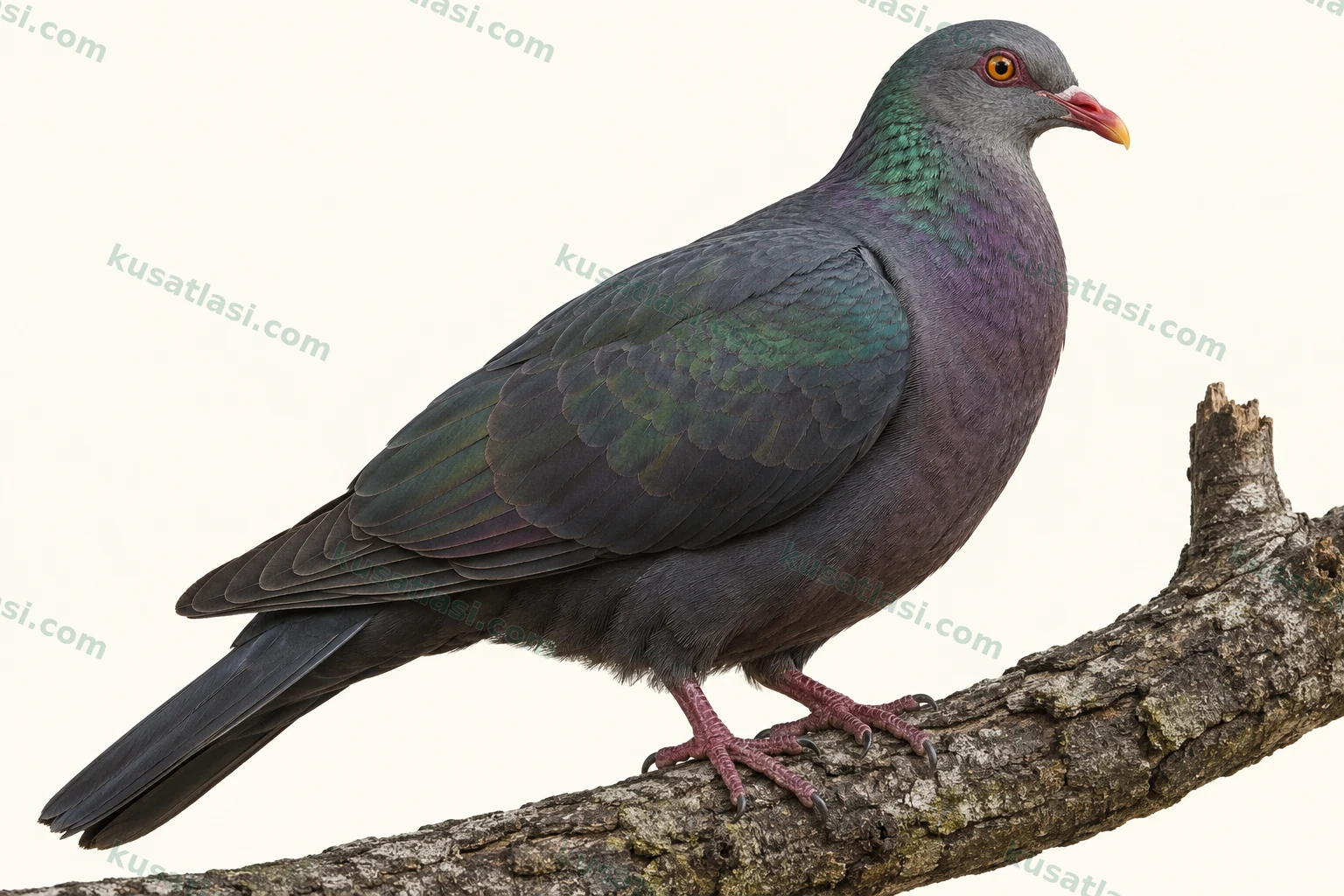
Large dark island pigeon with green-purple gloss; throat patch pale or dark according to locality.
Biometrics
Length
Male37–41 cm
Female37–41 cm
Shared species value
Wing length
Male21.64 cm
Female21.64 cm
Shared species value
Weight
Male345–430 g
Female268–511 g
Metallic Pigeon
Southeast Asia and southwestern Pacific islandsObservation guide in its natural range
Look for three features together
Do not rely on a single featureDark body, variable pale throat, reddish eye and feet.
Searches for fruit in forest trees and on the ground.
Southeast Asian and Pacific island populations.
Compare male and female
 FemaleMale
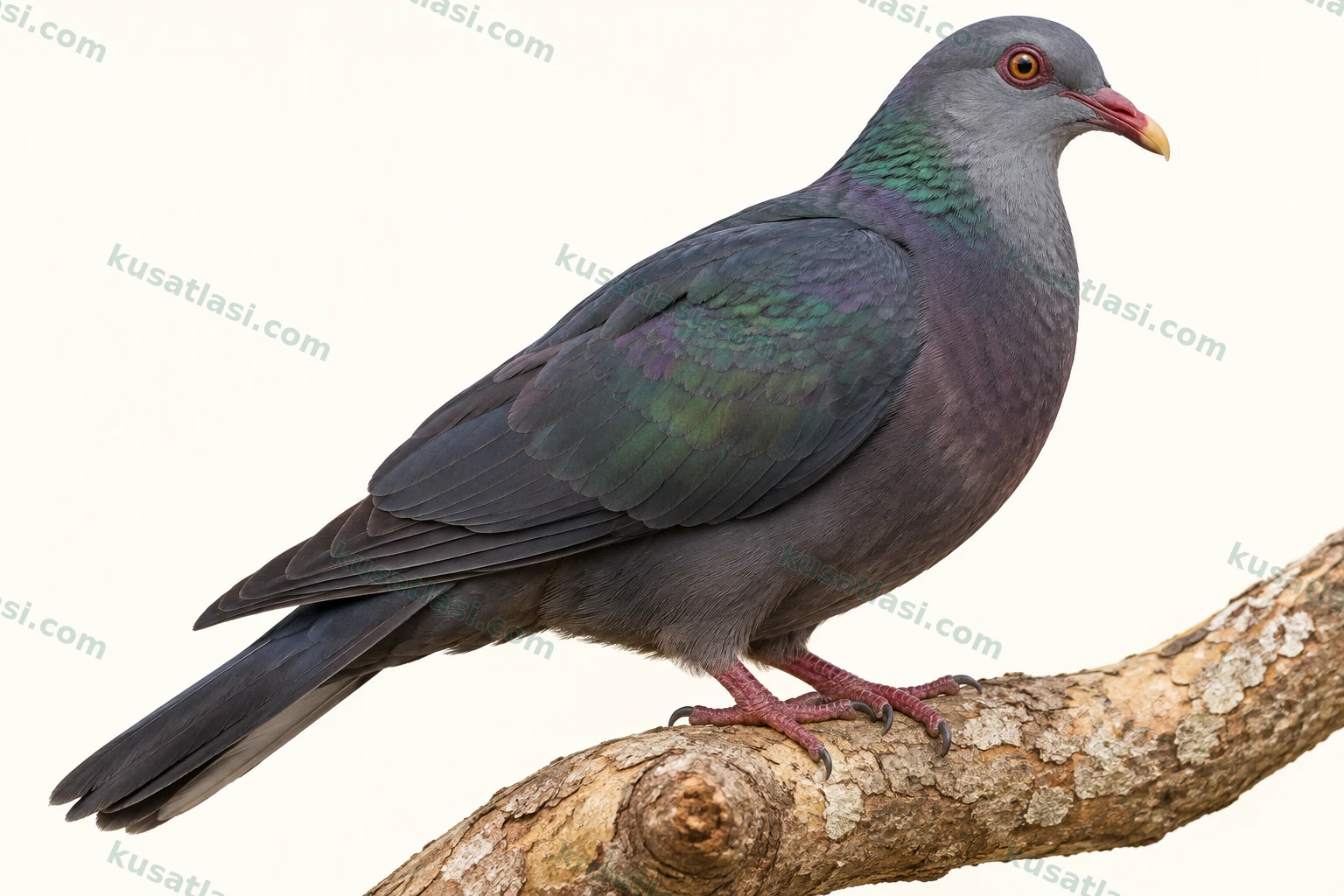
Adults are similar; dullness alone does not establish sex. Young may have less underpart iridescence.
Where to look in its natural range?
Fruiting forest trees, edge cover and small-island woodland.
Resident. The expert account gives September–January/early February breeding for Vanuatu; not extended to other islands. Local fruit-related movements; no shared definite migration calendar.
January
Vanuatu: within the regional breeding period reported by the expert account.
February
Data unavailable
March
Data unavailable
April
Data unavailable
May
Data unavailable
June
Data unavailable
July
Data unavailable
August
Data unavailable
September
Fiji: Viti Levu: an active nest with one egg was documented on 27 September 1975.
October
Data unavailable
November
Data unavailable
December
Data unavailable
Nest, egg and incubation
One or two eggs on a twig platform; expert compilation: 17–19 days’ incubation and about 21 days in the nest. The Fiji fern nest is one local observation.
Deep full calls and higher repeated song; rhythm may vary between islands.
Do not play recordings to attract birds; observe quietly, especially near nests.
Species information
Quick identification
The Metallic Pigeon Columba vitiensis is a large dark glossy forest pigeon of Southeast Asian and Pacific islands. Assess white or grey throat, reddish eyes and feet and green-purple feather sheen together. Throat colour varies geographically and may be distinctly dark in the Lesser Sundas. A white throat suggested by the Turkish name is not required in every island population.
A distant canopy bird may appear uniformly dark. Better views reveal the pale front-head/neck area's border, pale bill tip and dark plumage gloss. Cornell stresses broad elevation use from lowland to mountain forest and feeding both in trees and on the ground.
General appearance and posture
The body is robust, back, wings and tail appearing dark grey. Head, neck and underparts can carry chestnut, dark grey or purplish shades. Green or purple neck and body iridescence changes with light and angle.
In many populations, pale chin, throat and cheek areas show below the dark head. Metallica and griseogularis have grey throats, so looking only for white can miss them. Samoa's castaneiceps may be less glossy than some other island forms.
Eyes may be red or orange-tinged, bare eye surrounds dark wine-coloured, feet red-purple. The bill may have a reddish or purplish base and pale yellow tip. Not every fine detail is visible simultaneously in forest shade.
Males, females and young birds
Adults look alike; the expert account says females may be slightly duller. Yet shade on a male and sun on a female can reverse apparent brilliance. One darkness or gloss difference does not establish sex.
Young resemble adults in general shape but can be duller, less iridescent below. An inconspicuous pale throat does not prove youth because subspecies also differ. Compare a possible youngster with its region's adults.
Appearance in flight
Strong wingbeats give a heavy-looking direct flight. Flushed from cover it may move rapidly to a nearby tree. Dark body and broad wings may show while throat colour disappears in a short pass.
The expert account describes a male display climb followed by a gliding descent with partly closed wings. This differs from ordinary feeding flight. Perched display may involve a puffed neck and lowered head.
Voice and behaviour
Usually alone, paired or in small families. New Caledonian accounts mention occasional groups of several dozen, historically up to eighty. That local report does not mean permanent large flocks on every island. It uses upper food-tree layers and sometimes descends; ground presence does not sever forest association.
It has deep full pigeon calls and higher repeated song. Rhythm varies among islands. Expert accounts describe 2–3-note forms from New Guinea to the Solomons, several-second gaps on Makira, and shorter many-note forms on Samoa.
Locating a deep call from a concealed tree can be difficult. Match the seen bird's head and body to the source when scanning forest. Feeding pairs may move between tree and ground; daily movements are distinguished from long-distance migration.
Similar species
Pacific Imperial-Pigeon Ducula pacifica occurs on shared Pacific islands. Paler grey head, neck and underside contrast with dark upperparts; an adult bill-base swelling also helps. Metallic Pigeon is generally much darker, with paleness concentrated around the throat.
Rock Pigeon Columba livia varies greatly. Green-purple neck sheen on a dark individual alone does not prove this forest species. Assess head/throat pattern, bill, large forest-pigeon appearance and actual island together. A settlement or farm photo lacking these details is not identified by darkness alone.
Global range
Island populations extend from the Philippines and some islands off northern Borneo through the Lesser Sundas, Maluku, New Guinea surroundings, Bismarcks and Solomons to Vanuatu, New Caledonia, Fiji and western Samoa. This does not make the sea or every island continuous habitat. Palawan, Fiji and Samoa have separately named subspecies. Lord Howe's godmanae is an extinct historical population.
Status within its natural range
BirdLife's 2024 assessment gives Least Concern; total mature numbers are undetermined. A wide island range and extinction on Lord Howe can both be true. Loss of one subspecies does not mean global extinction; a low-risk global category does not secure every island population. Throat and gloss variation visibly reflect this diversity.
Movements and migration
It is considered resident. Changing fruit resources can cause local feeding movements, including crossings to neighbouring islets in some small-island settings. These are not a verified regular intercontinental route. One Fiji nest date is not copied as Vanuatu's entire season; no fixed common monthly route spans populations on both sides of the equator.
Breeding habitat
Dense evergreen forest, streamside woods and monsoon forest are major habitats. Edges, developed secondary cover and fruiting agricultural trees on some islands are also used. Elevation limits vary; the expert account includes lowland to 2,750 m records, not a shared upper limit on all islands.
Nest site
A platform of twigs and climber fragments is built. On 27 September 1975, Fergus Clunie found one in an Asplenium nidus fern on a Viti Levu tree, three metres above ground. It held one white egg. The expert compilation gives one or two eggs, 17–19 days' incubation and about 21 days in the nest; these periods were not measured at that single Fiji nest.
Daily habitat use
It feeds in upper fruiting trees and may descend to fallen food. Resting, feeding and nesting sites need not share one height. Small-island woodland near settlements can be used; a concealed tree nest can be less visible than an open daily feeding site.
What does it eat?
Fruit, seeds and buds are principal foods. The expert account includes Capsicum and other nightshade fruits. Some reports mention caterpillars and snails, not identical animal-food proportions on every island. Diet is chiefly plant- and fruit-based. Presence in one food tree does not prove dependence on a single fruit species.
How does it forage?
It takes food from trees and bushes, sometimes collecting beneath fruiting trees. Canopy and ground searching may belong to one daily routine. Shifting fruit abundance can explain local movement or neighbouring-islet visits. Philippine accounts mention joining other fruit pigeons' feeding groups; sharing a tree does not make appearance or diet identical.
A fern can support a nest
The 1975 Fiji nest lay within a large epiphytic Asplenium nidus. Fronds, accumulated litter and root surroundings supported the twig platform and hid it from below. The observer saw it only looking down from the slope above. This directly describes one local nest's concealment. Its platform diameter was about 25 cm, not a species-wide standard.
Nest date is not incubation duration
The Viti Levu nest on 27 September contained an egg in early incubation. This confirms an active nest date, not the time to hatching. The compiled incubation interval is not assigned to that observation. Direct nest evidence remains separate from the wider species account.
Throat patches carry island variation
Grey and darker-throated populations exist beside white-throated ones. Lesser Sunda birds need not repeat Fiji colours. Combining all forms in one standard bird erases real differences. Knowing the island helps especially with dark-throated identification.
A widespread species can lose an island population
Godmanae no longer lives on Lord Howe. The current list associates last historical records with the 1850s. This does not contradict surviving populations including Fiji and Samoa. Global category and one island's history have different scales; Lord Howe is not portrayed as current occurrence or breeding habitat.