

World Birds IUCN statusLC · Least ConcernGlobal IUCN category. BirdLife v10 (2025); taxon matching: AviList 2026 / IOC 15.2; checked: 29.10.2026. The list year is not the species assessment date. Source and method · BirdLife OrderColumbiformesPigeons and doves FamilyColumbidaeColumbidae
White-headed Pigeon
Columba leucomela
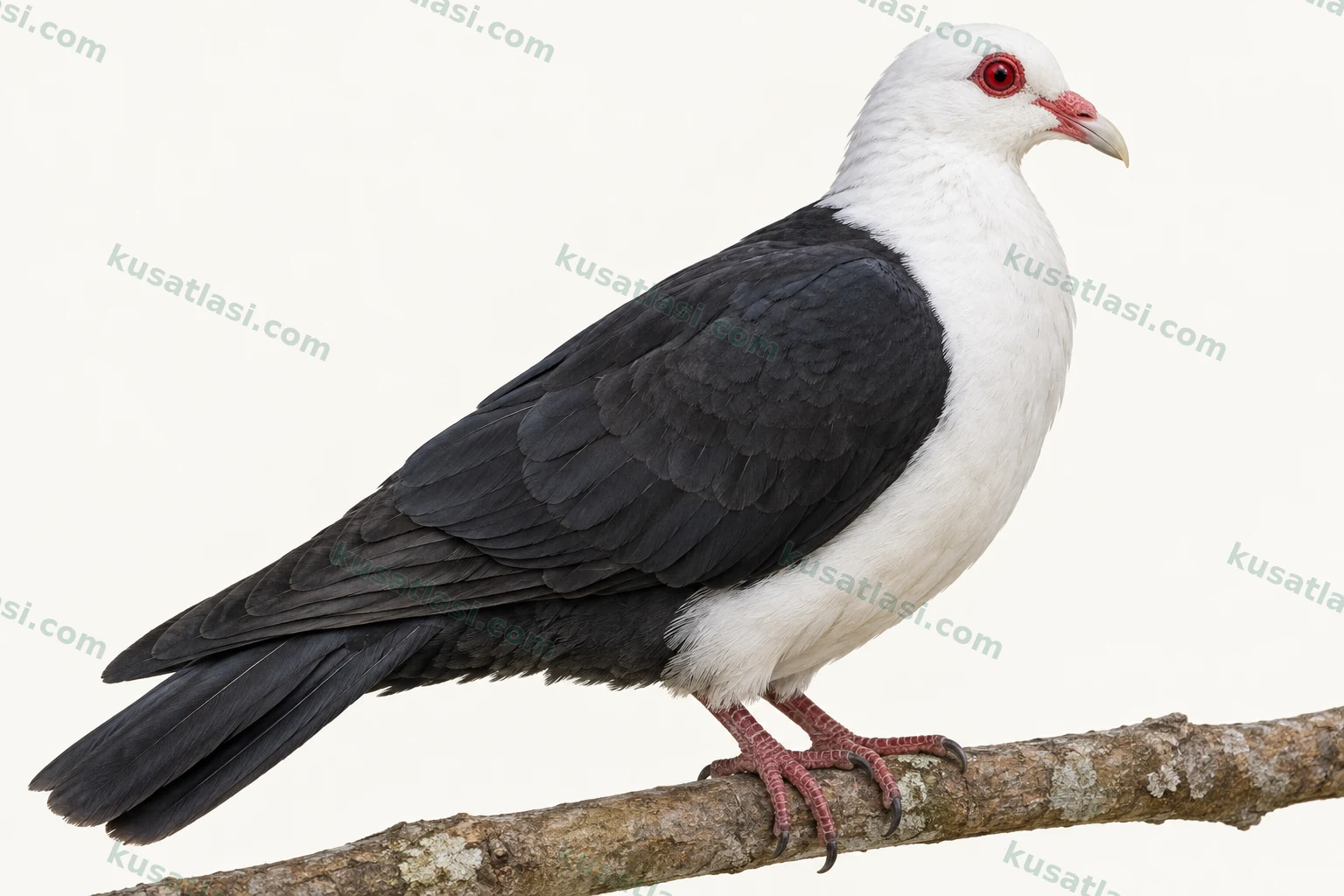
A large pigeon of eastern Australia: pale head and breast, dark back and wings; the adult female’s crown may show fine grey speckling.
Biometrics
Length
Male38–42 cm
Female38–42 cm
Shared species value
Wingspan
Male65–70 cm
Female65–70 cm
Shared species value
Weight
Male218–500 g
Female218–500 g
Shared species value
White-headed Pigeon
Humid eastern AustraliaObservation guide in its natural range
Look for three features together
Do not rely on a single featureWhite in the male; the female may have a very faint grey cap.
Dark, with green-purple reflections in suitable light.
The adult has an orange-yellow eye and a reddish bill with a pale tip.
Compare male and female
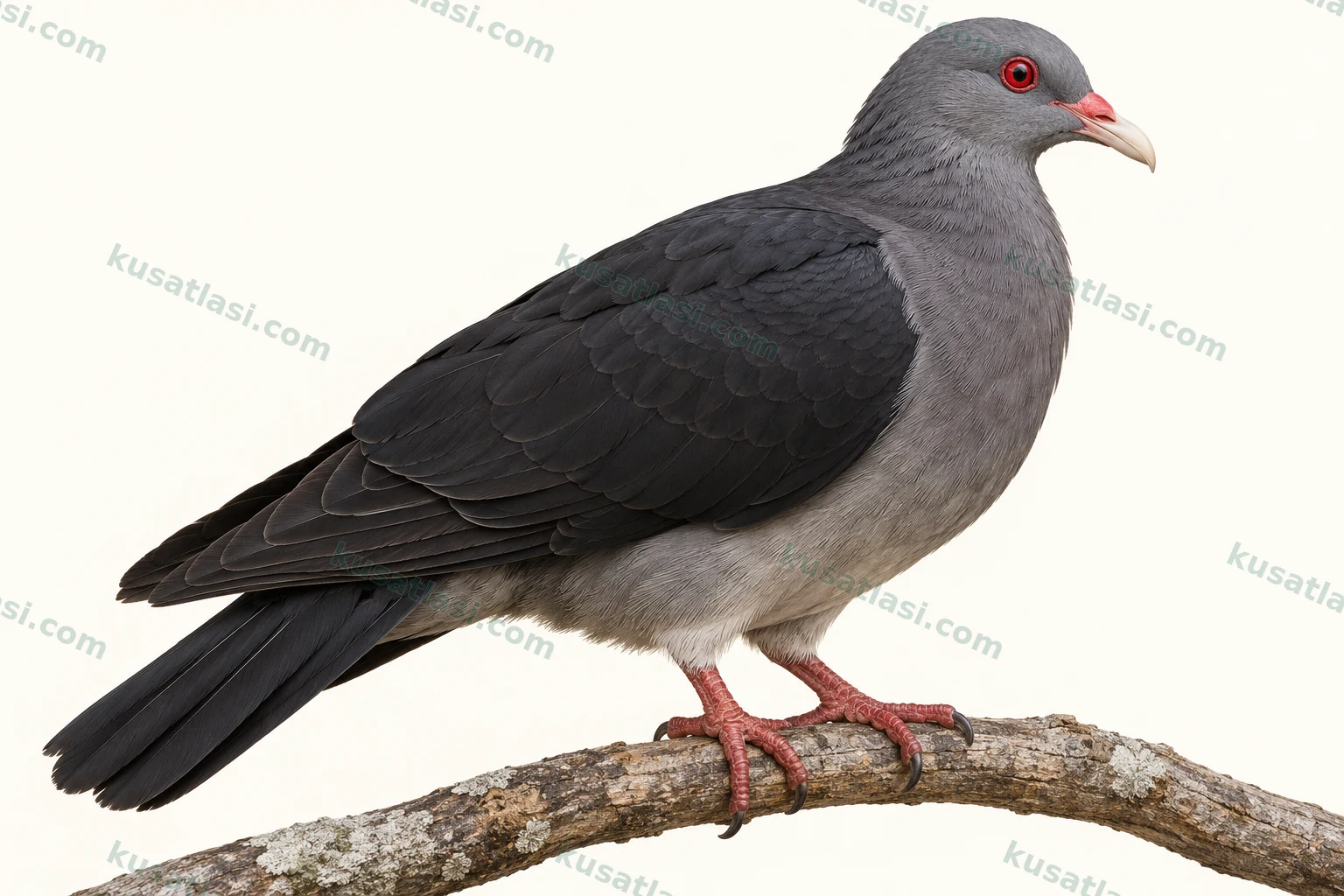 FemaleMale
The male’s head is white; the female may have a finely grey-speckled cap and grey feather bases on the underparts. Young birds have dark eyes and a greyer body; sex is not assigned with certainty at a distance.
Where to look in its natural range?
Rainforest, humid forest edges, fruiting woodland and rural gardens.
The regional calendar of nests followed at Goolmangar, northeastern New South Wales, in 2001–2010; it is not an unchanging calendar for the whole range.
January
Local movements follow food; no shared long-distance migration route was verified. Goolmangar, New South Wales: months in which egg laying was recorded in the long-term field study.
February
Local movements follow food; no shared long-distance migration route was verified. Goolmangar, New South Wales: months in which egg laying was recorded in the long-term field study.
March
Local movements follow food; no shared long-distance migration route was verified. Goolmangar, New South Wales: months in which egg laying was recorded in the long-term field study.
April
Local movements follow food; no shared long-distance migration route was verified. Goolmangar, New South Wales: months in which egg laying was recorded in the long-term field study.
May
Local movements follow food; no shared long-distance migration route was verified. Goolmangar, New South Wales: months in which egg laying was recorded in the long-term field study.
June
Local movements follow food; no shared long-distance migration route was verified. Goolmangar, New South Wales: months in which egg laying was recorded in the long-term field study.
July
Local movements follow food; no shared long-distance migration route was verified. Goolmangar, New South Wales: months in which egg laying was recorded in the long-term field study.
August
Local movements follow food; no shared long-distance migration route was verified. Goolmangar, New South Wales: months in which egg laying was recorded in the long-term field study.
September
Local movements follow food; no shared long-distance migration route was verified. Goolmangar, New South Wales: months in which egg laying was recorded in the long-term field study.
October
Local movements follow food; no shared long-distance migration route was verified. No verified regional date specific to this month was given; this does not mean local absence.
November
Local movements follow food; no shared long-distance migration route was verified. No verified regional date specific to this month was given; this does not mean local absence.
December
Local movements follow food; no shared long-distance migration route was verified. Goolmangar, New South Wales: months in which egg laying was recorded in the long-term field study.
Nest, egg and incubation
The nest is a platform of thin twigs in a tree or shrub. The Goolmangar study recorded one egg, with care by both sexes. Incubation lasted 19–20 days (7 observations), and nest departure 18–24 days (23 observations); total time to independence was not measured.
The main call is low, mournful and two-part; a less frequent growling call was also recorded during nest-site searching.
Do not play recordings to attract birds; observe quietly, especially near nests.
Species information
Quick identification
White-headed Pigeon Columba leucomela is a large pigeon native to the humid east of Australia. The pale head, neck and breast are recognised together with the dark wings and back. The adult male has a white head; the female’s crown and nape may look finely speckled grey. In bright sunlight the dark upperparts show green and purple reflections. This gloss alone is not evidence of a separate colour form or sex.
The pale head is a more specific clue than merely seeing a white pigeon: look on the same bird for a large body, dark upperparts and a long tail. It can occur in fruiting trees, on branches or around fallen fruit. Being near a settlement does not mean it is a domestic pigeon; it also uses gardens and modified wooded areas within its natural range.
General appearance and posture
The full body and rather small head create a pigeon silhouette. A quiet bird on a branch can draw in its neck and look rounder; when watching its surroundings it extends the neck, enlarging the pale head-and-neck area. The dark back, wings and tail are visible behind the pale front. The underparts are almost white in the adult male, while the female can look more mottled where grey feather bases show. It is wrong to expect every individual’s breast to be pure white in all light.
The adult bill varies from pinkish red to red, with an off-white or cream tip. The coloured part of the eye is orange-yellow, with an outer margin that may be orange or red. The bare ring around the eye is pink or pinkish red. The eye itself and its surrounding skin are separate structures; calling every warm-coloured area in a photograph a single red eye loses detail. The feet are pinkish.
Males, females and young birds
The adult male’s white head, neck and pale breast are useful against the female’s faint grey cap. The female’s difference is not a strong black cap: fine grey speckling can occur on a pale ground over the forehead, crown and nape. Distance or an overexposed photograph can erase this feature. A single low-detail image does not establish sex with certainty; where possible, crown, nape and underparts are seen together.
Young birds can have a greyer head and body, dark reddish-brown bill, dark-brown eye and dark-grey eye surround. The legs are also paler or grey-pink rather than the adult’s vivid pink. A grey body can lead a young bird to be mistaken for another pigeon. Development of the white cheeks and throat contributes to age assessment alongside bill and eye colour.
In the natural breeding study, newly departed young did not all look alike: most had a pale-grey body with a pinkish-brown wash, but some were markedly darker. A greenish sheen was also seen on the back of some young. This direct observation cautions against assuming that gloss is entirely absent in every young bird. A glossy back alone does not establish adulthood or sex. No exact number of months for the transition to full adult plumage is given here.
Appearance in flight
Flight is strong; the dark wings and tail contrast with the pale head and body. A bird moving between trees may briefly show only a dark wing surface. If the pale head is unseen in that moment, wing colour alone does not establish the species. Departure from a branch, open-winged flight and landing again are more useful for combining features of the same individual.
Being able to move several kilometres in search of food does not mean that every flock seen is migrating a long distance. Repeated journeys between fruiting trees are flight movements too. Directions seen at one place on one day are insufficient to infer migration direction; movements between feeding and resting areas are considered separately.
Voice and behaviour
Slow, low, mournful pigeon calls are heard especially during pair formation and nest-site searching. Direct field research describes the main call as two-part, with stronger emphasis on the first part; a less frequent growling call was also recorded. Voice is confirmed with the bird’s appearance. Low calls of other pigeons in the same woodland cannot be separated with certainty from a written description alone.
Pairs search for a nest site on a suitable branch or in a shrub. The male may call from a candidate site while the female remains nearby; the male may lead through the trees with the female following. During nest building the male brings dry twigs and the female arranges them. Both sexes share incubation and care of the young. Seeing one bird at the nest does not mean that only the female provides care; a brief visit can miss changes of duty during the day.
Species that may be confused
Ducula spilorrhoa is also large and black-and-white. Its body, however, is mostly white, with black concentrated in the flight feathers and tail tip. White-headed Pigeon has broadly dark upperparts. A white head does not distinguish the two: examine the whole pattern of the closed wing and back. This comparison is meaningful only where their ranges can meet; they are not assumed to belong to the same community throughout Australia.
A young White-headed Pigeon may not look as brightly white as an adult. Before comparing a grey body with another species’ adult plumage, check age characters. Presence at a fruit tree is not a definite identification either; several pigeons can use the same food source.
World distribution
Its natural range lies in eastern Australia, from the humid tropics of northeastern Queensland to eastern Victoria. The humid eastern surroundings of the Great Dividing Range, rainforest remnants and nearby wooded areas are important. A country name on a map does not mean all Australia is suitable; the arid interior and west coast are not substituted for its natural distribution.
The older or narrower summary on some specialist pages giving New South Wales as the southern limit has been considered alongside eastern Victoria in the current taxonomic list. The accepted species identity is Columba leucomela. Records of other white-headed island pigeons are not used to expand this species’ range.
Status within its natural range
It can use fruiting trees near settlements as well as humid woodland. A long-term nest study in New South Wales documented natural breeding in modified rural surroundings. This does not make all urban parks regular breeding habitat. Local frequency is related to fruiting trees and suitable nesting cover; a count in one school garden is not converted into a regional population.
Movements
It moves locally for food, and journeys between fruiting trees can extend several kilometres. The sources examined did not verify a shared annual migration route for the entire population. Disappearance from one point does not prove that migration has begun; the bird may have moved to another nearby feeding area. Invented seasonal routes or definite breeding months for every coloured map cell are not added.
Breeding habitat
Rainforest, humid woodland, forest edges and rural gardens with sufficient cover are used. In the Goolmangar field study, many nests were followed on school grounds in surroundings where natural forest had been extensively altered. The bird’s ability to use this area does not show that conserving the original forest is unnecessary; the research concerns a limited area with particular vegetation structure.
Nest site
The nest is a relatively sparse platform of thin dry twigs in a tree or shrub. The male carries material and the female arranges it. Old nests are also inspected during nest-site searching, and an earlier structure can be reused. All confirmed nests with eggs in the original study held one egg. Incubation was measured at 19–20 days and nest departure at 18–24 days, based on 7 and 23 completed observations respectively; these are results from one locality.
Daily use of space
It feeds in fruiting trees and descends to fallen fruit and seeds. A quiet appearance near the nest does not prove that human approach is always harmless. Waiting under nest trees, opening branches to see the egg or flushing the bird is inappropriate. A recently departed young bird in particular may return to the nest to rest; that return is not counted as a new breeding attempt.
What it eats
Fruit and seeds are its principal foods. It can make heavy use of fruit and seeds of the camphor tree, which has spread in eastern Australia; fruit of native trees also enters the diet. A study of digestive contents from 18 birds that had left the nest around Lismore found camphor seeds in all those samples. Most specimens were obtained after vehicle or window collisions, so this was not a randomly selected dietary sample across the whole natural range.
Eating unopened eucalyptus buds and swallowing bark of a paperbark tree were also observed directly in that research. A cicada’s outer casing in one bird does not prove that hunting insects is a regular dietary mainstay. Young are fed crop secretion and later food brought to them; examinations of young from natural nests provide records of this care.
How it obtains food
It picks fruit on branches and searches on the ground for fallen fruit and exposed seeds. Fruit condition changes through the season, so use of fresh fruit and dried seeds can change too. Seeing a bird’s bill in a food tree does not always identify the swallowed object with certainty. Local reliance on camphor trees is not a reason to plant this invasive tree in new places; native fruiting trees and forest cover should be protected.
One egg, care from two parents
Among 122 nests followed at Goolmangar in 2001–2010, all those confirmed with eggs contained one egg. Males could take the daytime incubation shift and females the night shift; both sexes also fed the young. This direct research fills a gap in an older measurement compilation that recorded shared incubation as unknown. An old uncertainty is not retained as settled information when newer observations exist.
Leaving the nest does not end all care
A young bird’s departure from the nest platform is not the same as full independence. In the study a parent was seen feeding a young bird 20 days after departure; the time to independence of all young was not measured. Some young reused their former nest as a daytime resting place. A young bird alone on a branch is not necessarily abandoned or uncared for.
A breeding calendar is read with the locality in mind
At this study site, egg laying was recorded in every month except October and November; most attempts were between late January and mid-August. This is not a rule that the species does not breed in October–November throughout its range. Sources can report different periods for different places and food conditions. The calendar names the study location clearly and distinguishes egg laying from care of young.
The function of swallowing bark remains uncertain
Swallowing paperbark fragments and finding them in digestive contents are direct observations. The idea that this could be a form of self-medication neutralising substances from camphor seeds is one explanation discussed by the researcher, not an experimentally proved result. Seeing a behaviour and finding its cause are different stages. Presenting the species as a bird known to cure itself with bark goes beyond the evidence.