

World Birds IUCN statusLC · Least ConcernGlobal IUCN category. BirdLife v10 (2025); taxon matching: AviList 2026 / IOC 15.2; checked: 29.10.2026. The list year is not the species assessment date. Source and method · BirdLife OrderColumbiformesPigeons and doves FamilyColumbidaeColumbidae
African Collared Dove
Streptopelia roseogrisea
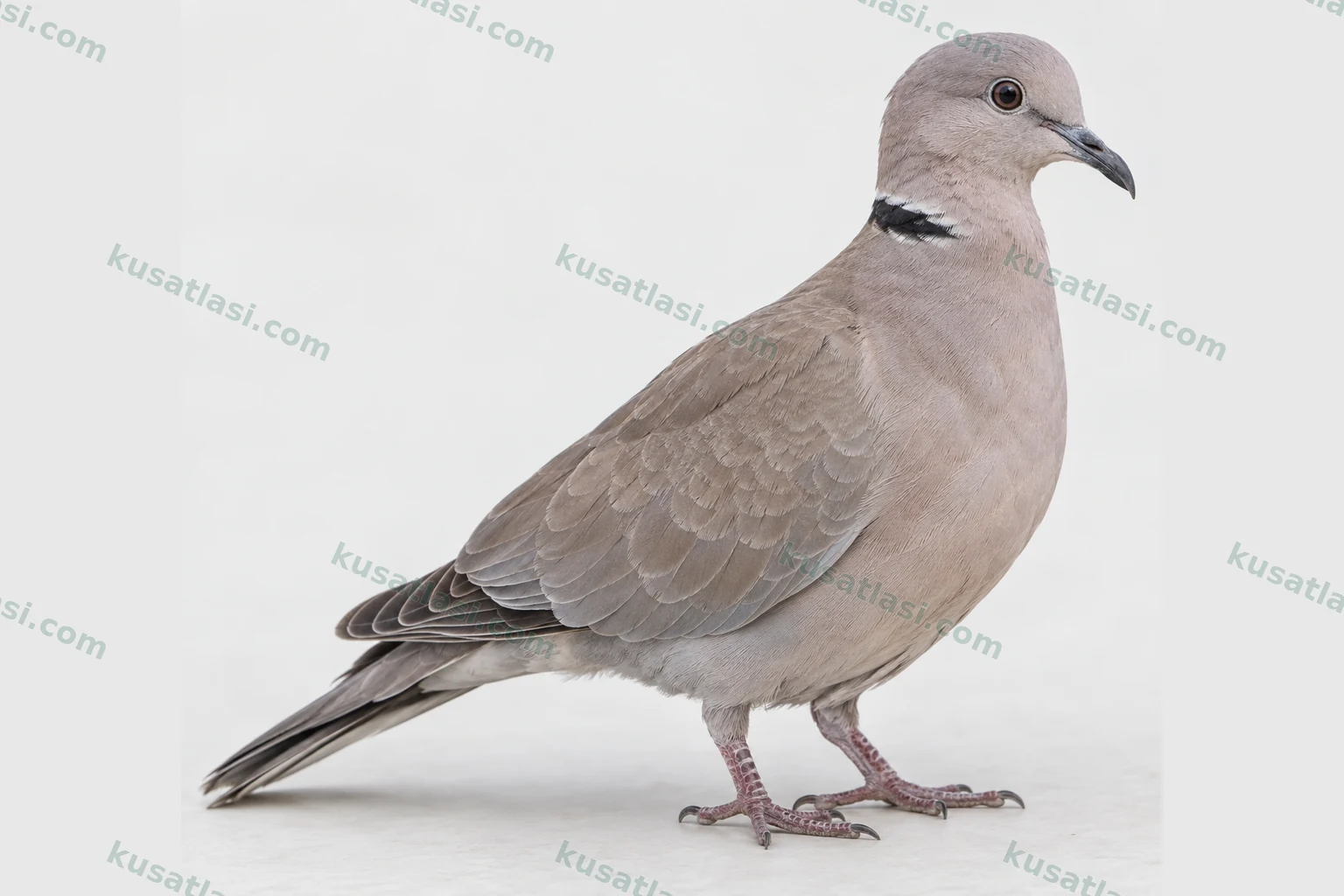
A pale collared dove of the Sahel and Red Sea surroundings; assess the white belly and undertail, wing pattern and natural song together.
Biometrics
Length
Male26 cm
Female26 cm
Shared species value
Wingspan
Male45–50 cm
Female45–50 cm
Shared species value
Weight
MaleData unavailable
Female155 g
African Collared Dove
Sahel and Red Sea surroundings; western and southwestern ArabiaObservation guide in its natural range
Look for three features together
Do not rely on a single featureSandy back, pinkish-grey head and breast, and white belly.
The black half-collar is also found in other doves.
Natural distribution is distinguished from records of free-living birds of domestic origin.
Compare male and female
 FemaleMale
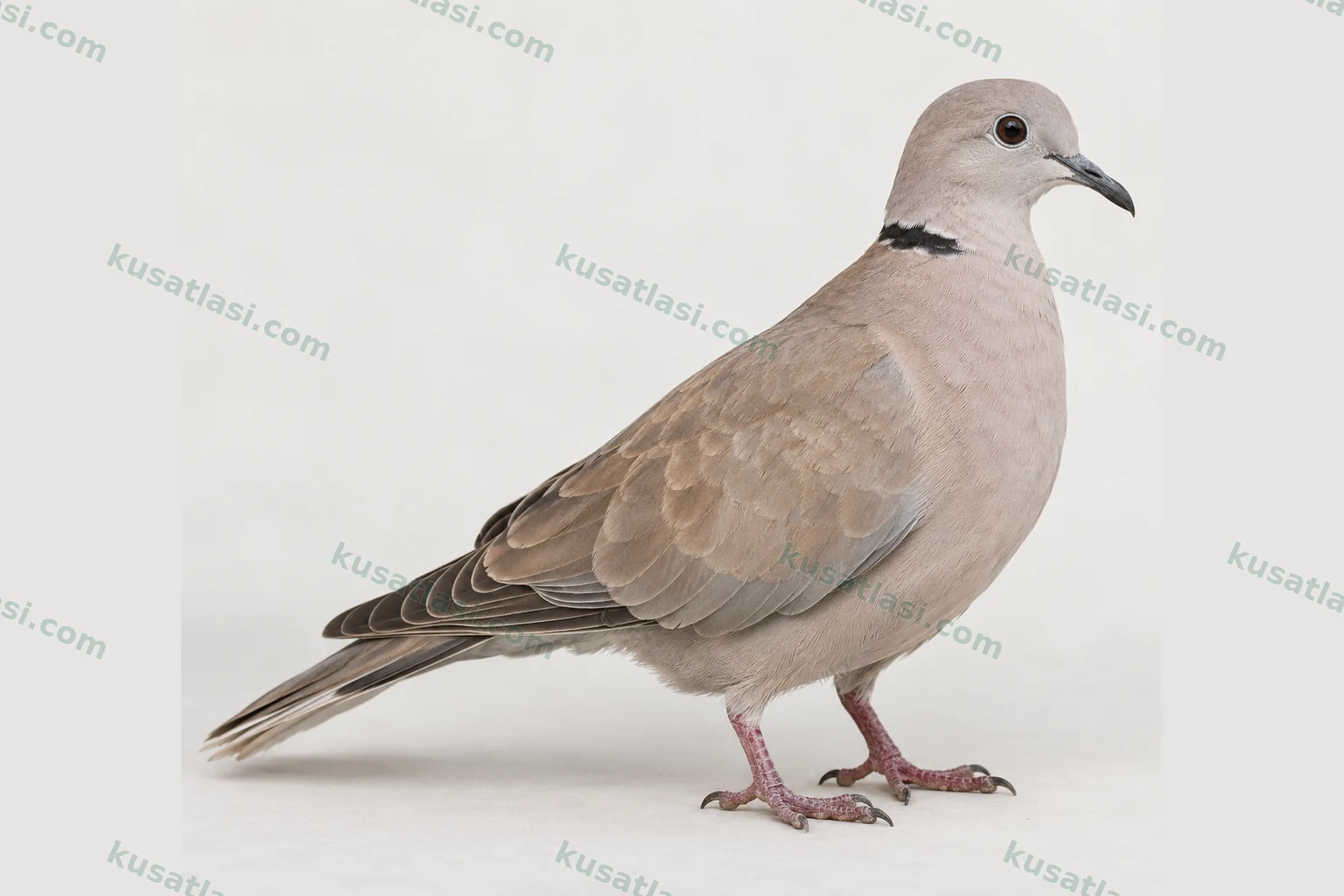
Adult males and females are similar. The young may have a weak or absent nape collar and pale feather edges on the wings; domestic colours are not sex differences.
Where to look in its natural range?
Watch open acacia woodland, scrub and seed-rich ground; do not approach nesting groups.
West African and Arabian examples show different breeding and residence periods; no single continental calendar is created.
January
The species is partially migratory; resident Sahel populations occur alongside breeding movements towards Arabia. Senegal and The Gambia: the specialist account reports breeding throughout the year. Saudi Arabia: some individuals remain in winter; this is not a breeding sign.
February
The species is partially migratory; resident Sahel populations occur alongside breeding movements towards Arabia. Senegal and The Gambia: the specialist account reports breeding throughout the year. Saudi Arabia: some individuals remain in winter; this is not a breeding sign.
March
The species is partially migratory; resident Sahel populations occur alongside breeding movements towards Arabia. Senegal and The Gambia: the specialist account reports breeding throughout the year.
April
The species is partially migratory; resident Sahel populations occur alongside breeding movements towards Arabia. Senegal and The Gambia: the specialist account reports breeding throughout the year.
May
The species is partially migratory; resident Sahel populations occur alongside breeding movements towards Arabia. Senegal and The Gambia: the specialist account reports breeding throughout the year.
June
The species is partially migratory; resident Sahel populations occur alongside breeding movements towards Arabia. Senegal and The Gambia: the specialist account reports breeding throughout the year.
July
The species is partially migratory; resident Sahel populations occur alongside breeding movements towards Arabia. Senegal and The Gambia: the specialist account reports breeding throughout the year.
August
The species is partially migratory; resident Sahel populations occur alongside breeding movements towards Arabia. Senegal and The Gambia: the specialist account reports breeding throughout the year.
September
The species is partially migratory; resident Sahel populations occur alongside breeding movements towards Arabia. Senegal and The Gambia: the specialist account reports breeding throughout the year. Chad: a regional example of breeding.
October
The species is partially migratory; resident Sahel populations occur alongside breeding movements towards Arabia. Senegal and The Gambia: the specialist account reports breeding throughout the year. Chad: a regional example of breeding.
November
The species is partially migratory; resident Sahel populations occur alongside breeding movements towards Arabia. Senegal and The Gambia: the specialist account reports breeding throughout the year. Saudi Arabia: some individuals remain in winter; this is not a breeding sign.
December
The species is partially migratory; resident Sahel populations occur alongside breeding movements towards Arabia. Senegal and The Gambia: the specialist account reports breeding throughout the year. Saudi Arabia: some individuals remain in winter; this is not a breeding sign.
Nest, egg and incubation
The nest is a light twig platform in a tree or shrub; low, dense nesting groups occur on some Red Sea islands. The Saudi account gives two eggs, incubation by both adults for 14–15 days and a nest period of about 15 days.
Drawn-out dove notes are strong at first and then fade; compare the whole pattern with the three-part rhythm of Streptopelia decaocto.
Do not play recordings to attract birds; observe quietly, especially near nests.
Species information
Quick identification
African Collared Dove Streptopelia roseogrisea is a pale dove of dry, open woodland in the Sahel and around the Red Sea. The black half-collar around the nape, sandy back, pinkish-grey head and breast, white belly and undertail together help identify it. Do not use the collar alone: several relatives, including Eurasian Collared Dove Streptopelia decaocto, share a similar nape marking. The pale body, general wing appearance, tail pattern and natural voice provide a more reliable combination.
The English name African Collared-Dove is used for this wild bird. Its relationship to the domestic laughing dove is more than a resemblance in appearance; a 2023 genomic study supports this bird as the domestic form’s main ancestor. Some publications use Streptopelia risoria to include both wild and domestic populations. This page retains the catalogue name roseogrisea and describes the wild African–Arabian bird. Differences in naming do not turn a domestic bird seen in any city into evidence of natural range.
General appearance and posture
The head’s pale grey connects with a slight pink tone on the breast; the chin is whiter. A narrow pale edge may show above the nape collar. The sandy back is bordered by dark flight feathers, but the upperwing does not show as distinct a three-colour arrangement as in Eurasian Collared Dove. When the tail is spread, the pale tips of the outer feathers and their white outer edge become important. A closed tail hides these details. If the bird is seen only from the front, wait for a natural turn rather than flushing it to see the collar.
The reddish iris and pale eye surround may be visible at close range; the bill is dark and the feet reddish. Pink or grey areas can change in tone under sunlight. A dark appearance in a shaded photograph does not make the same bird another species. Fluffed feathers also make the body look larger. Posture must be considered when comparing neck proportions of a walking bird with one stretching its head to watch the surroundings. The positions of feather regions relative to one another are more reliable than a photograph’s colour settings.
Males, females and young birds
Adult males and females share the colour arrangement. Reliable sexing should not rely only on the amount of pink, collar thickness or body width. Light, feather posture and individual variation can change these features. Assuming the calling member of a pair is male is not a substitute for a confirmed sex record based on appearance either. Care behaviour can be assigned separately to the individual observed; if its sex is unknown, the record should remain so.
Young birds look sandier and paler; pale edges of the wing coverts may create fine scaling. The nape collar may still be weak or absent, and the iris is browner than the adult’s reddish one. This age difference helps explain why not every dove without a visible collar belongs to another species. Conversely, an adult’s collar can also be hard to see in shade. Assess nape, wing coverts and eye appearance together; one missing mark does not establish an age boundary.
Colours produced by human selection in domestic forms and hybridisation are separate from natural age and sex differences. A pure white or unusually coloured dove must not be called the wild species’ normal female. The genomic study’s samples also showed gene exchange with Eurasian Collared Dove; the researchers did not derive definite proportions across the whole range from a limited sample. A photograph cannot establish every individual’s genetic origin.
Appearance in flight
When the wing opens, the generally less divided colour arrangement of the upperparts, pale belly and undertail are useful. The Saudi Arabian account notes a dark strip along the trailing edge of the underwing. This does not mean that the whole underwing is black. Distinguish whether the wing is seen above or below: dark flight feathers viewed from above are not the same observation as a trailing-edge strip seen below. If these details were not resolved during fast flight, the wing pattern may be recorded as unseen.
The placement of black and white on the outer tail feathers helps distinguish it from Eurasian Collared Dove. However, worn, missing or still-growing feathers may alter the pattern. One sample compared by the genetic research appeared hybrid in its outward features, while genetic examination produced a more complex result. A single tail feather therefore does not identify the species certainly in every situation. Flight is considered with head and body colours and the bird’s natural voice.
Voice and behaviour
The song consists of drawn-out, rolling dove notes, strong at first and fading towards the end. It may differ from the more distinct three-part rhythm of Eurasian Collared Dove. Listening to the length, stress and repetition of the parts is more useful than comparing the sound only to human words. This text describes the natural voice; a domestic bird’s recording is not automatic evidence of a wild population. Particularly outside the natural range, verify that sound and appearance belong to the same bird.
It feeds on the ground and may form small groups outside breeding or larger gatherings at suitable sites. Many birds at one place with water and seeds do not show equal density throughout the surroundings. During breeding, pairs may nest alone or in looser clusters; dense nesting groups have also been described on Red Sea islands. Do not treat every nearby bird as one family. Feeding groups and nesting groups may not perform the same function.
Similar species
Eurasian Collared Dove Streptopelia decaocto generally looks larger and darker; the division between coverts, the middle wing area and dark flight feathers is more distinct on the upperwing. There is more darkness at the base of the undertail. Both species carry the nape collar, so this shared feature does not separate them. Age, wear and possible domestic origin require assessing body, wings, tail and natural song together.
Red-eyed Dove Streptopelia semitorquata is a larger, fuller-bodied collared dove. The pale forehead, red eye surround and dull brownish tail tips in flight help identify it. A red eye is not enough alone: African Collared Dove can also have a reddish iris. Compare the bare area around the eye, tail tip and general body build. Its persistent six-part song can also help distinguish it.
Global distribution
The main wild distribution belt is the Sahel and nearby dry regions of northern tropical Africa. Its range eastwards from Senegal and The Gambia towards Sudan and the Horn of Africa does not mean that the whole continent is occupied. On the opposite Red Sea coast, western and southwestern Arabia and the area around Yemen also form part of the natural range. Free-living birds in South Africa, the Americas or another country are not automatically added to this belt; domestic origin and human-mediated establishment are assessed separately.
Status within its natural range
Use of dry open woodland and seed-rich ground can make it appear common in suitable places. The Saudi Arabian account describes a common breeding migrant and a less frequent winter visitor; this regional status is not transferred to all Sahel populations. Nesting groups on Umm al-Qamari and Kotumbul islands in the Red Sea are mentioned separately. These islands are not the same place as Socotra in the Indian Ocean. A country’s administrative boundary does not prove natural occurrence on all its islands.
Migration and movements
The species is partially migratory; resident birds in the main African belt occur alongside birds moving to outlying areas and Arabia to breed. The Saudi Arabian account describes crossing the Red Sea and some individuals remaining in the country from November to February. This does not give one bird’s complete route or migration date. Routes must not be created by drawing lines between observation points. The map’s general prediction and record points should be read separately; a domestic-origin record outside the country is not a new stop on natural migration.
Breeding habitat
It uses open acacia woodland, scrub, wooded farmland surroundings and dry settlement edges. Lowlands and plains below the western highlands feature in the Saudi Arabian account. This regional elevation description is not a firm upper limit throughout Africa. Desert should not be read as entirely vegetation-free sand: patches with seeds, suitable perching cover and nest support matter to the bird.
Nest site
A light platform of thin twigs is placed in a tree or shrub; grass and acacia pods may also be used. Lower and closely spaced nests have been described in Red Sea island groups. This special arrangement should not become a fixed height for every nest. The specialist Saudi account gives two eggs, incubation by both adults for 14–15 days and a nest period of about 15 days. An old nest may be reused for a new breeding attempt.
Daily use of space
The ground feeding area, resting tree and water point may differ. A seed-rich field can produce a temporary concentration; not every nearby shrub is a nest. Opening bushes or walking into the group to inspect nests can disrupt adult care. Food carrying, incubation changeovers and young birds’ natural movements are observed and recorded from afar. A low nest is not less sensitive simply because it is easy to see.
What does it eat?
Small seeds, especially grass seeds accessible on the ground, feature prominently in the diet. Foreign specialist accounts mention insects and small snails as well as plant food. This variety does not mean identical proportions at every place. Taking grain in farmland does not make cultivated cereals its only natural food. General descriptions mentioning fruit or insects are not species-specific measurements of quantity.
How does it feed?
It walks on the ground collecting small items; with the body held low, the head may also scan the surroundings. Not every item taken from the soil can be distinguished in a photograph. If the food cannot be seen, recording feeding behaviour is more accurate than assigning a definite seed or insect name. Scattering food to bring birds closer changes natural use of the site and may bring domestic birds and wild populations together.
Vegetation and seed availability changed by rainfall matter when interpreting movements in the dry belt. More birds after rain do not by themselves explain where they came from. A visit to water is not proof of feeding at that moment either. Keeping seed gathering, drinking and resting as separate observation events gives a more accurate understanding of the bird’s daily needs.
The wild relative of a domestic bird
The 2023 genomic study by van Grouw and colleagues supported African Collared Dove as the main ancestor of the domestic laughing dove. Signs of limited gene exchange with Eurasian Collared Dove were also found, but the sample was not considered sufficient for detailed proportions across the whole range. This result about domestic ancestry does not mean that every pale collared dove today is a wild African bird. An individual’s origin is a separate question from its resemblance in appearance.
Why there are two scientific names
Roseogrisea is associated with names described from the wild bird, and the older risoria with those described through the domestic bird. Donegan’s 2024 study presents a different assessment of nomenclatural rules and naming wild and domestic forms. This debate does not mean the bird is two different animals; it concerns which population and classification level a name covers. When reading a source, check its taxon scope as well as the final word of the name. The page separates wild natural distribution from domestic-origin establishments.
The Red Sea connects two shores
The breeding movement described in the Saudi Arabian species account shows a connection between natural African and Arabian bird populations. Small coastal islands may be breeding areas for this movement. The same role cannot be inferred for a more distant archipelago in the same country. Showing islands in one administrative colour on a map does not equate their biological functions. An island with a nest and a coast merely passed by a bird provide different evidence.
The tail helps, but is not conclusive alone
Researchers compared tail feathers of African Collared Dove, Eurasian Collared Dove and hybrid samples together with genomic results. Carrying the expected outward pattern did not always produce a simple decision about genetic ancestry. The practical field lesson is to assess the whole bird rather than one feather. Identification is stronger when wings, head, belly, tail and voice support one another. Recording an uncertain individual as uncertain produces more accurate information than forcing a definite name merely to add it to a list.