

World Birds IUCN statusLC · Least ConcernGlobal IUCN. BirdLife v10 (2025); taxon matching AviList 2026 / IOC 15.2; checked: 29.10.2026. The list year is not the species’ assessment date. Source and method · BirdLife OrderColumbiformesPigeons and doves FamilyColumbidaeColumbidae
Stephan's Emerald Dove
Chalcophaps stephani
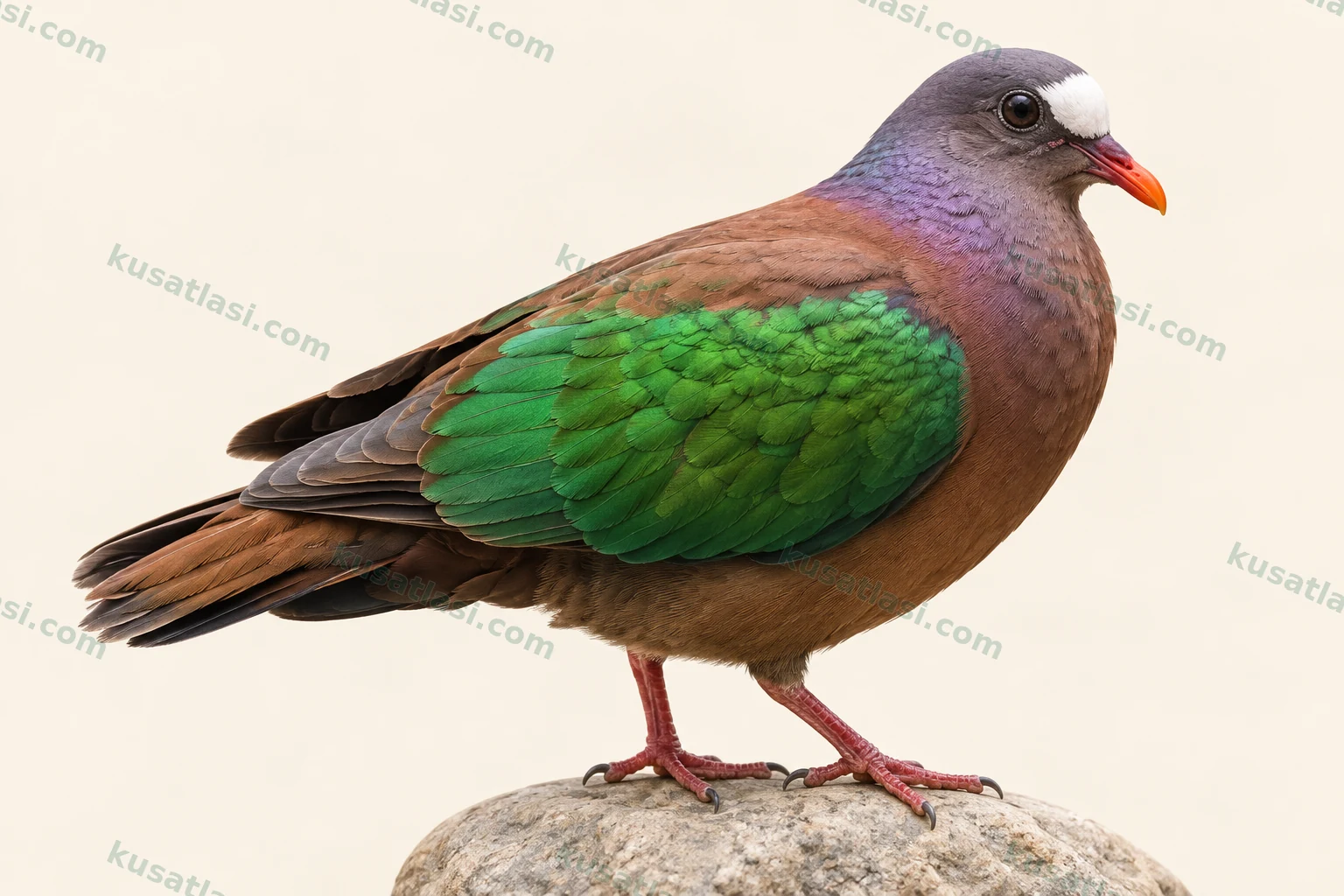
A reddish-brown ground dove of island forests; emerald-green wings, orange bill, white forehead in males and grey in females.
Biometrics
Length
Male23–25 cm
Female23–25 cm
Shared species value
Wing length
Male13.6 cm
Female13.6 cm
Shared species value
Weight
Male118–126 g
Female118–126 g
Shared species value
Stephan's Emerald Dove
Sulawesi, New Guinea, the Bismarck Archipelago and the Solomon IslandsObservation guide in its natural range
Look for three features together
Do not rely on a single featureThe pale patch is restricted to the forehead: white in males, grey in females.
Metallic green wings; brown back and tail.
Duller bare parts, reduced gloss and some barring in the plumage.
Compare male and female
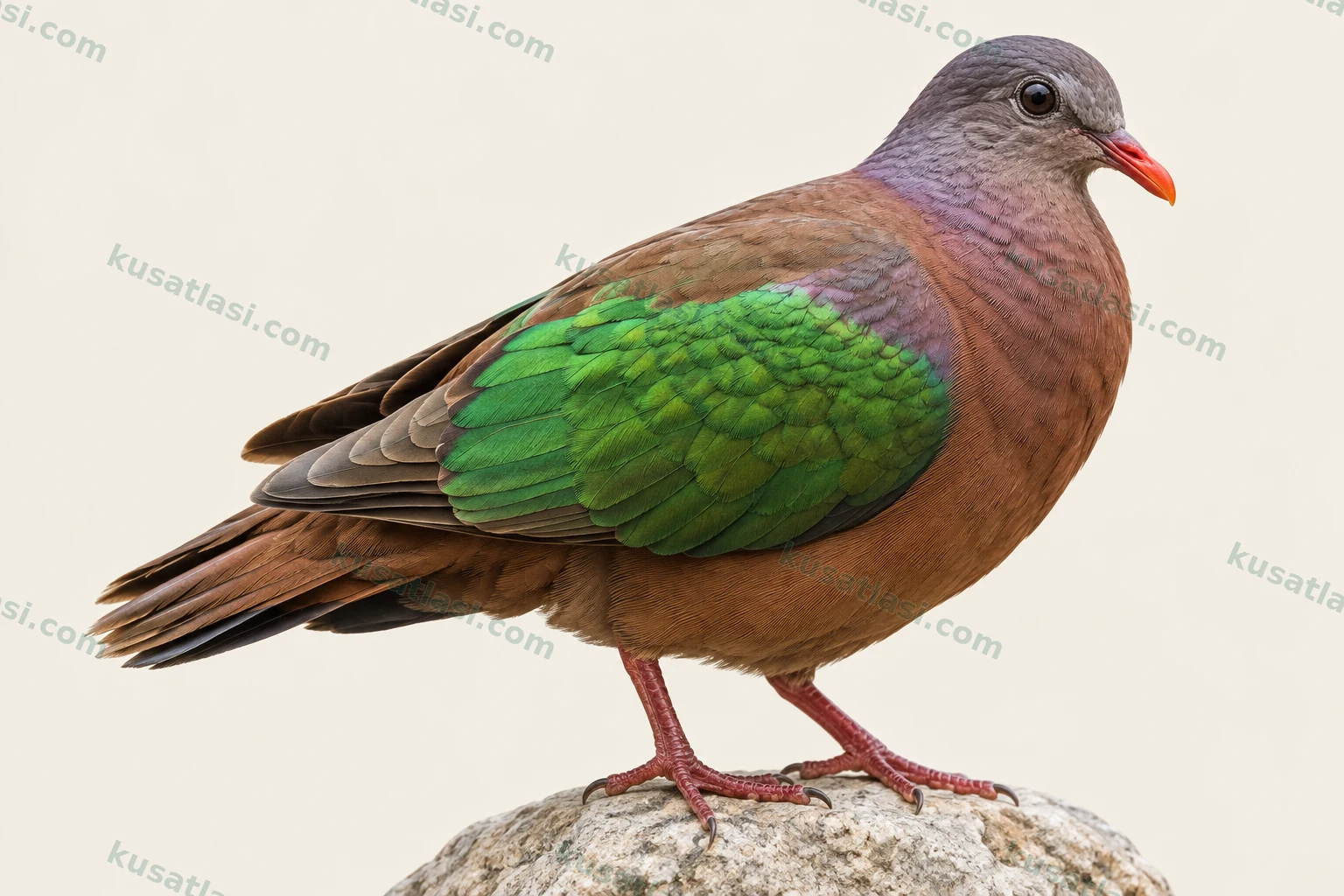 FemaleMale
The adult male has a white forehead and the female a grey one; both sexes have green wings. Young birds have duller gloss and bare-part colours.
Where to look in its natural range?
The leaf-littered floor and low branches of lowland forest; some secondary forests.
A nest was documented at Brown River in January and a female in breeding condition on Rennell in October; these records do not establish the breeding calendar for every island.
January
Resident forest bird; island colonisation does not mean regular annual migration. New Guinea, Brown River: an adult on the nest and a changeover in January 1977.
February
Resident forest bird; island colonisation does not mean regular annual migration. No verified regional date specific to this month was given; this does not mean local absence.
March
Resident forest bird; island colonisation does not mean regular annual migration. No verified regional date specific to this month was given; this does not mean local absence.
April
Resident forest bird; island colonisation does not mean regular annual migration. No verified regional date specific to this month was given; this does not mean local absence.
May
Resident forest bird; island colonisation does not mean regular annual migration. No verified regional date specific to this month was given; this does not mean local absence.
June
Resident forest bird; island colonisation does not mean regular annual migration. No verified regional date specific to this month was given; this does not mean local absence.
July
Resident forest bird; island colonisation does not mean regular annual migration. No verified regional date specific to this month was given; this does not mean local absence.
August
Resident forest bird; island colonisation does not mean regular annual migration. No verified regional date specific to this month was given; this does not mean local absence.
September
Resident forest bird; island colonisation does not mean regular annual migration. No verified regional date specific to this month was given; this does not mean local absence.
October
Resident forest bird; island colonisation does not mean regular annual migration. Solomon Islands, Rennell: an adult female in breeding condition in October 2018; not an active-nest observation.
November
Resident forest bird; island colonisation does not mean regular annual migration. No verified regional date specific to this month was given; this does not mean local absence.
December
Resident forest bird; island colonisation does not mean regular annual migration. No verified regional date specific to this month was given; this does not mean local absence.
Nest, egg and incubation
The nest is a platform; one was recorded at the base of a palm frond 6 metres above ground at Brown River. Two eggs are reported in New Britain observations. The species table gives 18 days of incubation; this was not a hatching interval followed from start to finish. Time to first flight could not be verified.
Soft, low, repeated dove notes; the series gradually rises and accelerates.
Do not play recordings to attract birds; observe quietly, especially near nests.
Species information
Quick identification
Stephan's Emerald Dove Chalcophaps stephani is a small dove of island forests extending from Sulawesi to New Guinea and the Solomon Islands. A reddish-brown body, shining emerald-green wings and orange bill attract attention together. The adult male has a white forehead, while the female's looks greyer. The pale forehead area does not cover the entire crown; the brown back and tail are important when separating similar species.
It is usually seen as a single bird feeding on the forest floor or resting on low branches. The green wing can darken in shade; the whole body is not expected to be green. For identification, check the pale mark at the front of the head, warm body colour, wing and tail separately. Having green wings does not mean it has the same colour pattern as a fruit dove.
General appearance and posture
It looks like a small, neatly built ground dove. Breast and rear head are warm brown; the wings shine distinctly metallic green according to the light's angle. The brown back is an anatomical area separate from the green wing. That distinction can disappear when only the wing is seen from the side; watch the back's colour when the bird turns slightly away.
Walking on the ground to find food and perching on low branches place it in a different search layer from fruit doves feeding continually in treetops. Looking only at high branches is not enough to find it. Small gaps through low vegetation and leaf litter can be watched carefully. Waiting quietly in suitable forest gives a better view than trying to drive the bird into the open.
Males, females and young birds
The adult male's pale forehead mark is white and the female's grey-toned. This difference can be hard to see if the head is shaded or a photograph is overexposed. Because the forehead is small, compare several moments of the side view. Both adult sexes have green wings; females are not portrayed as entirely without green, nor males as having wholly white heads.
In young birds, bare parts, particularly the bill, can be duller. The plumage has some barring and less metallic gloss than in adults. Cornell describes these three features together. Thus neither every adult with a less glossy shaded wing is a juvenile nor a pale-looking bill in one frame enough to assign a definite age.
An adult female examined on Rennell in the Solomon Islands in 2018 was compared with female museum specimens from other islands in the same archipelago. A genetic sample was used alongside plumage. The study established species identity from several lines of evidence rather than forehead colour alone. A female being the island's first documented record does not mean that only females occur there.
Appearance in flight
When a wing opens, the visibility of metallic green changes with angle. Brown back and tail are assessed with the shining wings. A green flash alone during a short shaded forest flight may be insufficient; check forehead and body colour when the bird lands again. No verified detailed underwing identification pattern was found for this species, so no new mark is invented.
Genetic connections among island populations have been discussed in terms of birds' ability to disperse across the sea over long periods. Such possible dispersal ability does not mean every individual regularly migrates between islands each year. A flight route or monthly island sequence cannot be derived from genetic similarity alone. Daily forest-floor movement and historical island colonisation are separate events.
Voice and behaviour
The song consists of soft, repeated low dove notes; the series can gradually rise and accelerate. In forest, listen to the whole sequence rather than a single note. In the Rennell research, typical low-frequency song from at least two other individuals was recorded on different days. Those recordings are evidence in the original research, not a count of all individuals in the archipelago.
At Brown River in January 1977, an adult female was seen sitting on a nest and leaving when the male arrived. The researcher could not see whether eggs or chicks were inside; the behaviour is therefore described as possible incubation or brooding. A single changeover does not measure equal sharing of all care duties throughout the day.
Similar species
Chalcophaps indica is another small ground dove with similarly shining wings. In Stephan's Emerald Dove, the pale area restricted to the forehead, brown back and tail are combined distinguishing features. The genetic study notes that both species can occur together on Sulawesi; the island's name alone cannot establish identity.
Chalcophaps longirostris can overlap geographically with this species in southeastern New Guinea. Compare the extent of the pale head area and the colours of back and tail. Older New Guinea publications used a broad Chalcophaps indica name, so transferring every behaviour in them to the present Asian species or this one is wrong. Taxonomic separation matters as much as the observed bird's habitat.
World distribution
The natural range comprises Sulawesi and the Sula Islands, the vicinity of southeastern Maluku, New Guinea's lowland forests and nearby islands, the Bismarck Archipelago and the Solomon Islands. It is not endemic to one country; Indonesia, Papua New Guinea and the Solomon Islands hold different populations. The open sea between them is not forest habitat for the species. It is not assumed that every island is fully occupied at the same density.
Status within its natural range
The current global conservation category is Least Concern. Local habitat differences matter: New Guinea studies caught it more often in extensive continuous forest, while documenting it in small forest fragments too. This does not mean forest loss has no effect. Forest structure, food resources and the height at which research took place are considered together.
The 2018 Rennell study documented the species using an adult specimen, voice and genetic comparison. Absence from earlier lists need not mean definite past absence from the island; an old overlooked population and more recent establishment are discussed as separate possibilities. The new record's date is not presented as the date of first arrival.
Migration
It is treated as a resident forest bird; no verified regular annual long-distance migration route was found. Genetic studies finding historical links among island populations do not show today's birds following the same sea route each year. Licensed observation samples and geographically constrained predictions are displayed on the map; neither monthly routes nor breeding grounds in every cell are inferred from them.
Breeding habitat
The interior of humid lowland forest, low vegetation layer and forest floor are its main habitats. Some coastal secondary forests can also be used. The Brown River study emphasised primary forest, while the Madang research recorded it inside forest fragments too. These different local results require caution about making one habitat sentence an absolute rule for every island.
Nest site
The breeding research classified nests as platforms. At Brown River, a nest at the base of a palm frond was 6 metres above ground. The same publication reports two eggs in older New Britain observations. The incubation study's species table gives 18 days; because the two nests examined were depredated, this figure is not a hatching interval followed from start to finish at those two nests. Time to first flight could not be verified.
Daily habitat use
Food searching can mainly occur on the ground, while resting can be on low branches. The New Guinea field synthesis describes taking fallen fruit and seeds from the forest floor. A bird on a low branch does not demonstrate that all its food comes from fruit on branches. Low forest movements can be watched without approaching the nest palm; not blocking a bird on a narrow forest path helps keep the observation natural.
What does it eat?
Seeds and fallen fruit are important foods. Invertebrates were also found in food samples from five individuals in the New Guinea doctoral research; the species is not described as eating plants alone. A small sample does not show identical dietary proportions in every country and season. Frequency of food occurrence in samples and the total quantity consumed over a year are different measurements.
How does it forage?
It obtains food mainly from the forest floor. Small patches where fallen fruit and seeds accumulate can be useful for watching its search behaviour. The older field publication also reports use of seeds discarded beneath Metallic Starling nesting colonies. This relationship does not mean every dove depends on starling colonies or cannot find food independently.
A feeding record is more informative when the item taken with the bill can be seen. Pecking among leaves does not alone reveal whether an item is an insect or a seed. Forest fruit trees and the food accumulating below them are protected; no food is scattered and no surrounding leaf litter removed to watch the bird.
A new island record need not date a new arrival
The Rennell research documented the species using an adult female specimen, other individuals' voices and genetic comparison together. Her breeding condition matters, but cannot be recorded as a number of active nests found. Failure of earlier surveys to record the bird leaves two possibilities: an overlooked earlier presence or more recent establishment. The researchers did not settle that distinction.
Similar green wings do not unite three species
Research examining two nuclear genes and one mitochondrial gene supported separate lineages for the three accepted Chalcophaps species. Their outward resemblance does not make all three a single species. The same study also discusses disagreements in some gene histories; these do not automatically overturn the whole species separation. Checking head, back, tail and natural geography together makes this separation practical in the field.
A nest need not be near the ground
Older New Britain records describe low nests, whereas direct observation at Brown River documented a palm nest 6 metres high. This difference shows why one nest height should not become a fixed rule for the whole species. A ground-feeding bird is not automatically expected to nest on the ground too. Male and female were seen replacing each other at the nest, but its contents could not be seen; the record is valuable with that limit retained.
One forest contains different food layers
This dove's ground feeding shows why its bright green wings should not lead one to expect continual fruit searching in upper branches. Invertebrates in food samples also remind us that a simple fruit-eater label cannot explain all its behaviour. Ground foods and records of using seeds dropped by other birds are considered together; one relationship is not presented as an obligatory ecological dependence.